
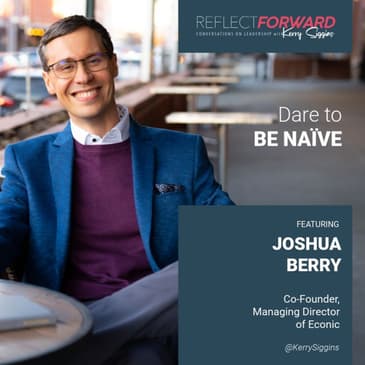

[00:00:10] [SPEAKER_02]: Hi everyone and welcome back to Reflect Forward. I'm your host Kerry Siggins and I'm so glad you're here today. Today my guest is Joshua Berry. He is the CEO and founder of Econic, which is a innovation, transformation and strategy consulting firm. He's built this amazing team that helps companies do all kinds of innovative things. He works for big organizations like John Deere, US Bank, P&G, Blue Cross, Bruce Shield, all kinds of big companies who are looking to do more good in the world.
[00:00:39] [SPEAKER_02]: And I actually met him at the ROI of Y conference. We were both speakers there and I just loved his message so much and his book, Dare to be Naïve, that I asked him to come on the show because I knew that it was just going to be such a fun conversation. I'm super excited to introduce you to Joshua. So hang tight and I will be right back.
[00:01:05] [SPEAKER_02]: All right. Welcome back, everyone. I have Joshua Berry with me today. He's the CEO and founder of Econic and I met him in Lincoln, Nebraska, which is where he lives. And I'm so excited to have you on the show today, Joshua. Thank you for joining me.
[00:01:18] [SPEAKER_00]: Kerry, I loved your presentation at the conference. So excited we were able to connect and can't wait to see where this conversation goes.
[00:01:25] [SPEAKER_02]: Yeah. So Joshua and I were both at the Do More Good. Actually, that's not it was part of Do More Good, but the conference name was ROI of Y. And it's all around businesses who are 1% for the planet, B Corp, employee ownership, all of us who want to run, operate, build businesses that do more good in the world. And that's where we met. It was so much fun. It was a great conference.
[00:01:45] [SPEAKER_00]: Yeah. There was a lot of great energy around people who are seeing what is the next stage of capitalism and a lot of different examples. What I loved was that there isn't one framework that needs to work. But the Do More Good movement has said there's things we can learn from all of those different frameworks you mentioned. And it brought to Lincoln. So that's cool.
[00:02:02] [SPEAKER_02]: I know. I know. I think I've been to Lincoln when I was a kid, but for sure not as an adult. And I was so impressed with the city, even though it was very windy, which I understand it's windy there a lot. But are you a Lincoln native or a Nebraskan native?
[00:02:17] [SPEAKER_00]: Yeah. So I was born in the middle of Nebraska. I moved a lot as a kid. We lived in 15 different houses before I was 15. And some of those around Colorado. So Fort Collins and Loveland area. My brother was born in Loveland, for instance.
[00:02:29] [SPEAKER_02]: Nice. And yeah, what was that like?
[00:02:31] [SPEAKER_00]: Moving so much as a kid?
[00:02:33] [SPEAKER_02]: Yeah, as a kid. Yeah.
[00:02:35] [SPEAKER_00]: Well, there's the version my therapist knows. And then there's the version that's podcast appropriate. It's a lot of change. And so it's probably no surprise that I am now in the space where we do consulting work that primarily revolves around creating space that's safe for change and innovation and growth and everything. It definitely gave me a lot of tuition for the life that I lead now.
[00:02:58] [SPEAKER_02]: So I grew up in the same place in the same house.
[00:03:03] [SPEAKER_00]: Oh, wow.
[00:03:05] [SPEAKER_00]: My wife was the same way. My wife's parents got married, moved into the same house. She grew up in that entire house the whole time. So very good.
[00:03:12] [SPEAKER_02]: Yeah. Yeah, absolutely. I couldn't even imagine moving around as a kid. Interesting. All right. So let's jump into your business and what you do. So tell us a little bit about what Econic does and how you started it, why you started it.
[00:03:22] [SPEAKER_00]: Yeah, absolutely. So Econic today, we are in our ninth year. We work with midsize companies who are trying to change the how or why of their business. And that typically looks like projects that are everything from innovation strategy to innovation program design, where we're getting to build innovation labs or innovator in residence programs, all the way to more direct cultural work, whether it's leadership development programs that we custom build all the way to workforce of the future programs.
[00:03:50] [SPEAKER_00]: The business started out of, I know you like to talk about things that work and don't on this podcast. And it started out of me eventually going out on my own after being in leadership at another consulting company. And the startup I originally went into didn't work out. We put our house up for sale. We were pregnant with our fourth kid. And I went all in on a startup and right away ran into team issues, cashflow issues, IP issues, et cetera.
[00:04:16] [SPEAKER_00]: And so I had to start to figure out like, what could we do to feed the family? And did I want to go back to work for a company? But those of you who know that, I don't know, that bug you get when you start to work for yourself and start to have some of that autonomy. Like I wanted to keep figuring out how I could do things on my own.
[00:04:31] [SPEAKER_00]: And those next couple of years were spent exploring what could I do? Who could I serve in the world and in a way that would feed the family? And that eventually turned into Econic in 2015.
[00:04:41] [SPEAKER_02]: And so the business that failed, was it also a consulting business or was it something completely different?
[00:04:46] [SPEAKER_00]: You know, it was going to be focused on people's, it was an assessment based business, but was still in need of services that were built around it. And so maybe not directly consulting as I'm Econic right now, more in a training and consulting bucket. This had a little bit more of a product bent.
[00:05:02] [SPEAKER_02]: Yeah. Well, you know, like those things, we start out on those journeys and we think we're going to go somewhere and we end up someplace completely different. It's like, oh, well, you know, that wasn't so bad, even though it might've been painful for a little bit.
[00:05:12] [SPEAKER_00]: I find that had happened so often. It takes intentionality to get started. And when you get started and then you realize, huh, okay, that wasn't exactly what I thought. You still have that momentum going to maybe take the next step. And so there's so much that comes from momentum, right?
[00:05:28] [SPEAKER_02]: Yeah. And those inflection points in your life. So I grew up in a town, a small town in rural Colorado called Montrose. I swore I was going to never be back in a small rural town anywhere, certainly in Colorado.
[00:05:41] [SPEAKER_02]: But, you know, it's funny how life takes you here. And I had an inflection point in my life in 2006. I had substance abuse issues. I accidentally overdosed and I had to come home.
[00:05:51] [SPEAKER_02]: And my mom had moved from Montrose to Durango. And I was going to only be here for a little bit of time while I figured out how to get my life back on track because I was a city girl, right?
[00:06:01] [SPEAKER_02]: I was never going back to a small town and going to stay there. And here it is almost 18 years later. And I never imagined, you know, especially like picking up myself off the floor of my apartment in Austin, Texas, and making this decision to get my life back on track and start over.
[00:06:17] [SPEAKER_02]: But thinking that it would eventually be back in Denver or wherever, somewhere else. And those paths that you take, those journeys that you take, that you think out, think that you're starting out a certain way and it takes you in a different direction.
[00:06:30] [SPEAKER_02]: You're like, this was really good. Yeah, I'm glad this happened.
[00:06:34] [SPEAKER_00]: Isn't that amazing? First off, thanks for sharing that, Carrie. That's a heartfelt story. And I appreciate that you have the right perspective on it now in terms of where you're at. I think there's so many people who are afraid maybe to take those steps because it needs to work out.
[00:06:46] [SPEAKER_00]: So stories like yours or stories maybe of our failed approach and a bunch of other ones I could share are helpful because it helps people see it almost never works out the way that you've imagined it to. And yet it works out and you and I are both still here.
[00:07:01] [SPEAKER_00]: And I think it comes from the action of trying and doing and still maybe directionally. There's still like some core things that are important to who probably you are and who I am that maybe get clearer over time.
[00:07:13] [SPEAKER_00]: But those things end up being more important than maybe the specific steps or that specific business or that specific idea or the specific thing that we did and not losing sight maybe of that deeper thing is important.
[00:07:24] [SPEAKER_02]: Yeah, and I think as humans this needs to happen or I can't do this because what if this happens and obviously maturing helps as you get more life experiences to realize, you know, like the details that it isn't necessarily what you need to focus on.
[00:07:39] [SPEAKER_02]: You need to take the bigger step back and say, okay, what is it that I want? And yes, I'm going to take this step, but that might open up a door rather than being so intent on it having to follow this very specific path that you have in your mind.
[00:07:54] [SPEAKER_02]: Or not doing something because you have this very specific fear in your mind. You think if I do these things, then this is what's going to happen. And 99% of the time, neither of them turn out right.
[00:08:06] [SPEAKER_00]: I think so. I think so. A friend shared it with me one time. It's almost like you have objectives, you have strategies and you have tactics. It's good to be consistent about your objectives. Like I have an objective that I want to be a really active grandparent. My oldest is only 16. So I'm hoping I can be a grandparent anytime soon.
[00:08:22] [SPEAKER_00]: And yet I want to be an active grandparent who can get out there and roll around with my grandkids and throw the ball. My strategy is revolve around exercise and nutrition and being good at those things. My tactics on those things change all the time.
[00:08:36] [SPEAKER_00]: I don't have consistent routines on those. And I think that's okay. When I get locked into this specific exercise plan or this way of eating didn't work out for me. And I think that's a loss. No, like those are meant to be held a little bit looser in my life.
[00:08:50] [SPEAKER_00]: And I want to keep focusing on making consistent progress, if you will, which isn't always forward, but consistent progress on the things that are strategically important towards some ultimate goals or directions that I'm heading towards.
[00:09:03] [SPEAKER_02]: Yeah, I really like that. I think we become our thoughts because our thoughts drive our actions and our action drives the outcomes that we create in our lives.
[00:09:12] [SPEAKER_02]: And so I think it's really important to at least at the high level to know what you want in your life.
[00:09:19] [SPEAKER_02]: I was just talking to someone the other day who we were going through this. Well, what do you want? And I don't know. And I just said, I can't work with I don't know.
[00:09:27] [SPEAKER_02]: I can't help with I don't know. Because how do you give any kind of advice if you're dealing with I don't know?
[00:09:35] [SPEAKER_02]: You've got to make a decision. Even if you don't know what the outcome is going to be. This is the objective that I'm going to go after.
[00:09:42] [SPEAKER_02]: And it might not be my objective five years from now, but I'm going to go after that so I can start making decisions in my life to move.
[00:09:50] [SPEAKER_02]: But that I don't know. That's a really hard thing to deal with.
[00:09:53] [SPEAKER_00]: It is. And I think giving someone permission to say, that's not good enough. I want you to work through that or wrestle through it. I think that's all right.
[00:10:03] [SPEAKER_00]: The subtitle to a book I wrote is how to find your true self in a noisy world.
[00:10:08] [SPEAKER_00]: And I think sometimes people need that pushback. Otherwise, there's just the adoption of this is what everybody else says successes or the thing they need to do or what I need to do next to this.
[00:10:17] [SPEAKER_00]: And they just go along with the flow. But having someone say like, no, no, no. What is it that you need?
[00:10:22] [SPEAKER_00]: What is it that you want or you don't know? Cool. Take some time to understand that or maybe be OK with less than perfect on what the answer is.
[00:10:30] [SPEAKER_00]: What's the next step that's good enough to be able to move forward on this?
[00:10:35] [SPEAKER_00]: I think that can keep if we're being open and practicing self-reflection can help us keep understanding what is it that I actually believe or think is true in this extremely noisy world.
[00:10:45] [SPEAKER_02]: And then having the courage to say it, because I think a lot of times people say, I don't know, but maybe they do.
[00:10:51] [SPEAKER_02]: But they're afraid to say it because it might be very different than what they're doing or it's going to hurt somebody because I want something different.
[00:11:00] [SPEAKER_02]: I just had one of my dearest employees leave the company. He went to go work for a customer of ours.
[00:11:04] [SPEAKER_02]: And I just I love this man. We've worked together for 10 years in the company.
[00:11:08] [SPEAKER_02]: We worked for, you know, almost like five years outside.
[00:11:11] [SPEAKER_02]: He worked for a dealer of ours when he was telling me, like, I want to leave.
[00:11:14] [SPEAKER_02]: I want to go after this opportunity.
[00:11:15] [SPEAKER_02]: I was like, well, what is it that you want?
[00:11:18] [SPEAKER_02]: And he didn't want to say it.
[00:11:19] [SPEAKER_02]: And he was like, I want to do something new.
[00:11:21] [SPEAKER_02]: And I was like, just say it to me.
[00:11:22] [SPEAKER_02]: I get it. Just say it.
[00:11:24] [SPEAKER_02]: But you're saying, I don't know what I want.
[00:11:26] [SPEAKER_02]: This is really hard.
[00:11:26] [SPEAKER_02]: But I think you do know.
[00:11:28] [SPEAKER_02]: I think you just don't want to say it to me because you don't want to hurt me.
[00:11:32] [SPEAKER_02]: And you know that it's going to hurt a little bit.
[00:11:34] [SPEAKER_02]: But once he said it, I really want to go after this opportunity.
[00:11:37] [SPEAKER_02]: I really want to go try and do something new.
[00:11:40] [SPEAKER_02]: This is going to stretch me further than I've ever been stretched before.
[00:11:43] [SPEAKER_02]: And I could say, yes, you should go do that.
[00:11:47] [SPEAKER_02]: I don't want you to go.
[00:11:49] [SPEAKER_02]: You know, you're such a huge part of my team.
[00:11:50] [SPEAKER_02]: And I love working with you.
[00:11:52] [SPEAKER_02]: And I'm really excited to work with you as a customer.
[00:11:54] [SPEAKER_02]: But you should go do that.
[00:11:57] [SPEAKER_02]: You just said what you wanted.
[00:11:59] [SPEAKER_02]: And anyway, it's just interesting talking about this conversation where people give that, I don't know.
[00:12:03] [SPEAKER_02]: But like sometimes you do know and you just don't want to say it because when you say it out loud, action is going to happen.
[00:12:10] [SPEAKER_02]: And there's going to be consequences of what happens when you put it out into the world.
[00:12:15] [SPEAKER_02]: One hundred percent.
[00:12:16] [SPEAKER_02]: Both good and bad.
[00:12:17] [SPEAKER_00]: One hundred percent.
[00:12:17] [SPEAKER_00]: I have a whole chapter.
[00:12:19] [SPEAKER_00]: They're short chapters.
[00:12:20] [SPEAKER_00]: But I have a whole chapter in my book dedicated to prioritizing employee growth even over organizational growth.
[00:12:26] [SPEAKER_00]: And the concept, the title of the book, Dare to be Naive, really gets at that idea that you're the gentleman that you're talking about.
[00:12:35] [SPEAKER_00]: It could sound naive that you would even admit to your boss that you were thinking of leaving to go somewhere else.
[00:12:41] [SPEAKER_00]: And it can sound naive if you as an owner or a leader are saying like, I'd be all right letting my person go if it was a better opportunity for them.
[00:12:50] [SPEAKER_00]: And yet both of those things are probably more true and more authentic and real and have a greater impact on our overall community and society if we would just dare to be a little bit more naive and allow that to happen.
[00:13:02] [SPEAKER_00]: Right.
[00:13:02] [SPEAKER_02]: I totally agree.
[00:13:04] [SPEAKER_02]: I think we just tell ourselves these stories about what's going to happen.
[00:13:07] [SPEAKER_02]: So we live with this fear and we have a whole very structured process for building out career development plans, CDPs.
[00:13:14] [SPEAKER_02]: And it was funny because even a couple of years ago as we were working on his CDP, he's like, I just want to be really good at my job.
[00:13:21] [SPEAKER_02]: I want to be really good.
[00:13:21] [SPEAKER_02]: I want to be the master of this.
[00:13:23] [SPEAKER_02]: And I pushed him a little bit like, OK, that's great.
[00:13:25] [SPEAKER_02]: But someday you're going to get bored of this.
[00:13:27] [SPEAKER_02]: And so what is it that you want next?
[00:13:30] [SPEAKER_02]: And think about it even outside this company.
[00:13:33] [SPEAKER_02]: Sometimes like we're a small company, right?
[00:13:34] [SPEAKER_02]: There's not going to be two CEOs anytime soon.
[00:13:37] [SPEAKER_02]: I'm not going anywhere for a while and we're not big enough to have multiple divisions to have people running over.
[00:13:42] [SPEAKER_02]: Someday we will.
[00:13:42] [SPEAKER_02]: But if you want to go do something like that, put that in your CDP.
[00:13:46] [SPEAKER_02]: I think I want to run a company.
[00:13:47] [SPEAKER_02]: I think I want to go do this.
[00:13:48] [SPEAKER_02]: I want to learn this new skill.
[00:13:50] [SPEAKER_02]: Even if it means that you're going to eventually leave the company because you want to go do something that we can't offer, I want to help you be able to get there.
[00:14:00] [SPEAKER_02]: And people are like, that's so counterintuitive.
[00:14:02] [SPEAKER_02]: Why would you help your employee gain skills to leave?
[00:14:05] [SPEAKER_02]: And I was like, because if we're creating people who can go out into leadership positions and continue to grow and change the world, then I'm doing my job as a leader.
[00:14:15] [SPEAKER_00]: 100%.
[00:14:16] [SPEAKER_00]: 100%.
[00:14:16] [SPEAKER_00]: I love that approach.
[00:14:17] [SPEAKER_00]: And it pushes you to think of a whole bunch of other things then too, right?
[00:14:22] [SPEAKER_00]: If I can't be reliant on like holding this person so tightly, what else has to be in place for this person to be able to go on and try to?
[00:14:30] [SPEAKER_00]: What else does our recruiting need to look like?
[00:14:33] [SPEAKER_00]: What else do our benefits or compensation packages or what are all the other things that we need to be better at versus going under this like fake belief that this person is going to be with us forever and then holding too tightly to that?
[00:14:49] [SPEAKER_00]: Because chances are, even if you wouldn't have prodded, that idea is still in the back of their mind at some point.
[00:14:54] [SPEAKER_00]: So all you're doing is like bringing out into the open things that are there anyways.
[00:14:58] [SPEAKER_02]: Exactly.
[00:14:59] [SPEAKER_02]: Let's just talk about it.
[00:15:00] [SPEAKER_02]: Let's just talk about it.
[00:15:01] [SPEAKER_02]: What does human means?
[00:15:01] [SPEAKER_02]: Exactly.
[00:15:02] [SPEAKER_02]: I completely agree with you.
[00:15:04] [SPEAKER_02]: And I think that more companies need to encourage that type of thinking.
[00:15:08] [SPEAKER_02]: And obviously, you never want to lose talent.
[00:15:11] [SPEAKER_02]: But sometimes when it's time, like when a person's like, I'm ready to go do something different.
[00:15:16] [SPEAKER_02]: I want a new challenge.
[00:15:17] [SPEAKER_02]: That opens up an opportunity within your organization for other people to grow and to step up or to bring a person in who brings a different level of experience into the company.
[00:15:28] [SPEAKER_02]: And so I think we have all of this fear around what if I'm honest with my boss?
[00:15:33] [SPEAKER_02]: I'm thinking about leaving or I want to do something that's different.
[00:15:36] [SPEAKER_02]: What if she fires me on the spot?
[00:15:38] [SPEAKER_02]: Or we have to hold on to employees so tightly that we limit the way that we look at the world when really there's always opportunities in every single change that happens.
[00:15:48] [SPEAKER_02]: And so what are you going to do with that opportunity?
[00:15:50] [SPEAKER_02]: Are you going to use it to be afraid, to beat yourself up, to judge, to do whatever?
[00:15:56] [SPEAKER_02]: Or are you going to say, hey, this is great and we're going to use this to get better, to learn, to do something different?
[00:16:04] [SPEAKER_02]: And I think it all comes down to your mindset.
[00:16:06] [SPEAKER_02]: How are you going to look at change?
[00:16:07] [SPEAKER_00]: Absolutely does.
[00:16:08] [SPEAKER_00]: One of the most extreme examples I found in my research was this manager who told me the story of someone on his team who'd gotten to their peak development level.
[00:16:21] [SPEAKER_00]: And he was calling around trying to find a mentor for this person.
[00:16:25] [SPEAKER_00]: And the only person that he could find was a competitor across town and the head of the business development group there as the potential mentor for that person.
[00:16:36] [SPEAKER_00]: And this leader even knew that person was being recruited by that competitor.
[00:16:40] [SPEAKER_00]: And he still said, you know what?
[00:16:43] [SPEAKER_00]: I think you should reach out to this person and have coffee just to learn what you can do.
[00:16:47] [SPEAKER_00]: And what's amazing is like there has to be such trust into that.
[00:16:51] [SPEAKER_00]: There's a bigger game being played here than just like my P&L this quarter.
[00:16:57] [SPEAKER_00]: And what's amazing is the trust and loyalty that came from that individual to say, wait, you would suggest this to be at?
[00:17:04] [SPEAKER_00]: Like, what a great place I work for.
[00:17:06] [SPEAKER_00]: So obviously that leader didn't do that because he was thinking like three steps ahead.
[00:17:11] [SPEAKER_00]: So he's going to earn this great loyalty.
[00:17:13] [SPEAKER_00]: He just believed that he was playing a different game.
[00:17:15] [SPEAKER_00]: And that to your point, in every single change, there is something that will come about that might lead to something good or something else that can happen.
[00:17:24] [SPEAKER_02]: I agree with you.
[00:17:25] [SPEAKER_02]: All right.
[00:17:25] [SPEAKER_02]: So let's talk a little bit about your book.
[00:17:27] [SPEAKER_02]: So Dare to Be Naive.
[00:17:28] [SPEAKER_02]: I love this.
[00:17:29] [SPEAKER_02]: It was what made me want you to come on my show and talk about it because being naive can have negative connotations.
[00:17:35] [SPEAKER_02]: And here, like you're giving people permission to be naive and look at what good things can happen.
[00:17:40] [SPEAKER_02]: So can you talk a little bit about the concept of Dare to Be Naive?
[00:17:44] [SPEAKER_00]: Yeah, absolutely.
[00:17:45] [SPEAKER_00]: First off, the title is Dare to Be Naive.
[00:17:47] [SPEAKER_00]: The first publisher I worked with was not a fan of the title.
[00:17:50] [SPEAKER_00]: Can we just encourage people to be curious or be greater changemakers or something?
[00:17:56] [SPEAKER_00]: But there was something about this word naive that struck me in my research.
[00:18:00] [SPEAKER_00]: And that was, to your point, so many leaders that I spoke to didn't always share everything that they knew they could share or felt comfortable sharing.
[00:18:09] [SPEAKER_00]: And some of them even used the phrase, this might sound naive, but.
[00:18:13] [SPEAKER_00]: And then they would share something amazing.
[00:18:15] [SPEAKER_00]: Like they used it as a shield of sorts.
[00:18:17] [SPEAKER_00]: And so that got me curious about what stops us from being seen as naive, from owning that idea of being naive, et cetera.
[00:18:25] [SPEAKER_00]: And a big aha that came out of that research was that, Kerry, you and I, we probably misunderstand the word naive.
[00:18:33] [SPEAKER_00]: In fact, it was just a few hundred years ago that naive was actually used in a more neutral or even positive way by our ancestors.
[00:18:40] [SPEAKER_00]: The root of naive means to be authentic or to be genuine or to go back to that thing, which was in you from the start.
[00:18:50] [SPEAKER_00]: And so if I challenge people instead to dare to be authentic or dare to be genuine, people would be like, of course, like that is absolutely what we want.
[00:18:59] [SPEAKER_00]: Merriam Webster's word of the year last year was authenticity.
[00:19:03] [SPEAKER_00]: And so I think the dare to be naive is to be able to say that sometimes when we have that pause of saying, should I share this or why would I share this?
[00:19:13] [SPEAKER_00]: The world isn't going to accept it.
[00:19:16] [SPEAKER_00]: To understand that it might actually be coming from a more authentic, genuine, deeper wisdom that's inside of you that might actually need to be shared in the world.
[00:19:26] [SPEAKER_02]: I'm really glad that you brought up that point because, of course, words have meanings, but they also have meanings that we attach to them.
[00:19:33] [SPEAKER_02]: And if you decide you want to attach a negative connotation to a word like naive, then that's what we do.
[00:19:39] [SPEAKER_02]: I think all too often we can go down these paths without really truly understanding and understanding, oh, I just put that meaning to that word.
[00:19:47] [SPEAKER_02]: And it's not maybe accurate.
[00:19:49] [SPEAKER_00]: Yeah. And I think if people were to pick up the book or listen to it, what they would hear is that the book doesn't advocate for go do the things that Carrie and I just talked about.
[00:20:02] [SPEAKER_00]: Go be naive. Go let your people run off and do whatever they want.
[00:20:05] [SPEAKER_00]: It's not actually a how to guide to go do ridiculously progressive, open ended like business practices.
[00:20:13] [SPEAKER_00]: I use, for instance, even going back to that chapter, I use examples like prioritizing employee growth over hoard growth.
[00:20:21] [SPEAKER_00]: And even that example in the book of that person who sent someone over to his competitor for mentorship fodder for reflective questions.
[00:20:30] [SPEAKER_00]: And the questions in the book say, great, you just heard that.
[00:20:34] [SPEAKER_00]: What did that stoke inside of you?
[00:20:37] [SPEAKER_00]: What do you believe?
[00:20:38] [SPEAKER_00]: Do you believe that was was was stupid to go do that?
[00:20:40] [SPEAKER_00]: Do you believe that was generous to go do that?
[00:20:42] [SPEAKER_00]: Like, what do you believe?
[00:20:44] [SPEAKER_00]: And then where did you learn that belief?
[00:20:46] [SPEAKER_00]: Is it true?
[00:20:46] [SPEAKER_00]: And what do you gain and what do you lose by holding that belief?
[00:20:49] [SPEAKER_00]: Because what I really think that we need more leaders to do is to be able to understand how their beliefs and how their principles drive the practices within their business and how they probably need to do a little bit more discovery on what do they actually believe and what is true to them.
[00:21:05] [SPEAKER_00]: And how do those things inform maybe how they're evolving their businesses?
[00:21:10] [SPEAKER_02]: So is the book a leadership book?
[00:21:12] [SPEAKER_02]: Is it a self-help book?
[00:21:14] [SPEAKER_02]: How would you describe it?
[00:21:15] [SPEAKER_00]: If I had to put labels on it, it'd be a business psychology book.
[00:21:19] [SPEAKER_00]: I have seen it at bookstores put under the self-help section.
[00:21:23] [SPEAKER_00]: Some people have taken the liberty to put it over into the self-help section.
[00:21:26] [SPEAKER_00]: I will say, though, it uses a lot of business examples throughout the book to be able to use this case.
[00:21:32] [SPEAKER_00]: So it was specifically written for people in the business community who have a bent on saying, can we use business for good?
[00:21:40] [SPEAKER_00]: Full circle back to how you and I met.
[00:21:42] [SPEAKER_00]: And what are sometimes the things that get in the way of us using business for good?
[00:21:47] [SPEAKER_00]: And many times it isn't because we haven't heard the case studies for it.
[00:21:51] [SPEAKER_00]: I think if you want to find the data for it, thinking about people and planet alongside profits is absolutely worthwhile and good for business.
[00:22:01] [SPEAKER_00]: What I still find, though, is not everybody's adopted it.
[00:22:04] [SPEAKER_00]: And so when I look at why there's other deeper beliefs that people need to work on around what success is, what they think success is.
[00:22:11] [SPEAKER_00]: There are beliefs about people and humanity and other things that need to continue to be worked on.
[00:22:15] [SPEAKER_00]: So that's what this is.
[00:22:16] [SPEAKER_02]: Yeah, the vast majority.
[00:22:17] [SPEAKER_02]: There's so many people doing great things out there.
[00:22:20] [SPEAKER_02]: But yeah, I just am continuously surprised by the perpetual focus on profit.
[00:22:27] [SPEAKER_02]: And of course, profit's important.
[00:22:29] [SPEAKER_02]: We all need it to be able to grow, to reinvest back into our businesses.
[00:22:32] [SPEAKER_02]: But I think people think it's like an either or.
[00:22:34] [SPEAKER_02]: In fact, I even had somebody tell me that once.
[00:22:37] [SPEAKER_02]: It was a person I was interviewing for a president for one of my companies.
[00:22:40] [SPEAKER_02]: And he said, I just really didn't think that you could have this really culture focused, people focused organization and make a lot of money.
[00:22:50] [SPEAKER_02]: But I think that's just such a prevalent mindset that's out there that you just have to maximize profits and push people as hard as you possibly can get the most out of them.
[00:22:58] [SPEAKER_02]: And they're expendable.
[00:23:01] [SPEAKER_02]: And it simply just is not true.
[00:23:02] [SPEAKER_01]: Yeah.
[00:23:03] [SPEAKER_00]: And I would even say where I'm trying to meet people at with the book is maybe even a step before.
[00:23:09] [SPEAKER_00]: And that isn't true.
[00:23:10] [SPEAKER_00]: I am very intentionally in the book trying to capture people at the earliest stage of shifting beliefs to say, what is it that you believe?
[00:23:19] [SPEAKER_00]: I believe that my business should maximize profits at the expense of people.
[00:23:23] [SPEAKER_00]: The book doesn't say, and that's wrong.
[00:23:26] [SPEAKER_00]: What the book says is, OK, where did you learn that?
[00:23:30] [SPEAKER_00]: Is it true?
[00:23:31] [SPEAKER_00]: And then what do you gain and what do you lose by holding that belief?
[00:23:35] [SPEAKER_00]: Because there's some reason why you're still doing it.
[00:23:38] [SPEAKER_00]: And until we can create a new reality for people, we have to help them see the current reality they're living in.
[00:23:44] [SPEAKER_00]: And so what I found and one of the Kirkus reviews, a great reviewer out there, they nailed it on the head.
[00:23:51] [SPEAKER_00]: They said it's a nonjudgmental book that lowers the barriers for people to say, OK, this isn't another shaming book of stop doing business the way you're doing it.
[00:24:01] [SPEAKER_00]: It's just meant to help you see, OK, you got to where you're at now.
[00:24:04] [SPEAKER_00]: There's things you gain and lose.
[00:24:05] [SPEAKER_00]: There's things that you and I are talking about, Carrie, that we lose out because we act this way in business.
[00:24:11] [SPEAKER_00]: That's all right, too.
[00:24:12] [SPEAKER_00]: The whole goal is can we get people to wake up a little bit more to the practices that they're bringing into business?
[00:24:18] [SPEAKER_02]: Yep, there's always tradeoffs.
[00:24:19] [SPEAKER_02]: You're 100 percent right.
[00:24:19] [SPEAKER_02]: There's always tradeoffs.
[00:24:20] [SPEAKER_02]: So tell me a little bit about the subtitle, how to find your true self in a noisy world.
[00:24:25] [SPEAKER_02]: Where did that come from?
[00:24:27] [SPEAKER_00]: It came from this idea of where is that voice coming from that is innate, that is genuine, that is where it might be.
[00:24:35] [SPEAKER_00]: I have a belief that our truest selves are those that are anchored in hope, that are anchored in optimism,
[00:24:41] [SPEAKER_00]: that are anchored in good.
[00:24:42] [SPEAKER_00]: I believe and there's things I gain and I lose by holding this belief that humans are innately good.
[00:24:49] [SPEAKER_00]: And finding your true self in a noisy world comes from the idea that when I speak to a lot of leaders and actually give themselves pause and they actually think about what would they want to do in a situation like that?
[00:25:03] [SPEAKER_00]: But a lot of times it does come back to good.
[00:25:06] [SPEAKER_00]: And there's a bunch of great stories out there.
[00:25:09] [SPEAKER_00]: I don't know if you've read.
[00:25:10] [SPEAKER_00]: I have it sitting right here.
[00:25:11] [SPEAKER_00]: Rutger Bregman's Humankind.
[00:25:13] [SPEAKER_02]: I haven't read it, but it's on my list.
[00:25:15] [SPEAKER_02]: Yeah.
[00:25:15] [SPEAKER_00]: It is such a good book of just showing again and again through evidence that even though media or other things would like to point to humankind as bad or innately flawed, yes, we are imperfect.
[00:25:31] [SPEAKER_00]: And yet at our hardest times, people show up time and time and time and time again for people.
[00:25:37] [SPEAKER_00]: And so the finding our true self in a noisy world is to say there is a lot of noise.
[00:25:43] [SPEAKER_00]: Some of it can be believed.
[00:25:44] [SPEAKER_00]: A lot of it may be not believed.
[00:25:46] [SPEAKER_00]: When you come back to who your true self is, I think there's goodness there.
[00:25:50] [SPEAKER_00]: And how might that be some of the seeds to help businesses start to flourish and change in different ways?
[00:25:57] [SPEAKER_02]: And I believe that almost everything, all of the bad parts of us, the dark parts of our personality that come out or the hurtful things that we do or say or judgments, all of it comes from fear.
[00:26:10] [SPEAKER_02]: And so I think if you put it into that sense, this person is showing up this way and it might seem really ugly or I might not understand it.
[00:26:19] [SPEAKER_02]: But if you take it back to the essence of it, and we're all trying to just figure out how to live our best lives.
[00:26:23] [SPEAKER_02]: And when we are showing up this way, it's typically driven by fear.
[00:26:28] [SPEAKER_02]: And that helps me put that into perspective of like, okay, like I know what I'm like when I'm scared.
[00:26:33] [SPEAKER_02]: And I tend to dig in when I'm scared.
[00:26:35] [SPEAKER_02]: And I tend to tell myself, you know, really negative stories when I'm scared.
[00:26:39] [SPEAKER_02]: And I make sure that I get out of an echo chamber.
[00:26:42] [SPEAKER_02]: And I do a lot of work on being able to make sure that I don't buy into those negative stories.
[00:26:49] [SPEAKER_02]: But if you don't have those skills or people helping you or you're in an echo chamber, it's really easy to get stuck into that fear.
[00:26:58] [SPEAKER_02]: But that helps me just give it perspective.
[00:27:00] [SPEAKER_02]: And I can be more compassionate even though I don't necessarily understand people's choices.
[00:27:05] [SPEAKER_00]: Yeah.
[00:27:05] [SPEAKER_00]: Well said.
[00:27:06] [SPEAKER_00]: You're gaining perspective.
[00:27:07] [SPEAKER_00]: And back to those questions, there's things they're gaining and losing by it.
[00:27:10] [SPEAKER_00]: There's things I'm gaining and losing by it.
[00:27:12] [SPEAKER_00]: There's space for both of those.
[00:27:14] [SPEAKER_00]: Yeah.
[00:27:15] [SPEAKER_00]: Part of what Econic brings or our company brings to the world is projects that matter to businesses,
[00:27:23] [SPEAKER_00]: that create spaces for people to practice the behaviors that grow themselves and the organization.
[00:27:28] [SPEAKER_00]: We definitely do some programs that are more focused on just behavior change,
[00:27:32] [SPEAKER_00]: helping people be more empathetic or creating psychological safety.
[00:27:35] [SPEAKER_00]: But our best work with clients, our projects really say, we're trying to bring this new business to market.
[00:27:42] [SPEAKER_00]: We're trying to innovate this product.
[00:27:44] [SPEAKER_00]: Let's pull together a team and start to get from point A to point B on that.
[00:27:50] [SPEAKER_00]: We're doing work that matters to the organization.
[00:27:52] [SPEAKER_00]: But all along, we're working on underlying behaviors with those people who are in it.
[00:27:58] [SPEAKER_00]: They're in uncertainty.
[00:27:59] [SPEAKER_00]: How are they dealing with uncertainty?
[00:28:00] [SPEAKER_00]: What stories are they telling themselves?
[00:28:02] [SPEAKER_00]: They have an unpopular opinion they're going to have to bring to the head of the division.
[00:28:06] [SPEAKER_00]: What stories are they telling themselves?
[00:28:08] [SPEAKER_00]: What beliefs do they have under that?
[00:28:10] [SPEAKER_00]: Working with an executive team to put in place different governance for their innovation work.
[00:28:15] [SPEAKER_00]: That's a space for executives to practice asking more questions, listening more, talking less,
[00:28:20] [SPEAKER_00]: questioning some of their assumptions that they have, not needing to be right.
[00:28:24] [SPEAKER_00]: There's so many great opportunities in business if we use it as the sandbox to help us practice the behaviors that grow ourselves.
[00:28:31] [SPEAKER_00]: But we have to create space for that.
[00:28:33] [SPEAKER_02]: Yeah, and look at it as an evolution.
[00:28:35] [SPEAKER_02]: I love that.
[00:28:36] [SPEAKER_02]: I mean, we're always evolving.
[00:28:37] [SPEAKER_02]: And actually, that's even how I talk to my team about change.
[00:28:40] [SPEAKER_02]: It's about evolving.
[00:28:42] [SPEAKER_02]: We all have to evolve.
[00:28:43] [SPEAKER_02]: We're always constantly evolving, which means that we're changing.
[00:28:47] [SPEAKER_02]: And I think people are adverse to change, but people are not adverse to evolving.
[00:28:51] [SPEAKER_02]: Maybe some.
[00:28:52] [SPEAKER_02]: But for the most part, this is just an evolution.
[00:28:53] [SPEAKER_02]: So we don't talk about org changes or org restructures anymore.
[00:28:57] [SPEAKER_02]: This is just the continuous evolving of our organization, of our company.
[00:29:02] [SPEAKER_02]: And I think that helps people maybe get a little bit more comfortable with it.
[00:29:05] [SPEAKER_02]: Like, yeah, I can see that.
[00:29:07] [SPEAKER_00]: Yeah, I love it.
[00:29:08] [SPEAKER_00]: So you might appreciate, or others listening might appreciate this framework.
[00:29:12] [SPEAKER_00]: We love the term thrive.
[00:29:14] [SPEAKER_00]: It is a little bit bug worthy nowadays.
[00:29:16] [SPEAKER_00]: But we use the definition from evolutionary biology, which says there are three things you need.
[00:29:22] [SPEAKER_00]: You need to preserve essential DNA for survival.
[00:29:25] [SPEAKER_00]: You need to discard DNA that no longer serves you.
[00:29:29] [SPEAKER_00]: And you need to create new arrangements of DNA to help flourish in this new environment.
[00:29:34] [SPEAKER_00]: And so when you're going into a change, like your org or systems or whatever is evolving into that, being able to name what are we preserving from the old one?
[00:29:42] [SPEAKER_00]: What are we intentionally discarding that we no longer need anymore?
[00:29:46] [SPEAKER_00]: And what are we rearranging around this?
[00:29:48] [SPEAKER_00]: And it helps people, I think, to feel like, oh, there is a way that we're moving through this change.
[00:29:54] [SPEAKER_00]: And some of it has to be discarding things because that's healthy.
[00:29:59] [SPEAKER_00]: We can't just keep adding on more and more for people to do.
[00:30:02] [SPEAKER_02]: Nope.
[00:30:03] [SPEAKER_02]: Absolutely.
[00:30:03] [SPEAKER_02]: Well, that's a great segue into the last topic I want to discuss with you.
[00:30:07] [SPEAKER_02]: And that is that you're thinking about making a big change in your organization.
[00:30:11] [SPEAKER_02]: We're an employee-owned company, and I know that's something that you're thinking about, and you're going through the process of figuring out what this looks like, you being the sole owner, and what it would look like if employees owned it.
[00:30:20] [SPEAKER_02]: Can you talk a little bit about what you see the evolution of your business looking, especially through the context of employee ownership?
[00:30:26] [SPEAKER_00]: Absolutely.
[00:30:28] [SPEAKER_00]: So employee ownership has been something we've talked about since the start of Econic, whether it's an ESOP or an employee-owned trust or even some unique models that some people in the region are looking at.
[00:30:42] [SPEAKER_00]: There's this nonprofit private equity model that the group is looking at that would create almost like a Patagonia-esque perpetual purpose trust that a lot of organizations could play into.
[00:30:53] [SPEAKER_00]: So I think there's a lot of different models we are looking at.
[00:30:57] [SPEAKER_00]: We got really sage advice from our mutual friend, Jason Weiner, that the wrapper that you choose for your employee ownership is the 10% of it.
[00:31:06] [SPEAKER_00]: There's all these things that you could be working on now so that you help with the change process and all of the systems to make it just a natural evolution of the business.
[00:31:16] [SPEAKER_00]: And so that's the stage we're in, and I can share a couple of those things that we've done.
[00:31:19] [SPEAKER_00]: And so maybe two real pertinent ones would be that we shifted how we do our bonus system.
[00:31:26] [SPEAKER_00]: We used to have a bonus system that was based off of individuals' percent of their comp if we hit revenue goals, a standard program.
[00:31:36] [SPEAKER_00]: We shifted over to a more direct, very equitable profit share model so that it, one, made people even more accountable and invested in understanding all aspects of the business, not just revenue, but also costs.
[00:31:50] [SPEAKER_00]: It helped increase the business acumen of the people on our team because now all of a sudden, if I have to understand those things, they're paying a lot greater attention to what's going on on our income statements.
[00:32:02] [SPEAKER_00]: And then three, it started to pave the way for a more equitable approach because when we just did percentage of comp, that just further exacerbated the gap that we had in some of our wages.
[00:32:13] [SPEAKER_00]: We knew that we wanted to create something that balanced out a little bit more and might be a little bit more like an employee ownership piece.
[00:32:19] [SPEAKER_00]: And so we ended up creating our bonus program based off of number of hours.
[00:32:24] [SPEAKER_00]: And each hour gets you a share of whatever the profit was for that quarter and the calculations that we use.
[00:32:30] [SPEAKER_00]: And so what's interesting about that is someone who's maybe making half as much as someone else, but works 10 hours more a week, earns more profit share than the others.
[00:32:38] [SPEAKER_00]: And so we said we already have this element of our comp stack that rewards different expertise or maybe client facing work or billable time.
[00:32:46] [SPEAKER_00]: We want this part of our comp stack to more recognize that your hour carry is 60 minutes, my hours, 60 minutes.
[00:32:54] [SPEAKER_00]: And we each have a choice of how we want to spend that 60 minutes.
[00:32:57] [SPEAKER_00]: And so we can equate those in that way.
[00:33:00] [SPEAKER_00]: So that was one shift that again, through guidance, we said, let's do that.
[00:33:03] [SPEAKER_00]: That'll help us on the path to employee ownership.
[00:33:06] [SPEAKER_00]: The other is starting to push into the hands of people, the management of their professional development and other important expenses.
[00:33:15] [SPEAKER_00]: So rather than having to get everything approved, saying, you know what, every quarter, everybody has $1,500 for their professional development.
[00:33:23] [SPEAKER_00]: You just need to post that in our Slack channel, what you're thinking of using it on, and we can help keep each other accountable.
[00:33:28] [SPEAKER_00]: Same thing with any spending outside of client expenses that is over $500.
[00:33:34] [SPEAKER_00]: Drop that into the specific Slack channel for feedback and advice on what you're doing.
[00:33:39] [SPEAKER_00]: You don't have to get approval for it, but at least seek advice when you have it.
[00:33:43] [SPEAKER_00]: And so we've just started to implement a couple of small things like that to continue to increase accountability and ownership mindset.
[00:33:50] [SPEAKER_00]: So that when we get to the point of saying, and now we're going to do this as our chosen new entity or structure for that employee ownership, it just feels like a natural transition.
[00:34:00] [SPEAKER_02]: Oh, those are great examples.
[00:34:01] [SPEAKER_02]: I love it.
[00:34:02] [SPEAKER_02]: We started out with profit sharing decades ago, long before I was at StoneAge too.
[00:34:06] [SPEAKER_02]: And I think because we did this very gradual model, we had an employee ownership program that allowed people to buy stock in the company before we did an ESOP.
[00:34:16] [SPEAKER_02]: And I think it just, it's very much like the advice that you're being given, set the groundwork.
[00:34:20] [SPEAKER_02]: It'll make it so much easier for people to understand what's expected, what it means, how they're going to show up in employee ownership if you're laying that groundwork ahead of time.
[00:34:29] [SPEAKER_02]: So I think that's really smart.
[00:34:31] [SPEAKER_02]: It'll definitely make it better.
[00:34:32] [SPEAKER_02]: And talking about it, a lot of people don't want to talk about it.
[00:34:34] [SPEAKER_02]: I'm a founder.
[00:34:35] [SPEAKER_02]: I want to sell the company.
[00:34:36] [SPEAKER_02]: I can't say anything because that's going to scare everybody, right?
[00:34:39] [SPEAKER_02]: That's where we go into these stories we tell ourselves.
[00:34:42] [SPEAKER_02]: But you could really bring employees along and I think make that transition so much easier because it's not easy for every company.
[00:34:49] [SPEAKER_00]: I'll share another one since I know you have a lot of owners also listening.
[00:34:53] [SPEAKER_00]: I had to also make what would be seen as a more difficult decision.
[00:34:57] [SPEAKER_00]: And now for the last five years have ran it this way where I have capped my earnings, even though it's 100% owner.
[00:35:04] [SPEAKER_00]: And we're an LLC taxed as an S Corp.
[00:35:07] [SPEAKER_00]: I don't do the typical end of year sweep out a bunch of profits from the company.
[00:35:10] [SPEAKER_00]: I've set my pay at the same as some of our other top consultants on the team.
[00:35:15] [SPEAKER_00]: That's transparent out there.
[00:35:17] [SPEAKER_00]: And extra cash that goes into it is into the investments of the company and whatnot.
[00:35:22] [SPEAKER_00]: It isn't just needing to train, if you will, the team members and the employees what it's like.
[00:35:28] [SPEAKER_00]: But very much as an owner, how do I start to act as if this was the case of what we have?
[00:35:34] [SPEAKER_00]: And that's been helpful from everything I've been told, very appreciative by the other team.
[00:35:39] [SPEAKER_02]: Yeah.
[00:35:40] [SPEAKER_02]: My husband is also an entrepreneur and has a different company than StoneAge.
[00:35:43] [SPEAKER_02]: And he wants to sell it to the employees.
[00:35:46] [SPEAKER_02]: It's definitely his top option.
[00:35:48] [SPEAKER_02]: And I told him, you want to start a profit sharing program?
[00:35:51] [SPEAKER_02]: Great.
[00:35:51] [SPEAKER_02]: Then you better make sure that the profits there are real profits.
[00:35:54] [SPEAKER_02]: There's all kinds of different things you can run business expenses.
[00:35:57] [SPEAKER_02]: No, like you're doing that as the owner of the company.
[00:36:00] [SPEAKER_02]: Are you doing that as the executive of the company or the employees own it?
[00:36:03] [SPEAKER_02]: I told him, you have to shift that mindset for yourself first and start running the business that way and do that for the next couple of years.
[00:36:10] [SPEAKER_02]: He's not ready to do anything with it for a while.
[00:36:12] [SPEAKER_02]: But why not be laying that groundwork right now?
[00:36:15] [SPEAKER_00]: Yeah.
[00:36:15] [SPEAKER_00]: And that's a big deal.
[00:36:17] [SPEAKER_00]: Those first couple of years, car payments.
[00:36:19] [SPEAKER_00]: I need a new this or that.
[00:36:21] [SPEAKER_00]: And you're like, I can do that.
[00:36:22] [SPEAKER_00]: And then that's what the world does.
[00:36:23] [SPEAKER_00]: And then again, you have to question yourself.
[00:36:26] [SPEAKER_00]: What do I gain and what do I lose by doing that?
[00:36:29] [SPEAKER_00]: And am I willing to bring some of that in?
[00:36:31] [SPEAKER_00]: And one of our first things on the comp side that started to shift is we don't do full transparent salaries, but we do ratios so that people can see what comfort ratios are and keeping those in a line much better than the results that we've seen in the last week or so in terms of CEO paid and on.
[00:36:46] [SPEAKER_00]: But we've been able to say, how do we put those things in place?
[00:36:50] [SPEAKER_00]: They're all just subtle shifts.
[00:36:52] [SPEAKER_00]: But they're things that we each have to.
[00:36:54] [SPEAKER_00]: And I especially had to work through.
[00:36:57] [SPEAKER_00]: What is my value from?
[00:36:58] [SPEAKER_00]: What do I do?
[00:36:58] [SPEAKER_00]: What does society say I should do and whatnot?
[00:37:01] [SPEAKER_00]: And I have been called naive by some of my peers when I start to share some of the practices we have.
[00:37:07] [SPEAKER_00]: Our accountants definitely think I should be doing some things differently.
[00:37:09] [SPEAKER_00]: And yet it feels like it's on the right path towards the things that we eventually want to have to be true in our company.
[00:37:17] [SPEAKER_02]: Well, again, the objectives.
[00:37:18] [SPEAKER_02]: The objectives.
[00:37:18] [SPEAKER_00]: Yeah.
[00:37:19] [SPEAKER_02]: This is it.
[00:37:19] [SPEAKER_02]: This is what I want.
[00:37:20] [SPEAKER_02]: This is the objectives.
[00:37:21] [SPEAKER_02]: I'm going to get that objective.
[00:37:23] [SPEAKER_02]: I got to do these things to make it happen.
[00:37:26] [SPEAKER_02]: I can't get to that if I go, oh, yeah.
[00:37:28] [SPEAKER_02]: Yeah, you're right.
[00:37:29] [SPEAKER_02]: I should do that instead, even though it's not going to get me where I want to be ultimately.
[00:37:32] [SPEAKER_02]: Yeah.
[00:37:33] [SPEAKER_00]: Yep.
[00:37:33] [SPEAKER_00]: Good call there.
[00:37:35] [SPEAKER_02]: Awesome.
[00:37:35] [SPEAKER_02]: Well, this has been such a fun conversation.
[00:37:36] [SPEAKER_02]: So my signature question, I ask all my guests, the name of this podcast is Reflect Forward.
[00:37:41] [SPEAKER_02]: What does Reflect Forward mean to you?
[00:37:44] [SPEAKER_00]: So Reflect Forward to me means that everywhere I go, I see mirrors that are reflecting back to me about things that I need to learn and things that are next for me of where I'm going.
[00:37:57] [SPEAKER_00]: And so I think a lot in the people that I meet, in the books that I read, et cetera, that these are just mirrors that I'm giving to myself to be able to reflect some things forward.
[00:38:08] [SPEAKER_00]: And so, yeah, I hadn't thought about that.
[00:38:10] [SPEAKER_00]: I should have prepped for that question, but that's what naturally came out.
[00:38:14] [SPEAKER_02]: I love it.
[00:38:14] [SPEAKER_02]: I love it.
[00:38:15] [SPEAKER_02]: It's great.
[00:38:16] [SPEAKER_02]: Thank you so much for coming on the show, Joshua.
[00:38:18] [SPEAKER_02]: This has just been so much fun.
[00:38:19] [SPEAKER_02]: I could talk to you forever.
[00:38:21] [SPEAKER_02]: We both have things to do.
[00:38:23] [SPEAKER_00]: Future episodes.
[00:38:24] [SPEAKER_00]: Future episodes.
[00:38:25] [SPEAKER_02]: There you go.
[00:38:26] [SPEAKER_02]: When you do that, you just let me know.
[00:38:28] [SPEAKER_02]: I'll be happy to come on and pontificate with you.
[00:38:31] [SPEAKER_00]: There we go.
[00:38:31] [SPEAKER_00]: There we go.
[00:38:32] [SPEAKER_00]: Thank you, Carrie, for this time.
[00:38:33] [SPEAKER_00]: It's been great.
[00:38:33] [SPEAKER_02]: Awesome.
[00:38:34] [SPEAKER_02]: Yeah, it's been great, too.
[00:38:35] [SPEAKER_02]: Thanks so much.
[00:38:36] [SPEAKER_02]: All right.
[00:38:36] [SPEAKER_02]: Hang tight, everyone.
[00:38:37] [SPEAKER_02]: I'll be right back.
[00:38:45] [SPEAKER_02]: All right, everyone.
[00:38:46] [SPEAKER_02]: I hope you enjoyed that interview.
[00:38:48] [SPEAKER_02]: Please be sure to check out Joshua's book, Dare to Be Naive, or his website, which all of those things are in the show notes.
[00:38:55] [SPEAKER_02]: But you can go to joshuaberry.com and find out everything about him.
[00:38:58] [SPEAKER_02]: With that, I will leave you to your day.
[00:39:00] [SPEAKER_02]: And again, if you like this podcast, please share it with a friend.
[00:39:03] [SPEAKER_02]: Write a review.
[00:39:04] [SPEAKER_02]: Rate it.
[00:39:05] [SPEAKER_02]: Go out and subscribe to my YouTube channel where all of these episodes are or subscribe on your favorite podcast platform.
[00:39:11] [SPEAKER_02]: It always helps get the message out from all of these great people who you might never have the opportunity to get to know.
[00:39:18] [SPEAKER_02]: All right.
[00:39:19] [SPEAKER_02]: We'll see you next week.
[00:39:20] [SPEAKER_02]: Bye.
[00:39:20] [SPEAKER_01]: Bye.
[00:39:21] [SPEAKER_01]: Bye.