
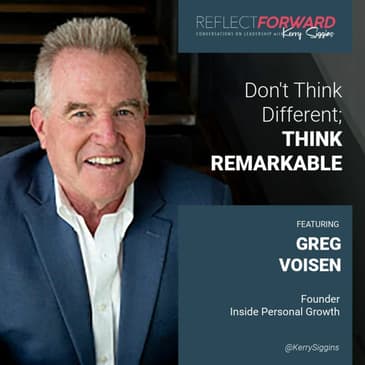

[00:00:00] Hi and welcome back to Reflect Forward. I'm your host Kerry Siggins and I'm so glad you
[00:00:13] were here today. Today my guest is Greg Boyson. He's an author, speaker, a podcaster and what
[00:00:20] he calls himself as a resultant, which is a consultant who gets results. I absolutely
[00:00:26] love Greg. I was on his podcast Inside Personal Growth where he's interviewed over 1100 authors
[00:00:32] and leaders and has just amazing content. He also has a consulting company called Illuminate
[00:00:39] where he helps small to medium sized business owners on financial management, human resources,
[00:00:44] capital development, process improvement, sales and market succession planning and ESOPs
[00:00:50] which I find really cool. He's also an author. He's written several books which
[00:00:53] he talks about in the podcast and he's just an awesomely amazing human being and
[00:00:59] I can't wait for you to meet him. So hang tight and I'll be right back with Greg.
[00:01:02] Welcome back everyone. I am so excited to introduce you to Greg Boyson. Greg,
[00:01:16] thank you so much for joining me on the show today. Oh, you're quite welcome Kerry.
[00:01:21] I appreciate you having me on the show and it's always nice to speak with a
[00:01:25] fellow podcaster. I've had this opportunity not many times but when it comes up I
[00:01:30] certainly take the opportunity because I think our listeners can learn and I believe you and I
[00:01:35] can learn. How long have you been podcasting? Something like 18 years? 18 years and 1100
[00:01:41] something plus podcasts. And I can only imagine how much you have gained from interviewing some
[00:01:48] of the most brilliant minds out there so you have so much to share. Well,
[00:01:54] thank you for that. I got into this kind of all by mistake. My son said, hey dad let's start a
[00:02:02] podcast show. This was like 18 years ago and I was like what's a podcast show? And it went
[00:02:07] from there and it was because I was involved at the time in a financial services industry
[00:02:13] and I was at a thing called the court of the table top of the table MDRT and I would
[00:02:17] hear these great speakers and I got very close to many of them and I started inviting
[00:02:24] them to the show and before I knew it I had Marshall Goldsmith and Ken Blanchard and all
[00:02:30] kinds of people and Stephen Covey all saying yeah we want to be on your show. And it wasn't
[00:02:35] because it was an early show it's just because they really liked the idea of being on something
[00:02:41] new. Yeah, I know I remember when I recorded my podcast with you I think you were just
[00:02:47] finishing up with Guy Kawasaki and you let me in a little bit early and I said that's
[00:02:52] so cool that you have all these amazing guests and I want to be able to get guests like
[00:02:57] that. And you said oh but I knew them all before they were famous. I did know a lot
[00:03:02] of them before they were famous. That is true. That is true. So tell us a little
[00:03:07] bit about your podcast. So Inside Personal Growth and really what you gained from
[00:03:12] it over the years of 1100 episodes. Well the show as I said briefly how it started
[00:03:20] back when it was kind of challenging to put together a podcast not like it is today with
[00:03:25] all the technology and the opportunities and we were on audio only we weren't video
[00:03:30] back then. All this is way pre-COVID. The interesting thing about the show is I always
[00:03:36] started off with personal growth, business, wellness, and spirituality. And I realized
[00:03:44] that in the business world which a lot of our listeners at the time would come from
[00:03:49] some from Facebook but a lot of them from LinkedIn and we knew this was an area where
[00:03:56] there were seekers. We always call it well who are the seekers out there. And usually
[00:04:02] the curious ones are the middle management and top management of companies saying hey
[00:04:08] we've got a problem we'd like to bring somebody in to speak, we'd like to do
[00:04:12] a workshop, we'd like to do something. My show started to become what I'm going to say
[00:04:19] the opportunity to not only promote the authors who wanted to do the workshops but actually for
[00:04:26] me to substitute a workshop where they could actually either listen and or read a book.
[00:04:32] I know that sounds kind of weird anymore but to read the book in the company and have a
[00:04:36] little book club and it sprouted from that because a lot of my authors would say oh
[00:04:44] this company ordered a case of my books or I got a case of these books sent to XYZ company.
[00:04:52] I love that. Oh my gosh how fun. Now before you were podcasting you've built several other
[00:04:59] companies haven't you? And I think a broad range, a toy company, and a software company.
[00:05:03] Can you tell us a little bit about what you did before this podcast or maybe even are still
[00:05:07] currently doing? I am still currently doing but I was in the financial services industry and I
[00:05:14] have to say after many years I felt a little burnt out. Like a lot of people get doing
[00:05:20] things. You get to kind of the peak of your game and then you say what's next or where
[00:05:25] could I go or what could I do. And I was always an extremely curious person so I would
[00:05:31] always look for things that intrigued me that I thought would give me a diversion from
[00:05:38] I'm going to just say it the pain that I was suffering and what I was doing.
[00:05:43] Because frequently like a lot of people I didn't turn to drugs I just turned to another
[00:05:49] adventure you know something that I thought would be fun and cool or whatever.
[00:05:54] So I was a serial entrepreneur and probably still am to that degree.
[00:05:59] One of the first ventures was something I did called sales solution systems for the financial
[00:06:05] services industry and I teamed up with David Allen getting things done. And I was actually
[00:06:13] running courses running around the country believe it or not. I remember flying into
[00:06:17] Denver for an event and it was blowing snow and we had to de-ice the plane wings.
[00:06:23] And I was doing events for people around purpose, process, programs and productivity.
[00:06:32] I called them the four P's and people would say well why are you talking about this thing
[00:06:36] called purpose? And I said if you don't have any purpose in your life you're probably not
[00:06:41] going to be a very good salesperson. And I'd go and speak to a big group and it was
[00:06:47] interesting after I was done it's like 12-15 hundred people or whatever was there.
[00:06:52] You get a handful of people just a handful that really got it. It was like I really
[00:06:58] understand how important purpose is. So I had created a system then after that somehow
[00:07:06] someone came along and said well I have this thing would you be interested in getting
[00:07:11] involved? And it was a company that ended up being called Wannabe, W-A-N-N-A-
[00:07:17] hyphen B-E. They were wannabe dolls and if you go back and even look on the internet today
[00:07:22] you will see them this was like bright this almost right after Cabbage Patch.
[00:07:29] And so I ended up being the person that focused on the manufacturing did all the
[00:07:36] contract negotiations with China did the letters of credit lines of credit the sales built the
[00:07:42] warehouse put the thing together distributed to Toys R Us back when Toys R Us was a company
[00:07:48] and it went from there. It did not succeed it was actually quite a failure and I learned a
[00:07:55] lot of lessons from that. Lessons around finance, lessons around running a business,
[00:08:00] lessons around sales, lessons around the importance of really understanding your market.
[00:08:08] You can't just say well I think somebody's going to beat a pathway to my door because
[00:08:12] I have a better mousetrap doesn't always happen that way. The other thing after that was I
[00:08:18] springboarded into a software company called Maestro and we were developing software for the
[00:08:27] training and learning industry. Now this was really interesting because we were right at the
[00:08:32] cusp at the same time Facebook was coming out so if anybody can remember here we are saying oh
[00:08:40] we're going to teach people we're going to build this LMS learning management system we're
[00:08:46] going to put in great videos we're going to put people in front of green screens we're
[00:08:49] going to go out and do all these things. And we did we started and I will have to say that the
[00:08:57] competition was so great in that field that we took it to Dale Carnegie and Carnegie said
[00:09:06] that they needed twice the amount of money to invest in it that we required. And I remember
[00:09:13] flying home on the plane with my son and I said hey Sean can we pull this off for what
[00:09:18] Dale Carnegie wants to invest in this and he said really dad I don't think so. I think
[00:09:27] that if you can't get the sum of money required between the programmers and everything we've got
[00:09:31] to do it isn't going to happen. So I made a decision at that point not to proceed forward
[00:09:37] and do a merger with Dale Carnegie. Oh my gosh that had to have been such a tough decision.
[00:09:46] It was because it was a baby we had gotten to a certain point when you incubate something
[00:09:52] and you have this great idea and it's proven and then you have a very large company that
[00:09:56] could infuse it with capital to take it to the next level saying hey we'll give you x but
[00:10:02] we won't give you y. And for us to say hey this was kind of our last pitch we were pitching
[00:10:08] it out there. We had gotten bites from other people but Carnegie was they said hey we will
[00:10:13] give you that so they were trying to get a bargain although if we had given them a bargain
[00:10:20] we wouldn't have been able to deliver what we needed to deliver. Yeah yeah that's smart
[00:10:26] hard to turn down but I think that's such good analysis to be able to say can we actually do
[00:10:31] this and it is it's your it's other people's money it's your money it's your baby it's
[00:10:35] your reputation all of those things that you have to think about if you fail. Right. So
[00:10:39] what did you do after that? After that I regrouped and I looked at my life and I did a sidestep
[00:10:47] and I said instead of being a licensed salesperson I'm going to be a consultant
[00:10:53] to these businesses. And what I've found is every time I went in, Carrie, that there'd
[00:10:59] be the same complaint because our company Illuminate Inc. E-L-U-M-I-N-E-T-E dot net
[00:11:06] but the company as it was Illuminate Consulting Inc. we'd hear the same thing from the owners.
[00:11:12] It was like we have these medical insurance plan and benefit plans and all this stuff
[00:11:16] but nobody really appreciates it that much and the costs just keep going up.
[00:11:21] And so I started advising on wellness and I said I think what could happen is if you really
[00:11:28] modify the behavior and help the people, I always had this hypothesis,
[00:11:33] help the individuals become well both emotionally, spiritually, psychologically, physically
[00:11:40] that you could have a healthy organization. And so I got very heavily involved in learning
[00:11:47] everything I could there and I teamed up with a company that was teamed up with
[00:11:53] Mayo Clinic with a product called 24 Alife and it was a digital app to help people
[00:12:00] in most areas of their life improve emotionally, physically. And did we see a correlation in
[00:12:08] premiums? I know a lot of companies say well if I put a dollar in I should get three dollars
[00:12:12] back because my employees would be healthier and whatever. Yeah we saw those kind of numbers.
[00:12:17] Did we see astronomical numbers? No. And I think because there's always non-compliant,
[00:12:23] it doesn't matter what group you have, you're going to have certain people that are going to
[00:12:28] be non-compliant. They just don't want to do it, right? Yep. So I went from that without
[00:12:35] deliberating too much longer into just consulting business on operations, ESOPs, employee benefit
[00:12:43] plans and the like, everything. And I became, I went back and got a degree in spiritual
[00:12:49] psychology. I used the psychology degree to work inside mainly family businesses where the
[00:12:56] mother and father or whoever was in the management team wanted to pass the business down. How were
[00:13:03] we going to make this happen? And I had all the degrees in finance and everything but I realized
[00:13:09] it wasn't about what the accountants did in the end. It wasn't about the study for the ESOP.
[00:13:13] It wasn't about any of that. It was really about the owner saying I'm really, really
[00:13:19] willing to let go and it's time. And I know I can do this effectively, whether it was through
[00:13:27] selling the business to the kids or putting in an ESOP like you did.
[00:13:34] Were you familiar with employee ownership and ESOPs? How did that become part of your
[00:13:38] consulting practice? I was always on the outskirts of ESOPs. I think ESOPs is such
[00:13:45] a specialty. Even today, I will call in other experts besides myself because there are so many
[00:13:52] nuances associated with it. You just can't be certain and you don't want to give people
[00:13:57] bad advice. So the whole thing around the trustee and who the trustee is going to be and
[00:14:03] they're going to negotiate on behalf of the employees. And then I got involved with, well,
[00:14:10] Ledoux was his name and he was from France. And many of the companies in Europe,
[00:14:16] they're co-ops. So I started studying co-ops and I started trying to really understand
[00:14:23] that marketplace. And then I really dug deep into the mechanics and really trying to
[00:14:29] understand it. And that's really all you have to do is you have to be one step above
[00:14:34] everybody else when you're consulting in this. Yeah, absolutely. Absolutely. So you have done
[00:14:39] so many pivots and I know that you're a big believer that failure fuels growth. So can you
[00:14:45] talk a little bit about how you used each of these when you had to walk away from your baby
[00:14:49] or say, hey, this isn't working or pivot your consulting business? How did you use those
[00:14:54] perceived failures or things not working out the way that you thought that they were going to
[00:14:59] help you move forward and grow? Good question. I think the first thing we default to as human
[00:15:05] beings is, we have a reduction of serotonin and the dopamine within our system. So emotionally,
[00:15:15] when something like that happens, we get down. And we get down both physically because
[00:15:23] something truly does trigger inside of our body. And what I realized is the things that counter
[00:15:30] acted that was more activity. So what I mean by that is, okay, we could all say, well,
[00:15:37] you're going to get a dopamine high if you go for a run or you go to the gym or you go on
[00:15:43] your life cycle or whatever it is or Peloton. Now I had to shift not only my physical
[00:15:49] activity by my emotional activity and thus my habits and my behaviors and my beliefs.
[00:15:58] So everything came in line, it was like, okay, you can take this failure and you can either go
[00:16:05] down one road or the other road. And fortunately I chose the high road. I did not
[00:16:13] choose to go down a road with drugs and alcohol and all that kind of stuff.
[00:16:17] I chose to go down a physical activity, meditation, Tai Chi, yoga, that kind of thing,
[00:16:22] which got me into the Eastern philosophies. And I started going to get this degree in
[00:16:28] spiritual psychology. And I remember waking up one morning and my roommate was a guy
[00:16:33] and he was sitting there at 5 a.m. meditating and I had never meditated. It's like,
[00:16:38] whoa, what are you doing? He says, why meditate? He says, do you want to go with me to
[00:16:44] the temple of Paramahansa Yogananda Self-Realization Fellowship? And I was like,
[00:16:49] hey, I'm game. So I went and I ended up becoming a member of Self-Realization Fellowship
[00:16:57] and yoga and meditation have been kind of the path of choice to keep me a little bit more
[00:17:03] and even keel. And so what I learned from that was any of us can get through it, we can
[00:17:10] grow through it versus go through it. Right? You don't want to just go through it because
[00:17:15] you don't learn anything from it, but if you grow through it, you can get to the other side
[00:17:20] and you can pivot and you can pivot very quickly.
[00:17:25] Yes, I agree completely. How have you used your spiritual psychology degree now on top of
[00:17:32] this? Like what is your life like now that you even have this deeper understanding and
[00:17:37] education around the mind, body, soul, spirit connection?
[00:17:43] Well, I've interviewed so many people from Ram Drost to Ken Wilbur to you name it to Thomas
[00:17:50] Moore. Some very, very famous people on philosophy of religion, spirituality.
[00:17:56] And if there's one thing that I would say is that no matter what your chosen path is,
[00:18:02] Christianity, Judaism, Muslimism, Sikh, all paths kind of lead up the mountain from a different
[00:18:09] direction, but they all kind of are saying the same thing. And one of that is compassion for
[00:18:16] self and compassion for others, love for self and love for others. And don't take this
[00:18:22] as being too airy-fairy, just take it as if you really realize that you're angry and you
[00:18:28] beat up on yourself. You're probably angry and beating up on other people as well.
[00:18:32] And the people around you begin not to like you so much. And so you wonder why your
[00:18:38] relationships are distant or whatever is happening in your life. And so once you
[00:18:43] reassess that and you retarget and you put some grit and determination and commitment in
[00:18:50] your life and have purpose, you can actually re-enliven your whole being.
[00:18:57] I so agree with you. I have been on that very similar journey myself. With love and
[00:19:03] compassion, like I just feel like there's, we're going to get philosophical here. There's
[00:19:07] just all this potential that's out there and energy, it's living there in potential. And if
[00:19:12] you activate that with positive emotions, with love and compassion and mercy and joy, how that
[00:19:19] takes you in such a different direction than if you activate that potential with negativity or
[00:19:25] selfishness or judgment or any of those other things. And of course, human existence, where
[00:19:31] we're going to feel all of those things. But if we can get ourselves into that space of
[00:19:36] how am I going to affect this potential moment, this potential energy and with positivity
[00:19:43] and what path will that take me down? It's so empowering. But I think so many of us are just
[00:19:48] living in the moment, living in that emotional moment of just reactivity and not really thinking
[00:19:54] through, wow, if I make this choice and choose to react this way, it is going to take me down a
[00:19:59] very different path than if I choose to show up with love or compassion or self-care or
[00:20:06] whatever term is appropriate. Yes, absolutely right. I always have like a little sign and
[00:20:13] I could show you my clock, but I have to pull it off the wall. But I could hold this up.
[00:20:18] Yes. It says be here now. And we really only have this moment that you and I are with us.
[00:20:25] Now people will say, that's kind of silly. And I say, well, but yesterday is a canceled
[00:20:31] check. Tomorrow is a promissory note. Nobody knows if you're going to wake up. So now let's
[00:20:35] talk about death and finitude. And your finitude really brings you to a realization
[00:20:43] that all you can be is the best you can be now. So why be anything other than that? Why try
[00:20:50] to be anything other than that? But remembering it is the key because our subconscious mind is
[00:20:57] so strong with the thoughts that really want to take people on this path that's like the
[00:21:05] pity party path because the ego is there and it's saying, you're not enough. And so in
[00:21:14] one sense it's trying to protect you. But I say become friends with the ego and understand
[00:21:19] what actually is going on. But in the subconscious side of the brain, I would tell
[00:21:25] anybody, and I'm not ashamed to say this, I have a hypnotherapist that works with me on
[00:21:32] a frequent basis to get in touch with that side of my brain. And he is amazing. And he taught
[00:21:40] me a lot. And he has a book out called Healing Beyond Pills and Potions. His name is Dr. Steve
[00:21:46] Berman. He also has a book about worry. You think about how many times do we think about
[00:21:52] and create hypothetical situations about, well if this happens that's going to happen,
[00:21:57] and this happens that can happen. Or before you know it you go down this road
[00:22:00] and then you're frozen. You're just completely frozen. You can't make a decision about anything
[00:22:05] because you've worried yourself into the corner. Yes, I know. Busy, busy mind and where it
[00:22:12] takes us. One of the things that I really practice, I was talking to you in the pre-show
[00:22:16] about a bunch of changes that we're going through here at StoneAge, and it's really easy
[00:22:20] to get caught up in the, okay what's going to happen? What's the outcome going to be?
[00:22:24] And one of the things that I really do is I just try to remind myself that this is an experience.
[00:22:29] How do I become less attached to the outcome that I want? My likes are my dislikes. I don't
[00:22:36] like where this is going. I like where this is going and just say, okay I'm just here to
[00:22:40] experience it. This is just an experience and I want this to have love, enjoy, and compassion
[00:22:46] even though it's hard. And that helps me be able to unplug a little bit from that worry,
[00:22:51] that planning, the trying to fix things that we all go to. Okay I'm just going to try to just
[00:22:56] experience this and look at it as an experience and not try to judge something if it's good or
[00:23:01] bad because how many times have we said something is going to be really bad and have
[00:23:05] this really negative outcome? But it's one of the best things that's ever happened to us
[00:23:08] because we just had no idea that that could be a potential outcome. And so that's how I've
[00:23:15] been trying to deal with my overactive mind is it's just an experience. How are you going
[00:23:21] to experience it? Oh and that's a great way to look at it because one of the precepts you're
[00:23:26] basing your decisions on is a Buddhist precept. There's the Four Noble Truths and then there's
[00:23:32] also this precept of non-attachment. That particularly comes from the Buddhist philosophy
[00:23:39] and if I really look at myself, I'm more Buddhist than anything and I'm not ashamed to say that
[00:23:45] because when everybody says well they hear the Dalai Lama say compassion is what's going to help
[00:23:51] solve all the world's problems. He's absolutely right because it's compassion. I just got a
[00:23:56] book in here from a guy in Spain about compassion in business. I mean this is a
[00:24:01] brick the textbook like this that he's going to be on the show but all he focuses on when
[00:24:07] he teaches the kids in the business school is compassion in business. Right? And so where
[00:24:12] we've come from is really unique when you think about it because it was all about me,
[00:24:21] me, me, me, me. Now it's become about we and I think the most important thing about we when
[00:24:27] you have a company like you have is that people don't do that for the gain for themselves.
[00:24:35] They do that to share their heart and everything with the other people as well meaning everybody
[00:24:42] else in the group. And you'll find that companies like yours will go so much farther,
[00:24:47] so much faster when you do something like an ESOP because it's truly sharing a piece of the
[00:24:55] return of the business. And by the way I've put my heart and soul in it. Why shouldn't I
[00:25:00] get something out of this too and share in it equally? Yeah I agree completely. And so how do
[00:25:06] you bring this idea of compassionate leadership running a compassionate business, building a
[00:25:11] compassionate business into your into the CEOs to the clients that you work with?
[00:25:17] How? Let's make it this way it's not difficult at all when somebody comes to you and is
[00:25:22] already in pain because they've tried different ways and they haven't worked. And I've found
[00:25:28] over the time never try and convince anybody of this. Let people come to you when they're ready.
[00:25:35] Now that may sound really strange but I've been doing this show for 18 years and I could say well
[00:25:40] you're trying to convince people about spirituality and personal growth and business and wellness
[00:25:45] and all that. And I'm saying yes I am but at the same time if I don't continue to seed you
[00:25:52] how do I know when you're going to be ready? When are you going to grow? So all I do is
[00:25:56] just keep putting water on it until it's ready to grow and be harvested. And so how I convert
[00:26:03] people to this is I don't convert them at all. I allow the language from within inside of them,
[00:26:10] the pain from within side of them, the what I want to call the angers, the frustrations from
[00:26:16] within side of them come to a point where they realize they can't withstand that anymore and
[00:26:22] they choose to do things differently and transform themselves. And what happens if a leader
[00:26:29] doesn't get to that point? I've seen people who are just so miserable, so stuck and unable to
[00:26:35] help themselves. Do you think that all people can come around or do you think that there are
[00:26:39] people who will just die just like never being able to do that inner work that maybe
[00:26:44] they're so attached to their pain that they don't know how to actually let it go?
[00:26:49] And I would say I'm sorry. I think that the answer to your question is will many people choose not
[00:26:59] to take the action? Yes. Will those people at some point beyond that when they're
[00:27:07] at their deathbed maybe have some realization that maybe some of the mistakes they made,
[00:27:14] I hope they don't go with that regret. I remember doing this interview with Marshall Goldsmith and
[00:27:21] around some of the top, top executives that he's coached over the years. We're talking big time
[00:27:28] Fortune 500 company CEOs. One of the things he said, and I'll never forget this during the
[00:27:34] podcast, he said, you know, they could have five or six degrees, a doctorate, own two or
[00:27:39] three companies, have a $10 million house and they always wanted more. When is enough enough?
[00:27:48] When are you going to stop and just count the blessings and be grateful for what you've been
[00:27:53] able to create versus just I'm going to continue to go after more and more and more and more?
[00:27:59] And he said at times when he's coaching these people they're so dissatisfied
[00:28:04] and it's that level of dissatisfaction that drove them to where they are. But it gets to a point
[00:28:11] you got to realize because those are the kind of things that kind of propel you, right? It's like
[00:28:15] things aren't right. I want to fix it. I'm going to grow this company more. I'm going
[00:28:18] to keep doing more. But now when you've got all the money and you got all the possessions
[00:28:23] and you've built the five or six companies or whatever you might have and things are going
[00:28:28] well for you, why does that same driver take hold? The driver now should be is how much can I give
[00:28:36] back? How much can I contribute? What can I contribute to the world and how can I do that?
[00:28:43] And that's the question I'd ask most CEOs who are in a position where they've made everything
[00:28:48] that they really need in this lifetime. So now how do you get back? Yeah, I think that whole
[00:28:55] comparison thing, right? There's always going to be somebody who's wealthier than you or more
[00:28:59] successful than you. And I think when we get into that comparison, that's what keeps that
[00:29:03] driving even though we might be exhausted by it or miserable by it. But it's like, oh,
[00:29:09] I just want to be richer than my neighbor over there. I want to have a nicer car than
[00:29:12] that person. And it's so unimportant in the whole scheme of things. What is actually important
[00:29:17] is the impact and how you give back and how you grow. But I know the human need that we
[00:29:22] have to compare ourselves to others, I think it's a part of what keeps people really stuck.
[00:29:26] Well, happiness and contentment. And people say, well, you're content and you're happy.
[00:29:34] Yeah, I would say contentment is a big one. And so if people could define what contentment
[00:29:41] would be, I'd ask them to say, what is that? Because truly, that is one of the biggest
[00:29:46] factors to say, oh, what I have is okay. I don't need more to make me happy. So if I don't need
[00:29:55] more, what can I do to help somebody else get to the same level that I'm in?
[00:30:02] I love it. I think it's brilliant. One more question before I ask you my final question.
[00:30:08] How do you feel curiosity plays into this? I know you are a very curious person. You've
[00:30:13] probably read all of the books behind you. I know you're an avid reader, a lifelong learner.
[00:30:18] You are truly interested in being curious about other people. How does curiosity
[00:30:23] fuel you? And when you're thinking about this idea of compassionate leadership, understanding
[00:30:28] that our spiritual sides are so integral into everything that we do in life,
[00:30:33] how do you think curiosity plays into that?
[00:30:35] I think fundamentally, not everybody is curious. But those that are curious,
[00:30:44] remember having Steven Kotler on here, wrote the book Abundance, The Rise of Superman,
[00:30:50] and all around flow, Getting in Flow, and the Flow Genome Project. And we have this
[00:30:57] discussion around personal growth. And at the top of everything, for most people who are
[00:31:04] in positions like you and I, is our curiosity. The curiosity then leads to whatever we were
[00:31:12] maybe curious about. Maybe it was about surfing or skiing or building a business
[00:31:17] or whatever it was, or it was a hobby we had a curiosity about. But the reality is
[00:31:22] it led to us finding a purpose. We had a really strong purpose. From that purpose then,
[00:31:29] we had the drive then to establish goals and a vision and all the initiatives that are created
[00:31:38] around that. So in reality, at the front end of all of this stuff before we get to the purpose
[00:31:44] is our own curiosity. And then to take whatever it is that we are thinking about and turning
[00:31:49] that into our purpose for our life, and then turn that into goals and aspirations,
[00:31:56] and then turn that basically into subset goals and the things we're going to do.
[00:32:01] I define to my personal purpose is I exist to serve, to inspire passion.
[00:32:06] I did that a long time ago, but I left it passion a little differently. Biblically or
[00:32:10] spiritually, passion was taking people from a position of unclarity or confusion
[00:32:18] to a position of clarity and understanding. And if you really look at what I do for my life
[00:32:25] as a consultant and a podcaster, that's all I'm doing. I mean, that's all I do. I don't do
[00:32:35] anything else. And if I wake up every morning and I go today, one of my goals and my purpose
[00:32:41] is to help make things clearer not only for myself but for others, I've done all the work
[00:32:49] I can do.
[00:32:50] Yeah, I love that. You're so inspiring.
[00:32:56] Well, thank you.
[00:32:56] Awesome. Yes, I know.
[00:32:58] I'm glad I made you smile.
[00:33:02] You see, you did your work today. You lived your purpose today. I love it.
[00:33:09] I do. I feel so much better. All right, final question before we talk about how we can find
[00:33:14] you. So the name of this podcast is Reflect Forward. What does Reflect Forward mean to you?
[00:33:20] I think it's really about how we actually can paint the picture in our mind about what our
[00:33:30] future can be. And so you say, well, I'm reflecting forward and I say, what does forward
[00:33:35] look like to you? Because you're not going reverse. You've already been there. That's
[00:33:40] a rearview mirror. You're saying I'm looking out the front windshield. And I'm saying if
[00:33:45] I'm looking out the front windshield, it's how I'm looking out there. It's how I've actually
[00:33:51] designed whatever is in that windshield that's coming toward me that actually creates my reality.
[00:33:58] But I create my reality right now about the windshield and the view that I create
[00:34:04] to reflect forward.
[00:34:05] Thank you so much. I knew you were going to have something else that would inspire all of
[00:34:09] us. All right, so how can people find you?
[00:34:13] They can find me at InsidePersonalGrowth.com. That is the podcast. There you'll see 1100 podcasts.
[00:34:21] Consume at will because there is no barrier to entry. It's all free. They can find me also from
[00:34:27] the consulting side at HackingTheGap.com. That's a book I wrote called Hacking the Gap
[00:34:35] From Intuition to Innovation and Beyond. I also was the co-author of a book with
[00:34:39] the gentlemen by the name Bo Parklett and Kathy Sparrow called The Precipice of Life,
[00:34:45] which is another place they can see me on Amazon with that book.
[00:34:49] I had a lot to do with that book. And the last place is the consulting company
[00:34:54] is Eluminate. That's spelled E-L-U-M-I-N-A-T-E dot net. There they can learn more about the
[00:35:01] consulting company and obviously at GregVoison.com.
[00:35:07] Wonderful. And I will include all of that in the show notes. And I have those, your books,
[00:35:11] sitting right here over on my desk and I am traveling next week and one of them is going
[00:35:16] with me. So I'm super excited. Well, Carrie, it's a pleasure being
[00:35:19] on your show Reflect Forward. I hope everybody who listens to this and all your other podcasts
[00:35:26] gains insight and wisdom from somebody like yourself who's really been there and done that.
[00:35:31] And I really mean that. I appreciate you. I appreciate what you're doing and I think
[00:35:36] what you're bringing to the world and really I look at you, you know, you're a mom,
[00:35:41] you're a wife, you're a CEO of a company, you have all these things. You run a podcast show,
[00:35:48] you wrote a book, all of that just tells me one thing. You love achieving but you also
[00:35:54] love helping others by how you achieve. You know, I look at leadership as not how
[00:36:01] people experience me but how they experience themselves in the presence of my leadership
[00:36:06] and that is really what I like, what I inspire to do, right? How can I lead in a way that
[00:36:12] inspires people to dig deep within themselves and be the very best version of themselves in
[00:36:18] that moment to go after their dreams, to believe in themselves, to take a risk,
[00:36:22] to do something big and so that's how I try to show up in my podcast and in my book and
[00:36:28] in my leadership is how do I help people see the very best within themselves and go after it.
[00:36:33] And I think Guy Kawasaki said in that interview and people can listen to it,
[00:36:37] the one I did he said, think remarkable. Yes.
[00:36:42] Don't think different, think remarkable.
[00:36:44] Think remarkable. Yeah, good. I'm totally stealing that.
[00:36:48] All right, Greg. Well, thank you so much for coming on the show. It's such a pleasure
[00:36:52] to talk with you again. Thanks, Karen.
[00:36:53] Thank you. All right, hang tight everybody. I'll be right back.
[00:37:03] All right, everyone. I hope you enjoyed that interview with Greg. Be sure to check out his
[00:37:07] books, check out his website and check out his podcast. It's really fantastic. He interviews
[00:37:12] killer guests. I'd love to have some of the guests he has on his show on mine.
[00:37:16] So maybe someday I'm going to put that goal out there and manifest it.
[00:37:19] All right, with that, I will leave you to your week. I hope it's a good one
[00:37:23] and please don't forget to subscribe to this podcast, write a review, go to YouTube
[00:37:29] and subscribe to it. Share it with a friend so you get amazing stories like Greg's out there.
[00:37:34] I so appreciate it. And don't forget to check out my book, The Ownership Mindset. You can
[00:37:37] find it on Amazon. Just go on and search The Ownership Mindset, Keri Siggins and you'll
[00:37:42] find it. Thanks so much. I appreciate it and I'll see you next week.