
[00:00:00] Hi and welcome back to Reflect Forward. I'm your host, Carrie
[00:00:13] Sickens, and I'm so glad you were here today. Oh, today my
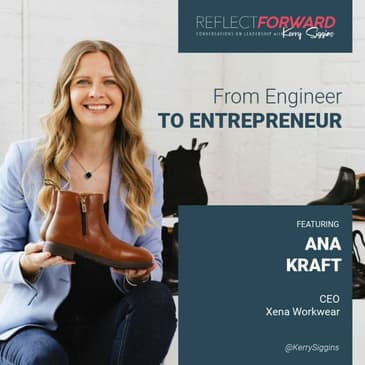
[00:00:16] guest is so much fun. It is Anna Kraft, who is the CEO and
[00:00:20] founder of Zeno Workwear. Zeno designs safety boots, stylish and functional made specifically for women.
[00:00:28] And I met her when I did a speech at the Women in Steel conference in 2023.
[00:00:35] And I knew I had to have her on the show.
[00:00:36] She has an amazing story.
[00:00:37] She moved to the United States from Germany.
[00:00:39] She has an engineering background and she started Zena Workwear out of frustration because
[00:00:46] she would have to wear safety boots in her manufacturing job and she was tired of how
[00:00:51] clunky they were and how everything seemed to be designed for men.
[00:00:55] And I know this, I have my own pair of stiltowed boots that I have to wear when I go into any
[00:01:00] plants and I hate them.
[00:01:02] And so she started this company in 2019
[00:01:05] and had no idea about anything about design
[00:01:08] and it's a growing success and it's just amazing.
[00:01:13] I love her leadership style.
[00:01:15] She is just so fantastic and I can't wait for you
[00:01:18] to meet her so hang tight and I'll be right back with Anna. Welcome back everyone.
[00:01:30] I am so excited to have Anna Kraft with me today.
[00:01:34] Anna, thank you so much for joining the show.
[00:01:38] Thank you so much for having me today, Carrie.
[00:01:40] I'm so excited about this conversation.
[00:01:41] So you are the founder and CEO of Zena Workware.
[00:01:45] And I can't wait to dive into your story because I too can relate to wearing
[00:01:50] clunky, chunky, awful looking work boots.
[00:01:52] But I'd like you to first tell us a little bit about Zena Workware and what you do.
[00:01:58] I started Zena in 2019.
[00:02:01] I should start with the fact that I never planned to launch a safety footwork
[00:02:06] company.
[00:02:07] I don't have a fashion background.
[00:02:08] I studied engineering in Germany and actually loved my job in the manufacturing industry
[00:02:13] after I moved to the US.
[00:02:16] But one thing I truly hated were my clunky work boots and I had multiple pairs under
[00:02:20] my desk.
[00:02:21] You can probably relate.
[00:02:23] I went to so many safety shoe stores and had so many
[00:02:27] shoe trucks come over to our company and had a collection of safety boots that I hated. And then
[00:02:32] I discovered the shrinket and pinket concept that traditional companies apply where they take a
[00:02:37] men's product, make it smaller, make it pink or purple. And that is not what professional women want and decided to
[00:02:45] launch the first stylish safety shoe that is actually designed on a woman's
[00:02:50] foot. So we launched in 2019 with just one style. For those who can have access
[00:02:56] to video, that's the gravity model. Decided to launch with just one product to see
[00:03:00] if there's a product market fit and we got so many orders from the very
[00:03:04] beginning and we're able to expand our product line.
[00:03:06] So it's been a wild ride since 2019.
[00:03:10] I love that.
[00:03:11] And how did COVID impact you?
[00:03:13] I mean, starting a business right before COVID, I'm sure brought it along
[00:03:15] its own set of challenges.
[00:03:17] What was that like?
[00:03:18] You know, it was kind of good and bad for so many businesses.
[00:03:22] In our case, the downside was that so many of our customers were sent home.
[00:03:27] A lot of engineering, everyone who was still in the manufacturing floor had to
[00:03:32] come in, but a lot of engineers got sent home to work remotely.
[00:03:36] But the good part about COVID, I shouldn't say a good part about COVID, it really
[00:03:42] helped us to build out our online presence because we launched through a website and we're shipping
[00:03:49] products from our warehouse so more and more people were more comfortable
[00:03:52] ordering products online. So that was helpful in the process to help people
[00:03:57] get more comfortable with online purchases and we of course tried to make
[00:04:01] the whole ordering process as easy as possible with re-exchanges and returns.
[00:04:06] So we learned a lot along the way without having an e-com background.
[00:04:10] That was a lot to learn.
[00:04:12] So how did you go about doing that?
[00:04:14] What did you study in school?
[00:04:15] I studied in southern Germany, and that was a very unique program that was designed by
[00:04:20] the automotive industry in southern Germany.
[00:04:23] And it's called International Project Engineering.
[00:04:26] So I have a very broad engineering background.
[00:04:28] We studied electrical engineering,
[00:04:30] thermal fluid dynamics,
[00:04:32] material science, manufacturing engineering,
[00:04:35] and had a huge focus on project management and some languages.
[00:04:38] So my role was to be a project manager
[00:04:41] and work with different specialists,
[00:04:43] but I was not a specialist in any of those areas.
[00:04:45] My goal was to get either a master's in electrical engineering,
[00:04:49] so I would be an expert in one area or start a business.
[00:04:54] By the end of that one year,
[00:04:56] you decided to start a company instead of going the engineering route.
[00:05:01] So that was unexpected, but I still applied a ton of things I learned,
[00:05:04] especially in manufacturing, engineering, and So that was unexpected, but I still apply a ton of things I learned, especially in manufacturing,
[00:05:06] engineering, and material science for safety shoe development.
[00:05:10] All the booths have to go through ESM testing at an independent lab.
[00:05:14] There's so many different safety certifications like electric hazards that are dissipative.
[00:05:19] So it's fun to be able to leverage some of that knowledge.
[00:05:24] Absolutely.
[00:05:26] And so this is so fascinating.
[00:05:27] I love it going into design and workwear fashion.
[00:05:30] I love that.
[00:05:31] So how did you get started?
[00:05:33] So you knew that there was this potential for a market, but going into something
[00:05:37] that you didn't have any experience in, what did you do?
[00:05:41] How did you figure that, how did you figure out where to get started?
[00:05:45] Yeah. What did you do? How did you figure that how did you figure out where to get started? Yes, initially I learned I wrote a business plan and did a market analysis
[00:05:50] To evaluate if there was a real need need in the market
[00:05:55] I actually waited for two years and to me it was so obvious that there was a gap in the market and I waited for
[00:06:00] Somebody else to fill this gap and nothing happened. So wrote a business plan
[00:06:03] and I waited for somebody else to fill this gap and nothing happened.
[00:06:07] So I wrote a business plan, bought the ESTM standards,
[00:06:12] learned everything possible about the testing that was necessary, and I worked with designer, shoe designer, to push the boundaries of designs
[00:06:17] while being able to pass all the necessary testing.
[00:06:21] So that was a very interesting part of the journey. Then I found a
[00:06:26] manufacturer in Mexico and we almost got a visa to Asia to China in this case
[00:06:31] and I'm so glad that we decided to work with Mexico. They're more expensive
[00:06:36] compared to Asia but we were in the same time zone and it's such a short flight
[00:06:42] and we get amazing quality and it's so much easier to communicate. So flew down to Mexico, met multiple
[00:06:49] manufacturers, selected one who we wanted to work with, who had the
[00:06:54] capability to do what we wanted to do but was small enough to take us seriously
[00:06:59] enough so that was there have been amazing partners and after five or six rounds
[00:07:05] of prototypes, we finally, I was happy with the fit.
[00:07:09] We passed the ESTM testing and launched with just one model.
[00:07:13] I love that.
[00:07:14] So you said the orders were coming.
[00:07:16] And so what happened next?
[00:07:17] How did you start to add more, more models into your offering?
[00:07:23] Yeah.
[00:07:23] So after we launched the first model that is designed as a walk-through
[00:07:28] boot, because it has a little heel in the back that is based on Canadian CSA
[00:07:32] standards, because the U S doesn't have any heel head limitations.
[00:07:35] We got so many requests for additional models.
[00:07:37] The second model was the Omega boot that has a lower heel and electric
[00:07:41] hazard certification, a slip resistant outsole and a steel toe cap.
[00:07:46] And we were able to expand our product line only because we have, were able
[00:07:50] to raise funding two months into launching our business.
[00:07:53] It was not a huge amount, but it really helped me to hire the first team
[00:07:59] member, officially, kids.
[00:08:01] We had so many friends helping us on the side in the evenings and
[00:08:05] on weekends.
[00:08:06] So, that was really awesome to be able to hire my first team member and invest in new
[00:08:11] product development.
[00:08:14] And you still had your engineering job and this was something that it was kind of a side
[00:08:18] hustle.
[00:08:19] Were you figuring it out?
[00:08:20] Tell us about that.
[00:08:21] Yeah, it was a side hustle for a while
[00:08:27] until we got accepted into an accelerator program.
[00:08:28] So by the time we had the product
[00:08:30] ready, we passed the ASTM testing.
[00:08:33] I get accepted into an accelerator
[00:08:34] program that helps you to
[00:08:37] really launch and grow the company.
[00:08:39] But you have to commit full time.
[00:08:40] And I decided to quit my job
[00:08:43] at that time. It was actually really
[00:08:44] good timing.
[00:08:45] I finished a massive project for one of my clients. They were really happy. It was kind of the perfect
[00:08:52] cutoff point to do this full-time. It was a little scary because you lose your...
[00:08:58] it's so unknown. Lose your health insurance was relying more on my husband and...
[00:09:06] lose your health insurance was relying more on my husband and but it was the right move. Like Sarah Blakely often says, failure is not the outcome, failure is not trying.
[00:09:11] So I decided to give it a shot.
[00:09:12] I love that.
[00:09:13] And so how did you overcome that fear?
[00:09:15] Because obviously that is a big step and you are taking on risks.
[00:09:18] So tell us a little bit about the conversations you had with yourself to overcome that fear.
[00:09:25] I decided to give it a real try.
[00:09:28] I think because I was more accepting of risks because I already moved to the US.
[00:09:34] I was actually born in Kazakhstan, moved to Germany, so I was very adaptable already.
[00:09:38] And I had such an amazing support system through friends and mentors in Milwaukee.
[00:09:44] So I felt very confident that this idea would work.
[00:09:47] But what happened when we launched the company, you would expect that I would
[00:09:51] have celebrated like, I'll open a bottle of champagne and have this big moment.
[00:09:56] I remember sending out a press release to multiple publications.
[00:09:59] And then when we actually launched our website, I saw multiple pictures
[00:10:04] of my face in newspapers,
[00:10:07] and that was terrifying.
[00:10:09] That was not a moment of celebration.
[00:10:11] I was so scared.
[00:10:13] I started thinking, oh my God, what if women will hate my boots?
[00:10:18] What if I fail?
[00:10:19] And most importantly, what will people think if I fail?
[00:10:22] And then I started doing more research around the topic of failure because it
[00:10:26] was just so unproductive to have those thoughts and I came across a founder of
[00:10:31] Spanks Sarah Bleagley who shared her story about launching Spanks and her
[00:10:36] whole approach of seeing failure differently and using her quote,
[00:10:40] failures, not the outcome failures, not trying.
[00:10:44] As a child, her dad always taught her to try new things and encourage
[00:10:48] her to fail along the way.
[00:10:49] So I tried to, and it took a while to adapt that new mindset, but I think
[00:10:54] so many of us have so many amazing ideas and sometimes even million
[00:10:59] dollar ideas in our lives, but because we're so afraid to fail,
[00:11:02] we don't even give it a shot.
[00:11:04] Yep.
[00:11:05] And speaking of failures, did you have any failures in those first couple of years?
[00:11:09] How did you bounce back?
[00:11:10] Because I'm obviously starting a new shoe company is not easy to do.
[00:11:14] Oh my God.
[00:11:15] Yeah, there were many smaller things that happened along the way.
[00:11:19] The first one was completely overestimating the amount of space we had initially.
[00:11:24] We didn't have a warehouse.
[00:11:25] We ship from a warehouse now, but in the beginning we wanted to ship from our house because we wanted
[00:11:30] to save some money but also have an additional quality control step. And then we realized that
[00:11:36] the insoles that were supposed to be sanded to a one millimeter thickness in the front where it not sanded. So we had to buy a belt sand and set it up on our dining room table and our whole house
[00:11:52] looked like a huge mess.
[00:11:53] So first of all, the products didn't fit in the one room that we dedicated for this.
[00:11:58] Our whole house, our guest bedroom, our living room and dining room were filled to the ceiling
[00:12:03] with boxes.
[00:12:04] So there were multiple
[00:12:05] smaller failures along the way that we had to overcome. Yeah, absolutely. And it reminds me
[00:12:11] of Shoe Dog. Have you read Phil Knight's Shoe Dog? Oh yeah, it's a really good book.
[00:12:16] It's so good. It's one of my favorite leadership biographies and it's just so inspiring to see how
[00:12:23] he made Nike happen.
[00:12:25] But I remember going like,
[00:12:26] I don't know if I could live with my entire house
[00:12:28] filled with shoe boxes.
[00:12:29] Sure.
[00:12:31] Yeah, it's really crazy.
[00:12:33] Or Albert said a story where they placed their first order of shoes
[00:12:37] and then realized that the men's and women's were made on the same last.
[00:12:41] But they didn't have more money for additional materials or
[00:12:46] production.
[00:12:47] So they just told people to take out the insoles and like try to squeeze in.
[00:12:51] So I can't imagine having the first production run be so messed up, but they made it through.
[00:12:58] They make great products.
[00:13:00] Before you started your business, had you been in leadership roles?
[00:13:03] Had you learned how to manage people?
[00:13:05] And then what was that transition like to starting your own company
[00:13:08] and then having to lead people?
[00:13:10] Yeah, before I started the company, I was a project manager and was supporting
[00:13:17] massive multimillion dollar projects and help teams develop project plans that
[00:13:22] were lasting two to three years and were multi-million
[00:13:27] dollars in budgets. And the biggest lesson I learned from that was you will
[00:13:33] get the best outcome if you don't tell people what to do but instead include
[00:13:37] them in the decision-making process and allow them to write down the activities
[00:13:42] that they will in the end have to perform
[00:13:46] and we'll ask them how long it will actually take.
[00:13:48] It really drives accountability.
[00:13:50] So that was one of the biggest lessons I learned from successful project management.
[00:13:55] And when I started this company, I had to learn how to build a team and lead a team.
[00:14:01] So I needed new systems and we briefly talked about EOS was a new tool that I
[00:14:07] had to implement to help create in the beginning, in the startup environment,
[00:14:11] everyone wears multiple hats and it becomes very difficult to separate the
[00:14:16] tasks that you're doing.
[00:14:17] So running on EOS really helped us to understand who's responsible for what
[00:14:21] role and help us set measurable goals not only on an
[00:14:26] annual basis because if you set goals only once a year you may forget about
[00:14:30] them four months in. Setting quarterly goals seems to be the most effective
[00:14:35] way for us and really inspire people to do their best every single day.
[00:14:40] Yeah and I know that you like the concept of radical transparency.
[00:14:45] I do too.
[00:14:46] I believe that when you tell people the truth, they can handle it for the most part and that
[00:14:53] they're going to be so much better off and a lot of people don't.
[00:14:55] They don't share information and so people feel like they're left in the dark and it
[00:14:59] causes all kinds of issues.
[00:15:00] So I have a big believer in radical transparency.
[00:15:03] How did you decide that was how you wanted to run your company with this idea of we're going to tell everybody
[00:15:09] and make sure everybody understands what we're doing as a company and encourage them to come
[00:15:12] up with their own ideas?
[00:15:14] Yeah, I think I got the radical transparency concept through Ray Dalio, the author of Principles,
[00:15:22] and that just made a ton of sense to me.
[00:15:26] It has its ups and downs.
[00:15:28] And also coming from Germany, I already had the more direct approach.
[00:15:32] Germans don't sugarcoat things.
[00:15:33] They are very direct.
[00:15:35] So I had to learn the sandwich method in the US where you say something nice, then you
[00:15:42] have your actual message, and then you wrap that up with a positive note in the
[00:15:46] end.
[00:15:47] So I had to learn it the hard way.
[00:15:49] I think radical transparency really helps us to get to the point faster and allows us
[00:15:54] to get the best idea to the top.
[00:15:56] I really like this idea of running a company not as a democracy but a meritocracy because
[00:16:03] not everyone needs to be involved in every company
[00:16:07] decision. There are things on the operations side that I allow my three team members to
[00:16:13] decide where I'm not involved at all because I don't add the right value. The same thing
[00:16:17] applies for branding or marketing. Not every single person in a team meeting needs to be part of that vote. And I encourage everyone to challenge ideas.
[00:16:28] And when we brainstorm, everyone's opinion is being heard.
[00:16:32] And my goal is to get the best ideas to the top through the radical transparency concept.
[00:16:36] The downside is I had to build a very thick skin because if I share transparency with my team members,
[00:16:42] it will come back to me and I get feedback
[00:16:45] from them all the time on things that I can do better.
[00:16:47] So if you decide to implement that, or anyone decides to implement that in their team or
[00:16:52] company, you have to be ready to get the transparency back.
[00:16:57] I really appreciate you said that.
[00:16:58] I am a believer that feedback is a gift and that there's always a way to own something
[00:17:02] in feedback, no matter what, even if it doesn't necessarily feel true. Because if somebody is perceiving you that
[00:17:09] way or experiencing you that way, then what can you do to help that situation? I love
[00:17:14] this idea that feedback is a gift. Tell me how you learned to toughen up, to develop
[00:17:20] that thicker skin. Did you always have it or were there times you're like, Oh, I don't
[00:17:24] like this.
[00:17:25] And you had to work through it.
[00:17:28] Yeah, there were definitely many times where
[00:17:31] I did not take your own medicine.
[00:17:33] You're like, ooh, that was harsh and I did not expect it,
[00:17:36] but I cannot complain it because we implemented this rule,
[00:17:40] made it part of our company values to have radical
[00:17:44] transparency as our
[00:17:45] communication strategy. So yeah, it was tough to adjust and I think there are
[00:17:50] still different ways to communicate with different team members but I think in the
[00:17:55] end everyone understands that everyone's opinion is being heard and that the goal
[00:18:00] is always to do the best for the company and that our goal as a team is to
[00:18:05] get the best ideas.
[00:18:08] I love that.
[00:18:09] So I can imagine that maybe this was an interesting process for people to go
[00:18:13] through because a lot of us come from environments where it's not safe to
[00:18:17] speak up, to tell people what you think.
[00:18:19] How did you help people learn that radical transparency was something that
[00:18:24] you really wanted, right?
[00:18:25] Not that you just gave lip service to. Did you have to teach people how to be radically transparent?
[00:18:30] I think after getting into, I think initially we communicated that transparency is really
[00:18:37] important to us. And then especially in our leadership meetings, it would get really heated.
[00:18:43] leadership meetings, it would get really heated. Sometimes, yeah, it's sometimes a little bit more intense and we run on EOS as well and
[00:18:51] ask them like, hey, is that okay?
[00:18:52] Or is something wrong for a company and the EOS implementer said, actually inside your
[00:18:58] internal management team, it's totally fine to have these discussions where sometimes
[00:19:02] people get loud or upset, but you
[00:19:06] all need to get on the same page because that cannot transpire to the whole team.
[00:19:11] Like you have to represent your goals as a team.
[00:19:15] And I think over time, everyone got more comfortable with the concept.
[00:19:20] But we have our weekly L10 meetings.
[00:19:23] It's a one and a half hour meeting that follows a specific agenda. So when we get to the last part of
[00:19:28] discussing issues and different topics, sometimes it's very smooth and rarely
[00:19:33] when we disagree on something it can get a little... people get passionate about
[00:19:38] their topics. But it's been working out really well and I think it's also
[00:19:43] helpful to have clear values for everyone on the team.
[00:19:47] And I think Yvonne Chouinard is another huge inspiration to me, the founder of
[00:19:51] Patagonia, who built Patagonia so well that he wanted to hire people who believe
[00:19:58] in the values of the company and don't need to be managed at all.
[00:20:01] He never wanted to micromanage his team.
[00:20:04] And he would even
[00:20:05] leave for half the year going, I think fly fishing is his big thing. And he would tell his team,
[00:20:10] like if the warehouse burns down, don't call me, trust you guys, you know what to do. You will
[00:20:15] figure it out. And apparently his people are so unique that they're unemployable anywhere else.
[00:20:21] Like they have a very clear moral compass.
[00:20:26] So I tried to apply that as well and learn.
[00:20:28] Give people work with trust.
[00:20:31] I think in his case it would be,
[00:20:33] his book is called, Let My People Go Surfing.
[00:20:35] When the weather was really nice,
[00:20:37] he would trust his people to go enjoy the weather
[00:20:39] and then get the work done when they have to get it done.
[00:20:42] And especially working in this environment
[00:20:44] where you have this remote work culture.
[00:20:46] I think the only way to build a successful business is to trust people and
[00:20:52] not have to micromanage something.
[00:20:54] I agree, trust is everything.
[00:20:56] We're an employee owned company and as you can see, I've got own it everywhere.
[00:21:00] And it's really important for us to hire people who can think and act like owners.
[00:21:05] And we do have to teach some people what that means because people aren't used to coming
[00:21:08] into an employee owned company and, you know, what does it actually mean for me to own it?
[00:21:13] And I tell my management team and I speak about this all the time, it starts with trust.
[00:21:17] You cannot expect someone to have an own it mindset if you don't trust them.
[00:21:21] They don't feel trusted.
[00:21:22] Why would they stick their neck out to do something
[00:21:25] or make a decision that might have some perceived risk or speak up and share an idea if they're
[00:21:31] not trusted. So that foundation of trust is incredibly important if you want to build
[00:21:35] a healthy team. I can agree with you completely.
[00:21:38] Very true. You cannot punish someone for making the wrong decision. You should learn from
[00:21:44] it and try not to repeat it again. But if you punish someone really harshly for making the wrong decision. You should learn from it and try not to
[00:21:45] repeat it again, but if you punish someone really harshly for making the
[00:21:49] wrong move, people will stop thinking outside the box and will continue doing
[00:21:54] the safe thing and that's not how you build a great company.
[00:21:58] Yeah, agreed. So what are some of the other things that you look at when you are
[00:22:02] hiring new people to join your team?
[00:22:05] I think lately we've been looking at people who are really good at executing projects and are really passionate about our cause
[00:22:12] with the people who want to help more women succeed.
[00:22:15] That's always very important to us and who want to be part of a startup culture and not everyone wants to.
[00:22:22] You have less structure and more responsibility.
[00:22:25] So if somebody is looking for more of a stable, non-stressful corporate job that may not be
[00:22:31] the right environment for them, so I'm trying to always be transparent with the ups and
[00:22:35] downs. If you want to have a real impact in a company, the startup route is the way to
[00:22:40] go because your ideas matter, your actions matter, so many more opportunities
[00:22:45] to have a real impact on what you do on the downside.
[00:22:49] It's probably less stability.
[00:22:51] You have to wear multiple hats throughout the week.
[00:22:53] Some people are really good at shifting hats throughout the day,
[00:22:57] test shifting, I think Elon Musk is really good at this.
[00:23:00] For me, I have to block off chunks of the day to focus.
[00:23:03] So understanding your old weaknesses, I encourage all my leadership team
[00:23:08] members to get a better understanding about their weaknesses and hire for those.
[00:23:12] Yep.
[00:23:13] I agree completely.
[00:23:14] My company's 45 years old, but I say we're like a 45 year old startup where we
[00:23:18] have to keep that adaptability and the flexibility and those new innovative
[00:23:22] ideas coming in.
[00:23:23] We've disrupted our industry multiple times over the last 45 years and
[00:23:27] several times since I've taken over as CEO.
[00:23:30] And I think it's really hard to do if you aren't clear about what your culture
[00:23:34] is and how people are going to be successful, what type of people are going
[00:23:38] to be successful, but I made lots of mistakes early on as I was bringing on
[00:23:43] executives into my company
[00:23:45] because I was thinking we're growing and so I want to bring in somebody who's been in
[00:23:49] a bigger company and who has this experience that could bring in more systems and structure,
[00:23:55] which of course we need, especially back then.
[00:23:57] But what I found is that it was really hard for them to thrive here because when you operate
[00:24:01] like a startup, you need people who know how to thrive in a startup environment and that
[00:24:04] doesn't typically come from big corporate culture. So it was interesting to
[00:24:10] think even though we were getting bigger and more mature, it still is really important to be able to
[00:24:14] thrive in that kind of environment and making sure you hire people who can.
[00:24:18] Yeah, one other thing that is really important is the willingness to learn. I don't care if you like to learn by reading books or watching YouTube videos or taking classes, but I think the
[00:24:30] willingness to solve things, I think it's incredibly important. Yep, I agree. Curiosity.
[00:24:37] It's everything. People who are not curious. Exactly. Yeah, they're not gonna make it
[00:24:41] working for me very long if they're not curious.
[00:24:52] You sound like such an amazing leader. What do you think your team really values in you and your leadership style? I think the value that their opinions matter. I give everyone the space to
[00:24:58] have a real impact. I think our quarterly meetings are really our annual planning session. Our
[00:25:03] quarterly meetings are incredibly helpful.
[00:25:06] We just, everything is on the table.
[00:25:08] I asked the team what goal we want to achieve that year.
[00:25:12] And after that is aligned, I asked them, where do you think you can have the biggest impact?
[00:25:19] If they want to start a completely new project, like, Hey, I want to bring Zeno on Amazon or I want
[00:25:25] one of my team members proposed a few years ago I think we should get on
[00:25:29] TikTok and I was skeptical that was actually really powerful. I give them the
[00:25:34] opportunity to do what they think would have the biggest impact and I think they
[00:25:39] all personality wise want to have that impact and have the space here. I think also creating a positive and optimistic work environment truly matters.
[00:25:49] I think it's been, everyone, we have a really good team balance right now.
[00:25:54] I think we have the right people in the right seats.
[00:25:56] That makes work more fun.
[00:25:59] In the beginning, it was a hard grind and they had more of those, as I mentioned,
[00:26:03] that heated conversations right now.
[00:26:05] I think we're in a spot where we have a very good balanced team where everyone
[00:26:10] knows what they have to do and want to do and I think just providing that space.
[00:26:16] It's really helpful.
[00:26:16] And I'm the person with the million crazy ideas.
[00:26:19] Yeah.
[00:26:20] Over time I learned not to force it on people, but just share my thoughts.
[00:26:24] And then my integrator helps me to sort out what we actually can accomplish in
[00:26:28] the next three to six months.
[00:26:31] I love that.
[00:26:32] I'm the same way.
[00:26:33] I'm an ideator.
[00:26:34] And we use the question, is this an idea or a plan?
[00:26:37] Because people would take my ideas, my brainstorming, and like, let's just
[00:26:42] get creative here and then think that that's what we're going to go do.
[00:26:45] And sometimes things would start to get implemented and I would say, well,
[00:26:48] why are we doing that?
[00:26:49] And it was like, that was what you talked about.
[00:26:51] I was like, I was just brainstorming.
[00:26:52] You know, I wasn't, I wasn't a plan.
[00:26:54] So probably about seven or eight years ago, we started, is this an idea or is
[00:26:58] this a plan and that has helped so much be able to set expectations around
[00:27:03] brainstorming ideas and allows me to
[00:27:05] be able to be creative and just kind of push things. But then I always, I just did it yesterday
[00:27:10] with my VP of operations. I said, this is just an idea that we're just ideating here.
[00:27:15] There's no plan because he's the kind of person that's just going to like run and go make
[00:27:18] it happen. And so these are just ideas and we're not going to do anything until we come
[00:27:23] back and regroup and talk about it. But that's really helped with that whole people going off and thinking that just because
[00:27:30] you came up with an idea that it somehow needs to be executed.
[00:27:34] Yeah. Yeah. I'm totally with you. I'm the ideas person who have to be careful and express
[00:27:39] ideas. I typically say this is just me thinking out loud right now. Let's use it as a brainstorming opportunity.
[00:27:46] It doesn't mean that we have to execute for sure.
[00:27:49] Yeah, it's good to have that space.
[00:27:50] Exactly.
[00:27:52] So what is next?
[00:27:54] What does the next couple of years or five years look like for Xena?
[00:27:58] What do you hope to turn this company into?
[00:28:00] We decided as a team that we really want to focus on safety
[00:28:04] for where we have explored a team that we really want to focus on safety footwear.
[00:28:05] We have explored a pair a little bit like functional lasers and safety
[00:28:09] vests and pants.
[00:28:10] And we realized that one thing we're really good at is safety
[00:28:13] footwear, and we still get so many emails for additional demands for style
[00:28:19] safety features.
[00:28:20] There's still so much to do in that space.
[00:28:23] So we want to stay focused and expand our photo art development, release
[00:28:28] more styles at different price ranges.
[00:28:32] We just finished a project with Vibram that we're really excited to launch.
[00:28:36] Pretty soon.
[00:28:36] That was a really long project.
[00:28:38] So, expand our product line, serve our customers, love to have a bigger impact
[00:28:43] on the nonprofit sites.
[00:28:45] Every time we run a big sales campaign, typically twice a year, I love picking
[00:28:52] a girls' nonprofit or women's nonprofit that supports STEM or trades education.
[00:28:57] And over time as we grow, I would love to have a bigger impact and help more women
[00:29:02] succeed and inspire the next generation of girls to explore these incredibly fascinating and well-paid careers.
[00:29:10] That's wonderful.
[00:29:11] That's so good.
[00:29:12] All right, final question before we wrap things up.
[00:29:15] The name of this podcast is Reflect Forward.
[00:29:17] What does Reflect Forward mean to you?
[00:29:21] That's a really good question.
[00:29:22] I think Reflect Forward to me means to apply the lessons you learned in the
[00:29:27] past and be open-minded and know that there's still so many more puzzles to
[00:29:33] solve and so many more skills to learn.
[00:29:36] And I stay open-minded with that mindset and learn from other people and help
[00:29:41] everyone grow along the way.
[00:29:43] I love that.
[00:29:44] Great answer. All right. So how can people find Zena Workware and
[00:29:48] how can people find you? People can find our website. It's zenaworkware.com.
[00:29:54] X-E-N-A. And you can find me on LinkedIn under Anna Craft, A-N-A-K-R-E-F-T. And we
[00:30:04] have an Instagram channel, Vina Workware.
[00:30:07] So we'd love if you guys would follow us and give us a shout out on social media.
[00:30:12] And if you have any requests for additional products, let us know.
[00:30:16] We have a running list of things that we would like to get to.
[00:30:20] So we always appreciate input from our customers and women working in that space.
[00:30:27] Wonderful.
[00:30:27] Well, I'll share all that in the show notes and congratulations on starting
[00:30:31] a successful company, you have such an amazing story and I really appreciate
[00:30:35] you taking the time today to come and share it with us.
[00:30:39] Thank you so much for the opportunity and really enjoyed chatting with you, Carrie.
[00:30:43] Wonderful.
[00:30:44] All right, everyone hang tight and I'll be right back.
[00:30:54] All right, everyone. I hope you enjoyed that interview. So much fun. Please be sure to check
[00:30:58] out her website, especially if you are a woman who are looking for stylish work boots. I know not all
[00:31:04] the listeners require those kinds of footwear, but
[00:31:07] certainly women in my industry do.
[00:31:09] All right.
[00:31:09] With that, I will leave you.
[00:31:11] And if you like this podcast, please share it with a friend, subscribe to
[00:31:14] it on YouTube or on your favorite podcasting platform, write a review.
[00:31:18] That's always very helpful and be sure to check out my book, The Ownership
[00:31:23] Mindset, a handbook for transforming your life and leadership.
[00:31:25] You can find it on Amazon
[00:31:28] or you can go to my website,
[00:31:29] karysiggins.com to find it.
[00:31:31] I so appreciate the support.
[00:31:33] And with that, thank you.
[00:31:34] We'll see you next week.
[00:31:35] We'll see you next week.
[00:31:36] We'll see you next week.
[00:31:37] We'll see you next week.
[00:31:38] We'll see you next week.
[00:31:39] We'll see you next week.
[00:31:40] We'll see you next week.
[00:31:41] We'll see you next week.
[00:31:42] We'll see you next week.
[00:31:43] We'll see you next week.
[00:31:44] We'll see you next week.
[00:31:45] We'll see you next week.
[00:31:46] We'll see you next week.
[00:31:47] We'll see you next week.
[00:31:48] We'll see you next week.