
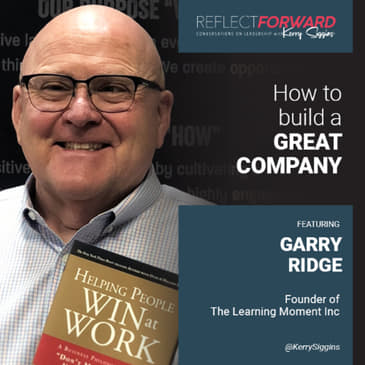

[00:00:10] Hi everyone and welcome back to Reflect Forward. I'm your host Kerry Siggins and I'm so glad you are here today. Today my guest is so much fun. It's Gary Ridge who was the CEO of WD-40 Company for 25 years. He grew into a multinational, multi-billion dollar brand and he's just such a remarkable human being.
[00:00:33] He was named by Inc. Magazine the top 10 most admired CEOs in the world and he has done all kinds of amazing things. And now that he's retired from the WD-40 Company, he fulfills his life purpose by transforming his learnings into teachings, extending his guidance as a coach to companies and executive worldwide.
[00:00:51] He is an author and helped co-author Helping People When at Work with Ken Blanchard who is like the servant leader guru and he has a new book that's coming out in March of 2025 called Any Dumbass Can Do It.
[00:01:03] This interview is so much fun and he is just a pure joy to chat with and I know you're going to love this interview. So hang tight and I'll be right back with Gary.
[00:01:21] All right, everyone. I am back with Gary Ridge. Gary, thank you so much for joining me on the show today. I've been so looking forward to this interview because you and I are like kindred souls.
[00:01:33] Well, thank you, Gary. It's just a delight to be here and thank you for doing what you're doing because you're helping spread the word about something that's really important. So thank you.
[00:01:41] Yeah, transformational leadership, building great cultures, engagement in organizations, helping your employees find purpose at work. It's what makes leading fun.
[00:01:50] Oh, absolutely. I mean, the 95-year-old you that's on your deathbed will not remember the strategic planning meetings, but you'll remember the people you had the opportunity to touch along the way. So that's really important.
[00:02:01] Absolutely. Well, I love the story of your career. So you spent 25 years as the CEO of WD-40, kind of came into this role of running a publicly traded company a little bit, maybe non-traditionally.
[00:02:17] So can you talk a little bit about what that was like? Because there's not a lot of people who spend 25 years as a CEO, especially at a publicly traded company.
[00:02:26] Yeah. Well, I started with WD-40 company in 1987. So I was actually 35 years with the company, 25 years as CEO. And I'm an Aussie, so I started in Australia and I moved to the United States in 1994.
[00:02:40] And in 1997, I was given the opportunity to lead the company. And I think the reason was that I had a dream to take the blue and yellow can with a little red top to the world.
[00:02:50] The brand back then was a brand that was very strong in the US with sprinklings around the world. And there were lots of squeaks around the world and I thought we could take care of them.
[00:03:00] I knew how to make the brand famous. I knew how to identify the potential end users. I knew how to make them aware of the brand. I knew how to build distribution.
[00:03:11] But the key to it all was you need people to do that. So for the first year and a half, I struggled around the fact, how do you build a global organization? And here's a true story.
[00:03:21] I was flying on a Qantas 747. I was 38,000 feet above the South Pacific Ocean, somewhere between Hawaii and Sydney. And as you do when you're on those airplanes, you take stuff to read.
[00:03:35] So I read something from the Dalai Lama and he said, the purpose in life is to make people happy. If you can't make them happy, at least don't hurt them. I thought that's so true.
[00:03:43] And I thought about the number of people that were getting hurt in organizations. Then I read another quote from Aristotle, which is pleasure in the job puts perfection in the work. And I thought, duh, if you really enjoy what you're doing, you're going to do it better.
[00:03:58] And that kind of messed in my head for a while. Then I got back to San Diego and I was reading a article in the local newspaper and it was talking about a master's degree in leadership at the University of San Diego.
[00:04:10] This degree was put together with Ken Blanchard, the one minute manager and his organization and the school. So I went to an information session and I heard Ken Blanchard speak.
[00:04:23] And Ken said, the problem with most MBA programs is they get people in the head. We've got to get it, start getting people in the heart. I thought that is so true.
[00:04:31] So here I was two years in as a public company CEO. And guess what I did? I went back to school. I enrolled in the program and I did a master's degree in leadership. Ken was one of my professors.
[00:04:43] You know, he is the guru of servant leadership. So I took his learning and all the other learning. And then I started to play with it at the company.
[00:04:50] And what worked, we turned up the volume on and what didn't work, we didn't turn the volume up too much. And slowly but surely, we built this amazing culture where people absolutely knew they belong.
[00:05:03] They knew they mattered. They could make choices and they would go home happy. So my journey was about learning. Now, Ken Blanchard often says, I say the three people that influenced me were with Adela Lama, Aristotle and Ken Blanchard.
[00:05:16] And he said, well, you didn't put me in bad company, did you?
[00:05:18] Oh, I love that. And was this kind of people focused approach always part of your leadership style in the early days as you were building your career?
[00:05:28] Probably, but I was doing it wrong. I wasn't aware of the leadership behavior that was toxic. It just seemed normal. For example, I love Marshall Goldsmith's work. Was I a good listener? Did I add too much value? Was I trying to be a micromanager?
[00:05:43] These were the things that I probably weren't aware of. And once you become aware of them, then you can change. I always loved the interaction with people. But in my first class at USD, we did a disc profile. And I was a Turbo D. You know what a Turbo D is?
[00:06:04] Be brief, be bright and be gone. And I had to change that. I used to introduce myself like this later in my career. G'day, I'm Gary Ridge. I'm the consciously incompetent, probably wrong and roughly right chairman and CEO of WD-40 company. And I need all the help I can get. And that was so true. I went from a Turbo D to an I and that was deliberate.
[00:06:27] Well, I think that your humility probably came through as you were growing WD-40 and you obviously did some amazing things. What is your approach to being a humble leader? And how did you help executives on your team develop more humility? I know that you coached some CEOs. How do you weave that into your work now?
[00:06:48] Well, you know, I think probably three of the most valuable words I ever learned were, I don't know. And getting comfortable with that. Unfortunately, with a lot of leaders, their ego eats their empathy instead of their empathy eating their ego. They think it's all about me, me, me. And it's not about all about me, me, me.
[00:07:08] So I think you've got to come to that kind of pivot point where you realize that your job as a leader is to help those you have the privilege to lead do their best work. And if you do do that, then the whole team wins. So I think it's an awareness thing. And just being a human being, if you think about, we changed the word manager to coach in the company because we said words matter.
[00:07:37] And if you think about, and if you think about a great coach, Kerry, a great coach, number one, understands what it takes to win the game. So they know the game. They spend a lot of time on the sideline observing the play. They will run on the field to help direct the player to play better, but they never take the ball away. They never go to the podium and pick up the prize. And here's the secret. They spend a lot of time in the stinky locker room because it's the stinky
[00:08:07] locker room where you really get to understand the people that you have the privilege to lead. And a lot of ego-driven leaders don't do that. You know, I used to say, we've got to get our shoes dirty. We've got to talk to our people. We've got to listen to our people. They have the answers. We don't have the answers. So I think it's really spent a lot of time in this stinky locker room.
[00:08:27] I like that. I think that a lot of, at least in my experience of maturing as a leader myself and helping dozens and dozens of other leaders grow as well. I think that a lot of times people don't understand the value in letting and helping people get there on their own.
[00:08:44] And so it's like, we got to get there fast. So it's just easier for me to tell people, this is what you should do, do their thinking for them, or, you know, tell them what the answer is so that they get there faster. But they miss out on such a valuable lesson on how to formulate their own thoughts and opinions and to gain confidence in their decision-making that if we don't act as coaches and we come in and just tell, we're really depriving people of that ability to grow themselves.
[00:09:12] And I think that that's really eye-opening when leaders get that. Yeah, it might be more efficient just to tell someone what to do, but you are not doing your number one job as a leader. And that is helping them grow and develop to be a great leader themselves.
[00:09:26] Well, you're not getting the multiplier effect. Those are the leaders who tell you they're burnt out and don't have any work-life balance because they're wanting to do it all themselves. I'm a lazy guy. I don't want to do it all. I want someone else to help me along the way.
[00:09:38] If you think about the two things that are very dominant in success in an organization, it's number one, it's strategy. Do you have a clearly thought out, well-defined, easily understood and communicated strategy? Where do we want to go and how do we want to get there?
[00:09:53] Now you can have the best strategy in the world, but if only 20% of your people come to work every day and are dedicated to, enthusiastic about, and wanting to execute against that strategy.
[00:10:05] Let's say your strategy was marked at 70 out of 100, 20 times 70 is 1400.
[00:10:10] But if 80% of your people are in that positive, but eight times 70 is 5,600.
[00:10:16] Our job is to help those we have the privilege to lead play their best game.
[00:10:21] Now that's not easy because you've got to bite your tongue sometimes, be a little more patient and all of the things that go with it.
[00:10:29] But at the end of the day, it's the way to go.
[00:10:32] At WD40 Company, we had 98% of our people said they'd love to tell people they worked at the company.
[00:10:38] We had a 93% employee engagement and 97% of them said they respect their coach.
[00:10:44] Now the coach is the boss or their boss.
[00:10:47] And when we asked them, why do you respect your coach?
[00:10:49] Well, this coach is here to help me win.
[00:10:51] That's amazing.
[00:10:52] So tell us some of your secret sauce because most companies would kill to have engagement like that, but they don't necessarily do what it takes to create that kind of engagement.
[00:11:02] So what are some of the things that you did to build this highly engaged culture?
[00:11:07] As I said earlier, there are three things that people want.
[00:11:11] Number one, they want to know and feel like they belong.
[00:11:15] So everybody who is listening to us or watching us today has either left a party, an event, a company, or even a relationship because they didn't feel like they belong.
[00:11:27] So what are you doing to show people they belong?
[00:11:29] Are you sincerely showing you care for them?
[00:11:32] Number two, they want to know they matter.
[00:11:34] So what are you doing to show they matter?
[00:11:36] Well, to matter, you have to have clearly defined goals.
[00:11:40] You have to have clearly defined outcomes and you have to reward and applaud them for doing great work.
[00:11:47] And then they want to make choices.
[00:11:49] So in making choices, the question is, do you have a clearly defined set of values that protect people and set them free?
[00:11:58] Because that's really what's so important.
[00:12:00] So those are some of the ingredients that you've got to think about.
[00:12:03] Do you have a purpose?
[00:12:05] Do you have values?
[00:12:06] Do people feel like they belong?
[00:12:08] Do they know they matter?
[00:12:09] And finally, have you taken fear out of the organization?
[00:12:13] And the way we did that is we took the word failure out.
[00:12:15] We said, we don't make mistakes.
[00:12:17] We have learning moments.
[00:12:19] And a learning moment is a positive or negative outcome of any situation that has to be openly and freely shared to benefit all people.
[00:12:27] You don't hear people running down corridors of companies yelling out with glee, I'm a failure.
[00:12:33] But if you can have people that are brave enough and comfortable enough, and there's enough psychological safety to say, I had a learning moment.
[00:12:42] This is what we were trying to achieve.
[00:12:44] We didn't.
[00:12:45] And here's why.
[00:12:46] This is what we learned.
[00:12:47] Let's share that.
[00:12:48] Or I had a learning moment.
[00:12:49] This is what we wanted to achieve.
[00:12:51] We excelled at that.
[00:12:52] Here's how we did it.
[00:12:54] We need to share it with everybody.
[00:12:55] So how do you create that psychological safety within an organization?
[00:12:59] I totally agree.
[00:13:00] We do learn so much from those learning moments when the outcome isn't what we expected or we just flat out made a wrong decision.
[00:13:09] Nobody ever says, oh, I learned so much from that because I did everything right.
[00:13:13] Now our learning moments come from those missteps that we make, assumptions that are wrong and poor decisions or good decisions that just didn't have the outcome that you were hoping for.
[00:13:23] So I agree.
[00:13:24] I had a lot of learning moments in my life, as we all have.
[00:13:29] And I'm so grateful for every single one of them because they've made me the person I am today, the leader I am today.
[00:13:36] It's not all the successes.
[00:13:37] It's every single time I screwed up and had to pick myself up and figure out how to bounce forward from that.
[00:13:44] Absolutely.
[00:13:44] You know, when I was at high school back in Australia many years ago, in fact, I'm going to my 50 year high school anniversary in Sydney in November.
[00:13:53] My science teacher gave me a Petri dish and that science teacher said, what we're going to do is we're going to grow culture in this Petri dish.
[00:14:00] And there are, there's some things you need to know about that.
[00:14:03] Number one is what are the ingredients that you need to put in the Petri dish to grow great culture?
[00:14:08] And secondly, you as the owner of this Petri dish now, you have to ensure that you feed the good ingredients and you attack the toxins because toxins will get in.
[00:14:19] So if people are out there thinking about what's the ingredients for their Petri dish, I can give you some examples.
[00:14:26] First, you have to have a people first mindset, your coaches, not managers.
[00:14:30] You have to have brave accountability and brave behavior.
[00:14:33] You have to have a clearly defined and authentic purpose, a hierarchical set of values.
[00:14:38] You have to have transparency in a simple vision.
[00:14:41] You have to have learning moments that reduce fear.
[00:14:44] You have to have belonging, acceptance and connectedness.
[00:14:47] And finally, you have to care about your people.
[00:14:49] You have to be candid with your people.
[00:14:52] You have to hold them accountable and you have to let them take responsibility.
[00:14:56] And you have to do it every, every, every day because if you don't, the toxins will get in the Petri dish and the culture will be sour.
[00:15:05] Yep, absolutely.
[00:15:06] And it's one toxic performer, even if that's a high performer, can really do so much damage.
[00:15:13] And I think that a lot of leaders are maybe afraid to get rid of some of those toxic high performers because they can produce results.
[00:15:20] But what are they doing to the culture when you allow those behaviors to exist?
[00:15:26] So how did you handle those toxic high performers in your organization?
[00:15:30] I shared them with a competitor.
[00:15:33] Yeah, that's it.
[00:15:34] I mean, there's no tolerance for that.
[00:15:36] If you've got someone who's a high performer, that's really not living the values of the organization or is allowed to behave in ways that are outside of our norm.
[00:15:46] Then everybody will say, well, people don't care about anything else here.
[00:15:50] If I can be an absolute a-hole and I'm going to be forgiven because it's all about results.
[00:15:55] So you don't build an enduring company over time.
[00:15:59] I invented someone.
[00:16:00] I don't know if I've introduced you to the person I invented.
[00:16:04] This is Al, Alec or Alice, the soul-sucking CEO of Fear Inc.
[00:16:12] And let me tell you with their character.
[00:16:14] Number one is they have a big ego and little empathy.
[00:16:18] They're a micromanager.
[00:16:19] They think they're corporate royalty.
[00:16:21] They love and want a fear-based culture.
[00:16:24] They're a master of control.
[00:16:26] They're a know-it-all.
[00:16:27] They have all the answers, even the wrong ones.
[00:16:29] They don't like the learning moments.
[00:16:31] They must always be right.
[00:16:33] They hate feedback, and they do not keep their commitments.
[00:16:37] So I'm sure we've all met an Alec or an Alice somewhere.
[00:16:43] So this is the soul-sucking CEO.
[00:16:48] Oh, I love that.
[00:16:50] It's such a good visual.
[00:16:51] And it's so interesting, especially even in these days where finally culture is, you know,
[00:16:57] you and I have been doing this for a really long time, but so many people kind of just
[00:17:01] poo-pooed culture, right?
[00:17:02] It's all about financial performance and innovation, which are obviously very important.
[00:17:06] But culture got pushed to the wayside.
[00:17:08] But so many leaders are Alecs and Alice's.
[00:17:12] And when is it going to change?
[00:17:13] I mean, hopefully we're getting enough momentum where people are realizing that we have to create
[00:17:17] great places to work if we want to be able to attract and retain the talent we need to
[00:17:22] be able to grow.
[00:17:22] If you want to have enviable performance in your organization, it's the will of the people times the
[00:17:29] strategy.
[00:17:30] Now, most people spend all their time on this strategy type, but what about the will of the
[00:17:35] people?
[00:17:36] And if you look at the opposite to Alec or Alice, you know, the great servant leader involves and
[00:17:42] loves their people.
[00:17:43] They're always in servant leadership mode.
[00:17:46] They're expected to be competent.
[00:17:48] They're forever learners.
[00:17:49] They're connected with high emotional intelligence.
[00:17:52] They love learning moments.
[00:17:53] They have a harder goal, but they have a backbone of steel as well.
[00:17:57] They're champions of hope.
[00:17:58] They know micromanagement is absolutely not scalable.
[00:18:02] They do what they say they're going to do, and they treasure the gift of feedback.
[00:18:06] That's the leader that's going to build an organization that has a highly engaged workforce who go to
[00:18:13] work every day and they make a contribution to something bigger than themselves, learning something
[00:18:18] new, being protected and set free by a compelling set of values and going home happy.
[00:18:23] And you know why that's important?
[00:18:24] Happy people build happy families.
[00:18:27] Happy families build happy communities.
[00:18:29] Happy communities build a happy world.
[00:18:31] And by golly, no one can argue with me that we don't need a little bit of a happier world
[00:18:36] right now.
[00:18:37] And business has a responsibility and the opportunity to make a positive difference in the world and
[00:18:43] be a high performer if they just think about their people.
[00:18:46] I totally agree with you.
[00:18:48] In fact, like that's on the first page of my book.
[00:18:51] It's this responsibility that we have.
[00:18:53] I mean, humans are meant to work.
[00:18:55] And when we can find purpose in and meaning our work, that is when we shine, when we know
[00:19:00] I'm doing what I'm supposed to be doing.
[00:19:02] And so if businesses can be able to help people find that, I mean, it's a personal thing.
[00:19:07] We all have to find it ourselves.
[00:19:08] But our companies can create environments in which people can flourish and find that
[00:19:14] purpose and meaning.
[00:19:15] It has such a profound ripple effect.
[00:19:18] And I personally think that's the biggest responsibility that we have as leaders is how
[00:19:23] do we create that?
[00:19:24] It's not about creating shareholder value.
[00:19:26] And, you know, I mean, obviously it's important.
[00:19:27] You have to grow your business and be profitable to sustain.
[00:19:30] But you're going to do that so much more effectively and efficiently and with humanity if you put
[00:19:37] people first and really try to help them build a better life for themselves.
[00:19:42] It will build a better company.
[00:19:43] I mean, you know that.
[00:19:44] I know that.
[00:19:45] Hopefully we can just convince other leaders to do that.
[00:19:47] Yeah, yeah.
[00:19:48] Yeah, yeah.
[00:19:50] One of the words that you mentioned is bravery.
[00:19:53] Being brave.
[00:19:54] Courage.
[00:19:54] I think that is such a leadership trait that is not really talked about as often as it should
[00:20:00] because to build a company, to make bold decisions, to do something different than what's the
[00:20:06] norm or what, especially in your case, you know, what maybe short-term analysts are expecting
[00:20:11] from you, it takes a lot of courage.
[00:20:13] So talk to me a little bit about how you found that courage within yourself and how you inspired
[00:20:19] courage in your employees.
[00:20:21] A really good friend of mine, Ron Carusi, wrote a great book and it's called To Be Honest.
[00:20:26] And I've known Ron for a few years and he has a great statement.
[00:20:31] Unfortunately, a lot of leaders protect their own comfort zone at the expense of other people's
[00:20:36] development because they're not brave enough to have that conversation.
[00:20:39] And that comfort zone is being protected for a couple of reasons.
[00:20:43] Number one is if there's not clarity around what we're holding each other accountable for,
[00:20:48] that redirection conversation actually becomes an argument.
[00:20:52] In the book that I wrote with Ken Blanchard, which is called Helping People Win at Work,
[00:20:56] the byline is, I'm not here to mark your paper, I'm here to help you get an A.
[00:21:00] So the first thing is what does an A look like?
[00:21:02] What do you expect from me and what do I expect from you?
[00:21:05] The second one is we're here to build enduring businesses over time and it's not easy.
[00:21:10] It's simple, but not easy and time is not your friend.
[00:21:13] And you've got to be brave enough to gather the facts and really forgive yourself.
[00:21:20] Marshall Goldsmith says, if you're in a situation and you're questioning what you did,
[00:21:25] ask yourself a couple of questions.
[00:21:27] Did I do what I thought was right?
[00:21:29] Yes.
[00:21:30] Did I do my best?
[00:21:32] Yes.
[00:21:33] Take a deep breath.
[00:21:36] Let it go.
[00:21:37] Instead of trying to second guess ourselves.
[00:21:40] This is hard.
[00:21:41] I mean, leadership is not easy.
[00:21:44] No good deed goes unpunished, Kerry.
[00:21:46] And we know that.
[00:21:48] And it's not a popularity contest.
[00:21:50] You're not going to be popular sometimes.
[00:21:54] But if you're acting within the company values and your values and you're looking at the long haul
[00:21:59] and you're wanting to build something that's going to sustain itself over time, then you have to be brave.
[00:22:06] And I think as you build credibility and that trust, it helps with that.
[00:22:10] I remember years ago, probably about a decade ago, I was making a big shift in our go-to-market strategy
[00:22:17] and not everybody agreed with me.
[00:22:19] But I had built up enough capital and enough trust to say,
[00:22:23] okay, I don't know how this is going to work, but we're going to help or we're going to try to make this happen.
[00:22:26] Last year, one of my employees who's been here for longer than I have been here,
[00:22:31] he's probably been here close to 25 years, told me,
[00:22:34] I really doubted that decision.
[00:22:37] I thought you were crazy for making that decision, but I promised I was going to help you make it successful.
[00:22:42] And look at where we are now.
[00:22:44] You made that right call.
[00:22:46] And it took a lot of courage to be able to do it because you changed everything in our industry.
[00:22:53] And a lot of people just didn't believe that this was the right decision.
[00:22:57] And it 100% was.
[00:22:59] And I so appreciated that because it was really scary back then to make a big, bold move like that,
[00:23:05] that I knew was the right decision to set us up.
[00:23:07] And I knew that not everybody saw that vision because it was just comfortable.
[00:23:12] Like we've done it this way for the last 20 years.
[00:23:14] Why would we change it?
[00:23:15] But it was just such a heartening and inspiring conversation that was such a good reminder on having that courage to make those kinds of decisions
[00:23:25] and to try to bring people along.
[00:23:27] And that even when people are saying, nope, this isn't going to work,
[00:23:30] that you still have to push forward with what you think is the right move for the company.
[00:23:34] And then, you know, to have a decade later somebody come up and say,
[00:23:37] I never told you this, but good job.
[00:23:39] You made the right call.
[00:23:40] Well, and I'm sure that call you made wasn't made on a whim.
[00:23:44] I'm sure that you did your homework.
[00:23:46] You know, that's your responsibility.
[00:23:48] There's a difference between a good idea and a well-thought-out strategy.
[00:23:53] Absolutely.
[00:23:54] And it was a good reminder too.
[00:23:57] You know, that particular instance, we were making significant changes in our go-to-market strategy
[00:24:02] and we didn't want anyone to know until we could announce what was going to happen.
[00:24:06] And so we created like this war room with 20 of us, the executive management team and key people.
[00:24:13] And we did it all in secret.
[00:24:15] And I will never do that again.
[00:24:18] Transparency is one of my core values.
[00:24:20] And when we announced what we were going to do, so many of our employees were like, what?
[00:24:25] You know, what are we doing?
[00:24:26] Why?
[00:24:27] And they knew we were doing this planning, but they didn't realize all of the conversations
[00:24:30] that we were having and all the planning and the thought and the surprise.
[00:24:34] And in one of our culture surveys that came out, a comment was, I feel like I'm a mushroom
[00:24:40] kept in the dark and fed poop.
[00:24:42] And that has stuck with me forever.
[00:24:45] And I'm like, never again, never again.
[00:24:47] I'm going to trust my employees and we're going to talk about it.
[00:24:50] If you think about the stages that you go through and change, the third stage is implementation.
[00:24:56] The first two stages are answering personal concerns and information concerns.
[00:25:02] Because if you answer those two first, then execution is accelerated.
[00:25:07] But if you just come out and you haven't answered those, exactly what you said happens.
[00:25:12] You get churned because people say, well, wait a minute.
[00:25:15] What does that mean to me?
[00:25:16] What don't I know?
[00:25:16] Why don't I know this?
[00:25:17] How's it going to affect me?
[00:25:18] So it takes a little longer.
[00:25:20] Yep.
[00:25:20] That's where they go first.
[00:25:21] Well, it was one of those learning moments.
[00:25:24] And I said, I'm never doing that again.
[00:25:26] I can do it much better next time.
[00:25:29] And I'm really grateful that we went through that.
[00:25:30] And I'm really grateful for that feedback because it just showed me that while we still
[00:25:36] made the right decision, I missed out on that.
[00:25:39] I created that fear because we didn't help people understand what does this mean to me?
[00:25:43] How is this going to impact us?
[00:25:45] Like what happens if this fails?
[00:25:46] Am I going to have a job?
[00:25:48] And I missed that step.
[00:25:50] So yeah, big learning.
[00:25:51] Nice.
[00:25:52] That's good.
[00:25:52] Bank it.
[00:25:53] Bank that one.
[00:25:54] Yeah, right.
[00:25:55] Exactly.
[00:25:56] So another thing that you talked about that I want to dive into here before we wrap up
[00:26:00] is feedback.
[00:26:00] I am a huge believer in feedback.
[00:26:02] We have a culture of feedback.
[00:26:03] We do training around feedback and we give people all kinds of opportunities to do that
[00:26:07] here.
[00:26:08] Feedback is a gift.
[00:26:09] Talk to me a little bit about how your thoughts on feedback evolved as you matured as a leader
[00:26:16] and how did you make it safe for people to give you feedback as a CEO?
[00:26:20] Well, the second one is I shut up.
[00:26:24] Marshall Goldsmith coached me and said, when anybody gives you feedback, you only have to
[00:26:30] say two words.
[00:26:31] Thank you.
[00:26:33] Or let me take that on board and see what I can do with it.
[00:26:36] Because if you're intent about listening to it, there may well be something there.
[00:26:41] You know, my mom lived till she was 99 years and nine months old.
[00:26:45] And I used to fly down to see her in Australia.
[00:26:49] She died, passed away about nine or 10 years ago now.
[00:26:52] She was the greatest giver of unconditional love of anybody.
[00:26:56] And I remember I'd arrive in our family home.
[00:26:59] She was about 95 at that time.
[00:27:01] She'd always have a cup of tea ready when I tell her you don't need it.
[00:27:04] She'd sit down at the kitchen table and then she would start with, now Gary, there's a
[00:27:09] few things we need to talk about.
[00:27:11] And it was like, why didn't you ring your nephew when he won his soccer?
[00:27:15] You know, all the, and she was right.
[00:27:17] Auntie Mari's been in hospital and you didn't send her a card.
[00:27:20] And it's a bit like, all you need to know when your mom's 95 is two words.
[00:27:24] Yes, mom.
[00:27:25] And all you need to know when someone is giving you feedback is thank you.
[00:27:29] And just say to yourself, I'll take that on board and see what I can do with it.
[00:27:33] And it's hard because that little man in their head's going, when someone's giving us feedback
[00:27:41] and it's, well, okay, thank you.
[00:27:44] Well, and that's where the growth happens.
[00:27:46] Because I believe that there's always a way to own something in the feedback.
[00:27:49] Even if it's a misperception, you're not doing a good job of managing those perceptions.
[00:27:54] And so there's always a way to own a piece of it, even if it's just from a relationship
[00:27:59] standpoint.
[00:28:00] Even though sometimes it stings, like a lot of people want to avoid it because they don't
[00:28:04] like that sting.
[00:28:05] We just miss out on an opportunity to really grow if we don't actively seek it out and
[00:28:10] do something about it when we get it.
[00:28:13] And again, I love the statement.
[00:28:15] Let me take that on board and see what I can do with it.
[00:28:17] I remember early times in board meetings, I'd have eight or nine board members giving me
[00:28:22] feedback on eight or nine different things.
[00:28:24] And I'm saying, how can I do all that?
[00:28:25] Each of your pieces of feedback is different.
[00:28:27] And I used to say, well, okay, I'll take it on board and see what I can do with it.
[00:28:31] And I'll either do something with it or I won't.
[00:28:34] It wasn't a directive.
[00:28:35] It was just an opinion.
[00:28:37] Understood.
[00:28:39] And how about on the flip side, giving feedback?
[00:28:41] Has it always been easy for you to give your employees or teammates feedback?
[00:28:47] Did you have to develop that?
[00:28:48] Do you have any stories to share around that?
[00:28:50] You know, it wasn't easy until I realized that if I love them enough, I have a responsibility.
[00:28:57] And that's where that statement around, I didn't want to protect my own comfort zone at
[00:29:03] the expense of someone else's development.
[00:29:05] And, you know, I thought, well, if I love my people, I need to.
[00:29:08] Now, what you need to do is make sure that as you're giving the feedback, it's based on
[00:29:14] something you can point to and you can agree on.
[00:29:18] And most feedback around performance is because we weren't clear about expectations.
[00:29:24] I used to say to people, I just want to walk alongside you.
[00:29:27] You know, if we were walking along together and there was a hole in the road ahead, I just
[00:29:33] want to be touching your elbow.
[00:29:35] I'm not going to let you fall in the hole, but you may need to know that the hole was
[00:29:40] there.
[00:29:41] But as you develop trust with people and if you go with a pure heart and for the right
[00:29:46] reasons, then I think it becomes easier.
[00:29:50] It became easier over time.
[00:29:53] Yeah, I agree.
[00:29:54] I like that when you just have that mindset of like, I care enough about you to give you
[00:29:57] this feedback.
[00:29:58] That's really what it is.
[00:29:59] If you don't, you're depriving them of an opportunity to really grow and develop.
[00:30:04] Okay.
[00:30:05] Last question for you before we talk a little bit about your book and how people can find
[00:30:09] you.
[00:30:09] So the name of this podcast is Reflect Forward.
[00:30:11] What does Reflect Forward mean to you?
[00:30:17] When will be the next time you'll do something for the first time?
[00:30:22] I'd love that.
[00:30:23] Is that for you?
[00:30:24] I just did it.
[00:30:25] I've never been on your podcast before, so I just did it.
[00:30:31] I love it.
[00:30:32] I love it.
[00:30:33] That's such a great mindset.
[00:30:34] Yeah.
[00:30:37] All right.
[00:30:37] So you have a book that is coming out here shortly.
[00:30:41] So can you talk a little bit about what your book is about?
[00:30:44] I know it's called Any Dumbass Can Do It, which is such a fantastic title.
[00:30:47] Yep.
[00:30:48] There it is.
[00:30:49] Tell me about it.
[00:30:50] What inspired you to write it?
[00:30:51] So it's learning moments from an everyday CEO of a multi-billion dollar company.
[00:30:56] And what I wanted to do was write a book as if I was writing personal letters to leaders
[00:31:02] about my experiences.
[00:31:03] And why I call it Any Dumbass Can Do It is I'm a dumbass.
[00:31:07] I am now the dean of dumbassery.
[00:31:09] With a lot of help from other people, we built an amazing organization.
[00:31:13] So I don't want people to be scared that you can't do it.
[00:31:16] You can do it.
[00:31:17] So yeah, it's in the works right now.
[00:31:19] Publishing date is March.
[00:31:21] You can pre-order it.
[00:31:22] If you go to my website, www.thelearningmoment.net, there's a tab that says books and you can
[00:31:29] pre-order it there or follow me on LinkedIn.
[00:31:33] There's information that goes on there.
[00:31:35] I'm just G-A-R-R-Y Gary Ridge on LinkedIn.
[00:31:38] You'll find me.
[00:31:39] But I'm excited about it.
[00:31:41] It's my third book, my last one.
[00:31:43] This is it.
[00:31:44] I'm not doing it again.
[00:31:45] It's really a tough job.
[00:31:46] But I was very fortunate.
[00:31:48] I had a wonderful co-writer named Martha Finney.
[00:31:50] The Forwards by Ken Blanchard, my mentor.
[00:31:55] I'm excited about it coming out.
[00:31:57] But I really want it to be an inspiration for leaders to know that if you're a dumbass,
[00:32:02] that's okay.
[00:32:03] You can build a great culture because I am the dean of dumbassery.
[00:32:07] Well, I don't believe that, but I appreciate your sentiment and where you're coming from.
[00:32:13] I think to do what you did with WD-40 Company was truly remarkable.
[00:32:17] And I can't wait to read the book and learn from you.
[00:32:20] So I'm excited.
[00:32:22] So I'll share your website, the link to your LinkedIn page in the show notes as well.
[00:32:28] And I so appreciate you coming on the show today, Gary.
[00:32:32] This was so much fun.
[00:32:33] I wish you the best of luck with this last book that you're writing.
[00:32:37] And I hope it's super successful.
[00:32:39] Well, thank you.
[00:32:40] And again, thank you for doing what you do because it's not easy to produce these podcasts,
[00:32:45] I know.
[00:32:45] And getting the word out is important.
[00:32:47] So thank you.
[00:32:50] All right, hang tight, everyone.
[00:32:51] I'll be right back.
[00:33:00] All right, everyone.
[00:33:00] I hope you enjoyed that conversation.
[00:33:03] So much fun.
[00:33:04] And be sure to check out Gary's new book.
[00:33:06] When it comes out, you can preorder it.
[00:33:08] Check out the link in the show notes to be able to get to it.
[00:33:11] With that, I will leave you to your day.
[00:33:13] I hope you have a fantastic one.
[00:33:15] And if you like this podcast, please share it with a friend, write a review, subscribe
[00:33:20] to it on your favorite podcast platform or on YouTube.
[00:33:23] It helps get these amazing stories out to the world.
[00:33:26] Take care.
[00:33:27] We'll see you next week.