
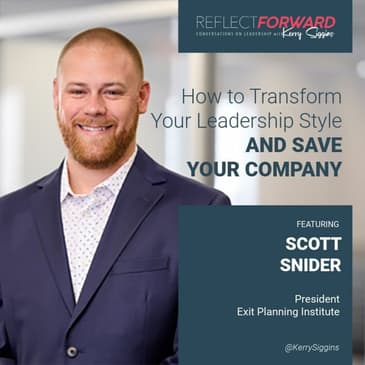

[00:00:00] Hi everyone and welcome back to Reflect Forward. I'm your host Kerry Siggins and I'm so glad you are here today. Today my guest is Scott Snyder. He is the president of the Exit Planning Institute, also called the EPI, where they train, teach, educate, certify, exit planning advisors, which are folks that are working with the
[00:00:28] founders and business owners exit their business successfully. Not just with money, but successfully. Like what do I do with my life after I sell my business? He explains all about what the EPI does and it's so much fun. I had the pleasure of meeting Scott. When I went on his podcast, the exit is now last year. And I'm speaking at the Exit Planning Institute's annual conference down in Marco Island, Florida at the end of this month where I get to talk about
[00:00:58] the Exit Management Institute's first ownership mindset and employee ownership as a great strategy for building culture and for exiting your business. So hang tight and I will be right back with Scott.
[00:01:10] Scott Snyder
[00:01:18] Hi everyone and welcome back. I am with Scott Snyder, who I had the pleasure of getting to know when I went on his podcast, The Exit is Now in 2023 and we hit it off. And so I'm so excited to have you on my show today so that I can return the favor and cover you with all kinds of hard questions.
[00:01:36] Scott Snyder
[00:01:37] Well thanks for having me on. Yeah, we had a blast when you were over in Cleveland with us so I'm excited to hang out on your show. So thanks for having me.
[00:01:44] Scott Snyder
[00:01:45] Absolutely. All right, so you are the president of the Exit Planning Institute. So maybe you could talk to us a little bit about what that is and what your vision is for the organization and then we'll talk a little bit about how you got there after you tell us about it.
[00:01:57] Scott Snyder
[00:01:58] Yeah, sure. Yeah. So the Exit Planning Institute we're an advisor facing organization so we have 15,000 professional advisors across the United States and really across the globe I think we're in about 18 other countries but primarily here in the US.
[00:02:11] The professional advisors come to us or maybe one of maybe five different things that I would say the general theme is education resources tools and a network or a community of like-minded advisors that are helping business owners grow value in their company and eventually position them for a sale whether that's an internal sale or
[00:02:29] or an external sale. So we have about 15,000 across the United States and 5,000 of those advisors are what we call certified Exit Planning advisors or CEPAs. So again looking for content courses, conferences, a community of people that really all focus on helping owners grow something of
[00:02:48] significance while aligning business personal and financial goals. So that's who EPI is today we're founded back in 2005 and been growing really ever since.
[00:02:57] That's awesome. Now I love that you talked about how to build value in the business and I think that you believe that people should be working with CEPAs far before they're thinking about exiting so that they can build that value.
[00:03:10] Can you talk a little bit about the importance of planning that far ahead even if a founder or founder isn't thinking about exiting in the next couple of years?
[00:03:18] Yeah, I think that as business owners overall so I owned my first business I started my first business when I was 16 sold it when I was 24 and then basically took a year of what I always say wandering the earth to figure out what was next to my life.
[00:03:31] And then came into this business with my father who was actually a member of the organization before we were owners.
[00:03:37] And that's a great lesson my first exit planning lesson was that I had a good business so business planning was good at a pretty good financial strap personal financial plan for a young guy, but I really lack personal planning.
[00:03:48] So when I sold my business I quickly realized that I kind of let my business define who I was.
[00:03:53] So if I was always decentralizing my business over that maybe nine or so year period, I would have been focusing on what was next in the next phases of my life.
[00:04:02] And so what we talk about at EPI is the difference between a successful company and a significant one.
[00:04:07] I think many owners if I even asked you Kerry, do you feel proud of what you've done? Do you feel successful in what you've done?
[00:04:14] We have great people, great products, great services, great customers.
[00:04:18] We run a lean business, make good money.
[00:04:21] And I think many business owners are very proud of what they've built very successful companies.
[00:04:26] And then when they go to sell their company again whether internal or external they're kind of slammed across the face for the first time because somebody's in fact called their baby ugly.
[00:04:33] And they're shocked because they're like wait a second I've done everything that the books told me the podcast my business mentors college high school.
[00:04:40] I've done everything I focused on growing this solid company strong P&L and strong balance sheet.
[00:04:45] What do you mean? I don't have value in my company.
[00:04:48] And so that we have this mindset and they go for our business career that teaches us to grow income producing businesses and we don't change that conversation to relate it over to value.
[00:04:57] And if we could go down a whole rabbit hole talking about exit planning but as somebody young like me that's 40 years old who's grown up through value acceleration.
[00:05:06] I can tell you it's really helped me to balance my life overall while decentralizing myself and my business as we all have other passions as well and growing by 54 or 66% each year over the last several years.
[00:05:19] Beyond that I might round that out which is simply saying is that we are human and things do happen right we teach something at EPI called the 5Ds these five destroyers of companies.
[00:05:29] And so although we might have this very successful company if we're not planning for a partner this agreement a sudden death of disability.
[00:05:36] It could really change the way that we're running our companies are in fact kill it 50% of the exits in our country today are due to involuntary exits where the business owners forced outside of their company.
[00:05:47] Whole kind of bunch of information there but nonetheless yeah that very simple answer is I don't care if you're 25 years old just starting your company or seven years old trying to more immediately exit.
[00:05:56] We do things in our company every single day that eventually affect our exit in our valley.
[00:06:01] I love that great thank you for explaining that it's it's such an important thing for for founders to be thinking of for businesses to be thinking of how do I exit out of this and still build a sustainable company.
[00:06:13] How do I build a sustainable company without me.
[00:06:17] Exactly and that's not always to do especially when you're in the nitty gritty of it.
[00:06:21] All right let's talk about what you did before now because you talked about starting your first company when you were 16 and you sold it when you were 24.
[00:06:29] And I was in landscaping right.
[00:06:31] Yeah totally yeah totally opposite of what we do today.
[00:06:34] In the khaki pants and the tucked in polo shirt like planning the tree and mowing lawn and doing stuff like that.
[00:06:40] So yeah we did really full service right so we had the landscape construction and landscape design build and maintenance.
[00:06:47] And then obviously being from the north here in Cleveland Ohio we had snow and ice management as well so really full service nice company matter like 13 employees seven trucks and maybe another 10 seasonal workers that came into the business during our busy times but a really really nice company.
[00:07:01] I actually went to horticulture school and the recession kind of hit and took a dive a little bit so we used to do what we would call high image oriented companies that use their property use their image to sell their product or service a high end like luxury condo
[00:07:16] community nursing assisted living facility we had all the Marriott hotels here in northeast Ohio things of that nature wedding venues stuff like that.
[00:07:25] And so when the recession hit everybody cut their landscaping budgets back and I always laugh because knowing what I know today it's like the one oh one level entrepreneurship course industries you shouldn't get into no barriers to entry no licenses or certifications very price
[00:07:39] sensitive. And I was doing so well that I would just like yeah no wasn't preparing for any kind of recession recession hits we got our budgets cut and we struggled for a little bit not like wildly bad but certainly a struggle to the large national companies that came in were able to do volume type contracts.
[00:07:55] We got an unsolicited offer from a competitor of ours that liked our people our equipment our contracts the way we did things.
[00:08:02] And luckily I dad's a certified exit planning advisor so I knew a little bit more than the next guy about what it takes to exit a company. I remember sitting and asking dad do you think we should take this.
[00:08:11] And he said yeah I think that looks like a pretty good deal so we ended up taking it and transitioned over maybe a six month period of the small micro market company and then as when I entered the next phase of my life was like wandering around Cleveland in the world for a little bit trying to figure out who I wasn't what I wanted to do.
[00:08:26] But nonetheless yeah I went from wearing the khaki pants and the polo shirt with grit under my fingernails to a very soft hand these days and like a polo shirt with this nice fancy pull over.
[00:08:39] So let's talk a little bit about leadership I mean starting your own business when you are 16 not a lot of us really understand grass leadership maybe we're in leadership roles I know that you're an athlete that requires leadership skills.
[00:08:52] Tell us a little bit about what your leadership style was like in those early days and how it's evolved.
[00:08:58] I think we might have talked about this a little bit of my show too because it's such a big transition for me.
[00:09:02] My early mentors were baby boomer business owners or baby boomer leaders and I just think characteristically it's not bad or good it just kind of is through the 80s and 90s there was a certain style of leadership.
[00:09:12] And now into the 2000s 2024 you have this next generation of leaders and they grew up different they want to be led differently.
[00:09:20] I've always was taught to be a sponge just like water is absorbed by a sponge you're absorbing knowledge from your mentor so I was very blessed to always have great mentors along the way.
[00:09:29] And so my leadership style and in a previous kind of life to go way back to Scott in high school at that same time I was starting my company.
[00:09:36] I had dead set on I was going to join the military I wanted to leave the military from ROTC maybe come to US partial or a police officer maybe go into law school thereafter I say that because my style has always been kind of militant
[00:09:49] or what I guess militant would be like I've been my buddies who are in the military always said sky he'd make a really good drill sergeant and that kind of worked in the hierarchy of my landscaping company was owner general manager form in and it was kind of like direct and take orders and it
[00:10:03] really worked well for me we grew fast we had a nice company.
[00:10:06] I wasn't very like empathetic I wasn't very understanding it was very just bark orders make it happen take the guys out to the bar after the end of the shift do it all again the next day right.
[00:10:16] Then when I got into the API particularly fast forward through API a little bit just recently to our pandemic.
[00:10:23] I was still in that kind of militant barking orders culture what was people that are highly educated very holistic minded and now people that are an API I'm like the old guy at 40.
[00:10:35] Most people are 20s and 30 so again totally different generations but younger end of the Gen X and through the millennials want to be led in a very different way inside of our business today and it wasn't till really our pandemic that kind of.
[00:10:48] Talk about getting slapped across the face and a really sat me back in my chair to figure out who we are and who we want to be we literally ripped the plaque of core values off the wall and read did the whole thing during covid because we rediscovered who we were.
[00:11:01] And became a little bit more holistic I always say it's like rainbows and butterflies a little bit for me it's a little soft these days for me but it's really just an intentional and deliberate change what I think I've learned is that growing our business is more about the people than it is at the expensive people.
[00:11:17] And so really took it was a humbling experience going through leadership some leadership training some transformational leadership training type stuff.
[00:11:24] When some new core values up on the wall that we actually lived in kids can show examples by and I'd like to think that I've embraced some of that.
[00:11:32] And I've been able to really think about that kind of gritty and direct that I used to have with a much more like kind of empathetic and holistic way of living which has really helped me to decentralize myself so back in February first time in my entire business career but I took 30 days away from the business.
[00:11:47] I probably really took three weeks of that first week I was still pretty active and then I got deeper and deeper into the hole where I was like oh man I don't really have to do anything because I've my executive leaders have really taken the reins and the average age of the executive leadership
[00:12:00] in here at EPI is probably like 33 years old a pretty young group but it's been a pretty big four years for me in terms of leadership.
[00:12:09] How about feedback if you're the kind of person who barks orders and that drill sergeant it might not always feel safe to give you feedback. Do you feel like you are much more able to accept feedback what is your relationship with feedback and how do you get it
[00:12:24] and make sure that you don't get into drill sergeant mode when you do get something you don't want to hear.
[00:12:28] I think that we're really good at it now so it was pretty interesting during pandemic as we started to change our culture.
[00:12:34] We did our first ever anonymous employee survey where we asked them several questions and then ended up saying look at the end of the day what would you rank our culture from one to six which is our scale that we use in teaching at EPI.
[00:12:45] It's being perfect one being worse and in the sixth scale there's no average so when you feel like I might be average on either three slightly below or slightly above.
[00:12:55] So 2020 our employees rated us a 3.2 so slightly below average as we ended last year we now ranked at a 5.24 and I lead with that because it takes a while to get there and I think feedback really starts with building an environment of trust and respect.
[00:13:12] Once you get that and you get to know people there may be two other things that really stick out to me in terms of accepting and giving feedback one we always say deliver the mail to the right address.
[00:13:23] So if me and you have an issue but I'm over there talking to this other employee John he's not the issue here the issues and then we also have another one that's actually put up on the core values it's number one core value out of the seven that we have.
[00:13:34] And it's called put it on the table.
[00:13:36] We might have just seen this around the holiday time right there's all kinds of awkwardness sometimes around the Thanksgiving or the Easter or the Christmas table because our family has some of drama that would just throw it under the table.
[00:13:46] Yeah we don't really want to talk about it but once you pull it for out from under the table and put it on the table it just opens up your environment to the whole new world.
[00:13:53] Now none of that really works if you don't spend some time getting know somebody and trusting in them.
[00:13:58] But I would say when I look at feedback certainly a two way street I always thought I was very accepting of back but I for my perception wasn't my reality because everybody around me was like I don't want to talk to Scott because he's kind of a tough dude.
[00:14:13] But once you build that and then get around yourself for values is actually quite natural but you have to have trust accelerators to two years for us to surround ourselves with those.
[00:14:23] And once we embrace those out we have a culture of delivering the mail the right address and putting things on the table so the feedback process actually comes quite easy along the way.
[00:14:34] Yeah I love that we call it keep it real here because that's what we all want right I like to put on the table keep it real let's just be real we're all human beings here and we'll just keep it real.
[00:14:42] We're all human beings here and we all benefit from feedback but if you just sweep it under the rug all you get is a lumpy rug and you know what you do you trip over lumpy rugs.
[00:14:51] You're gonna get you're never going to get anything done I always say to the another thing that was a big epiphany I guess for me in this in the same time frame was I was always taught by my mentors is that you leave the personal stuff at the door this is a business there's
[00:15:04] no time for crying there's no time for your personal drama and I guess I just never investigated that or challenged that carry because once you get into it and you as you know with multiple employees like if you're having a bad day at home you're probably having a bad day of work and if you're having a bad day of work
[00:15:18] you're probably bringing that home to your kids your husband your wife and so on and so forth.
[00:15:22] So why not make business personal.
[00:15:24] Why does it have to be left at the door.
[00:15:26] It's culture feedback the culture of putting it on the table these trust accelerators in place if you're going to the trenches with that person every day at work why can't you carry what's going on.
[00:15:35] There's something you want to talk about is there anything I can do for you and if you have this more open culture, you can have that discussion and move things along or at least have a better understanding of what's going on in people's lives.
[00:15:45] Yep totally agree.
[00:15:46] We are our whole selves and that is such a you know 80s and 90s way of managing right leave a personal stuff at the door like it's just yeah it's so cool.
[00:15:56] So, I'm so unfulfilling when you have to pretend to be somebody else at work and you can't be authentic, you know, and having and having a rough time having a having a bad day.
[00:16:06] I'm going through some stuff and it does affect your performance and if you have a leader who can understand that and help you get through it.
[00:16:12] It's just such a much better place to work.
[00:16:14] I could tell you it's quite tiring to because so Gina Whitman is the founder of us worldwide nice first time I saw him speak I saw myself on stage with him it.
[00:16:24] He said my wife threw me a 40th birthday party or 50 I forget what it was but she threw me a big birthday party and it was a surprise.
[00:16:31] I walked into this room and they made me go up on this little stage and say a few words and he said it was the first time in my life that I had everybody in my life all in one room.
[00:16:40] And I looked across the stage at these round tables that everybody was sitting at and I said to myself who am I going to be today because he's about to say a few words on his big 40th birthday party but he looked over here
[00:16:50] he saw his family. He looked over here he saw his employees he looked over here he saw his leadership team he looked over here so as golf buddies you know he looked over here saw his kids friends that are on the baseball team and the music shows and stuff like that
[00:17:02] and he said there's like six or seven groups there and I'm a different person in every single group. So that's what I said to it's just a way better way of living where you could just come into the office that you're going to spend 810 hours at every day
[00:17:15] and just be who you are when you're at the ballgame or when you're at your we're sitting in your basement watching a show or whatever it might be just show up the way who you are.
[00:17:23] And once I learned that that was a big part of my leadership transformation. You kind of get who you get and if I could tell you I was Gino I have had that same exact experience and it is literally mentally exhausting where I'm like OK.
[00:17:35] Personal Scott off I just got home for the NASCAR race and the RV trip. So that guy set aside now I'm frame proper business Scott you know and I was like what an exhausting tax. I wonder my wife is like dude why are you so tired after work.
[00:17:49] I'm like because I had a whole nother game on so not to say that you don't polish yourself up in certain scenarios right. NASCAR Scott is a little less polished than church Scott with his mother but nonetheless you're pretty much getting the same guy.
[00:18:01] I love that. It's so important. I think people want real leaders and part of our issue in the United States is that we put these leaders on a pedestal and they're not real. They're not showing up as their authentic self.
[00:18:16] I do have this persona and it's not real. And so then we're so disappointed when we learn differently or they feel like they have to put this facade on because I can't be who I really am. And I've learned over my 17 years of running Stone Age that people just appreciate a real person.
[00:18:35] I always say like your title just a bunch of letters behind your name like CEO like it's just some letters. I'm a human being and I have a role to play in this company and my job is to play it to the very best of my ability.
[00:18:47] Just like an individual contributor would in any position in the company it's just letters behind the name and that allows you to just connect on the realness of being human and just trying to figure this whole thing out rather than like oh well.
[00:19:01] I'm the CEO so I have to put on this face because otherwise my employees won't respect me. And it just somebody is in today's leadership. It's the opposite right.
[00:19:10] Yeah.
[00:19:11] I think the people in their 20s 30s 40s 50s they see right through that now and they're like oh yeah that's not carry I actually saw carry out of the golf course or I saw her at the NASCAR racer. I saw her at the movies the other day that's not how she really is.
[00:19:22] I think they see right through it now so it's actually kind of hard to hide.
[00:19:25] Yep.
[00:19:26] I think that's great. So how does vulnerability play in that for you right because coming in with that more of that authoritarian command and control like there's not a lot of room for for vulnerability. You know how does that how is that played out for you as you've transformed as a leader.
[00:19:41] I can tell you it's like that what is that kind of basic saying that we always hear get comfortable being uncomfortable. I can tell you that still to this day I think we're again we've embraced this kind of transformational leadership concepts in our core values but it's not to say that it's
[00:19:54] not uncomfortable or easy so I would say that for me maybe it's a little bit you know easier than the next because I'm more of a kind of an open book or certainly more so today than I've ever was but you take my dad right so my dad's
[00:20:07] middle 60s baby boomer a baby boomer business owner baby boomer leader that came out of big corporate and then into the micro market kind of leadership and companies.
[00:20:16] Dad doesn't really like peeling back the layers the onion looking under the sheets he's like this is who I am and this is how I look and I definitely don't want to look weak don't make me look weak so if I'm sick I'm pushing through that I'm coming to the
[00:20:27] office don't tell anybody I think it's difficult but again difficult in the sense of what is the framework that you're operating it within so if you build a culture of trust we have some trust accelerators that we all believe in we have a culture of putting
[00:20:40] it on the table we have a culture of delivering mail to the right address we understand that in order to get the whole company and organization forward we have to open up sometimes and it's not going to be all that easy but it again it goes back
[00:20:52] to what we were just talking about it's very authentic in human but I would say for me that's probably the hardest part I'm actually getting a little weird out even thinking about it because it's like man they're going to really have to know about
[00:21:02] that really like that's so embarrassing but it goes back like I also went carry 13 years of private Catholic school where you were just like premon proper I had the tie on in high school went to all boys school and you're like very premon
[00:21:15] proper so you're always trying to look your best again I think it's just totally different in today's world now that people don't want the best because that's not how life is they rather meet the CEO that says man me and her even though I might be the part time hourly
[00:21:28] employee me and her have the exact same type of issues that's so interesting and then you have this cool connection now imagine you blast that out to 50 people or 100 people across the entire organization but nonetheless being vulnerable is certainly a element or a task
[00:21:43] or a trade that I still work on daily no doubt. I remember when I decided to tell my executive team about my past substance abuse issues and I was overdosing back in 2006 and I carried so much embarrassment and shame around it and some people knew but certainly not at work
[00:22:02] and we were doing a team building session and we were having these vulnerable stories I thought this is the time I need to tell people because it was a massive pivot point in my life and inflection point it changed everything for me in so many ways even though it was the darkest moment of my life
[00:22:16] and so I told them and my heart was racing and like I can't believe I'm doing this it felt so risky but what happened afterwards was amazing because then another person said well I wasn't going to tell this story but since you just shared this I'm going to share
[00:22:33] and so we shared a deep story about a family member and very very personal to him and then it just opened up this deeper vulnerability for everyone and we were so connected and it changed everything about the team and that's when I realized the power of that vulnerability like we think that we're going to be judged and there are certainly people who judge me for my past
[00:22:51] and I understand that but the connection that I built with the people who matter the most in my life because I was finally just honest about it it made such a huge difference and I know that me sharing my story had changed the way people viewed me in a positive way
[00:23:06] I had an employee call me from Las Vegas in trouble he got drugged at a strip club and signed his card over and they took everything and he called me and he was suicidal and I talked him off the ledge literally and got him home and then we put together a plan and it actually wound up being like this crime circle that all of these strip clubs were involved in and he got all of his money back and more because we as part of this like class action suit
[00:23:35] but is because I helped him and he said I didn't know who else to call but I knew that you would understand that yeah like I mean so people are like oh my god that's crazy you know employee calls you is like in trouble but he might not be alive today if he wouldn't have felt safe to call me and know that I could actually help get him home
[00:23:54] and that is worth it all if my story just saved that one person's life because I was vulnerable in my company to tell people then it's worth it
[00:24:02] well it started right I think that's a true trait of a leader right is that it started with you and so when you ask me about vulnerability or even the stuff like put it on the table and having this kind of a culture of feedback if that's the kind of company you want to have it's going to have to start with you
[00:24:16] I remember in 2020 you know 2020 is tough time right because we do in person programming can imagine in your world if you make something and you don't have any trains boats planes cars to get it anywhere you just have a warehouse full of stuff and you have a bunch of people that have bought stuff and you can't get it there
[00:24:31] similar to us in March and April we had maybe 300 people coming to our credentialing program but no way to deliver because we had in person programming we went two months with no revenue but I had looked at my dad and me and dad are basically 5050s 51% out 49% owner
[00:24:46] I said dad I think we need to pony up this cash though because there's something missing here I want to enter into this transformational leadership program that we were debating on going through and I just tell you that story because when we jumped into this
[00:24:59] transformational leadership training it was with 11 of my core people we have almost 35 people now so that's how much we've grown since 2020 but I knew that there was something missing still when we kind of popped out in the summertime of 2020 we entered this
[00:25:14] transformational leadership training and it wasn't anything like any of the traditional trainings that we've gone through it was kind of like therapy where people were getting stuff out and just talking about who they were and some of the issues that they had and by me just talking about what was going on in my life because I also had a really horrible breakup that had gone on for me in 2020 like my world was literally just shaking and I was trying to build back and I just was open with all of my team about that
[00:25:39] and what I realized in my business that helped us change is that all 11 people given this is maybe two months into these sessions that's how we have something to talk to you about the culture was so bad at your business that all 11 of us were looking for jobs
[00:25:54] so think about that information from an owner and leader stamp when I was like holy shit like if 11 people leave my business I don't have a business anymore because just me
[00:26:03] and so we were able to dissect that and I think two people ended up finding something else to do but the nine people that were in that original group are still here today they're the people that you met when we hung out here in Clevo but think about that you know being vulnerable being open
[00:26:16] and a culture of feedback a culture of personal and professional growth literally it's changed who we are as a company just like it it changed that guy's life in your story
[00:26:27] that's a tough thing to hear everybody in your company wants to leave and you met so much like those original nine and some of those are like my close personal friends like Josh is in charge of our strategic relations I was the best man in his wedding
[00:26:40] I've known Jocelyn and Paige are two other directors for nearly 15 years and I see them outside of work you can imagine how awkward and tough that was for them to tell me I think I just finished up that conversation and took a seat back and then
[00:26:55] I have my dad's relatively decentralized from the business so I had to get off that call and go over to dad and say dad we got a real serious issue. So first thank God that we spent the 200 grand taking our team through this professional development when we had no revenue
[00:27:08] we had no revenue coming in but a bunch of expenses to pay we're like let's spend another 200 grand and go through this program and that was immediately that's when it was like okay the next session that we had
[00:27:21] and I think some meetings leading up to the next formal session we said let's dissect that guy's like I love those they're like my friends how is it this bad and they were like well it's this it's this it's this it's that militant parking orders
[00:27:31] you leave work not happy and then I go home and my husband or my wife are like dude what's your problem and like my job is stocks and they're like well just quit and they're like I can't quit we do have a good overall thing going
[00:27:44] and I love Scott you know I would say out of the nine that stayed five of them were close personal friends it's kind of weird how the universe works sometimes because without their personal relationship they probably would have just left
[00:27:54] but because we knew each other outside they stuck around a little bit longer maybe than they should but thank God and then they tugged along the other four because they're like Scott's a good guy he's just lost right now
[00:28:04] but again going back to a vulnerable culture of feedback that was the catalyst for us it's like where the value is down and that was it when I was like okay clearly an issue here I got to investigate myself first and so I did
[00:28:18] that's awesome thanks for sharing that you know I just read a article I think it was in fast company and people are getting divorced at unprecedented rates this was focused on Gen Xers but I still really know plenty of millennials who are going through divorces and a big cause of it is workplace stress
[00:28:33] and our leadership styles it has such a ripple effect it's like man if I'm creating an environment where people are so stressed that they are getting divorced because it's ruining their relationships at home
[00:28:45] right you know and no way that I want to build that kind of company anyway I just found it really fascinating and I believe leaders need to take responsibility for that what kind of culture are you creating
[00:28:55] yeah I totally agree as we've grown from those 11 employees to our 35th employee and we're growing to 54 employees I have learned as a leader how much people replicate and model your behavior more so than ever before and so yeah you see it so I think for many leaders you got to keep that top of mind
[00:29:13] particularly if you do have the younger end of the millennials working for you to that might just be a year or two into their careers they will start to model the culture that you have whether for good or for bad so no as a person that has been divorced and now remarried as a person that has been there
[00:29:29] I certainly don't want to be a culture of that like what a horrible thing right like what a horrible horrible thing.
[00:29:37] I'm with you. All right one last question before we wrap things up here you have a really young executive leadership team right the average is 30.
[00:29:45] 33 or 33 you know I feel old guys like you yeah right and and obviously some people who are younger than that and you know there's such a that stigma I think every older generation always says all this younger generation that you know and some of those things might be true
[00:29:59] and a lot of it's just painting people with broad brushstrokes of stereotypes but I am curious because I know this question had to come up of like what is it like to have such a young leadership team and do you buy into any of those stereotypes that that millennials and that Gen Zers are really getting
[00:30:17] to have such a young leadership team. I can tell you for me it's certainly challenging right I think that because again I went to horticultural school and dropped out so I don't even have a college degree so the people that surround me on our exact particularly our executive leadership team.
[00:30:29] I'm like always challenged like coming up today at two o'clock we'll have our two hour executive leadership meeting where we'll solve problems and do all that and I'm always kind of like loading backwards in the corner like wow like what a stimulating conversation I'm like making tons of notes and everything.
[00:30:44] So it's been really cool to see the different versions. So I don't buy by into the stereotypes but I do like understanding generation if you look at research not just stereotypes or actual research generations have general characteristics so for example you take my dad who certainly a boomer.
[00:31:00] Maybe a couple of things that stand out for me and dad that are leadership team very young folks shouldn't just give them crap about they should just understand them in the way he thinks.
[00:31:09] So dad at 66 years old. He is the inventor of the 60 hour workweek they believe in rolling up the sleeves and making it happen. He's the guy that's like dude I'm sick as hell but I'm still coming into the office to make it happen.
[00:31:20] And he's very proud about that because his core value in life generally is success. So whether that's his business his marriage his faith his golf game he wants to feel success within it.
[00:31:31] So those are two critical characteristics to know when you're working with a boomer. Now if you go down into the Gen X call it 44 years old to 59 years old.
[00:31:39] These people believe in a work life balance. They want to work smarter not harder typically through use of technology they value their time. So if I'm trying to take a person that's 44 or 50 likely.
[00:31:50] I'm saying hey man you got a crank 60 hours a week. I can't believe you're taking so much time off. That's going to totally rock their world because we're like wait a second.
[00:31:58] I can get my job done in 35 hours and I like to blend and balance because they got little kids home so knowing that and then millennials I would say two things and maybe one in terms of leadership that certainly stands out is they are very ambitious.
[00:32:11] I think super entrepreneur maybe has entrepreneur or more entrepreneur than the baby boomers but they are not very focused. So you'll get people like me frankly and are like visionary so I got all kinds of friggin ideas and they're never framed and they're like well Scott how do I put it together so just knowing that
[00:32:26] then those are facts they're not pure for every single person but I'm sure in those age groups those generations. They have some type of what their generation kind of stands for means characteristically.
[00:32:39] So for me I was just having this debate with my 80 year old uncle yesterday over some glasses of wine and because at our company we have unlimited vacation.
[00:32:48] So my uncle who works in a factory since he was 18 is 67 and my other uncle who's 80 they're like this is fricking crazy young people don't even want to work anymore.
[00:32:57] And I'm like hey man I would challenge you to give me 30 days each of us do a similar job I could probably do a quicker faster and higher quality and get it done in half the time you don't need 60 hours and what's your life like outside he's 80.
[00:33:10] He's my great uncle my great and has passed away he's trying to figure out what to do in life. So think about that he's eight years old and he's like who am I outside of my job. What a shame to realize it when you're 80.
[00:33:21] Anyways my point being is I don't think it's bad or good that was my point to my family and this debate yesterday over glass of wine I said look I think that you just look around the table and say look these people in their 20s and 30s probably have some characteristics that are like them and then value some things.
[00:33:35] These people in their 30s and 40s different and these people in their 50s and 60s different. So knowing all of that how can we work better together as a team because those are just facts to embrace those things not good or bad it just is I don't care that my dad had been at the 60 hour work week.
[00:33:48] It's just that's how he thinks so let's kind of combine it together so I don't know if I don't necessarily believe in deep stereotype but I do believe in facts and research and I'm saying how do we use that to blend a culture but so that's my for me when I get into one of these big leadership
[00:34:02] means no doubt. I love it. I love it. I love it. Thanks for sharing those stories. Thanks. Awesome. Okay so last question and then we'll ask how people can find you the name of this podcast is reflect forward what does reflect forward mean to you.
[00:34:17] Yeah I always like that podcast name to me I guess in my own way we call it purposeful growth for me and it's like very similar for that. I think that it became one of those seven core values. And so I think that for whether it be personal or professional we should always be reflecting
[00:34:33] building evolving and growing in both ways again personal and professional so when I think about reflect forward. I think about slowing down to speed up and I think about making a deliberate and intentional effort to better yourself and better your business. That's right.
[00:34:47] Thank you. Yeah. All right how can people find you.
[00:34:50] Sure the easiest way and maybe two ways so just go to earn seba.com so that's earn and then see but is CEPA stands for certified exit planning advisor so earn seba.com that'll take you to the website you can poke your spoke around over there or just go to LinkedIn type in Scott Snyder and I try to share kind of the stuff that we're talking
[00:35:08] about I talk about authentic which kind of share different stories and laid it back to my journey as a business owner and exit play so just like a Scott Snyder on LinkedIn you can find me there.
[00:35:17] Awesome and I'll include all that in the show notes. Awesome. Thanks. Well it has been so awesome to spend this last half an hour with you and I can't wait to see you at the end of the month when I'm down there speaking and yeah do an author showcase and panels and all kinds of fun stuff with you
[00:35:32] off who knew that you would be hanging out and I'd meet you very briefly like that and then we'd like I'm like to carry wants to hang out for three days and Mark Wilde I'm a bringer down there for sure you're gonna love it it's a great crowd hopefully
[00:35:44] don't get away as a non advisor they will love your story so I love it well I can't wait I'm so excited it made sense since I've got to be in Tampa for the NCEO conference and board meeting so it was like flying to Florida from Durango Colorado is not an easy thing
[00:36:00] to do and so it's like going back and forth now I'll just hang out with you guys. Well thank you I appreciate that thanks for having me on your show. Thanks. All right. Hang tight everybody I'll be right back.
[00:36:10] All right everyone I hope you enjoyed that interview with Scott he's so much fun and I just see so many synergies between what he's doing at the exit planning institute and what we're doing at the commission for employee ownership here in Colorado
[00:36:32] and I just recently joined the board of the National Center for Employee Ownership the NCEO and I just think it makes sense to be working with certified exit planning advisors on how to advise founders and business owners looking to exit
[00:36:48] own employee ownership because it is such a great way to transfer your company to the people who are building value in it employees and really start to address the issue that we have with the ever increasing wealth gap here in the United States
[00:37:04] and employee ownership is a great way to build a great company and to help transfer some of that wealth to the middle class to the people who are building companies. I look forward to a lot more collaboration with Scott as we are doing things in our respective organizations.
[00:37:20] All right with that I will leave you to your day if you like this podcast please write a review share it with a friend subscribe to it on your favorite podcast platform or on my YouTube channel it always helps with the algorithms that it gets these great interviews out there to the world and don't forget to pick up a copy of my book the ownership mindset
[00:37:38] you can find it on my website carry sick and calm or just go to Amazon and type in ownership mindset and you will be able to find it there it's on audible Kindle and in hardback.
[00:37:49] All right take care we'll see you next week.