
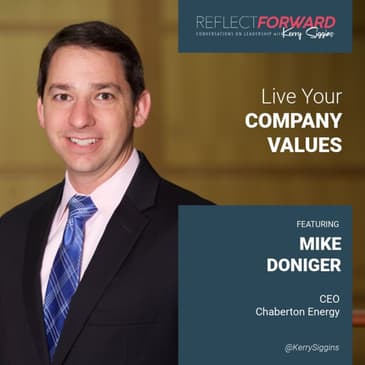

[00:00:00] Hi everyone and welcome back to Reflect Forward. I'm your host Kerry Siggins. I'm so glad you're here today. Today my guest is Mike Doniger. He is the Chief Operating Officer of Chaberton Energy, which is a community solar company, which he tells us all about really, really cool stuff. He and his partner started it in 2020 and he shares how they've grown. I also really love how he shares how he drew upon his experience of being in the Navy and working on submarines. And
[00:00:37] needing to hone in that ability to deal with things that are thrown at you that you've never dealt with before and how that translates into leading a startup. We talk about values and the organization and how important it is to live and breathe them. It's just an awesome story. And I'm super, super excited for them. I cannot wait to see what they do. They've grown exponentially over the last four years and I think they're going to continue to skyrocket in the renewable energy space. So hang tight and I'll be right back with Mike.
[00:01:13] Hi everyone. I am back with Mike Doniger. Mike, thank you so much for joining me on the show today. Absolutely. Pleasure to be here, Kerry. Awesome. So I am so excited to dive into your background and your history. So why don't you tell us a little bit about yourself and what you do? You know, maybe like in a minute or less.
[00:01:33] Minute or less. Sure thing. Well, I began my career in the Navy as a submarine officer that was in the Navy for about nine years and then have been really in renewable energy since then. I first started on the biomass side, which is a little bit lesser known and have migrated now towards solar where I'm at Chapperton Energy, one of the co-founders. And we focus on kind of a niche aspect of solar called community solar.
[00:01:59] So tell me a little bit about your leadership style. We have conversations on leadership and I know you said that you learned a lot about leadership with being in the military. So can you tell us a little bit about how you view leadership and what your leadership style is?
[00:02:13] Absolutely. Yeah, I think this is one of the really great things about your podcast. You're like focusing in on packing leaders in different situations and industries. So thanks for having me here today.
[00:02:25] So as you can imagine, being in the military is a very interesting experience. Very different than being in a large company. I've also worked in Amazon and then also in startups, which I've had a couple of experiences with as well. And I've really had the pleasure of an honor of serving with lots of great leaders and picking up various different things from each of them over the years.
[00:02:48] One thing that I think is kind of interesting and some folks may not even realize, but I look back on the submarine force and carrying forward some of those skills of having to be in kind of a higher pressure environment when you're out at sea and really having to figure out how things are going to be done with just the resources you have.
[00:03:07] Which, by the way, is very transferable towards leading in a startup as an entrepreneur and where you have very limited resources and trying to accomplish something really big and putting those building blocks in place to really ramp things up. You know, I've really gained an appreciation for understanding the folks that you bring onto your team, where they're coming from, how to build that team in a way that's very intentional and engage employees in ensuring that they're doing what they need to do.
[00:03:37] Everyone feels valued and participating in something that's bigger is something that I think is a really important piece of my leadership style.
[00:03:45] So I think that's really interesting because a lot of people have no idea what it's like to be on a submarine and how you might be faced with challenges and things that you've never done before. And that makes a lot of sense, you know, going into a startup, founding a brand new company.
[00:04:00] And so maybe you could talk a little bit about how you pull from the pressure that you have felt and not always knowing what you need to do, but just knowing that you needed to rise to the occasion to get it done and how that has translated into starting up your own company.
[00:04:13] Absolutely. And I think that your question really leads me towards one of our core values at Chaverton, which is the creativity piece.
[00:04:22] And one of the things that we look for in our employees and really drive intentionally through our culture is looking for folks who can really lean into creativity, think innovation, thinking outside the box, finding ways to understand what challenges are in front of us and then change those into opportunities.
[00:04:39] And I think that is a skill set that some people come naturally and some people can learn. And so when you think about whether it was back in the submarine force or here as an entrepreneur, there are always things that come up in their various situations that you didn't expect.
[00:04:54] You get that phone call or a realization that something happens. How can you take a step back and lean on both your experience, but then also the experiences of the folks around you to think creatively and leverage their shared experiences to really maybe find a different route around or sort of change the game you were trying to play at the beginning to really achieve what you're trying to achieve, but taking into account that hurdle that comes your way.
[00:05:20] Yeah, I mean, we're talking a lot about the need to pivot and that does happen so often in startups or any kind of high pressure situation. So have you had to pivot a lot within your leadership or within Chaverton?
[00:05:33] Oh, all the time.
[00:05:35] So, you know, as solar developers, we start from imagining something from nothing.
[00:05:41] So really the way I think about it, creativity from this really base form, you know, going up there and finding a piece of land, whether that's a pretty green field or a brown field and imagining what could be and then charting the path to get there.
[00:05:57] And a lot of times your initial thesis is not accurate. It's not fully formed, it's not fully baked.
[00:06:03] And so as you go along, you're going to find out things that you didn't realize.
[00:06:08] And so we go through that in a bit of a structured way.
[00:06:11] We try to help folks.
[00:06:12] We have what we call the one Chaverton sort of way of doing things.
[00:06:16] So we provide some structure.
[00:06:18] But what we realize is no project is actually going to follow all those steps that we've outlined exactly as we've outlined.
[00:06:25] But at least by having the path drawn, we know what normal or ideal might look like.
[00:06:33] Then we can manage those exceptions.
[00:06:35] And I think that's enabling our employees to think outside the box because they're not reinventing the wheel each time on everything across the project, but rather being able to focus their energies, their creative energy on the pieces that really matter most and kind of pressing autopilot on other
[00:06:51] pieces that are not as critical for that particular project.
[00:06:54] I love that.
[00:06:55] I want to talk about the other core values that you have too.
[00:06:57] Absolutely.
[00:06:58] I'm a big values person, but just to give some context a little bit about what Chaverton does and the types of projects that you're working on.
[00:07:04] Can you give us a little bit of context about how you work with your clients and what these projects might entail?
[00:07:11] Absolutely.
[00:07:11] So let me start from what is community solar because everyone understands solar from the aspect of putting panels on your roof at your house or perhaps the very, very large projects that you might drive past
[00:07:23] that are in the hundreds or a thousand acres, which we would call utility scale solar.
[00:07:28] Chaverton focuses on smaller niche part of solar, which is called community solar.
[00:07:33] And it's really designed to provide access for those who cannot afford to participate in the solar evolution on their own.
[00:07:42] So maybe you don't have enough money to put solar panels on your roof.
[00:07:46] Maybe you're renting, maybe you're in a multifamily unit, or you've just got these amazing trees on your property that shade your roof.
[00:07:53] And so many reasons why people can access it.
[00:07:55] But in some ways, I think of the community solar as the most altruistic version of solar because it's really there to help those who need it most.
[00:08:03] Right.
[00:08:03] Lower income families, renters, et cetera, small businesses as well, allow people forget about that.
[00:08:09] So keeping Main Street alive and well is another piece of the community solar aspect.
[00:08:14] And we build projects on the ground, but they're normally around 20 or 30 acres.
[00:08:19] Could be a little smaller, could be a little bit bigger.
[00:08:21] But they're ground mounted projects, generally speaking.
[00:08:24] We also put them on roofs of warehouses as well.
[00:08:27] And then people can subscribe in so no money down and they get a discount off their monthly rate because we can build it cheaper than you can build it on someone's roof or at the small scale or even at the large scale.
[00:08:39] So it's really a great way to access solar.
[00:08:43] I do have to say it's not available in every state.
[00:08:45] So some of your listeners, I'm sorry, but maybe we can lobby your representatives to bring it to more states.
[00:08:51] Only about half the states in the country have implemented community solar programs.
[00:08:55] So maybe just delving into then as you said, what do we do?
[00:09:00] Chaberton is a developer.
[00:09:02] You can think of it as a real estate developer, but instead of placing homes, building neighborhoods, we're building community solar projects, these small kind of community oriented projects that can be placed
[00:09:15] in a community, in a location that isn't being used for other ways and provide folks the opportunity to access solar.
[00:09:23] So we are first looking at the grid, working with the local utilities to understand where they can use generation on their grid at this smaller scale.
[00:09:34] And then we're working with communities.
[00:09:36] We're out there engaging with landowners, with business owners.
[00:09:40] Where should we put this in your community?
[00:09:42] Who should be the beneficiaries of this?
[00:09:44] We're very community minded as well.
[00:09:47] That's our third value of humanity, productivity, excellence in humanity.
[00:09:51] Trying to find those win-win scenarios where we can really bring benefits to multiple stakeholders in the process.
[00:09:59] So who calls you?
[00:10:01] Does a landowner call you?
[00:10:02] Does a city or a town call you?
[00:10:05] How do you initiate these projects?
[00:10:06] All of the above.
[00:10:08] Maryland is one of our core states.
[00:10:10] I think a very typical conversation that we might have with a landowner, for instance, maybe they're a little bit elderly.
[00:10:18] Their kids have all moved off.
[00:10:19] The kids don't have an interest in farming.
[00:10:21] And so they would like to diversify their incomes, be able to keep the farm and the family.
[00:10:26] We provide that.
[00:10:27] We can take a corner of their farm, basically provide them a regular lease, you know, rental check essentially that comes in each quarter.
[00:10:35] And like you said, diversify their income.
[00:10:37] Maybe that takes care of their tax bill.
[00:10:39] So their next generations can sort of decide what to do with the farm without having to figure out how that property will stay in the family.
[00:10:46] So that's a really nice way that I think we're helping, you know, a certain segment of the population.
[00:10:52] But we also get calls from businesses that are looking to reduce their environmental footprint, meet their sustainability goals.
[00:10:58] And in those cases, they might have some extra lands, you know, by a factory on the roof of a warehouse, etc.
[00:11:04] that we can install solar as well.
[00:11:07] And then do you have to collaborate with the local utilities to be able to make sure that they're willing to accept more power into the grid?
[00:11:15] There's probably some sort of negotiation that has to happen there.
[00:11:17] Yes, absolutely.
[00:11:18] In fact, we split our company up into three major teams.
[00:11:22] So the first team is when I just described locating the right place to put the solar and then where the projects spend the most time chronologically is in the development team,
[00:11:34] where we are working with the utility to understand how to interconnect to the grid, get that capacity, understand any upgrades that might have to happen.
[00:11:43] Working with a local municipality, the local county, depending on how it's set up to get all the permits in order.
[00:11:50] Working with environmental groups to make sure we're doing as best we can with the environment, not just meeting, you know, again, humanity here, not just meeting the base, the minimums, but actually figuring out how do we best fit in here into this neighborhood, into this environment that we're going to plate the solar panels.
[00:12:06] So there's a number of things we have to do to make sure that we're ready to actually be able to build the project.
[00:12:12] And that takes a while.
[00:12:14] It takes two to three years normally, and it could take even longer.
[00:12:17] But these projects, there's a lot that goes into when they finally get constructed.
[00:12:22] It actually only takes about six months to construct a project, sometimes even less than that.
[00:12:27] So that's the easy part.
[00:12:30] How do you keep your teams engaged with such a long cycle from the time that you get the first phone call?
[00:12:36] This is an opportunity to go in through all those negotiations to building it.
[00:12:40] How do you keep the team engaged through a multi-year cycle of a project?
[00:12:45] Great question.
[00:12:47] And I would add another layer to that, which is that we started the company in 2020.
[00:12:51] And so, of course, that means that we started 100% remote.
[00:12:55] And so that's been a layer that we've grappled with this employee engagement in a fully remote company.
[00:13:01] Even now, we do have an office in Rockville, Maryland on any given day.
[00:13:05] Ninety five percent of the company is not in that office.
[00:13:09] They're out in the field.
[00:13:10] They're working in other homes and doing those things.
[00:13:12] And so being very intentional around how do we engage folks in that kind of an environment?
[00:13:18] It's something that we've put a lot of thought into.
[00:13:21] One example, you know, we found that individual employees could go a week or maybe two weeks with minimal
[00:13:29] contact with other employees.
[00:13:31] They're direct supervisor, of course they're talking to, but there was really no way to sort of touch home base.
[00:13:37] And so what we did was we opened up our project calls to everyone.
[00:13:43] And so normally we would only invite those who really had a speaking role in those project calls, the
[00:13:48] owners of that geographic market, et cetera, that were involved, directly involved.
[00:13:52] But now we have it open to everyone.
[00:13:54] So it's optional if someone has taken a call from a landowner or whatever other piece of their
[00:14:00] schedule that they've got going, they make that decision.
[00:14:03] But they always know they can touch home base.
[00:14:06] They can interact.
[00:14:07] We've created a bit of a social piece to the first few minutes of the calls, just sharing kind of good and
[00:14:13] welfare news around the group.
[00:14:15] And then we get into the actual subject matter that the agenda.
[00:14:19] And so I think that's created one of the pieces that's really been able to create the engagement
[00:14:24] with folks in this environment that we find ourselves in now.
[00:14:28] So since you started the company in 2020 and it takes two, sometimes maybe three years, how many
[00:14:34] projects have you completed since you started the company?
[00:14:37] That's a great question.
[00:14:38] So we actually have a dozen projects that we've either fully developed or are now operational.
[00:14:44] And we did have a bit of a walking start, I'll say my partner, Stefano was in solar working on
[00:14:50] behalf of other companies previously.
[00:14:52] And one of those companies really supported us in getting started.
[00:14:55] And we were able to take some of the projects with him or with us as we transitioned to
[00:15:00] starting Chabertin in its current form.
[00:15:02] So we've accomplished a bit more than you might otherwise expect.
[00:15:06] We now have over 100 projects in our pipeline.
[00:15:08] We hit that at the beginning of this year, which represents over a gigalot of solar that
[00:15:14] we're working on developing.
[00:15:16] And that's really exciting.
[00:15:19] It is.
[00:15:20] Oh my gosh.
[00:15:21] So I can totally see how creativity and humanity, you know, those two core values really
[00:15:26] fit into the vision of what you're trying to create.
[00:15:28] Let's talk about your third core value, which is excellence, I believe.
[00:15:32] So can you share a little bit about what excellence means to the company and how those
[00:15:36] three really work together to help drive the company forward?
[00:15:40] Absolutely.
[00:15:42] As I mentioned, creativity, excellence, humanity, those are our three core values.
[00:15:46] And as a developer, it really starts with the creativity, imagining something from
[00:15:50] nothing. And of course, our mission is to do well by the world and that's something
[00:15:55] that's bigger than just us and making sure that the humanity piece comes in.
[00:15:58] As we've talked about excellence to me is really what keeps all of it in
[00:16:02] balance. If you think about creativity, you lean 100% into creativity, but you're
[00:16:08] always going to be reinventing the wheel.
[00:16:10] We wouldn't be able to scale that way.
[00:16:12] And so by documenting our processes and procedures, having that one Chabertin
[00:16:18] model I mentioned earlier of here's how we want to develop projects.
[00:16:23] Here's what we think is the best practice of developing projects and then managing the
[00:16:27] exceptions to that.
[00:16:28] So that's one. Another example is taking a stage gated approach to our development
[00:16:34] process. So when we get a project, the first thing we do is we identify all the
[00:16:38] critical flaws or potential critical flaws that project places that I would call
[00:16:43] binary risk. And we tackle those directly with just a little bit of resources
[00:16:49] directed against them.
[00:16:50] And once we've gotten to a point where we've gotten those binary risks, those
[00:16:55] critical risks identified and mitigated, then we open up the gates, if you
[00:16:58] will, and then authorize additional resources to really move forward.
[00:17:02] And so that could potentially slow down a little bit of the development, but to
[00:17:06] me it's a balance between how do we approach our process in a disciplined
[00:17:12] manner and overall we streamline it.
[00:17:15] And I think on average, it really accelerates and allows us to move forward
[00:17:19] that much quicker.
[00:17:21] And how do you integrate these values?
[00:17:23] I mean, they're very clear how they tie your business into the vision in your
[00:17:28] mission. But how do you make sure that employees are all bought in, engaged
[00:17:32] and living and breathing the values like you and your partner?
[00:17:36] Great question. And I'm smiling because when I worked at Amazon, Amazon has 14
[00:17:42] leadership principles or values and they do a really good job actually of
[00:17:46] making sure folks are living by them.
[00:17:49] But in any given moment, any Amazon employee would be challenged to need all
[00:17:53] 14 in one breath.
[00:17:54] The Navy has three core values and that may have influenced my, my ask for
[00:17:59] us to have three core values, but we've made sure that these are not
[00:18:03] values that just live on a wall.
[00:18:05] So if you think about an employee life cycle right from the beginning, when
[00:18:09] we're interviewing, we're interviewing against the cultural fit of
[00:18:13] creativity, excellence and humanity.
[00:18:16] And as we then move forward through annual reviews, mid-year reviews, it's
[00:18:22] structurally put in and that folks are evaluated against guess what?
[00:18:27] Creativity, excellence and humanity.
[00:18:28] How are they leveraging those skill sets to accomplish the goals that
[00:18:33] they've been assigned to them?
[00:18:36] And we highlight it in a number of ways.
[00:18:38] We're about to have a company gathering, which we do twice a year and then
[00:18:43] in another week or so, and each one of these, we end with awarding three
[00:18:48] people, one each who has demonstrated exemplary creativity over the last six
[00:18:53] months, excellence and humanity.
[00:18:55] And so, you know, we're living those, we're holding them up as
[00:18:59] examples of folks that have demonstrated the values in such great ways.
[00:19:04] Those are just some examples.
[00:19:05] Honestly, it's part of the lexicon at this point.
[00:19:08] You know, it's just part of the day to day how we view challenges
[00:19:11] that come up our way.
[00:19:12] Are we going to lean into creativity on this one or are we going to
[00:19:15] swing towards humanity on this one?
[00:19:17] Different situations call for kind of using them in different ways.
[00:19:22] I love that.
[00:19:22] And I agree with you.
[00:19:23] We have three core values here at StoneAge2 and it just makes it so
[00:19:26] much easier to talk about them, embody them, to speak about them, to recall
[00:19:32] them. So I am a big believer in no more than three core values, all the
[00:19:36] companies that I advise and sit on the boards of, I'm always like, no,
[00:19:40] you have to take it down to three because that's something people can
[00:19:43] remember.
[00:19:44] And if everything is important, then nothing is important.
[00:19:47] And I've read Amazon's book.
[00:19:48] I can't remember any of their 14, but I remember thinking like, that
[00:19:51] is really overwhelming.
[00:19:53] It'd be hard to know that with your three or with our three, it's
[00:19:57] really easy to be able to point to, am I doing those?
[00:20:01] So I applaud you for simplifying it down.
[00:20:03] I think it makes it a lot easier for everybody, including, you know, you
[00:20:06] to make sure that your role modeling them as well.
[00:20:10] Yes, absolutely.
[00:20:11] It is so critical to nurture the culture and the role modeling comes
[00:20:15] from the top and, you know, just simple things like we encourage
[00:20:19] almost mandate folks to take PTO, to take a break in this connected
[00:20:24] world.
[00:20:25] Your phone can ding with an email or a Teams message anytime.
[00:20:30] And then all of a sudden you're up all night thinking about something.
[00:20:33] And so we've put in ways to minimize or try and mitigate that as well.
[00:20:37] But the executives on a company make sure that they put their PTO on
[00:20:42] the calendar and advertise it so that people understand that that is
[00:20:46] something we value, that we want you here for the long term.
[00:20:49] And, you know, one of the quotes I just love from one of our
[00:20:52] employees is that they found with us the first time that they've not had
[00:20:56] a job, but a place where they want to make a career.
[00:20:59] And that just is such great feedback about how we're trying to approach
[00:21:04] the culture and nurturing that.
[00:21:06] Yep, I think it's great.
[00:21:08] So now talk to me a little bit about how you are focusing on your
[00:21:13] culture as you're growing quickly because going from a few projects,
[00:21:18] what you said, walking to now having over a hundred in just a few short
[00:21:21] years, that's pretty fast growth.
[00:21:24] And there's lots of challenges that come from that, but I'm particularly
[00:21:28] interested in the one around culture and how you're making sure that this
[00:21:32] culture that you've curated over these first four years carries on to the
[00:21:35] future as you're growing rapidly.
[00:21:36] Absolutely.
[00:21:38] One of the things that I think we've done really well on with the
[00:21:43] respect to your question here about guarding and nurturing the culture is
[00:21:48] how we've gone about hiring.
[00:21:50] And in addition to the hiring and the actual process of hiring, but
[00:21:54] we've been pretty thoughtful about how frequently we hire.
[00:21:59] And so what we've ended up gravitating to is actually hiring in waves.
[00:22:03] And for context, we've grown our head count 50% every year,
[00:22:08] year over year since 2020.
[00:22:10] So four years now, every year, 50% increase, we're now at 45 people.
[00:22:16] But what we've tended to do is group the hires together and then take
[00:22:20] strategic pause so that we can onboard them properly, that we can train them.
[00:22:26] And then guess what?
[00:22:28] A lot of them become the trainers for the next group behind them.
[00:22:31] And it's not just in the hard skills of the actual business, but also in
[00:22:36] the cultural pieces and the soft pieces that we get them thinking, you
[00:22:40] know, and approaching project development the way we do or whatever role they have.
[00:22:45] And I think that's something that's really been successful and helped us
[00:22:48] aid in our success is sort of that grouping of hires together and then
[00:22:53] having that onboarding program.
[00:22:55] And they almost feel now that they're part of a cohort.
[00:22:58] So we've got our 2021 class and many of them are now VPs in the company.
[00:23:03] And they're now, you know, training the trainers of the
[00:23:06] folks that are coming in now.
[00:23:08] What a great idea.
[00:23:09] How interesting.
[00:23:10] We unfortunately can't group it quite like that, but one of the things that
[00:23:13] we do is we give people a culture buddy.
[00:23:17] And so they have that person who will be able to help them navigate where
[00:23:21] to find things, who to go to for what, what this means.
[00:23:24] We created an acronym dictionary that we have on our internet site so that
[00:23:28] people understand all the different acronyms that we use.
[00:23:31] I hate acronyms, but you can't help it.
[00:23:33] They're everywhere.
[00:23:34] And so a person to really help them kind of navigate that just for that
[00:23:38] reason, like what you're doing is how do you make people feel really
[00:23:42] like they belong and they're part of it.
[00:23:43] And they understand the company and the values and the direction and what their
[00:23:46] role is and how to navigate the culture in those first three to six months.
[00:23:50] It's really, really important timeframe to be able to have
[00:23:54] longevity with your employees.
[00:23:56] So that's something that we do.
[00:23:58] So when you get bigger and you can't hire in cohorts, that might be an
[00:24:01] idea that you can implement is to give them, you know, that kind of
[00:24:04] culture partner that can help them navigate and not feel like
[00:24:08] they're the only newbie.
[00:24:10] No, I think that's so great.
[00:24:11] One of the things that I think reflects in what you just shared is that the
[00:24:15] right answer for us in 2020 is not the right answer now in 24 and will not
[00:24:20] be the right answer for us in 20.
[00:24:22] You have to continually adapt, innovate and kind of meet the company,
[00:24:27] meet the culture, meet the people where they are.
[00:24:29] And that's going to continue to change.
[00:24:31] When we went from 30 to 40, was we were going through that head count
[00:24:36] shift, it was a tremendous shift for us.
[00:24:39] We went from a point in time where I felt individually that I kind of knew
[00:24:45] everyone, I interacted with them on a fairly frequent basis to kind of know
[00:24:50] where they were and how they were doing.
[00:24:52] And that's not possible when you're at 45 people anymore.
[00:24:55] And so it was very marked shifts.
[00:24:56] And so we've had to rethink some of pieces and just like you're
[00:25:00] thinking about as we go now through the next phase, I'm sure we're
[00:25:04] going to repeat that innovation process again.
[00:25:07] Yeah.
[00:25:07] It's always evolving.
[00:25:08] We don't do org restructures here.
[00:25:11] We talk about it as an evolution.
[00:25:12] It's always evolving.
[00:25:14] And as we evolve as a company or as something happens in the industry that
[00:25:18] we need to be able to respond to, it takes evolution and it's changed
[00:25:23] and it's shifting, but I think people are like, oh, another reorg.
[00:25:27] But if it's like, no, we're just always evolving.
[00:25:29] And I think it just frames it a little bit different.
[00:25:32] That's exactly what you're going to be doing.
[00:25:33] You're going to be evolving and it's going to look very different
[00:25:37] in four years than it does now versus four years ago.
[00:25:40] And I think it's the same thing for all companies, but I think that
[00:25:42] language that you use to frame the, there's changes and how the company
[00:25:46] is going to have to change, it really is an evolution.
[00:25:48] And I think that that helps people understand it a little bit better
[00:25:51] that you're growing and scaling is tough.
[00:25:54] And it definitely means that what you did when you were a startup
[00:25:56] is not going to be the same when you're not a startup.
[00:26:00] Absolutely.
[00:26:00] I agree with you a hundred percent.
[00:26:02] I'd say it's tough, but it's also exciting.
[00:26:04] It's also what we learned.
[00:26:05] Yeah.
[00:26:05] This is my passion projects, right?
[00:26:08] So did you know that you wanted to be an entrepreneur?
[00:26:11] I mean the Navy and then Amazon.
[00:26:14] That's very different than starting up your own company.
[00:26:16] So maybe you want to share a little bit about what that was like for you.
[00:26:20] Was that always in the picture and why did you and your partner
[00:26:22] decide to start this company?
[00:26:23] That's a great question.
[00:26:24] I would say yes and no, a little bit of both.
[00:26:28] When I initially got out of the Navy, I got out of the Navy in 2008,
[00:26:32] you know, Layman Brothers hit the news and I had two job offers.
[00:26:35] And I took one of them and it was a startup.
[00:26:38] So it turned out pretty good for me.
[00:26:40] Spent another nine years there, but then shifted back to one of the biggest
[00:26:45] companies in the world of Amazon and then shifted back to starting up this
[00:26:49] company, I feel equally comfortable, I think in both, but generally speaking,
[00:26:54] you can kind of find your business unit, your team and employ similar
[00:26:59] types of thinking and approaches to how you function as a smaller unit
[00:27:05] within the larger business.
[00:27:07] And frankly, that even exists today, even with just 45 people in
[00:27:10] Javertin, you can start to see a little bit of the engineers with
[00:27:14] their cultural style versus our market managers perhaps with their
[00:27:18] cultural style.
[00:27:19] And I think that's a good thing, that diversity of thought in nurturing
[00:27:23] those smaller teams and also how they interact with each other is
[00:27:27] really important and it can lead to increased efficiencies and
[00:27:30] productivity over time.
[00:27:32] You're also a public benefit corporation too, right?
[00:27:35] We are, yes.
[00:27:36] Yeah.
[00:27:36] So maybe you can talk a little bit about why you decided to incorporate
[00:27:40] as a public benefit corporation and what that means for you in your
[00:27:45] next phase of growth.
[00:27:46] Absolutely.
[00:27:47] So we're incorporated in Delaware and Delaware has this public
[00:27:50] benefit corporation category that you can incorporate as.
[00:27:54] And for us, when we saw this and started reading about it, this was no
[00:28:00] brainer.
[00:28:00] This is just us.
[00:28:02] It's spring off the page for us.
[00:28:04] And basically in a short encapsulation is it just allows us to make
[00:28:08] decisions on behalf of the public benefit, the public good, not solely
[00:28:13] for just our stakeholders, our shareholders.
[00:28:16] And I mean, that is written right into our mission statement.
[00:28:21] So that just spoke exactly to us.
[00:28:23] And to all of our shareholders as well, this was a very easy conversation.
[00:28:28] And so you could just rest on your laurels as a solar company or
[00:28:32] fighting climate change.
[00:28:33] There's nothing else to do there.
[00:28:34] We're doing it already.
[00:28:36] Check that box.
[00:28:37] But we do track, we track DEI metrics.
[00:28:40] We have sustainability goals.
[00:28:42] We hired last year the fourth member of our management team, which is
[00:28:47] Erica Brinker as our chief commercial and sustainability officer to bring
[00:28:51] that in at the highest level and kind of make sure that we're thinking
[00:28:55] through both of those lenses all the time in really a structural way.
[00:28:59] So it's just a piece of who we are.
[00:29:02] Yeah, it brings that accountability and I think also credibility that
[00:29:07] you're not just talking the talk, but walking the walk.
[00:29:09] Exactly.
[00:29:10] That's exactly right.
[00:29:12] All right.
[00:29:13] And then one last question before I ask my signature question, where
[00:29:16] does the name Taberton come from?
[00:29:18] So my partner who's our CEO, Stefano Raddy, he grew up very close to
[00:29:24] Mount Taberton in Italy.
[00:29:27] And so it sits on the border of Italy and France, changes hands every time
[00:29:31] something crops up between the two countries, though it's been a little
[00:29:34] bit stable for a few decades now.
[00:29:36] So that's good.
[00:29:37] But he grew up sort of looking at Mount Taberton and summiting the
[00:29:40] Mount Taberton peak was sort of the distant dream of his when he was a kid.
[00:29:45] And so that's where the name comes from.
[00:29:47] So it's got good roots, let's say.
[00:29:50] I love that.
[00:29:51] I love that.
[00:29:52] And how did you two meet?
[00:29:54] We met at the biomass company.
[00:29:56] We both worked at.
[00:29:57] Yep.
[00:29:57] So we had some experience there together and then we got together here.
[00:30:02] That's great.
[00:30:03] Okay.
[00:30:03] Final question.
[00:30:04] So the name of this podcast is Reflect Forward.
[00:30:06] What does Reflect Forward mean to you?
[00:30:10] In my view, I think the name of the podcast is so well taken to embody
[00:30:16] paying it forward for the world.
[00:30:18] A lot of times in my volunteer activities outside of work, I really
[00:30:21] focused on kids and the youth and how do we train them, give them experiences.
[00:30:27] I happen to be a private pilot and so you give people rides
[00:30:30] and give them that experience.
[00:30:32] And so that's one of the ways that I think about Reflect Forward,
[00:30:36] pay it forward, but here in the business as well, we're building
[00:30:39] something that's bigger than any single one of us and I'm really
[00:30:43] privileged to be part of it.
[00:30:45] That's awesome.
[00:30:46] Great.
[00:30:47] Thank you for sharing that.
[00:30:48] Okay.
[00:30:48] So how can people find you and Chabertin?
[00:30:52] Give us some insight.
[00:30:54] I guess the easiest way is either the website, chabertin.com or LinkedIn.
[00:30:58] We have a very LinkedIn active LinkedIn channel as well.
[00:31:01] Just look, just search for Chabertin and we'll come right up.
[00:31:05] Perfect.
[00:31:05] And you as well, you're active on LinkedIn.
[00:31:07] I am.
[00:31:08] Yes.
[00:31:08] Feel free to reach out to me there.
[00:31:10] Perfect.
[00:31:10] Okay.
[00:31:11] Well, I'll include all those in the show notes as well.
[00:31:13] This has been such an awesome interview.
[00:31:15] Thank you so much for coming and sharing your passion and vision and leadership style.
[00:31:21] I think this has been very insightful for our audience.
[00:31:25] Thanks for hosting.
[00:31:26] Absolutely.
[00:31:26] All right.
[00:31:27] Hang tight, everyone.
[00:31:27] I'll be right back.
[00:31:37] Hi everyone.
[00:31:37] I am back.
[00:31:37] I hope that you enjoyed that interview with Mike.
[00:31:39] So much fun.
[00:31:40] Great guy.
[00:31:41] Just doing really cool stuff.
[00:31:42] I just love interviewing those entrepreneurs who are doing things
[00:31:46] to make humanity a better place.
[00:31:48] With that, I will leave you for your day and I look forward to seeing
[00:31:50] you next week here on reflect forward.
[00:31:52] And if you like this podcast, please subscribe to it either on your
[00:31:56] favorite podcast platform or on YouTube, share it with a friend so that they can
[00:32:00] hear these great stories that are out there of it.
[00:32:02] We just wouldn't know about it.
[00:32:03] If it weren't for podcasts, write a review and rate it.
[00:32:06] It always helps with the algorithms and we so appreciate it.
[00:32:09] Thanks.
[00:32:10] See you next week.