
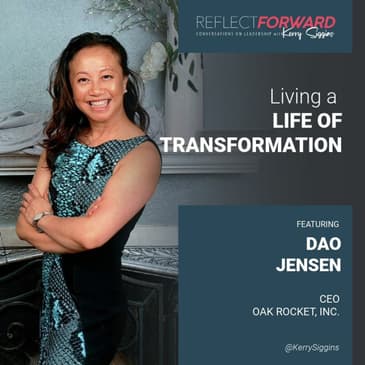

[00:00:00] Hi, welcome back to Reflect Forward. I'm your host, Kerry Siggins. I'm so glad you are here today. Today my guest is Dow Jensen. She is the founder of Oak Rocket, which is a cloud solutions company that she started in 2013.
[00:00:30] She's also in YPO with me. I actually met her when we did a girls trip to Bali in April of 2023 and oh my gosh, she is on fire.
[00:00:41] She is such an amazing human being who has gone through significant transformations in her life. She left corporate America to become a founder when she never thought about being an entrepreneur.
[00:00:54] She went through a divorce right before she started her business. She lost her daughter last year and she has such a view on life that is worth sharing and an energy that is contagious and she's absolutely brilliant and I know you are going to love this interview. So hang tight and I'll be right back with Dow.
[00:01:25] All right, welcome back everyone. I have my dear friend Dow Jensen with me. Dow thank you so much for joining the show. Thanks, Kerry, for having me. We'll look very excited to talk to you.
[00:01:36] Yes, well you have such an interesting background in history and we're going to talk about transformation today but before we get started, why don't you tell our listeners a little bit about your company and what you do?
[00:01:49] Yeah, sure. Oak Rocket is a cloud transformation company. We help people migrate and do digital transformation into the cloud, AI, Gen AI and we also help people save money on their cloud billing AWS Azure Google, especially when people are remote and they don't want to be stuck in a data center or
[00:02:11] what made you start the business? I was not making the corporate ladder executive fast enough. So I wanted B C F O C R O or C X O of any type like CEO and I was running into a lot of roadblocks as a woman Asian Silicon Valley executive and I really didn't have the patience to wait to not do something. It was a vice president who was in sales with me that saw my skill set and said, you know what you probably would be better than me.
[00:02:40] I think that's what you probably would be better off for entrepreneurship and I had never thought about it before. And so why do you think you ran into Redbox? What were you hearing?
[00:02:48] I think I was more opinionated than they wanted me to be they wanted me to stay in my lane, right? You're in sales. You don't need to give us marketing tips. You don't need to tell us how to run forecasting and operations. And so I think that was where I was running into roadblocks as I don't
[00:03:04] play the bureaucracy game or the political game as well as most people. If I see something, I want to speak my mind and be able to say let's try to make a change.
[00:03:13] And so what gave you the idea for Oak Rocket for going into the particular industry that you're in?
[00:03:19] Yeah, so I've been in tech sales forever but never did cloud AWS cloud computing and I really just talked to my customers who had followed me through large companies down to smaller companies. I thought going to smaller companies was going to be easier for me.
[00:03:32] You know, being a bigger fish in a smaller pond and to become a CEO and it wasn't the case. And when I went to talk to my clients they were telling me where the macro economics was going even if they weren't spending money in AWS, they were seeing a trend there.
[00:03:47] And so I picked something that I felt was a trend at the time they weren't being able to really report revenues of what AWS did versus Amazon.
[00:03:56] And so we were kind of making a gut decision on the fact that we were seeing a lot of people move in that direction. It was only a few years later that we realized the amount of billions Amazon was doing in AWS cloud and that it was the only profitable side of their business in Amazon that's keeping the rest of the company afloat is AWS.
[00:04:16] And so did you start the company on your own or did you leave with your VP. How did that happen?
[00:04:22] I started the company on my own. I bootstripped it with $40,000 and I had actually customer VPs who took tests for me so that we could have the certifications that we needed because I was not technical right and most people who were in the cloud business at the time were technical consulting companies.
[00:04:37] And so that is a significant transition right you're climbing the corporate ladder working for other people never thought about being an entrepreneur and now all of a sudden you're going to go for it. What did that feel like?
[00:04:48] What was going through your mind at that time?
[00:04:50] Oh my gosh, I was so scared and like I said, it wasn't something I was planning but I think you run into people in your life that are lucky at the right time.
[00:04:59] And so my boyfriend I was dating at the time had had his own companies and see you out of college.
[00:05:04] And my customers wanted to be entrepreneurs so they wanted to support me. I didn't even know how to do a registration of a business.
[00:05:11] So really this was from scratch going and doing networking at AWS events learning the ecosystem, figuring out what I was selling as well as who I had to work with.
[00:05:21] And it was really thrilling but on the other hand really scary and you don't know when you're making mistakes and you are going to make mistakes.
[00:05:28] But as long as those mistakes don't stop you from growing so far, it's worked.
[00:05:34] So those people might consider pretty significant risk.
[00:05:38] Yeah. Was that in your personality? Have you lived your life like that taking those types of risks? Tell us a little bit about how you view risk taking especially through the lens of your own transformation.
[00:05:48] Yeah, you know me so well carry right. So I think I do go on the edge of everything in life.
[00:05:55] I was the first Asian youth governor in the state of Minnesota at 17 and I didn't realize I was any different than any of the white kids there.
[00:06:01] Right. I see myself as what we call a banana.
[00:06:03] So white Asian on the outside but really white on the inside because I grew up in Minnesota.
[00:06:07] But my parents didn't see it that way. And so when I ran for governor they didn't even think I could win and asked me to my representatives to have me quit.
[00:06:15] And so doing things like that were out of the box and becoming pregnant at 19 and quitting my full ride for someone I loved only for nine months.
[00:06:24] I mean, that's risk taking right as well as getting divorced 14 years later having four kids and then starting a business with a six bedroom house in the city of San Francisco with a $40,000 runway.
[00:06:36] I bootstrap the company had no business partners but followed nothing that the Harvard Business School case study say you should do.
[00:06:43] And the good thing was though I had good mentors like even though I say I didn't move the corporate ladder fast enough.
[00:06:49] I actually did make some very good relationships and had respect for people like John W. Thompson who became the chairman of the board of Microsoft.
[00:06:57] He was CEO at semantic at the time everyone has their own path and he saw that I needed to do a different path and wished me well as I moved to smaller and smaller.
[00:07:06] And so I would say you have to be a risk taker and you have to have the gut for it but that doesn't mean that you can do it alone.
[00:07:13] You need people around you to talk to and you need people who believe in you sometimes more than you believe in yourself and I talk about that in my talk.
[00:07:20] You can find it on YouTube of Dow Jensen how to get up in the face of setbacks.
[00:07:24] And so let's talk a little bit about a few of those setbacks that you had so you start this business you have customer support tell us about those first couple of years and did you have to pivot what was that like?
[00:07:34] No, absolutely even though we said we were in Amazon Web Services company. We took any order we could so whether it was hardware renewals anything we could to just build revenue was what we did probably for the first three years.
[00:07:46] Probably around year five was when we started saying you know what now we're going to be our true selves and focus only on cloud because we figured out the industry.
[00:07:54] We want to be a pure EBITDA play on cloud only because hardware pulled down the multiplier of a company and we started making that shift in 2017.
[00:08:05] And I think it's done well for us.
[00:08:07] And how about from a leadership perspective now your CEO of your own company and building teams what was that like and maybe describe a mistake that you made on your leadership journey?
[00:08:18] I think there's so many mistakes we make in leadership journey this could take us hours and days to talk about.
[00:08:24] But when you're bootstrapped and you don't have a lot of funding first of all no one I didn't think was going to go give me money for having never having been a successful CEO before.
[00:08:33] And you pay for what you get and you would have to train people into an industry I took a mathematics teacher and taught her how to do accounting in cloud.
[00:08:42] And how to work with reseller so the growth was longer and the negotiations with people giving them titles isn't something you should always give people right away because once they come into your company one of the things I even see today is they feel like you can't run your business without.
[00:08:57] And as an entrepreneur and a business owner you never want to have one single throw to choke even yourself in running the business so anyone who says to me we can't run this company any further without this person will fold I'll say if we're folding because I die there's no reason we're going to fold because someone else is gone.
[00:09:15] We should be the right leaders to get everything in place in terms of SOPs and guidelines and those are things that scare me when people come to me and say you can't run this business without me you ultimately go away then you start playing an extra strategy for them.
[00:09:29] So tell us a little bit more about building that team have you kept your team around for a long time did you have to turn over people as you were figuring this out I did sadly I will not the great case study of someone who's been with having lots of employees who've been with me for over the last 10 years.
[00:09:44] I feel that even the difference of one year and having no products and ideas and customers to when you have a dozen customers people don't always grow with the way you do things and people have a sense of ownership and you start bringing other people in and they start having a sense of you know not teamwork.
[00:10:03] Sadly right you want everyone to grow together but life and personalities go on and unfortunately over time you lose people also you have to let them grow when we bring people in and train them in a certain area and they grow fast enough they need to go somewhere else because we're not that big.
[00:10:19] And they realize as they get distinguished in their job that they want to go do only development and not development and sales.
[00:10:26] I've really noticed that as we've grown our company you know starting off small getting bigger there were people who were multiple hats have to narrow down and just do one thing and it's hard for me to make that transition.
[00:10:36] We even had to allow one of our employees to go run for councilmen Minneapolis councilman right before George Floyd I didn't want to lose him he had built everything and then he went and was councilman for two years plus and it was the hardest job he ever had eventually he asked could I come back.
[00:10:53] And it was a very different perspective for him and sometimes you have to let people and want people to go follow their dreams but I think one thing I can say is that the people who've left are still very loyal mostly and want to see oh crack it do well but I do look at some of these companies like wow they have people who've been there for 20 something years is that good or not.
[00:11:12] I know I question that too I've been at Stone Age for 17 years but you know I think the thing has that's been really interesting is just when you're constantly transforming and and disrupting the industry it's like I've had in my CEO career of 15 years I've had like six different versions of that job and there's always that ability to grow.
[00:11:33] And it's like it's so hard to believe that I've spent so much of my career running this company and for a long time I questioned it like maybe I should go do something else.
[00:11:41] No but like you said you've transformed it so much you've acquired so many companies you're looking at what's next right that's what's kept you interested.
[00:11:48] I think if I wouldn't have been able to do that this company would have somehow become stagnant which I can never imagine because that is not my style.
[00:11:56] No I think that that's where it really would have been like okay this time to go do something different because let's face if you're not growing you're dying you've got to continuously be investing in your skills and your knowledge and your experience that's part of our evolution is leaders.
[00:12:11] And if you're not failing you're also not exactly trying hard enough to transform and change.
[00:12:18] Yep that's right so that's a great segue into your talk that you give about bouncing back from setbacks can you talk a little bit about why you speak about bouncing back from setbacks and really how that's helped you become where you are today.
[00:12:34] Yeah and I love talking to you because you've experienced the same things in your life right and I think the world overall would be such a better place if we supported people who fell down and believed in them and knew that they could be someone else even though they might not be that exact person today right.
[00:12:52] Being a teenage pregnant mom was not the thing I expected as a straight-a student someone who is going to be president United States and change the 22nd amendment and be the first immigrant to run for president United States.
[00:13:03] That wasn't this isn't the life I was expecting at 19 and I think why I do these talks is because especially in the Southeast Asian culture divorces faux pas teenage pregnancy is faux pas losing a child is a faux pas like you're a bad parent.
[00:13:18] And if we can all have people around us that support and say that wasn't your fault or if it was you can still change your life we would have such a better country in a better world.
[00:13:28] If we didn't just push people down because they failed once or twice.
[00:13:32] Yeah I agree we are so filled with judgment about even though we love come back stories but we only love come back stories when they involve certain things like addiction for me that's a tough one for people to absorb like I mean I still have.
[00:13:48] People even though that was so far in the past still look at me like really like you had a severe enough addiction that you overdosed and they think of people that you see on the streets of San Francisco thinking like that's what it must be like and it's really hard to overcome those preconceived notions that people have of you
[00:14:06] and break through to live a better life it's why people can't sometimes get ahead is because the system really holds them down.
[00:14:13] And it takes a lot of perseverance and self esteem to be able to break through those stigmas that are put upon you.
[00:14:21] Yeah so that's why I do the talks is because I think we could change this world so much more and have so much better leaders if we just give people courage to get back up when they fall.
[00:14:31] Whether it's their fault or not or it's just life to be able to come back and bring input meaning back into the world and love.
[00:14:38] Yeah so let's talk a little bit about divorce we don't talk a lot about that but being an executive leader I know that you got divorced right before you started your business is that correct yeah yeah so talk a little bit about what that was like because I know that that was a really difficult decision for you
[00:14:54] and how to impact the way that you were showing up in your business and do you think that it was part of what made you decide that's it I'm going to go do this on my own I'm going to go do something for myself.
[00:15:06] Well I think part of the reason I got divorced is because my husband at the time did not want me to take a job that had fluctuation and wasn't steady right he was a banker and felt that that was risky enough.
[00:15:19] He wanted me to still make my $700,000 and keep having child number five and number six and number seven and I was bored and at some point someone else's desire to be able to lead their own career and not give you a chance to grow can stagnate you
[00:15:35] and I didn't want my children to see me do that I didn't it took me three years to get divorced learn how to do my own taxes put my footing in and then be able to start a company but I wouldn't say that even my divorce was the like I ran right into starting a company I was looking to go be part of startups and smaller companies that were more risky at the time I thought even working for a $7,000 employee company was small right and here I am running a 20 something person company right and so it's our views and life are very important.
[00:16:04] Our views and life are different as we get older and our risk tolerance but I had to learn to be myself and I couldn't be myself safely by being married to him.
[00:16:15] Yeah that's really powerful thank you for sharing that and then you've had another tragedy hit you recently where you lost your teenage daughter and I know how difficult that has been for you.
[00:16:28] Would you share a little bit about the impact that's had on you and how that's affected your outlook on life and has it caused another transformation for you.
[00:16:38] Yeah I think I'm in the middle of that transformation I'm not sure what I can tell you what that is exactly yet.
[00:16:42] I had lost my mother in 2020 I lost my dad in 2023 February less than six months later and he was living with me so it was actually a year yesterday that was his one year anniversary.
[00:16:52] I lost my daughter unexpectedly she was 16 and I was very depressed after my parents were died but for my daughter it was such a shock that it was like I can't sit still and be depressed and not do events and activities.
[00:17:05] I need to have her spirit keep living I want her beauty and imperfections to be known around the world and so it really got me up to start doing talks and think about being the Tony Robbins for Southeast Asia.
[00:17:18] I don't think Asian women can look at a Tony Robbins and say I relate to him and everything he's having me do and also that he understands the cultural implications of a daughter of an Asian parent and what they expect out of you.
[00:17:32] You shame them by being a teenage pregnant mom or having a divorce I was actually the only person in my family that my parents allowed to give a divorce two out of six girls.
[00:17:41] And so with Angotrines passing it's been very profound I couldn't stop talking about her I couldn't stop you know not being able to make it worthwhile.
[00:17:51] So it's caused me to be closer to my children it's caused me to reevaluate how hard I am on certain situations at work or how I won't let it affect me because in the scheme of things it's very miniscule and you realize that personalities are so important in terms of the time you spend with someone.
[00:18:10] You'll never have enough time and that is the fact of life of Wabi Sabi right life is temporary you have friends they go away you have parents they go away.
[00:18:19] But you're not used to thinking that you're going to have a young child go.
[00:18:23] Yeah it really does show you the impermanence of everything.
[00:18:27] So what does the Tony Robbins of Asia look like?
[00:18:32] That's for you.
[00:18:34] So I think people have a hard time getting in front of stage like you said and talking about their failures their mistakes and how they got back up.
[00:18:44] And what does that mean that you need an order to get back up because when I was a teenage pregnant mom I was it still feels like the worst time of my life versus when I lost my daughter.
[00:18:54] And you can't even compare the two like my daughter was the worst loss I've had or the worst situation I've had but it's because I had such a community around me number one.
[00:19:04] That sees me for more than I am and love me versus at 19 your community is still young they're trying to figure out each other and it's just your parents and siblings right like you don't have a lot of judgment and a
[00:19:15] judgment and a judgment. Yeah at 19 I was a darling child who is the youth governor and then all of a sudden I became a teenage pregnant mom in quick college in a full ride.
[00:19:23] So number one is having a community around you that had built in the last 16 to 27 years and then two doing more schooling in your head and brain than just what schooling does for you.
[00:19:34] So I call it NLP which Tony talks about it's like everyone wants to focus on the past and how they can change things and it doesn't do anything productive for you.
[00:19:42] Angers like a poison pill you swallow and you expect the other person to die but really you're like creating bad energy inside you and creating cancer inside you.
[00:19:50] And that's a lot of training and I happen to start doing that after my divorce so that training and being able to go Harvard on a scholarship at the age of 42 with a CEO program and the people I met who come from family and wealth or who've done exceedingly well in their industry.
[00:20:05] Who am I as a $10 million business when I first came into that program and they see you for like wow well if I had nothing like you I wouldn't be where you are at and the mutual respect you have from other people.
[00:20:17] And then the third part is really understanding that life is temporary and if I only had 13 years left to live like Martin Luther King or we did would we live our life the same way day to day.
[00:20:27] And so I spend more my time talking so that women who feel like I'm not advocating divorce but how can you change NLP between you and your husband or your significant other partner and be able to still live a life you both love powerfully but with respect.
[00:20:42] And I wish I had done that during my marriage instead of afterwards alone without him.
[00:20:47] Yeah, absolutely. And what does NLP stand for?
[00:20:51] NLP stands for NLP Sticks Program.
[00:20:54] So Joe dispends the untethered soul or some very good books I recommend.
[00:21:00] Yeah, definitely. I just finished the surrender experiment by Michael Singer who also wrote the untethered soul and yes it's so good.
[00:21:07] I don't like the word surrender. I like trust like instead of just surrendering is like I trust I trust that the universe knows better than me.
[00:21:14] And so how do I let it flow rather than trying to orchestrate every outcome which is pretty much the stupidity of my life.
[00:21:20] And it's a really fascinating way to look at life when you start to say how do I manifest what I want.
[00:21:29] How do I track what I want in life and how do I really be unattached to the out to my likes and dislikes and let life flow.
[00:21:37] It's not easy to do, but it's a really powerful mentality.
[00:21:42] Life is sometimes planned for us, no much how we try to plan for ourselves and prepare for things and you know the secret like you said the manifestation that is all NLP really in the long run.
[00:21:52] And I call it shoots and ladders the game that we played as a kid right we're all going to get down a slide at some point.
[00:21:58] How do you figure out at one point to find that ladder that gets you to make up for that time?
[00:22:02] I mean Walmart was not created until his age of 50 neither was Kentucky fried chicken and I'm not even 50 yet.
[00:22:08] I think there's so much we can do in such a five-year period versus a one-year period.
[00:22:12] I just don't think there's enough people who get open-minded to this and they're so hard on themselves on what is imperfect about them or the failures that they had or the losses that they've had that they couldn't overcome and move their heart forward to open up and try and be more risk-taking.
[00:22:31] Yeah, I like the idea I play with the idea in my head it's the doing the dance the dance between trying to make things happen and let things happen because I think a lot of people get what they get wrong about manifesting is that you just wish it to be true.
[00:22:46] And then it happens and that's not true there always has to be action with your intention.
[00:22:51] And so that's why I think it's like this really beautiful way to look at it is the thing is you have to go make things happen and sometimes you have to let things happen.
[00:22:58] And so how do you do that dance of letting things happen and making things happen so that it's not so hard and that when something doesn't happen the way you want it to, you're not attached to it so there's less suffering.
[00:23:14] And if we could all practice that I think life would be better for every single human being on this planet.
[00:23:20] Well, and every quote-unquote failure opens a door for something new opportunity right I mean it happened for a reason for us to learn if we don't learn from what that's the problem.
[00:23:28] And I think you're right it's successes when preparation meets opportunity right you can't just sit back and hope that success will happen if you aren't preparing to.
[00:23:38] Yeah, I agree. So how does the speaking play into what you are trying to build with Oak Rocket?
[00:23:46] You know, what does that look like do they converge do they separate you know, what do you see five years down the road?
[00:23:52] I think they converge in many ways like I have clients who have me come to speak to their leadership team now and to their employees so that it's not just about us handling their cloud business but really as a partner that is here to give a resource to them in their organization.
[00:24:07] Right the biggest value you have is your people and what they can do and how they can live a life powerfully and when they love at work and out of work.
[00:24:15] And so that's where it converges but on the other hand, I hope to build this business so that I have the right executives in place and become a serial entrepreneur where
[00:24:23] you know my next venture maybe Asian Molle with my six my sisters and call it six sisters or something because I love food technologies not my only love and I want to be able to make sure that I'm dabbling and giving in other ways like speaking in front of audiences.
[00:24:38] It brings me joy. It brings me opportunity to meet unique people around the world as I go talk around the world and you wouldn't have that chance to be spotlighted
[00:24:48] if you were just in an audience and then having to go talk to someone right you have Marjorie Dixit who's like Hollywood, Bollywood star the women who did projects for the moon and the rocket ship in India.
[00:25:00] Like come talk to you when you've talked and you've touched their lives and you've touched something in their soul that's what I get out of the talking so whether or not it converges with Oak Rocket.
[00:25:10] I still make time for it, but I think there are times when it absolutely makes sense for one our team to see that we're doing this and the people that we move in our customer base, especially the younger generation.
[00:25:21] Yeah, yes, for sure because that's all you and I have how can we help the younger generation learn from us and learn from our mistakes and inspire them to even better stewards of the universe.
[00:25:33] Yeah, I agree. I share your sentiment exactly people ask me all the time like why do you write a book and why do you speak all the time and it's bigger impact and it is absolutely woven together my whole philosophy is around this idea of the ownership mindset when you own everything that happens in your life, you are so empowered to change your life to make your life better.
[00:25:54] But when you are blaming time or a situation or even yourself, are you stay stuck and I know how owning all of my shit really did allow me to transform my life and it's allowed me to transform this company through this idea of teaching people how to think and act like owners and the responsibility that comes with that.
[00:26:15] And it's such a powerful way to live your life and if I can just inspire one person in an audience to take lean into that responsibility and own everything that happens in their life and their career, then that's the kind of impact that I want to leave behind and hopefully I can do it on a much broader level and that I am doing it on a much broader level.
[00:26:35] But that's what matters right is that we're all here to inspire each other like I am inspired by so many people by you by, you know brilliant people who are out there doing big things and why shouldn't we be able to inspire others with our stories as well.
[00:26:50] Yeah, no, I think that one thing that always takes out to me that I talked to some of the young girls as they go, I was taught not to take up a lot of space.
[00:26:58] Yeah.
[00:26:59] And they said so how can I change my mind to think about that and I said look it, it's like when you talk about transformation and space it comes together you're a caterpillar and if you don't have the space to spread your wings once you've transformed no one can see the beauty that's within all of those pieces and layers of those wings that took you to get you there.
[00:27:17] And then if you can't see, if you don't show your beauty how can people come and say let me take advantage of your beauty or like how can you help me or I help you if you aren't seeing.
[00:27:28] And so I'm trying to change their minds to just think that way that space is important to have and being seen yeah not just who you know but who knows you is more important.
[00:27:40] Yeah, I just had this really interesting experience so I just got back from my chapter, why P.O. chapter retreat in Columbia and I was the only female member who went we only have what's a new relatively new chapter we're building it and there's only I think four or five women in it.
[00:27:57] And I didn't know until right before we were going to the trip that I was the only female member and luckily I live in a male dominated world so I was like okay well you know I would prefer there to be other women but I can handle myself and right.
[00:28:08] And so one night we were all out and I was like okay I'm gonna set some ground rules here and so I like gathered all the men in the chapter around I was like okay I just need to say this right now and one of my fellow chapter mates came up to me afterwards and he said that was unbelievable what you just did there.
[00:28:26] I am going home and I'm telling my daughters about this and you know for me I'm just so used to being able to take up the space that I can own and be comfortable putting myself out there and setting boundaries and having those kinds of conversations.
[00:28:41] We make ourselves small we don't say what needs to be said because we think that it's going to hurt people's feelings or make us look bad or that we're going to somehow get ridiculed or fail but boy when you start putting yourself out there and saying this is who I am and this is what I'm okay with and this is what I'm not okay with.
[00:29:01] You start to be able to create those boundaries that people will eventually respect but you have to start somewhere and it was a really it was in the moment type thing but it was a really powerful reminder to me of how rare we that happens and how powerful it is when you do when you take up your space and you put yourself out there and you say this is who I am this is what I'm good with this is what I'm not good with.
[00:29:26] I was talking to another person about not that particular not what happened but we were talking about when women feel like when do women feel like we're talking about Harvey Weinstein right we're talking about when women feel like they don't have a voice and we're talking about is it a man woman thing and I said no I think it's a status and power thing and when you do not feel like you have equal power or equal status.
[00:29:48] It's really hard to speak up it's really hard to set those boundaries and that can be in any kind of a relationship whether you know it's in Hollywood or it's a husband and wife in a small town power and status really matter for making it safe to speak up.
[00:30:07] And so I think if anybody wants to encourage people to speak up especially in like in your company for example you have to understand the power dynamics and work really hard to minimize that so it does feel safer.
[00:30:20] And of course there are lots of people who use it to their advantage who can keep people down and keep voices quiet but that power and status that really is what does so much damage especially with women and not feeling comfortable to stand their ground or speak up.
[00:30:33] Yeah but like you said you and I have been used to being in a very male dominated industry yeah so it's maybe been easier for us now after having done it for decades but for women and men who aren't used to being able to have that dramatic difference right they don't feel like they have to sometimes or they don't have someone to support them to do it because it's like oh you're just another one of the girls so why wouldn't you be that way.
[00:30:55] And that's what I really like about an organization like YPO it's that I feel like I have equal status I've built a great company and I deserve that seat at the table.
[00:31:05] And I deserve to have my voice but that comes with power and status and I don't ever take that for granted you know I understand that that has something that I've had to really work for I know 10 years ago 15 years ago for sure there were times where I didn't feel like I had that yet.
[00:31:24] I didn't have the experience or the success to really be able to stand up for something that I believed in it was just easier to keep quiet and so I think it's why it's really important for us to help that next generation like you said both men and women find their authentic voice and be able to speak up for themselves
[00:31:42] and also at the same time make space for other people to do the same and we're not living in a world at least in our politics and the things that we see on news that make room for that.
[00:31:51] But I think we as leaders it's really important for us to do it because it is how we bring that future generation forward.
[00:31:58] I think the sad part I run into a lot too is people who don't have a love and passion and they said you knew what you wanted to be when you were young but I still haven't found that how do what am I supposed to do because that's what drives us right.
[00:32:09] And so the only thing we can encourage people is to try things out to test it out you know people don't test and try things out because they worry about failure.
[00:32:17] Yep, I agree. Well I did not know what I wanted to be and I was completely lost and I tried lots of different things and this role fell into my lap it was a never should have happened but what I did as I followed my heart I said I need to be home I need to you know I went left when I should have gone right
[00:32:38] and I need to figure out how to get back on to a different path. And it was in that that lowest moment of my life when I said okay I have to rebuild my life I have to do something different that huge opportunity arose
[00:32:51] and I think that's what people need to understand is that there's not just going to be this perfect path of understanding what you want to do with your life of knowing right out of college what your passion is you have to try things you have to take risks and if you aren't happy
[00:33:05] you are responsible for that and sometimes you might just have to take it a U turn and go backwards and figure it out.
[00:33:12] Yeah I think the thing that the next transformation I'm trying to get to is being able to get to a point to be able to share all parts of my life that I've experienced and tried and tested
[00:33:23] and not have that actually the hardest critics or the biggest concerns is not about people criticizing me but people criticizing my children and my siblings and family members because they are related to me.
[00:33:36] Yeah and they don't respect or appreciate a divorcee or they don't respect or appreciate a teenage pregnant mom who wants to be and so I think those and there's many other stories like you said that I will only tell you right now that I'm still not even ready to put on a book yet but I've been encouraged too because by having done it and tried a lot of these things
[00:33:56] that we don't feel comfortable to talk about it's the only way to help other people who run into situations that they don't know how to handle or they think is the wrong path
[00:34:05] who says traditional marriage is the only way anymore especially when we as women like you and I have a hard time finding men who make more than we do or are as ambitious.
[00:34:14] And you know I might not want that I might want someone who's more family oriented or I might want it and it might take me longer time and be single for a lot longer and the Midwest where I grew up and where you live is like why you're not married now after 15 years.
[00:34:29] I just love your spirit, your soul, your insight has been so much fun having you on the show.
[00:34:36] I do have one last question to ask you before we wrap up and you can tell people how to find you.
[00:34:41] The name of this podcast is reflect forward what does reflect forward mean to you.
[00:34:46] Oh that's great because we've been talking about forward for a lot of the board stuff that I've been doing for other people and it means being able to be in motion.
[00:34:56] Not necessarily being able to be stuck somewhere and thinking that there are obstacles in your way that won't get you there and until those obstacles or those situations happen, you then can move forward.
[00:35:08] And so reflect forward means look at your past and see what you learned from it but do not use it as a predicament of moving forward nor do let certain requirements be the reason why you can't move forward.
[00:35:20] There's always something you can do to move forward and even if that just means walking and talking to people without anything that you get out of it reflection is really important but you can't let the past reflection affects you moving forward and being in motion for too long.
[00:35:33] I love it beautiful answer thank you.
[00:35:35] Thank you very much.
[00:35:36] All right so how can people find you?
[00:35:39] Yeah, so you can find me at Dow Jensen on LinkedIn or Dow at O'Grakett in Instagram.
[00:35:45] Perfect and do you have a YouTube channel?
[00:35:47] I do not have a YouTube channel or is your just your talk is on.
[00:35:50] Yeah so if you go on to YouTube and look Dow face of setbacks or getting up in the face of setbacks, you'll find it immediately.
[00:35:58] Perfect and I'll include all of that in the show links so Dow thank you so much for coming on the show.
[00:36:03] This has been such a fun conversation.
[00:36:05] I could talk to you about this stuff all day.
[00:36:06] I can't wait to see you in person again soon.
[00:36:08] Thanks Carrie.
[00:36:09] Me too. Me too.
[00:36:10] All right.
[00:36:11] I think tight everybody.
[00:36:12] I'll be right back.
[00:36:17] All right everyone I hope you enjoyed that interview.
[00:36:22] Please be able to please be sure to check out her talk.
[00:36:26] It is absolutely worth listening to it's in the show notes and that's it for this week.
[00:36:30] And if you like this podcast, please share it with a friend go on to your favorite podcast platform and write a review.
[00:36:37] Subscribe to it subscribe to my YouTube channel helps with algorithms and I always appreciate this work.
[00:36:42] Hope you have a fantastic day.
[00:36:44] We'll see you next week.
[00:36:47] Bye.