
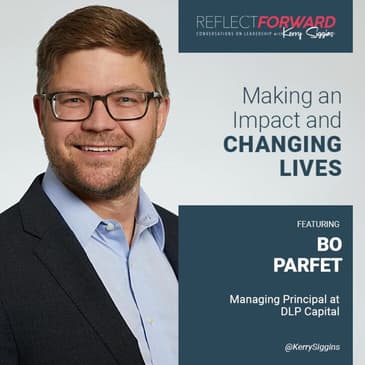

[00:00:10] Hi everyone and welcome back to Reflect Forward. I'm your host Kerry Siggins and I'm so glad you are here today. My guest is Bo Parfet. He's a managing principal at DLP Capital. DLP Capital is all about impact investing and they are trying to solve the attainable housing problem. He shares all about how he actually got into impact investing and left being an investment baker with JP Morgan years ago and really how he has infused doing something for a bigger reason beyond yourself as part of everything that we've been doing.
[00:00:40] He does in his personal and professional life. He is an avid climber and mountaineer skier and he's done all seven summits for the highest mountains on each continent. He's published four books which I will include in the show notes and he's just this phenomenal human being who is trying to make the world a better place both personally and professionally and I know you're going to absolutely enjoy this interview so hang tight and I'll be right back with Bo.
[00:01:17] Hi everyone. I am back with Bo Parfet. He is a fellow Coloradoan, lives in Boulder part-time or most of the time in Steamboat Springs so he's a mountain guy like me and I'm so glad to have you on the show today Bo. Thank you for joining me.
[00:01:32] Thanks for having me.
[00:01:33] Alright so let's jump into what you do. Can you talk about your company and what you do and then we'll dive into all of your adventures.
[00:01:42] Sure. So I grew up in Michigan but I've been in Colorado the last 13 years. My wife is a fifth generation Coloradoan so that's kind of like a unicorn.
[00:01:54] We have two boys. They're 12 and 9. We love living in Colorado. I'm an executive at DLP Capital.
[00:02:02] DLP Capital is about a $5.5 billion impact real estate company which is pretty cool. We're trying to solve the attainable housing crisis.
[00:02:12] And then on the other side I love to climb and ski mountains and write books about it.
[00:02:18] So that would be kind of a nickel tour of my background.
[00:02:22] Let's dive into a little bit about DLP Capital so that everybody can understand what impact investing is and how are you going about trying to solve the homelessness problem?
[00:02:32] Sure. So for those listening that may not know this or if you do maybe it's a refresher.
[00:02:36] An impact company is really cool. So let's unpack it.
[00:02:40] What an impact company or an impact investment is you can solve a problem in the world and make a financial return at the same time.
[00:02:49] And there's a range. So the returns don't have to be concessionary.
[00:02:53] Some impact returns, I mean you can shoot for the moon and some can be a very small amount of return.
[00:03:00] Hey, just to return a capital or a 1% return.
[00:03:03] So there's no wrong answer. It's just kind of I guess germane to that person or the family on what kind of impact or return they want to have.
[00:03:11] So at DLP, there's a shortage in America of about five to seven million attainable housing units in the United States of America.
[00:03:24] So who are these hardworking folks?
[00:03:26] So it's a teacher, could be a fireman, police officer, a custodian at a high school or college,
[00:03:32] a small entrepreneur, a shop owner, a manager at a store or a restaurant worker.
[00:03:39] And they need a place to live. So we've had a housing crisis in America, frankly, since 1776.
[00:03:45] So this has been here a long, long time and we're doing our best to put a dent in it.
[00:03:50] And there's different types of attainable housing.
[00:03:53] So there's Section 8 where the government is largely paying your rent.
[00:03:58] Okay. And that's a demographic and we need to do that for some folks and they need that assistance.
[00:04:03] And then there's another level kind of higher than that.
[00:04:06] We call it market rate or attainable housing.
[00:04:09] So that's what we try to solve for.
[00:04:12] Again, we're about a five and a half billion dollar company.
[00:04:15] And when you're trying to solve a problem as big as this, we can't do it alone.
[00:04:20] So we put purpose ahead of pride.
[00:04:23] So sometimes DLP is the owner and operator and developer, but we also provide financing
[00:04:30] to about a hundred or so other real estate operators that have the same mission we do.
[00:04:37] Our returns are not concessionary.
[00:04:40] We have two debt funds and two equity funds.
[00:04:42] Just at a very high level, our debt funds have historically paid about 10, 11% net return.
[00:04:50] So a million dollar investor can make a hundred, 110 grand a year and help solve the housing crisis.
[00:04:56] And that we have two equity funds.
[00:04:58] One is where we're building ground up construction.
[00:05:00] And the other one is value add apartments.
[00:05:03] And those have been in kind of the mid teens type of returns on a net basis.
[00:05:08] Obviously past performance is an indicative of future performance.
[00:05:12] But it's neat to solve a problem.
[00:05:14] So before I joined DLP, I was just making a living.
[00:05:18] Now I'm making a life and we all jump out of bed every morning, excited to come and tackle this problem.
[00:05:24] I love that purpose over pride.
[00:05:26] What a fantastic way to frame that.
[00:05:29] And I completely agree with you.
[00:05:31] I mean, that's what we're doing here at StoneAge as an employee owned company is building a high impact company,
[00:05:36] not only in the industry that we're serving, but also for employees and helping them find purpose,
[00:05:41] meaning and wealth creation from their work.
[00:05:44] So I can really appreciate you diving into this and wanting to do something that's bigger than just make money.
[00:05:50] I know you started out at JPMorgan Chase and you kind of were in that traditional banking kind of capital space.
[00:05:56] What made you decide you wanted to go into impact investing?
[00:06:00] Did you always have this as part of your ethos, your being, or did something switch in you that says,
[00:06:07] Hey, I want to do something that's bigger than just make money.
[00:06:09] So it was an evolution of kind of me stumbling upon impact investing.
[00:06:16] And I'll start with kind of a cool story.
[00:06:19] So when I was working at JPMorgan, I was working in New York City.
[00:06:23] I was doing mergers and acquisitions and corporate finance in the concrete jungle of Manhattan, working 100 hours a week.
[00:06:30] And I had worked about seven months straight.
[00:06:33] So I was a financial analyst and I worked seven months straight.
[00:06:36] And that's not just Monday through Friday, that's Saturday and Sunday too.
[00:06:39] And I don't think I had left the office before like 11 PM.
[00:06:43] So I'm seven months in 40, 50 pounds overweight.
[00:06:47] I go into my boss's office and I say, Hey, I'd like to take my first vacation.
[00:06:53] And he said, okay, yeah, that's just about the time people start to do it.
[00:06:56] And he goes, what do you want to do?
[00:06:58] And I said, I want to go climb Kilimanjaro.
[00:07:00] And he looked at me and then he looked down at my belly, which is pretty big.
[00:07:06] And he looks back up at me.
[00:07:08] And I remember kind of like trying to cover up my belly a little bit.
[00:07:10] He goes, well, Bo, what makes you think you can make it?
[00:07:12] And I go, I don't know.
[00:07:14] I'm kind of determined.
[00:07:15] And then I listed some reasons why I wanted to do Kilimanjaro.
[00:07:18] And he goes, Bo, you mentioned you want to do Kilimanjaro.
[00:07:21] That's cool.
[00:07:21] And all you've talked about is why this is going to be good for you.
[00:07:25] And he said, do you want me to tell you a secret?
[00:07:27] You know, one of the secrets to success.
[00:07:29] I said, sure.
[00:07:30] He goes, if you do anything in life for something bigger than yourself, you're going to have more
[00:07:36] energy than you could possibly imagine.
[00:07:39] He said, you think about that.
[00:07:40] You come back to my office.
[00:07:42] So I thought about it for a couple of weeks.
[00:07:44] I came back and I decided to go to Kilimanjaro and help the continent of Africa.
[00:07:50] Why Africa?
[00:07:51] Well, Kilimanjaro is the tallest mountain in Africa.
[00:07:53] I'm going there.
[00:07:54] I found this cool organization, did all this research.
[00:07:57] And I said, gosh, for $6,000, I can pay for someone from a shanty town, which people that
[00:08:04] don't know what that is.
[00:08:06] It's a very poor area now.
[00:08:08] Dirt floors.
[00:08:09] It was very poor.
[00:08:10] And there's an organization that's really good at finding folks in these shanty towns
[00:08:14] and they test them for their cognitive ability.
[00:08:16] And I can create a doctor.
[00:08:18] For $6,000, I can pay for somebody's medical school.
[00:08:22] And then they can go on and save lives for the rest of their career.
[00:08:27] So I want to create a doctor.
[00:08:29] So I was telling him this story and I said, hey, what do you think?
[00:08:33] And he said, and he loved the story.
[00:08:35] And he opened up his desk drawer and he starts writing something down kind of to the side.
[00:08:42] And he said, well, you're going to do two doctors, right?
[00:08:45] Well, I had really only thought about doing one.
[00:08:47] I was like, sure, let's do two.
[00:08:49] And he wrote a check for $6,000 and he handed it to me.
[00:08:53] And he said, now you only have to do one more.
[00:08:55] So then I went all over J.P.
[00:08:57] Morgan telling the story.
[00:08:58] They wrote an article in the J.P.
[00:09:00] Morgan magazine and it got a lot of press.
[00:09:03] So fast forward, we've now funded 10 doctors over the years and we track how many lives we've saved.
[00:09:12] So twice a year, I touch base with all these doctors who are now friends.
[00:09:16] We've saved over 415,000 lives on the continent of Africa because of these doctors.
[00:09:23] Like that's a huge impact.
[00:09:26] And our goal is to save a million lives.
[00:09:30] So that kind of impact started to really resonate with me.
[00:09:34] And then when I sold my first company, it was a student housing real estate business.
[00:09:40] And I had some dry powder in the bank.
[00:09:42] Everybody said to me, oh, just create a 501c3.
[00:09:45] Just create a nonprofit.
[00:09:46] I kept hearing, I'm like, there's got to be another way.
[00:09:48] Not that that's not important.
[00:09:50] I still want to do that.
[00:09:50] But what else is there?
[00:09:52] So I went on this huge journey and I discovered impact investing, where you can actually solve
[00:09:59] some of the biggest problems in the world and make a financial return.
[00:10:02] It started in Kilimanjaro.
[00:10:04] And then when I had the exit, I dug in even more.
[00:10:08] I absolutely love that.
[00:10:10] It's so fantastic.
[00:10:11] And I have two questions.
[00:10:13] One, did you lose weight and climb Kilimanjaro?
[00:10:17] And what was that like?
[00:10:18] And two, how long did you stay with JPMorgan Chase after your boss gave you this great idea
[00:10:25] and kind of changed the way that you look at things going forward?
[00:10:29] Good, good questions.
[00:10:30] I climbed Kilimanjaro very overweight.
[00:10:33] I just, I didn't have time to train.
[00:10:36] And when you're working that hard, you eat all the time, it seems to get energy.
[00:10:42] And I barely made Kilimanjaro.
[00:10:44] I mean, I barely made it that first time.
[00:10:49] And it did make me self-reflect after I got back and say, hey, do I really want to be an
[00:10:55] investment banker for my whole career?
[00:10:58] And the answer was no, I didn't want to do that.
[00:11:01] And by the way, nothing wrong with people that do that for their career.
[00:11:05] On the way down from Kilimanjaro, one of my climbing partners said, hey, you know, are
[00:11:11] you going to do the seven summits?
[00:11:12] I didn't even know what the seven summits was.
[00:11:15] And he said, there's seven continents on the planet.
[00:11:18] You can climb the tallest mountain on each continent.
[00:11:20] And I said, well, that's a pretty cool goal.
[00:11:22] Let me begin to embark on that journey.
[00:11:24] And then your second question is, I think I kind of answered it, but just to really be
[00:11:29] clear, I think it's a lot of people ask, well, would you work at JP Morgan again?
[00:11:34] Would you work those hundred hour weeks again?
[00:11:36] So whether it's the military, hey, I'm going to go do four years in the military and they're
[00:11:41] going to kick my butt, but I'm going to learn a lot.
[00:11:44] Whether it's working as a consultant or for a bank, like getting that base skill set in
[00:11:51] some form or fashion is very, very important.
[00:11:53] So I do recommend getting that skill set.
[00:11:57] Okay.
[00:11:57] So now let's talk a little bit about that because it's also inspired you to write books and take
[00:12:03] this even further.
[00:12:04] So can you share your story of climbing the seven summits and why it inspired you to write
[00:12:09] books on leadership and overcoming adversity and doing hard things?
[00:12:14] Absolutely.
[00:12:15] So the two most important moments of your life are the moment you're born and then the
[00:12:21] moment you know why.
[00:12:24] And a lot of people don't know their why or they have a why, but they think, well, I can't
[00:12:29] add another one.
[00:12:30] Well, yes, you can.
[00:12:31] You can have more than one why, right?
[00:12:33] One of my whys is to explore my inner and outer world.
[00:12:39] So I did climb the seven summits.
[00:12:42] And I wrote my first book about it called Die Trying.
[00:12:45] I ended up doing a climb and then doing some type of philanthropy connected to it.
[00:12:51] And that just makes me feel good.
[00:12:53] One of the things that people ask is, how do you create that energy?
[00:12:57] And I call it adding these delicious layering cakes of your life.
[00:13:02] I'll give you an example.
[00:13:04] So when I climbed Kilimanjaro, I got hooked on the seven summits and I began to embark on
[00:13:09] this journey.
[00:13:10] And then I was living in New York.
[00:13:12] I learned about the Explorers Club.
[00:13:15] For those that don't know what that is, it's a really cool organization that kind of, if
[00:13:19] you're an adventurer or an explorer, but also like science or doing field research, it kind
[00:13:26] of marries the two.
[00:13:27] And our mission is impact the world in a positive way through exploration and science.
[00:13:32] So I heard about this expedition that was going back to Kilimanjaro and they were looking
[00:13:38] for new species to relate to some new technology and some science they can do.
[00:13:43] So without getting into too many details, we basically did this really cool project on Kilimanjaro
[00:13:49] and we discovered 29 new species, which was pretty darn cool.
[00:13:54] I would have never thought that I would have been a member of the Explorers Club.
[00:13:58] It just got me connected into learning about science and trying to help out mankind.
[00:14:04] And then as I embarked on the seven summits, more and more people wanted to hear about
[00:14:08] it.
[00:14:09] So then I wrote Die Trying.
[00:14:11] And I will share this.
[00:14:12] When I first wrote the book, my first thought was, oh my gosh, this is going to be a bestseller.
[00:14:17] I'm going to be on the Oprah Winfrey show.
[00:14:20] And then somebody who had written a lot of books basically splashed some cold reality
[00:14:25] and said, Beau, you're lucky if your kids even read your book.
[00:14:30] There's like a million books published today.
[00:14:32] He goes, what you're really hoping for is that one person reads your book and it changes
[00:14:37] their life.
[00:14:38] That's why you're writing it.
[00:14:39] So I went on this nationwide speaking tour.
[00:14:43] And sometimes I'd go in and there'd be 300 people in a room.
[00:14:47] Sometimes I'd go in and there'd be two people and I would just give my little talk.
[00:14:51] But about a year later, I got an email from a woman and I could tell that her email address
[00:14:59] made it so I wouldn't know who she was.
[00:15:01] And you'll know why in a second.
[00:15:04] So she said, I heard you speak about this cliff of change.
[00:15:09] Like so many people are right on the edge of change.
[00:15:11] They're on the cliff of change.
[00:15:14] And what I talk about is, is it's more painful to stay there than it is to jump, go chase your
[00:15:18] dream.
[00:15:19] So I get a chair and I do this big dramatic thing and I jump off the stage or the chair
[00:15:23] and said, just go chase your dream.
[00:15:26] And basically she said, so here's a little bit about me.
[00:15:30] I've been mentally and physically abused by my ex-husband.
[00:15:35] I've had broken arms, broken ribs.
[00:15:38] And she said, I always wanted to become a doctor, but he told me I wasn't smart enough
[00:15:43] and all these other bad words.
[00:15:45] So she said, I want you to know I took the MCATs and I'm in medical school and I want to
[00:15:51] thank you because you were my nudge.
[00:15:54] And I'm reading her email.
[00:15:55] I'm crying.
[00:15:56] I'm like, oh my gosh, it's amazing.
[00:15:58] So that was the first, I've gotten more of those and they're different and everyone's
[00:16:03] different.
[00:16:04] But I wrote the book for her to change that one life was pretty darn cool.
[00:16:08] And here I'm talking about mountain climbing and making mistakes and learning from them.
[00:16:13] But so if it wasn't my book, it would be somebody else's book.
[00:16:17] Right.
[00:16:17] So I always encourage people, tell your story.
[00:16:19] The media is filled with negativity.
[00:16:22] It's just filled with negativity.
[00:16:23] It is.
[00:16:24] So I think positivity is contagious.
[00:16:26] I also think negativity is contagious.
[00:16:28] So for the positive folks out there, let's just put more positive news out there, stories,
[00:16:33] books, and hopefully we can kind of tilt it more towards making an impact and changing
[00:16:37] people's lives.
[00:16:38] So that's some of the journey that I've been on.
[00:16:41] I mean, I would have never thought I would have connected with someone like that woman who
[00:16:45] now is thriving.
[00:16:47] That was a really good question you asked.
[00:16:49] And I don't often tell that story.
[00:16:50] So I'm glad it came up here.
[00:16:51] I so love that.
[00:16:53] I feel the exact same way about my book.
[00:16:55] You know, if it changes one person's life and if it inspires one person to step into their
[00:17:00] leadership or to look at their flaws and figure out how to turn them into a superpower, then
[00:17:05] I did my job.
[00:17:06] I love that you shared that story because that's what it is.
[00:17:09] We're all here to be able to inspire others and to be inspired by our journeys.
[00:17:13] So what is the thing that you learned most about yourself through this journey?
[00:17:20] The, as I mentioned before, the cool thing about being a mountain climber is you get to
[00:17:25] explore your outer world and inner world.
[00:17:27] The thing that I learned the most is about my gray spots or my blind spots.
[00:17:33] So I went to go climb K2, which for those that you don't know, it's the second tallest mountain
[00:17:39] in the world.
[00:17:39] They call it the Savage Mountain.
[00:17:42] One out of four people perish climbing K2.
[00:17:46] And I was just obsessed with K2.
[00:17:48] I was obsessed.
[00:17:49] And I had to climb K2.
[00:17:51] So my wife and I were struggling to have kid number two.
[00:17:55] And we started doing IVF.
[00:17:57] The plan was, hey, when I come back from K2, let's have our kid number two.
[00:18:03] Well, we got pregnant naturally and it turned out my second son was going to be born three
[00:18:09] weeks before I was supposed to climb K2.
[00:18:12] So I had a three week old baby and I left to go climb K2 and, you know, one out of four
[00:18:18] perish.
[00:18:20] So went to K2.
[00:18:22] I trained for a year and I was working 60 hours a week and then training 40.
[00:18:27] So I obviously had pretty little time with my family.
[00:18:30] And then when I got back from K2, it was about a month.
[00:18:34] And my wife said to me on a Sunday afternoon, hey, Bo, do you want to hear about my K2?
[00:18:41] What do you mean?
[00:18:41] You didn't climb K2.
[00:18:42] I did.
[00:18:43] No, no, no.
[00:18:43] I had my own K2.
[00:18:45] I had my own climb.
[00:18:46] Do you want to hear about it?
[00:18:47] And I knew I was in trouble.
[00:18:50] I knew I was in trouble.
[00:18:52] So I said, no, I don't really want to hear about it.
[00:18:54] Not really.
[00:18:55] And then she came back about a week later and she brought it up again.
[00:18:59] Do you want to hear about my K2?
[00:19:02] And I knew I wasn't going to be able to wiggle out of this.
[00:19:04] And I said, sure.
[00:19:06] So she told me some of my blind spots.
[00:19:09] We used a marriage coach and I really got to learn more about myself.
[00:19:14] And I don't think I would have been as open to that if I didn't climb all these mountains
[00:19:18] and just get humbled by these awesome peaks that just kick your butt.
[00:19:23] I wouldn't have been open to it.
[00:19:25] So between an awesome marriage coach climbing all these mountains and a pretty darn cool wife,
[00:19:30] after six months, we were in a much better place than we had ever been.
[00:19:34] And so I would have to say that that's probably the best thing I've learned being on this journey.
[00:19:39] Thank you so much for sharing.
[00:19:41] Obviously, you're an intense person.
[00:19:43] Only people with a certain amount of intensity can go do what you did.
[00:19:47] And that can be really hard to handle in a relationship when you're so focused and driven
[00:19:52] on doing something big.
[00:19:54] And it can leave other people behind.
[00:19:57] It's a very, I think, real story for entrepreneurs and for any professional that's really driven
[00:20:03] that says, I'm here to do something that's bigger.
[00:20:06] And it does.
[00:20:07] It has a profound impact and sometimes negative on the people around you.
[00:20:11] So thank you for sharing because I think that that's a very real thing for a lot of entrepreneurs
[00:20:16] and executives.
[00:20:17] Yeah, I love this quote.
[00:20:19] Somebody said this the other day.
[00:20:20] They said, you know, Bo, there's two types of pain in the world.
[00:20:23] There's the pain of discipline and the pain of regret.
[00:20:26] And one of them weighs a heck of a lot more than the other.
[00:20:30] And I want to minimize my regrets.
[00:20:32] So I'm so glad that I was able to just always be learning.
[00:20:38] I mean, another key takeaway is just have grit, have that growth mindset.
[00:20:43] And, you know, that's been very helpful for me.
[00:20:46] So thanks for asking.
[00:20:47] What about you?
[00:20:48] What have you learned on your journey?
[00:20:51] You know, you wrote an amazing book, The Ownership Mindset.
[00:20:53] What was one or two big takeaways for you on that journey?
[00:20:58] Yeah.
[00:20:59] So, you know, one, having the discipline to write a book when you are leading a company,
[00:21:04] especially through COVID, is really hard.
[00:21:07] And you have to make sacrifices.
[00:21:09] But I don't look at sacrifices as giving up something.
[00:21:13] It's really working towards something.
[00:21:15] And so that's how I reframed the trade-offs I had to make with writing the book and not doing other things.
[00:21:22] For example, skiing.
[00:21:23] I wrote my book, The Winner of 2020 and 2021.
[00:21:26] And I gave up skiing every weekend, you know, really focusing to get the book done.
[00:21:31] And that might seem like it's not that big of a deal, but it's time with my family.
[00:21:36] It's time doing other things.
[00:21:37] And I really wanted to write a good book.
[00:21:39] So there's lots of sacrifices that went into making that happen.
[00:21:44] I think that was a big takeaway.
[00:21:46] I figured that that was what it was going to be, but it's hard to write a book.
[00:21:50] I'm writing my second one and it's much easier now that I've been through it the first time.
[00:21:54] But I gave up a lot on my personal side to be able to get this done.
[00:21:58] And it was 100% the right decision.
[00:22:01] I think the second thing is really about impact and storytelling.
[00:22:05] And I love the stories that you've shared because they're so relatable.
[00:22:10] Even though maybe people haven't done the seven summits, they can still see themselves in doing hard things or being so focused on their goals that they forget what their families are experiencing.
[00:22:21] I wanted to be able to share my stories in a relatable way that people could see themselves in it and realize that they too can get through something that's really hard.
[00:22:30] And that was a big takeaway.
[00:22:32] It's that same thing as you.
[00:22:33] Just if it impacts one person's life and helps them through a tough situation, then it was absolutely 100% worth all of the effort, time, and money that you put into writing a book.
[00:22:45] So I have to ask, if you don't mind sharing, can you tell the audience about your second book and the theme of it or what you're kind of thinking there?
[00:22:53] Yeah.
[00:22:53] So the theme of my second book is going to be on feedback.
[00:22:55] I came up with my own feedback model.
[00:22:57] And the reason why I'm writing it, I actually have another book on why we work and how to find purpose and meaning in it.
[00:23:04] But that's going to take a lot longer and a lot more research and interviewing.
[00:23:08] So that's going to be book number three.
[00:23:09] But book number two is on feedback because it is single-handedly the thing that comes up most in my company.
[00:23:15] And after every keynote I give, people want to talk to me about how do I have a hard conversation with my employee, with my boss, with my partner, with my spouse.
[00:23:26] So I decided that I wanted to share all this experience because we have a culture of feedback here at StoneAge.
[00:23:32] We teach all of our employees how to give feedback to each other and to their managers and managers to their employees.
[00:23:38] It's always that thing that comes up.
[00:23:40] It's so freaking hard to do.
[00:23:42] So I wanted to be able to share my model and how I prepare myself and how I teach my employees how to do it.
[00:23:49] Share stories and experiences of feedback sessions that have gone well and feedback sessions that haven't gone well to hopefully inspire people to commit and have the courage to say what needs to be said.
[00:24:00] I like it.
[00:24:02] I can't wait to read it.
[00:24:03] I love that topic of feedback.
[00:24:05] That is, again, at work, with family, with friends, with spouses.
[00:24:11] I can't wait to read the book.
[00:24:12] Thank you.
[00:24:13] So what's next for you?
[00:24:14] Do you have more books on the horizon?
[00:24:16] What's going to happen with DLP Capital?
[00:24:18] What do you see these next couple of years looking like for you?
[00:24:21] So on the DLP side, business side, one of our big goals is to provide housing for 1 million people, 1 million families, attainable housing.
[00:24:32] And we're about 10% of the way there.
[00:24:36] So hopefully next three to five years, we either achieve that goal or we're a lot closer.
[00:24:42] So that's pretty darn cool.
[00:24:44] And then one thing at DLP is we give a big chunk of our profits to the DLP foundation.
[00:24:50] The capital markets are a great way to solve 90% or majority of problems.
[00:24:55] But sometimes capital markets or a for-profit model can't solve all the problems, and that's okay.
[00:25:02] So a big chunk of DLP's profits go to the DLP foundation.
[00:25:06] And there we do focus on homelessness or childhood trafficking, for example.
[00:25:12] I look forward to making a big dent in those areas too.
[00:25:16] On the family front, I have two boys, as I mentioned before.
[00:25:20] We're trying to do the 50 high points, the highest point in each state.
[00:25:25] We've done seven or eight so far.
[00:25:27] We just kind of started this.
[00:25:29] And then we're going to write a little guidebook on how to climb the 50 high points.
[00:25:33] So hopefully in a few years, we're more than halfway.
[00:25:37] So definitely look forward to that.
[00:25:39] And then on the personal side, I have a goal to climb and ski the two tallest skiable mountains in South America.
[00:25:50] So I've done Ecuador.
[00:25:51] I've done Bolivia.
[00:25:53] I've got Chile, Argentina, and Peru next.
[00:25:56] So hopefully we're talking next year or in two years and when your book's coming out.
[00:26:01] And then I've done hopefully a few more of these.
[00:26:04] But I just take a week of vacation, go down to South America, and then just climb and ski.
[00:26:09] Which is really cool.
[00:26:11] One thing that I have added, dawned on me a couple of years ago, just being on top of mountains.
[00:26:15] We have these beautiful views.
[00:26:18] But there's a lot of people that don't get a chance to see these beautiful views because they can't see.
[00:26:23] They're blind.
[00:26:25] So I've partnered with a cool organization called Sea International.
[00:26:30] And with just a pretty basic eye surgery, they can see again.
[00:26:34] So we can bring eyesight to blind people.
[00:26:37] So far, we've brought eyesight to over 1,000 people.
[00:26:41] But I want to bring eyesight to 100,000 people.
[00:26:45] I want to pair that up now with my climbing and skiing expeditions, which is pretty cool.
[00:26:50] So thank you for asking.
[00:26:52] What about you?
[00:26:53] Well, I'm like you.
[00:26:54] I like 10X-ing everything.
[00:26:56] I just did this exercise because I'm reading 10X is easier than 2X.
[00:27:01] Have you read that book?
[00:27:02] Mm-hmm.
[00:27:03] I'm writing it down now.
[00:27:05] You will love this book.
[00:27:06] It's written by Dan Sullivan, who is a prolific executive coach and has a big coaching program.
[00:27:12] And Dr. Benjamin Hardy, who's written a ton of books.
[00:27:15] These guys are great.
[00:27:15] And in the book, they have this exercise of going back and look at every time that you've 10X'd in your life.
[00:27:20] And so I did this exercise and I really wrote it down.
[00:27:23] And there's been some major things that I've gone through in my life that have allowed me to 10X.
[00:27:28] Some led by positive things and some most led by making mistakes and really stupid decisions and then getting myself out of it.
[00:27:36] So I've really been focusing on what this next 10X looks like for me.
[00:27:41] And my passion is transformational leadership and doing that through building a high-impact company and inspiring others, too.
[00:27:50] So my goal is to create 1,000 millionaires through employee ownership and then be on stage and be able to reach millions of people to understand that there is a different way to lead and a different way to build companies and create wealth and to make capitalism work for everyone, not just for the top few.
[00:28:11] So my goal is to just continue to get on bigger and bigger stages to be able to share my story, my experiences, and my vision for this different way of doing business.
[00:28:23] And I'd love to be at the World Economic Forum in five years speaking on this.
[00:28:28] So really trying to hone in my storytelling and my message and my experience so that I can do something really big like that.
[00:28:39] Super cool.
[00:28:41] Yeah.
[00:28:42] And I want to ski and mountain bike as much as possible.
[00:28:44] So I like to have those adventures in my life as well.
[00:28:50] Anything you're thinking about, hey, maybe this year or next year, kind of some cool adventure?
[00:28:55] Yeah.
[00:28:55] So my big thing that I'm working towards, and I've just got to figure out how to make it happen with other people, I want to go heli skiing in Antarctica before it's gone.
[00:29:05] And they have it where you are basically on a boat and the boat moves at night.
[00:29:09] And so you ski all around Antarctica.
[00:29:12] And I want to make that happen.
[00:29:13] It's a big trip and not a lot of people want to do it.
[00:29:17] Obviously, Arctic skiing is very different than skiing in Colorado.
[00:29:20] And good skiers are like, why would I want to go ski that when I can ski powder here?
[00:29:24] But that's my big goal.
[00:29:25] And it probably won't happen until 2026 or 2027.
[00:29:28] But that's the big adventure that I've put on my dreams list and want to make happen in the next couple of years.
[00:29:34] Fantastic.
[00:29:35] I love it.
[00:29:36] That sounds really cool.
[00:29:37] So my signature question to wrap things up, and then you can tell people how to find your book and how to find you.
[00:29:43] The name of my podcast is Reflect Forward.
[00:29:45] What does Reflect Forward mean to you?
[00:29:47] I think to reflect forward, you have to reflect backwards.
[00:29:52] And see the things where you did really well in life and where you struggled.
[00:29:57] And that's probably where the good nuggets are, the wisdom is.
[00:30:00] I think you touched on this too, Kerry.
[00:30:03] Most people learn from failures.
[00:30:04] I think that having an active process where you can continue to grow.
[00:30:11] That's the big thing.
[00:30:13] Like the growth mindset.
[00:30:14] I love the book Growth Mindset.
[00:30:16] I love Grit by Angela Duckworth.
[00:30:19] We're only on this planet for so long.
[00:30:23] Time is our greatest adversary.
[00:30:26] So how can we make an impact with the limited amount of time we have?
[00:30:30] You may have heard this, but a million seconds is like 33 days.
[00:30:35] And a billion seconds is like 33 years or something like that.
[00:30:40] So I'm 47.
[00:30:42] Maybe have a billion seconds left.
[00:30:44] Maybe a billion and a half.
[00:30:46] Who knows?
[00:30:47] So, you know, I think life's short and go for it.
[00:30:50] Chase your dreams.
[00:30:51] Chase the lion.
[00:30:52] So that's probably what I would say to people.
[00:30:54] And then, oh, I would end here.
[00:30:56] This is a cool story.
[00:30:58] People always ask, well, how do I create that energy?
[00:31:00] What can I do?
[00:31:01] I'm 60 years old.
[00:31:02] I'm 70.
[00:31:03] I'm 50 or I'm 40.
[00:31:05] A great way to start is to reclaim something from your childhood.
[00:31:10] A lot of times somebody takes something from you.
[00:31:13] They don't mean to do it, but they, you know, it's a teacher says something.
[00:31:16] Oh, you may not be good at that.
[00:31:17] And you just pile it away.
[00:31:19] So a friend of mine heard me speak and he said, I've always wanted to become a chef.
[00:31:24] He's 71 years old.
[00:31:25] I'm lonely.
[00:31:26] I always wanted to be a chef.
[00:31:28] Okay.
[00:31:29] And he took a four week cooking class, met tons of people.
[00:31:33] And then he said, well, Hey, I'll have people over at my house for dinner.
[00:31:37] He had about 20 people over for dinner and they had so much fun.
[00:31:41] They said, you should do this once a month.
[00:31:43] So then he started doing it once a month and then switching up the people that come to his
[00:31:47] house.
[00:31:48] And then he goes, well, I want to increase my cooking skills.
[00:31:51] So then he goes to Europe, takes cooking classes over there, met a bunch of friends
[00:31:57] over there.
[00:31:58] And now people from all over the world fly in to have dinner at his house once a month.
[00:32:04] And he has more energy and more passion than he could possibly imagine just because he's
[00:32:09] chasing his dream.
[00:32:10] He reclaimed something from his childhood that somebody suppressed at some point.
[00:32:15] So don't be afraid to, if that's, if you're in the audience and that's you take it, reclaim
[00:32:21] that sucker and go after it.
[00:32:23] That's such an example of reflecting forward.
[00:32:25] And I love that story, especially because at 71, he created the life that he wanted.
[00:32:32] He went after.
[00:32:33] And so I think a lot of people say, oh, I'm too old or my best days are behind me or I
[00:32:38] can't do that.
[00:32:39] It's too big of a risk.
[00:32:40] And it's so not true.
[00:32:42] Every day is a new day.
[00:32:44] And so if you want to do something, go do it.
[00:32:47] It does not matter if you felt like I should have done it 15 years ago or my dream was stolen
[00:32:52] because somebody told me I wasn't going to be good enough at it.
[00:32:55] You're never too old to go create the life that you want.
[00:32:59] I love it.
[00:33:00] Yeah.
[00:33:01] So, so thanks for having me.
[00:33:02] And if people want to learn more about DLP Capital, cool.
[00:33:05] We're at dlpcapital.com.
[00:33:07] If you don't want to, that's cool too.
[00:33:10] And then my latest book is called The Precipice of Life.
[00:33:13] It's on Amazon.
[00:33:14] You can check it out.
[00:33:15] But forward to your next book called Feedback, right?
[00:33:18] Feedback.
[00:33:19] Yeah.
[00:33:19] I've still got some working titles.
[00:33:21] In fact, as we came in, the proposal for book number two just came through.
[00:33:25] So we'll be working through all the details.
[00:33:27] I've got the first draft done.
[00:33:28] It still needs work, but it's going to be super exciting.
[00:33:30] And I'll share links to your books in the show notes as well so that people can get them.
[00:33:35] Thank you for sending them to me.
[00:33:36] They're fantastic.
[00:33:37] You're such a great storyteller.
[00:33:39] So everybody should pick up one or two of them and be inspired by some really amazing
[00:33:44] adventures that you've been on.
[00:33:47] Thank you.
[00:33:48] And right back at you.
[00:33:49] If people haven't read The Ownership Mindset, check it out.
[00:33:52] It's awesome.
[00:33:53] Awesome.
[00:33:53] Thank you.
[00:33:54] All right.
[00:33:55] Hang tight, everyone.
[00:33:55] I'll be right back.
[00:34:04] All right, everyone.
[00:34:04] I hope you enjoyed that interview.
[00:34:07] Be sure to check out Bo's books.
[00:34:08] And hopefully someday I'll be able to do one of these fun expeditions with him.
[00:34:12] I'm not sure if I'm a mountain climber.
[00:34:14] I climb mountains in Colorado, but not like really hard mountains.
[00:34:16] But I don't know.
[00:34:17] Maybe I'll get to climb Everest with him or something.
[00:34:19] All right.
[00:34:19] With that, I will leave you to your day.
[00:34:21] I will see you next week.
[00:34:22] And if you like this podcast, please subscribe to it on your favorite
[00:34:25] podcast platform or on YouTube.
[00:34:28] Share it with a friend so that these great stories can get out to the world.
[00:34:32] And if you're so inclined, please write a review.
[00:34:34] It always helps with the algorithms.
[00:34:36] And I so appreciate it.
[00:34:37] Thanks so much.
[00:34:38] Have a great day.
[00:34:39] We'll see you next week.
[00:34:39] We'll see you next week.