
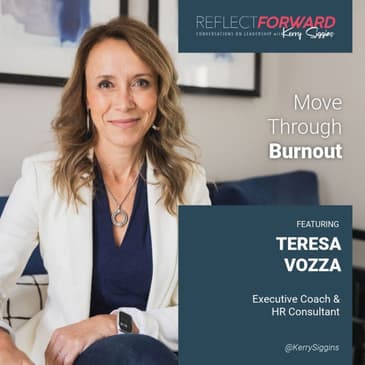

[00:00:10] Hi, and welcome back to Reflect Forward. I'm your host, Kerry Siggins, and I'm so glad you are here today.
[00:00:15] Today, my guest is Teresa Vozza. She is a certified executive coach and resilience trainer,
[00:00:20] but also a former CHRO, a chief human resources officer who had worked her way up in an organization
[00:00:26] and then burnt out. She had a big burnout story, and she shares that with us in the episode.
[00:00:33] And I just love this conversation because I do think that so often we maybe minimize burnout and we think
[00:00:41] that was like a 2020 issue, but the reality is that burnout is real. It is real every single day
[00:00:48] within our organizations. We absolutely have executives and managers and individual contributors
[00:00:53] who are feeling the stress of performing, getting things done, wanting to impress and climbing the
[00:00:59] corporate ladder, or just having too much work on their plate. And it really does affect people's
[00:01:05] overall well-being, which means that then they can't show up and be their best selves at work. So
[00:01:09] this is a really powerful episode, and I am so excited for you to meet her. She is wonderful,
[00:01:15] and I think you'll really enjoy this episode. So hang tight, and I will be right back with Teresa.
[00:01:28] Hi, everyone, and welcome back. I have Teresa Vozzo here with me, who is an expert in burnout
[00:01:34] because she knows what burnout feels like. And I know many of us are feeling the same way or certainly
[00:01:39] have in the past. And so I'm really excited to have you on the show to dive into this really
[00:01:44] interesting and timely topic. Thanks. I'm so excited to be here too. It's going to be fun.
[00:01:48] Wonderful. So can you talk a little bit about what your coaching practice is, and then we'll dive
[00:01:52] into your burnout story, which helped set you on a new path. Yeah, thank you. Yeah. So my coaching
[00:01:57] practice is really working with executives at that director, VP, and up level. And it's really doing
[00:02:03] one of two things. One, ensuring that there is a role alignment, that they're in the right roles
[00:02:08] that capitalize on their best skills. And two, putting them in a position to be free of stress,
[00:02:15] overwhelm, and burnout. So giving them the practices, the self-regulation tools and strategies,
[00:02:20] the mindsets, the ways of thinking, which now are very much about agility and adaptability,
[00:02:26] so that they can manage change in their company in a way that is sustainable and doesn't have them
[00:02:33] burning out or stressing out. So it's really about creating happy leaders and not leaders who are
[00:02:39] always looking for the door. So that's a little bit what I do. Yeah. Wonderful. And maybe you could
[00:02:45] share your burnout story and how it led you to making the career shift and doing what you're doing now.
[00:02:51] Yeah, my burnout story, my goodness. So it was in 2015. And as you and I were sharing just quickly
[00:02:58] before we pressed record. So my background is as a chief HR officer. And in 2015, I was promoted to,
[00:03:07] at the time, VP of human resources for this large global entity. And I was really stressed about the
[00:03:16] role because we were acquiring two companies. So we were in the middle of merger and doing all the work
[00:03:21] that's required to bring two companies together. And I felt very uncertain of myself, quite honestly.
[00:03:27] I felt very unsure of myself. I felt the classic imposter syndrome. Do I know what I'm doing?
[00:03:33] Is this the right role for me? Why did I say yes? So I was going through a lot of emotional turmoil.
[00:03:39] It's what I would reference now as kind of like the silent work. It's like that silent burden of
[00:03:44] leadership that no one really talks about because it's not in a job description. So as I was navigating
[00:03:48] all of these different emotions, there was a time I was in a boardroom with my CEO and the chief
[00:03:55] medical officer at the time. And we were interviewing someone and I started to feel very faint and I
[00:04:02] started to feel like I was going to panic. My heart was beating really fast. And as I got up,
[00:04:08] I noticed that I was feeling even more woozy. And I just, all I remember saying is, excuse me,
[00:04:14] I need to step out for a moment. And then I kind of fell over onto a chair. That's what I remember.
[00:04:20] And it was at that time, it was like a blur of events happened. The ambulance was called.
[00:04:28] I remember the CEO just looking over top of me thinking, what is happening here to this person
[00:04:33] I just promoted? And I was carried off in a stretcher. And it was very embarrassing because
[00:04:39] it was just new in the role and it was in front of all my peers and colleagues. And long story short,
[00:04:45] when I got to the hospital, I was convinced I was having a heart attack. And I'll never forget
[00:04:52] the doctor's words who, after running a battery of tests, said to me, Teresa, you are not having
[00:04:59] a heart attack, but what you are is depleted and you need to do something quick. And I remember like
[00:05:07] just that feeling in your body, like you just shivers and like chills going down your body. And
[00:05:11] me just really realizing something had to give that I couldn't keep going at this pace.
[00:05:17] And I went and saw my GP, she diagnosed me with burnout and I didn't take any time off work.
[00:05:23] That was the interesting thing. I had too much pride. I was like, no, I'm not taking time off
[00:05:27] work. I'll just take it easy. So I wish I could tell you that was like the aha moment. It was the
[00:05:33] beginning of an aha moment, but it took me many different falls up and down to get to a place where
[00:05:41] I finally was like, okay, I actually have to do something really differently to manage my burnout and
[00:05:47] enjoy leadership. Because if I don't, then they hired the wrong person because I would always be stressed
[00:05:52] out. So it was a real eye opener. What happened next? So you didn't take time off, but how did you
[00:05:58] recover from that or at least somewhat recover enough to be able to function at work? Yeah. So
[00:06:04] I would say the pivotal moment came for me when someone introduced me to a mindset coach. And at the
[00:06:11] time I've never had a coach before. I never, I mean, I understood it because I hired coaches for my
[00:06:16] company, but never really thought about it in terms of for myself. And so I hired a mindset coach
[00:06:23] and she really started to help me unravel what I call now and what I use in my practice,
[00:06:32] conditioned tendencies. So these are the conditioned tendencies we have for how we work,
[00:06:37] how we think, how we move in the world, how we relate, how we interact. And so many of these
[00:06:43] tendencies of mine were conditioned from a very young age. So it wasn't so much, it wasn't therapy. Like
[00:06:53] in my life, although I have no problem with that. And I've actually done that work too. That was
[00:06:59] actually part of my burnout recovery is realizing I needed to do some trauma-based therapy. So it was
[00:07:04] actually very good for me. But the beginning, what started it was realizing that this wasn't
[00:07:10] something that was just who I was. It was conditioned in me from a very young age to believe and act
[00:07:15] and move through the world in a certain way. And so I started to create new belief structures.
[00:07:22] I started to challenge my assumptions. And that created tactical actions like creating boundaries,
[00:07:29] mental and emotional boundaries, but also work boundaries. Because I have a long history of
[00:07:35] addiction in my family. And so behavioral addictions, substance addictions are all over the place.
[00:07:40] But for me, where it really came was overwork. I was a workaholic and I found all my value
[00:07:46] in work and getting that type of esteem back from people in authority, like CEOs and board members
[00:07:53] and so on and so forth. So I really had to untangle this mess I had in my mind that my worthiness
[00:08:02] was attached to work and to impressing authority figures. That was a big piece and started everything
[00:08:09] for me. And so what was kind of the turning point? When did you decide I'm leaving and I'm going to go
[00:08:15] out on my own and do something entirely different? Well, the good thing was it happened when I was
[00:08:20] really on that path of healing. So I was feeling really good. I had the opportunity to create a coaching
[00:08:26] program within Allianz, the company I was working at. So I worked with a number of executive women and
[00:08:32] up and coming leaders. And I found such great reward in that practice. And then COVID-19 happened
[00:08:38] and we were all forced in our homes and our business was tanking because we were in insurance and no one
[00:08:45] was traveling. And so I decided I'm going to go back for my coaching certification. I was certified
[00:08:52] once before many years ago, but I was much too afraid at the time to start off on my own. So I wanted
[00:08:57] to get recertified just to see what changed. And through that process, I really saw that I had a
[00:09:04] gift. I saw that I had a gift of being able to connect with people. My trauma background also enabled
[00:09:11] me to create more trauma-informed coaching principles. So I was able to really work with men and women who
[00:09:15] also suffered from those conditioned tendencies like I did. And I started to just build a side hustle,
[00:09:23] a business that just kept growing. And then in 2020, I remember just saying to my boss,
[00:09:30] thank you so much for a great few years. I had a great CEO. I think it's time for me to go. I think
[00:09:36] that I'm really ready to start off and start on my own and create my second curve in life, if you will,
[00:09:41] and build my own business and really do what I love. Because I was starting to feel a little bit
[00:09:47] tired as well of the kind of corporate minutiae. But I knew that I had a gift of being in front of
[00:09:53] people and being able to help them make an impact in their personal lives and professional lives.
[00:09:59] So that's what really started it. That was in 2020. And the business has been very successful
[00:10:06] since then. And I've been so, so grateful for that gift.
[00:10:10] Now, let's talk a little bit about the silent aspect of leadership that struck a chord with me.
[00:10:16] Can you tell me a little bit about what you mean by that?
[00:10:18] Yeah. It really refers to that invisible work. It's what no one tells you when you're ascending
[00:10:24] into leadership. So here's a quick example. If you're moving from, say, director level to
[00:10:29] vice president and your CEO says, hey, you need to really clean up department X because there's a lot
[00:10:37] of waste and projects are not coming in on time or on deadline and you're new to leadership,
[00:10:43] leadership. Not only are you learning the ropes of your new role and your new peer group, because
[00:10:49] now your team is no longer your department, it's your peers on the executive team, you're also
[00:10:55] grappling with the internal doubt. And so that silent burden or that invisible work would be things like
[00:11:02] dealing with imposter syndrome while you're ascending to a new role. It could be navigating conflict with
[00:11:09] colleagues who are really upset with you because you're coming in and trying to create change and making people
[00:11:14] accountable. So that creates a whole other dynamic that, again, isn't on a job description. It's all silent.
[00:11:21] It's all work that is done as part of transformation within a team or with a department or with a company,
[00:11:29] but it's not talked about. So that is what we call, and this isn't coined by me, I forget who came up with this,
[00:11:36] but emotional labor. It's that labor that comes with putting a smile on your face saying, sure, I can do it.
[00:11:42] I want to show you that I'm a great new VP, but then inside thinking, oh my God, how am I going to do this?
[00:11:48] And then there's that stress and that anxiety that might come about that, again, you're not going to
[00:11:53] show on the surface. So it's really helping leaders understand that you're not alone. This is normal
[00:12:00] to have this kind of invisible work show up when you take on a new role or even if you're tenured.
[00:12:06] And here's some resources and support that we have for you to be able to help you. So this one company
[00:12:12] hired me as an executive coach for all their new leaders once they created a major acquisition.
[00:12:18] And that's precisely what I do is I work with people on the silent burden side of leadership.
[00:12:24] So they do have a place to go to that's safe and confidential and allows them to deal with that
[00:12:32] side of leadership that no one talks about in the boardroom.
[00:12:35] And what do you think companies can do differently about getting the silent leadership
[00:12:39] skills, traits, requirements out on the table so that it isn't something that we don't talk about?
[00:12:45] Yeah, I think first and foremost is painting an accurate picture. I think that one, we need to
[00:12:50] become aware. We need to become aware that there is invisible work, that there is silent burdens of
[00:12:54] leadership, that most people I know that move into a new role don't come back to me and say, oh, it's
[00:12:59] even rosier than I thought. No, what happens is they usually go in and they're like, wow, there's a lot
[00:13:04] to do here. And so I think it's one just painting an accurate, honest picture of the challenges that lay
[00:13:11] ahead. And I think one great thing a CEO can do or a senior leader is to state you are not alone.
[00:13:18] What problems? You have this person here to support you. You have that person there to support you.
[00:13:24] You may, if resources are plentiful, have an executive coach that'll have you work with so
[00:13:29] that you can work through some of these challenges for you in your first 90 days or your first six
[00:13:34] months. So there's lots of things that can be done. But I think first and foremost is not what we call
[00:13:41] smuggling in change management language, which is we're really ambiguous and we don't really paint the
[00:13:46] whole picture of what a transformation might look like. Instead, it's about saying, no, there are going
[00:13:52] to be challenges. This is what we see. There's probably others that we haven't seen. You're going to
[00:13:57] uncover them, but you are not alone. And here are three different ways that we can offer you support as you
[00:14:04] these struggles. That I think would position a new leader or even a tenured leader who's struggling
[00:14:10] with a sense of emotional safety. And when emotional safety is there, they're usually
[00:14:18] your executives for life because they know that they're safe in that company and that they're
[00:14:23] supported throughout that journey, even when things get tough.
[00:14:28] Yeah. Just thinking through the burnout from my perspective, being an achiever, it sounds very
[00:14:32] similar to you wanting to make sure that people know that they can rely on me and that I'm impressing
[00:14:37] that I'm seen as a good leader. And, you know, I think that drive is what leads to burnout a lot of
[00:14:42] times. And then, of course, being a high achiever and always wanting to take on more, a leader is going
[00:14:47] to be like, yeah, here, go ahead. Yeah. And so through your lens of being that kind of person,
[00:14:51] I'm curious because I have kind of my own journey with this as well.
[00:14:55] For those people who are really driven, really high achievers, what advice do you have for them
[00:15:01] about how to maybe regulate themselves in this space?
[00:15:05] Yeah. So good. I didn't coin this. I heard this, but I remember hearing it a long time ago and it's
[00:15:09] so resonated, which is like the dark side of our DNA. So the dark side of the high achiever DNA
[00:15:15] is that urgency, that impulsivity. It's like that ability to get things done and to do it
[00:15:21] spectacularly. I think first and foremost, there needs to be a case to be made to the high achiever
[00:15:28] that there is a dark side. I think they need to understand that not just theoretically,
[00:15:34] but from what I call a somatic sense, like in an embodied sense. One of the things that I suggest
[00:15:40] to new leaders or existing tenured leaders who struggle with that high achiever DNA is understanding
[00:15:47] what is the cost to you to run at this pace. Once they get in touch with the cost, I also ask them
[00:15:55] to go a step further and ask them, where do you feel that in your body? And often they can find it.
[00:16:00] It's a tight chest. For me, it was like the fertile brow or it was a tight jaw. And so once we can
[00:16:06] find where that's located somatically and then ask them to relax into releasing that tension
[00:16:15] and then to make decisions from that place, what we often find is that high achievers tend to go a
[00:16:22] little slower. They tend to make more thoughtful decisions because I know for myself, I'm a super
[00:16:28] high achiever just like you, Carrie, but sometimes what that does is it makes me be too impulsive and
[00:16:34] I'll make really quick decisions that I have to then go back and fix. And I learned that when I was in
[00:16:39] leadership. So understanding what the cost is, understanding what it feels like to be in a body
[00:16:45] on a daily basis that is driven by thoughtfulness and presence and resonance in my work, and then to
[00:16:54] practice that. So I like to get really hands-on with people and say, okay, your next meeting,
[00:16:58] I want you to practice being really soft and stance as you respond to questions or make a
[00:17:04] presentation or whatever it might be. Come back, report to me, how did it feel? So it's really about
[00:17:10] number one, understand the cost and where does that cost live in your body? And then the third piece
[00:17:16] would be now go out and practice that one practice at a time, at a meeting, at a presentation, at a board
[00:17:23] call, whatever it is, and then start to integrate it so it becomes a new way of being and not just a one-off.
[00:17:32] I love that you talk about the body because so many people are not aware of what your body's telling
[00:17:37] you, but your body is the best instrument you have to understand what's going on with you in the moment.
[00:17:43] So many people just ignore it. They just have no idea how to feel this stress in the body or how to relax
[00:17:50] within the body or how to ask their body, what are you trying to tell me right now? So I love that you do
[00:17:56] that kind of work and I love that you call it somatic. Is that what, is that the word you use? I haven't
[00:18:00] heard that before. Yeah. So can you, will you tell me a little bit more about what that means?
[00:18:03] Yeah. So somatic, the root word is soma and soma means body. And so the idea is that there is like
[00:18:09] body-based practices that allow you to integrate insight, which you get from the coaching process,
[00:18:15] which is very cognitive, but we integrate it with the body, which has been shown to create the most
[00:18:23] lasting transformation in people. So it's one thing to know something. No. And even in coaching,
[00:18:32] like I see this a lot with the new coaches, they can function on the head and really focus on
[00:18:37] limiting beliefs and changing the narrative and reframing, all of which are very powerful.
[00:18:43] However, to really deepen that insight, you need to integrate it with the body. So it becomes a way
[00:18:49] of being. And so I learned this through the Strozzi Institute, Richard Strozzi, who has a whole program
[00:18:57] on embodied leadership. And it's really about creating leaders who actually do integrate learning with
[00:19:04] their soma, with their body. And we call this somatic leadership. So leading with the body and the head,
[00:19:11] like the two go together. And that makes for, I think, some of the best decisions I think leaders can make
[00:19:17] and humans, quite frankly. Can you give me an example of a client or somebody has gone through
[00:19:24] this process and recovered from extreme burnout? Yeah. So the best client I can think of,
[00:19:30] she was a director level woman. She was experiencing a lot of stress and anxiety in her role.
[00:19:35] She was convinced that a Boston Laker, that he was talking about her behind her back,
[00:19:42] that he was not supporting her in meetings. And so we started traditionally, as I often do with just
[00:19:50] like, where do you feel that? So we just asked her to just get really close in her seat and start to,
[00:19:56] where do you feel that tension, that feeling? And she was very quick. And for her, it was like,
[00:20:00] it was in her head. It was like all here. And then I would ask her, where else? So first,
[00:20:04] just about where else do you feel that? And when you're with him, what does that look like?
[00:20:09] And she would say things like, my posture would be rigid. My brow would be furled. My body would be
[00:20:14] like a ruler. It would be tight in a line. And so I'd say, okay. And then I would ask her to flip
[00:20:21] the experience. And I would say, so who in your life do you feel the most cared for, loved, and
[00:20:27] supported? And she would call to mind someone. And in this case, it was her sister. So she brought her
[00:20:33] sister to mind. And I brought in what's called heart-centered breathing, which is a scientific
[00:20:39] principle that I learned through the HeartMath Institute. And I asked her to put her hand in
[00:20:43] her heart and to start to breathe in and out very slowly, calling to mind her sister. So she did that
[00:20:50] for a count of five or 10 breaths. This is over a number of sessions. So then I started, so now,
[00:20:55] how does your body feel? And she'd say, I feel like my shoulders are a little bit more relaxed.
[00:21:01] I feel my chest is a bit more expansive. I feel like my legs are not so tingly. I was like, okay,
[00:21:08] cool. So let's hold on to that for a moment. Let's just stay there for 30 seconds, 60 seconds.
[00:21:14] And she did. And then I would say, okay, let's think about the week ahead. And she had a particular
[00:21:20] one-on-one with her boss and that was coming up. And I said, now I want you to envision,
[00:21:26] and this is what we brought up in envisioning, bringing in from this place where you have your
[00:21:31] sister in mind in the body to this meeting, what would look differently? And at this point,
[00:21:38] her eyes were closed. And she said, well, what would look differently is that I would not be
[00:21:42] coming in so rigid. I'd be coming in a bit more relaxed to the meetings. I said, great. So what
[00:21:46] happens next? And she just played it out. She said, I would sit down. Then what next? Then I would
[00:21:51] outline what are the things that are going well at the organization. And I just had her like work
[00:21:56] through what that would look like from this place. And then I would just check in. How are you feeling?
[00:22:01] Feeling relaxed? And what would you tell yourself if he started to ask you more questions? He's just
[00:22:08] asking questions, but she was only able to access that from a really softened physiology. And so we did
[00:22:16] this over a number of sessions. And then I think three sessions in, she said to me, we had a great
[00:22:22] conversation. It just naturally and organically happened. And he just said to me, Rose, you just
[00:22:28] seem different in these meetings. You seem way less tense. And she said, you know what, Rob? I am.
[00:22:35] And thank you for noticing that. I was feeling like maybe you and I were a little disconnected.
[00:22:39] And then they just had this great conversation about what was happening in the company. And that was an
[00:22:43] example of all she had to do was to evoke something within her body somatically, what it was like to be
[00:22:51] and feel not hard, not rigid, not like a ruler, and have that be a heartfelt experience. Like you can't
[00:23:00] fake that. You have to actually conjure up the image of someone that you care for. And that's why
[00:23:06] sometimes it can take a while because I work with a lot of executives and they're very rigid sometimes.
[00:23:11] And so it takes a while for them to get comfortable getting into the body. And that was a wonderful
[00:23:16] experience. She ended up working really well for him, but she did eventually leave because she got a
[00:23:20] promotion, but they're good friends still today. So it was a great outcome.
[00:23:25] And it's such a good reminder of the stories we tell ourselves and how toxic it can be, right? I mean,
[00:23:30] to sit there and for her to think he doesn't like me and I'm going to get fired, all of these things,
[00:23:34] which was a story she was telling herself. And then what it was, how it was really negatively
[00:23:39] impacting her life. It's just such a great reminder. The stories you tell yourself are
[00:23:43] not always true, but it's hard to get out of it, right? You have to go through a process to
[00:23:47] get out of that story. It's so true. And you know, what's interesting,
[00:23:50] Kyrie, is that if I wanted to, I could have strictly just talked to her about,
[00:23:54] do you know that's true? How do you know it's true? And really worked at it cognitively.
[00:23:59] And maybe we would have gotten to the same place. I'm not convinced that we would have,
[00:24:03] but it probably would have taken way longer. But in this instance,
[00:24:07] we didn't need to go into the story because the story wasn't the problem. What we needed to do
[00:24:13] was access what was going on internally and in her body. And over three sessions, she was able to
[00:24:20] actually change the narrative all by herself. I didn't need to do anything by just allowing her to
[00:24:27] tap in to a state of being that was healing and fruitful for her. And to me, it was like just such a,
[00:24:37] a testament to releasing the story and also just really getting into your body and allowing it to
[00:24:44] do the work for you. So if a person is listening who says, this story resonates with me, that I feel
[00:24:50] this, what are some things that they can do right then and there to help themselves get into their
[00:24:55] body and be able to move through whatever stress that they're feeling? Yeah, I would say really simple,
[00:25:01] just start with noticing. In the very beginning, you have no knowledge of body work or kind of
[00:25:06] nervous or intimidated or don't even want to do it. I'll just say, okay, that's cool. Let's just
[00:25:10] start by noticing. I want you just to spend a week. I want you to notice when you go into a meeting with
[00:25:17] your boss or when you're doing a presentation, just what's happening in your body. Just make a
[00:25:21] couple notes. Just start noticing what are you thinking? What are you feeling? And what are you
[00:25:26] doing? And so I just start with that. So they do a bit of an audit. In the beginning, they'll
[00:25:32] might say, I don't notice anything. I just notice how much I don't like him or he's not listening to
[00:25:36] me. And I'll go, okay, cool. So now notice what is your body doing in those meetings? And then they'll
[00:25:41] start to be like, well, I'm shifting in my seat a lot or I'm crossing my legs all the time or I'm going
[00:25:46] like this, crossing my arms or I'm really like tight face. I'm like, oh, okay, cool. Let's keep
[00:25:52] going. And so once I get them to notice, that's when I know, okay, I'm getting somewhere. She's,
[00:25:56] she or he is now getting to a place of noticing that their body's also in the room, not just them.
[00:26:04] So for your viewers, I would just say the same thing. Just start to notice. Start to notice when
[00:26:08] your body tenses. Start to notice when you feel tight, when you feel constricted or hard in any
[00:26:15] place in your body. And very simply play with just relaxing it. That's it. That would be the very
[00:26:24] first thing I would do. So you feel it, you're in a meeting. Oh, I remember Teresa saying on that
[00:26:28] podcast about noticing it, relax it. So if you feel the shoulders up here, just relax it. Just start
[00:26:36] with that. And then that is enough of a signal and a message from the head to the body to say,
[00:26:44] we're doing something different here. And that can really start to disrupt the patterning that's
[00:26:49] obviously there. And that's what we want to do in the very beginning. It's just start to
[00:26:53] interrupt the pattern. And we interrupted by noticing, softening, noticing, softening. And
[00:27:00] then we start to do some deeper work after that. Yeah. Whenever I feel myself getting anxious in a
[00:27:05] meeting or wanting to jump in or stressed, I think about my feet on the floor. Yeah. That is a good
[00:27:11] way. Like, right. Just, okay. My feet are on the floor. And then you just automatically relax a little
[00:27:15] bit because you're putting yourself into the body, but it's also very real and tactile, right? I can
[00:27:20] think about my feet on the floor right now. So it's just an easy way that, you know, reminds me
[00:27:25] very much of what you're talking with to be able to say, okay, like I can stop this right now. I don't
[00:27:30] have to go down this path of getting worked up about something. I can just get into my body and just take
[00:27:35] a deep breath and feel my feet on the floor and relax. Yeah. That one really works too. And I find
[00:27:39] with my male clients, CEOs or executives, grounding works really well because their feet are firmly planted
[00:27:47] on the ground and we just expand the body. And that for whatever reason, centering, grounding,
[00:27:54] aligning helps them show up and access different emotions and ways of talking that may not otherwise
[00:28:02] have been there. So I love that example. It's a really good one. Yeah, absolutely. What other advice
[00:28:08] do you have for a struggling VP, executive, C-sweeter when they're in burnout, but even more interesting
[00:28:14] before they get to it, right? Because that's a really important thing is to recognize, ooh,
[00:28:19] I might be getting to this point and not getting to where you pass out or feel like you're having a
[00:28:24] heart attack. Yeah. Yeah. And that's so important because I think the big burnout stories hit the
[00:28:30] news. Like my story was a big burnout story, but the truth is it happened way before that. And it's all
[00:28:36] these micro examples of burnout. So I would say for VPs, for directors, anyone in a leadership role,
[00:28:44] start to notice irritations, start to notice when you check out, start to notice when you become
[00:28:50] apathetic or for many of my clients, it begins with, I just don't care anymore. That's a big one.
[00:28:57] I just don't care anymore. I just don't. The truth is they really do care. It's a defense mechanism that
[00:29:01] we put in place to protect us and it's valid. But I think for existing leaders is just start to
[00:29:07] notice when you're checking out or starting to experiencing any one of those kind of beliefs or
[00:29:12] behaviors and just stop, just pause in the day, pause in the moment that you're in and do something
[00:29:19] totally different. And I think that too is all about interrupting the pattern. So do something
[00:29:25] completely different. If that means you're going to get up and go for a five minute walk or take your
[00:29:30] dog out, go. If that means you're going to go to the washroom and just sit in a stall for 10 minutes,
[00:29:35] do that. If that means you're just going to pick up a meditation or something that you're inspiring to
[00:29:41] read that's on your phone, do that. But whatever it is, just stop. Recognize this is a moment of stress.
[00:29:49] I'm going to do this now. And then that will start to change the pattern and create some space
[00:29:55] between micro burnout and big burnout. So I think that would be the first thing I would say.
[00:30:02] Yeah, that's great advice. Yeah. Okay. So tell me a little bit as we wrap things up here,
[00:30:06] what makes you different and what kind of things do you offer? I know you have courses,
[00:30:10] I know you do coaching. So share a little bit about what you do and why it's different than all
[00:30:15] of the other leadership coaches that are out there. Yeah, good question. I think a couple of things
[00:30:19] that make me different. One, I think the embodiment piece is big. There's not a lot of leadership
[00:30:24] coaches that do a lot of embodiment work. I think it's for a number of reasons. They're intimidated by
[00:30:29] it. They don't know how to do it. It feels almost esoteric and it's not. It's very scientific
[00:30:37] based practices that get into the body. So I think that's first and foremost is that
[00:30:43] my coaching practice is grounded on science and it's grounded on research that works to help transform
[00:30:49] people's internal state. There's two things that I think are my biggest offers. One is helping
[00:30:56] ascending leaders at that director, VP, and up level really develop into the type of sustainable leadership
[00:31:06] that has them enjoying what they do and not burning out and being part of that journey with them as we
[00:31:13] go along. So really equipping them with strategies, tools, embodiment practices, scripts, things that
[00:31:21] they can use with their teams, things that they can use on their own to bring in more a sense of
[00:31:26] presence and whole person leadership. So I think that's the number one thing. I do that through
[00:31:32] usually customized programs, but also leadership coaching in groups. I do that a lot with teams.
[00:31:37] And the second would be private, very private, bestowed, customized one-to-one work that's very
[00:31:44] much geared to the particular client and what they're challenging as well. I often find that because my work
[00:31:50] is so much in the embodiment side, I don't need to work with them for six or 12 months. We can get a lot
[00:31:56] of impact in six or 12 sessions. So there's also that appealing nature to really busy executives
[00:32:02] that feel like, I don't know if I want to work with someone for six months or 12 months, but I would
[00:32:07] really love to work with someone for maybe six sessions and experience this piece for myself.
[00:32:14] So that would be more of the private one-to-one work.
[00:32:17] That's great. That's great. And how can people find you?
[00:32:20] Yeah, super easy. They can just go to my website, TeresaVoza.ca. I'm really active on LinkedIn.
[00:32:26] I'm not on Instagram. So LinkedIn is my home. They can get in touch with me there and I'm pretty
[00:32:32] active and responsive there as well. Great. I'll include all those in the show notes.
[00:32:36] Okay. Final question. That's my signature question. The name of this podcast is Reflect Forward.
[00:32:40] What does Reflect Forward mean to you?
[00:32:42] Yeah. I love this question. I think Reflect Forward means what do I want to be known for?
[00:32:48] I always think about that with my children. I think about that as a businesswoman. I think
[00:32:53] about that as a friend and as a wife. What do I want to be known for in six months from now,
[00:32:59] in 12 months from now, in five years from now? I'm very inspired by thinking about how my kids will
[00:33:07] describe me going back and how clients will describe me looking back. So that's what I think
[00:33:12] about. I love that. Yeah. Teresa, this has been so much fun to have you on the show. I got all kinds
[00:33:18] of great advice being in the C-suite. It's a stressful job and you got to manage it carefully. And so I
[00:33:24] really appreciate your insights. I will be taking some of it to heart and putting it into practice.
[00:33:29] Awesome. Well, thank you so much for having me. It's been a great deal of fun.
[00:33:33] Thank you. All right. Hang tight, everyone. I'll be right back.
[00:33:42] All right, everyone. I hope you enjoyed that podcast. She sure is a fantastic coach and I hope
[00:33:48] you check out her website. I think that she could help many of us out there. So with that, I will
[00:33:53] leave you for your day. If you like this podcast, please share it with a friend, write a review,
[00:33:57] subscribe to it on your favorite podcast platform or on YouTube. It helps with the algorithms and it
[00:34:02] gets these amazing stories for people like Teresa out there to the world. So thanks so much and
[00:34:07] we'll see you next week.
[00:34:08] Bye.