
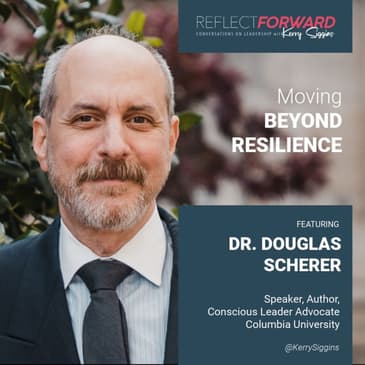

[00:00:00] Hi everyone and welcome back to Reflect Forward. I'm your host Kerry Siggins and I'm so glad you're here today. Today my guest is Doug Shearer. He has become a good friend of mine.
[00:00:21] I was introduced to him from another person, a podcast guest that will be coming on here in a couple of weeks and I met him in Washington DC when I was out speaking on Capitol Hill
[00:00:30] and we hit it off and I knew he had to come on the show. He is an author, a keynote speaker, a facilitator and a professor at Columbia University where he teaches strategic thinking and leadership and fostering innovation.
[00:00:45] And he is passionate about helping individuals and organizations thrive at life and at work. And during this podcast we talk about his book called, BORGED, Six Practices of Great Leaders in Volatile Times. And we talk all kinds of things about mindfulness and leadership and resiliency and fear and
[00:01:07] it's just a super fun conversation that I know you're going to enjoy. So hang tight and I'll be right back with Douglas. Alright everybody, I am back with Douglas Shearer. Douglas, I am so glad you were on this show.
[00:01:27] This has been a while in the making since we got to meet each other in person in Washington DC in April. I'm so excited to have you here to have this conversation. So why don't you tell the audience a little bit about what you do because you're kind
[00:01:40] of a man of lots of different skills and different roles. So give us a two minute kind of pitch about what you do. Absolutely. Well, my work is focused on leadership and helping leaders and I have multiple
[00:01:53] things in their workshops I do, keynotes and also helping folks create their strategy and their pitching practices. So I have a book that came out a couple years ago on leadership called Forged and
[00:02:07] in that I talked to different kinds of leaders all the way up the scale to one of the board members of JetBlue, to the local leaders of the food pantry and kind of looked at the similarities and differences and what kinds of leadership practices come
[00:02:21] out of that especially, and I was interviewing them during the pandemic, in volatile times. So these are times of uncertainty where you don't really know the answer and there's constantly new things coming up. So basically how do you deal with uncertainty and ambiguity in your leadership practices?
[00:02:38] I love it. And so tell us a little bit more about what inspired you to write that book, how has leading in times like we have today helped you form your ideas around your book? Yeah. So it was a little bit forming out of a couple different things.
[00:02:53] I had actually started working on a book about leadership mindfulness because I'm also trained in what's called MBSR, which is this mindfulness based stress reduction. And I bring that into my work and into my work with executives.
[00:03:05] And I was working specifically on the mindfulness and then I kind of got put into this cohort. I found this wonderful cohort of authors and they really focused on getting stories out of leaders. So I was you know, I'm an academic, so I have a lot of research.
[00:03:21] I was doing a lot of research on the mindfulness and I thought, wow, what a great way to really get into it. Find talking to people about their stories in the moment of this complete state of uncertainty that we were in in the pandemic.
[00:03:34] So I talked to not only the board member of JetBlue, the local food pantry, but people who were involved in HR having to completely redo how they were working on their performance reviews. And in some cases, completely doing reorgs of their entire business and how
[00:03:50] people were going to work together online suddenly. So there were all ways that people were coming to me with stories about dealing with ambiguity, how we were dealing with the new world, how we're dealing with being separate.
[00:04:01] And one of my favorite ones was actually a pilot I talked to, an entrepreneur friend of mine, David Clark. And he was telling me a story I share in the book about making intuitive decisions. And this is one of my favorite areas to work in because when you're
[00:04:16] dealing with uncertainty, there's not enough data in the world that's going to give you the exact answer. As a leader, and you know this, that you have to make a decision based on the information you have, which may not be complete.
[00:04:27] And so there's a leap that you have to take. And he was flying his plane from I think North Carolina back to Maine. And he was getting to around the Newark area and suddenly his mind
[00:04:39] kind of went, hmm, I wonder if I have enough fuel to get back. Now he's an engineer, that's his thing. And he's made this trip multiple times. So he's done the calculation right. But something in his gut said, I have to check this.
[00:04:51] So he landed, took him an extra hour for the trip. It turned out for some reason he was four gallons short. And so he basically would have been landing somewhere in the Bronx. So what is it that made him even think of that?
[00:05:04] You know, just sometime intuitive gut sense. And I love working with that. A lot of that came out in this talking to different leaders, not only the gut sense, but then how do you take that forward?
[00:05:16] And part of that that comes out is like, I call it recasting ideas. It's the R and forged is being able to work not only with your own mindsets, but the mindset around you and others around you and take that forward.
[00:05:31] The story I tell in terms of recast ideas, one of them is with Virginia Gambell who's on the board of JetBlue. And she was the one that actually brought wifi to airplanes for the passengers. And it took her two years of coming to the board.
[00:05:48] Nah, doesn't sound right. Doing research, coming back to the board over and over again. And she had to convince them and get everybody on board with, you know, we may have to drill holes in the planes to create a new satellite connections
[00:05:59] and set up all these kind of all new technology, right? But her goal and her sense was, I do not want to put bad wifi in the planes because then it's a bad experience. And research has shown and the numbers are in the book that people will
[00:06:16] definitely come back for good wifi experience, especially if they're business passengers. And so there's a bit of grit in there because it's not giving up, it's coming back, but knowing in that intuitive sense, knowing, and eventually they did that and they had to reconfigure the planes and all
[00:06:31] that. But JetBlue was the first one to have high speed wifi. I love that. I think intuition is such an important part of leading. And in this day and age, it can be so easy to overemphasize data. But our intuition really is based on our experiences.
[00:06:49] And so you're pulling from past experiences, which in itself is a form of information, is a form of data. You know, I think about like COVID when there was no possible way that any of us could know what the outcomes were going to be.
[00:07:04] You know, there's no data to be able to look back on and say, well, this is what's going to happen with any particular business. I've always trusted in my intuition. There was no other choice. I have to make decisions. I've got to pull people in together and collaborate.
[00:07:18] But ultimately the buck stops with me and I have to make these calls. And what does my gut tell me that I should do? And I'm so glad I listened to it because it worked. And even though it was a really tough year, 2020, we made tough decisions
[00:07:35] to make sure that the business was going to be able to go forward. But we were smart about where we made those cuts because we knew it when we bounced back, it was probably going to look a certain way.
[00:07:45] And so it was very validating saying, okay, there's going to be times where you don't have the information. You don't have past experiences exactly like this to pull from. So what do you use? Well, you have to rely on your gut.
[00:07:57] So I'm really glad that you brought that up because I think it's an under-talked about trait in leadership. Yeah. I have this triangle of values, expertise and awareness. And I love hearing that story because I think it really ties into that.
[00:08:12] Your mission statement should represent that, but also it's your internal sense of wanting to do well for the company as well. And I know, especially in your company, which is employee owned, everybody's in this for each other.
[00:08:25] And so there's a whole values model in there, which I think would be amazing to deep dive on in itself. And then the expertise is the knowledge that you talked about, but it's beyond that because there's skill sets in there, but it's also having dealt
[00:08:39] with things that you haven't seen before in the past and knowing that you have to take that leap. And the awareness is like undoing the biases, undoing the assumptions, especially in situations and not only in the pandemic, but just in business in itself.
[00:08:54] I mean, the pandemic is like an explosive version of that, but just the market in itself. You're always having to deal with competitors, new technology. I mean, people went crazy with AI when, how is that going to affect us?
[00:09:07] And you know, we're still working on that, but that's where the values piece comes in as a guide. The expertise comes in as the knowledge and the awareness of this situation is always going to be something different than what we've seen before.
[00:09:21] This kind of leads into my next question in your book, you talk about reflection and action, and I love that. So can you talk a little bit about what reflection in action is and how leaders can do it to make more intuitive decisions? Yeah, sure.
[00:09:37] And I love the title of your podcast, reflect forward. You know, I was looking all over, you didn't have exactly like it's spelled out, but the sense I get of that is that I'm really doing the
[00:09:47] introspection I need to do to move forward in ways that we've never done before. Does that sound about right? Exactly. That's exactly right. So I'm going to use that as my tagline. Thank you. I'm going to copy that. It's yours.
[00:10:00] But the reflection in action comes from a study done in the late sixties, early 1970s at MIT and was written up in a book called Beyond the Stable State. And the stable state is this place where you see technology and new things happening,
[00:10:18] but you try to run back and try to make everything the same as it was before. It's almost be like if you see AI coming out and you say, well, we're just going to try to make everything the same, but now using AI.
[00:10:29] I mean, like, why would you want to do that? And you're not going to be able to do that because now the change is now organizational. And so the reflection in action is saying, I'm going to take things that I know and an open mindset.
[00:10:44] So I'm going to reflect in the moment. So while I'm taking action, I'm reflecting on it. There's after actionary views, which would be reflection on action. So reflection on this thing that I've done. And then there's knowing in action is what they call it, which is
[00:10:59] basically just taking everything I know and just repeating it. But reflection in action is keeping this open mindset so that I can move forward. And I think it just beautifully dovetails with your title.
[00:11:10] And I know that to do the kind of work that you do in reflecting forward, you have to be really open to what's really happening right now and kind of jettisoning all your assumptions about the situation. Yep. Agreed.
[00:11:24] I know you talk about in your book, you know, about mind storms. So can you share a little bit about what that means and how reflecting and action relates to this? Yeah, that's my favorite example. You picked the right one. Nice. So that's Lego.
[00:11:40] And so they came to a very interesting moment, which was in they came out with Lego mind storms and they were able to program this little robot. And the language of doing that was proprietary. And so as soon as that became proprietary and it came out, of course,
[00:12:00] someone over at Stanford, an engineering student published, reversed engineered it and then published that as a paper. So there was a choice to make because there was now the same year there came out the law that kind of prohibited that the federal regulation.
[00:12:14] And so the lawyers at Lego said, we're going to sue this guy, right? Cause this guy now exposed to everything. We're going to lock it down again in a different way, even further. And so that's the legal mindset.
[00:12:29] The marketing mindset, I forgot the gentleman's name that came out with this idea, but he was the head of marketing and he said, let's go back to the values of Lego. The values of Lego is that we want to encourage people to create.
[00:12:45] We want to use it as an educational tool and that's not locking things down. Let's just take advantage of this moment. And instead of going and suing this guy and creating all this bad blood, let's actually allow them to use the open code.
[00:13:01] And so Lego Mindstorms became like the biggest product they have. But to me, that's a soul searching moment and they went back to the values in their mission statement and use that to move forward and created this whole community around it. I just, I love this story.
[00:13:19] I think it's so fantastic. And I think it really falls in line with my personal philosophy is love is the answer for everything. And even in a competitive situation, when something negative is happening,
[00:13:32] a lot of us want to go to fear and then that causes us to want to retaliate or protect. And there are certain times when protecting matters, but I still think it needs to come from this place of what is good for the world?
[00:13:45] Where can I bring the best parts of my personality, the most loving parts of my personality in making these decisions? We don't talk about that in leadership either, but it's so true because I think that we find ourselves going down, I think these
[00:13:59] really negative situations because of fear, because we do want to retaliate like, you know, maybe our initial reaction is right where we let the lizard brain take over rather than how is this really good? How does this align with our values?
[00:14:12] So I just, I love this example because I think it comes from that place of, you know, more mindfulness. Like you talk about instead of mindlessness, you know, how does this align with who we are and who we want to be? Yeah.
[00:14:25] And you know, when you were saying that, what I was thinking of is as in leadership and management is micromanagement. So the fear set, I think leads to micromanagement versus a creative open innovative place. Right? So yeah, I mean, okay.
[00:14:44] What gets measured gets done and we're in business. So there's metrics all over the place and we're accountable for them. But to what nth degree do you take that as a leader to your team?
[00:14:55] To really get the most out of them, you have to give them the support they need. So allow them to ask questions and guide and you know, it's an honor really to be asked questions rather than a burden, but to allow them
[00:15:10] to do their thing, to give them a responsibility and then to take it forward. You're hiring folks because of their abilities, because you believe in them. Not because you don't believe, I mean, micromanagement is like not believing in them, right?
[00:15:24] So that kind of love you were talking about to me is also a trust in both directions and that as a leader is not micromanaging up the nth degree, but allowing them to give them a task and give them big swaths to get it done
[00:15:39] that the way they can get it done the best way. Yeah. And micromanagement a hundred percent is fear-based. No one can do it as good as me. It might be done incorrectly if I don't do it. But the other thing that I think that people don't understand about
[00:15:54] micromanagement and when they're doing it is how much, not only does it hold your team back from growing, but how much it holds you back from growing, I've witnessed micromanagers before burnout because they're so involved in making sure every little detail works that they have too much
[00:16:12] on their plate, but then they're not also working on the bigger things. Like leaders need to be thinking strategic and delegating to their team and giving their team autonomy to do their jobs. But if you're micromanaging and so afraid that other people are
[00:16:25] going to do things wrong, then you are missing out on this huge growth opportunity for yourself and you risk burnout. So for anybody who works for me that has a micromanagement tendency, like those other conversations that I have of like, you think this is
[00:16:39] actually going to make you more successful, but that is not true. It's going to not only hold your team back, but it holds you back. But it's really hard to let go of that need for control that I think so many micromanagers have.
[00:16:54] This idea of control is a fallacy. Not only is it burning you out, like you just talked about, why? Cause you're looking at like everybody else's problems are now your problems. They're there so you don't have those problems.
[00:17:07] And also what you were alluding to the way I hear it and the way I also think about it is if you're managing to that integrity, you're not being a strategic person, you're not really being a leader. You're just being a micromanager basically.
[00:17:20] But there's an illusion that we can control things. I mean, we can't control the market. We can't, well, maybe someone way up there can control the market. I mean, you know, but, but, you know, we can't control what's
[00:17:31] really happening around us, but we think we can, so we put these locks on everything trying to keep it the same. That's the stable state is trying to keep everything the same. There's also this term and it's used, I think incorrectly, this idea of resilience.
[00:17:44] I mean, resilience is actually coming back to the state you were. So when we say like, even at the pandemic or if we had some sort of failure, it's not enough to really come back to where we were.
[00:17:55] It's what were the lessons that were learned and then how can we take them forward to be even better than we were, or maybe to find out, you know what, we don't want to do that anymore. But this idea that where we control something is just a fallacy.
[00:18:10] You just can't, I mean, you don't control the world. And the other thing is to know that nothing's perfect. So this idea of control is really joined very tightly with this idea of perfection. So everything's going to be perfect. Everything's going to be exact.
[00:18:24] The color is going to be, you know, I mean, we're not living in a world of like Pantone sheets, right? We're living in a world of just things are evolving and moving. And that's again, this idea of this reflection and learning is based a lot on learning.
[00:18:39] This reflection action is so much this learning piece of it that we're going to evolve, we're going to change. And so we have to have an open mindset that we can continue to learn and do things differently as we move forward. Yeah.
[00:18:51] You know, I think another piece that goes into this too, and where micromanagers come in, we can't control other people either. And I think that's a big piece of this is that you so want to control the outcome that you feel like you have to control people.
[00:19:05] And you can't, and I see that as a common mistake, a common frustration. People put their expectations onto others and maybe don't even communicate what they are. Even if they do, you still can't control how that person is going
[00:19:20] to decide to take that or what they're going to decide to do. What their hopes and dreams are and how that impacts the decisions that they make within your organization or your team. And so that's another big piece of it.
[00:19:31] Certainly the I've learned along the way is that I can make decisions that drive towards the outcome that I'm looking for, but the reality is that I control very little in that process because you never know what's going to get thrown at you.
[00:19:46] You never know how people are going to react or any of those things. And my life is so much better when I've just surrendered to that, but I can't necessarily control that outcome. Right.
[00:19:57] I'd like to, I mean, I'd be interested in asking you like, so as you come to this knowledge, so for me, I feel like the sense is almost existential. It's just kind of like letting go and the idea that freedom is like
[00:20:11] another word for nothing left to lose. That's exactly right. But you know what's interesting about surrendering when we're leaders and you know, we are, the thing is it feels very uncomfortable because that's that control piece is you're letting go.
[00:20:27] And as a leader, you often want to move yourself towards the goal. And so to me, there's a difference between intentions and goals. Like intention is this kind of motion, this movement, this energy that's moving me towards an intent somewhere I want to get to, but
[00:20:42] a goal definitely has a measure in a metric against it, and you could actually meet your intention, but maybe not meet your goal. And so that's the surrender part is to say, well, it's not exactly that, but it's actually better.
[00:21:00] It's actually somewhere where we wanted to get to, but you know what? A lot of times it's, we couldn't define it properly at the beginning. We defined it as best we could. But as we move forward, that's the letting go is we're realizing,
[00:21:12] oh my God, this is really the direction now. This was nice that we started out this way, but let's see the direction we're going and let's take it where it needs to go. Yeah. And I think what comes to mind is it always evolves.
[00:21:26] And that's what I have absolutely learned in my almost 18 years of running stone age is that I like that we have intention, this is the goal. This is the outcome that we want, but it is going to evolve and where
[00:21:41] we thought we were going to be might be very different than where we go. But that's because our thoughts evolve and our actions evolve based on what we learn and so I think that's where that suffering comes in is when you
[00:21:53] don't reach the goal and you think that you're a failure rather than looking at as it was just the evolution. It was the evolution of our thinking. It was the evolution of our processes, our companies, and that's okay.
[00:22:03] But I think that people, especially who want to have that control, like they really struggle with that. One of my sales executives, we did this test of a new product. So we wanted to put out this pilot of a new subscription offering. We don't sell subscriptions.
[00:22:18] And so we're testing. And so we said we wanted to sell five subscriptions. We sold three and he was like, this failed. And I was like, how did it fail? Like we sold three and we learned so much through this process.
[00:22:32] And I am so glad we did it. And so it was just really interesting, like the different mindsets that we had. I saw it as success, even though we didn't hit the goal because the intention was for me to learn so that we could evolve what the
[00:22:46] subscription offering was going to be. His goal was sell, to sell. And so here we had the exact same experience, but I looked at it as a success and he looked at it as a failure. Yeah.
[00:23:01] And I'll relate that directly back to reflect forward because you took this thing and said, that's the forward motion of it, right? I'm going to reflect on this. I'm moving it forward. This is not a failure. This is now a step on the road to being a success.
[00:23:17] Exactly. Look at what we learned. Look at everything we learned. Yeah, this is great. We wouldn't have learned it if we wouldn't have done this experiment. It's interesting how our personalities, our experiences, our fears and the
[00:23:29] stories we tell ourselves so shape our mindset and then in turn how that affects how we show up and lead. Yeah. Well, there's a whole other ball of wax there about people's impressions of us and how that affects the way we now think.
[00:23:44] And one thing is a, we're far better than we think other people think we are. And two is that mindset that's going on is we're even more than we think we are because that mindset, that loop as you know, is a voice from the
[00:24:00] past, you know, like I can't, I can't, or I'm worried that's all voices from the past and where it's a voice from the future, it's worry about stuff that hasn't happened yet. So we're better than we think we are. Oh my gosh.
[00:24:14] It's so funny you brought that up, but I'm confident in my leadership. Like I know that I'm a good leader, but when change happens, things that are out of your control, things that are within your control, you start to maybe get some of that imposter syndrome.
[00:24:28] And I just had that recently where like, God, you know, I just, I'm a shitty leader and I didn't do these things right. And everybody is judging me and no one wants to lead and like went into
[00:24:42] this total pity party for like half an hour before I had to snap out of it. And it's like, what are you doing? But you're so right. You can get sucked into all of this self doubt, those negative stories,
[00:24:55] those fears, and all the things that I was thinking people were thinking about me, none of them were true. You know, when you go and you say, okay, like how did you experience this? And people are like, oh, not at all. Like what you just described.
[00:25:09] And it's so funny how our brains just want to turn it into a negative story about how we aren't as good or how we're failing or how we're falling short when really we're not. You know, maybe not as short as we think we are. Well, yeah.
[00:25:22] And, and you know, the, the interesting thing about imposter syndrome is that it's way more pervasive than we would think, cause when we're on our own, and also this is where it helps to have other folks to talk to, but not just
[00:25:34] isolate yourself and thinking I'm a leader at the top of this structure. But I know so many speakers, you know, in the keynote, you're a keynote speaker, I'm a keynote speaker. And so we're in that world and so many just before they get up, just worry.
[00:25:50] I mean, you would think we get up a million times, it's nothing, but so many times people who I just think are amazing speakers, and they tell me, yeah, I, I'm just so nervous before I get up.
[00:26:00] Some people pray, some people just drink some water or breathe and it knows all kinds of techniques. But amazing that people who are so good at what they do have so much worry about like how it's going to go and then just get in front of a
[00:26:14] giant audience and just nail it. I like that. I do. I get nervous when I go up and speak, especially in front of a big audience. But for me, I use it as like fuel. I've learned how to use it as fuel. Like, okay, yeah, I'm nervous.
[00:26:27] And so how do I turn that into? I'm going to blow it to this just means I'm doing something important. And so you're doing something important. You're sharing an important message and go out there and kill it and really
[00:26:38] trying to like switch that negative chatter, but I'm the same exact way. I get nervous before even virtual, even virtual stuff. It's like, you know, can't even see the audience and I'm like nervous. Yeah. Yeah. And taking it that way, you're really using that energy to better connect.
[00:26:55] And can I tell the story of DC and your panel? Yeah, of course. Of course. So in DC, you were presenting on a panel and you had senators and practitioners and lawyers all around you and everyone was sitting and I was in the back
[00:27:10] and I couldn't see you at all. And I'm guessing anybody past the fifth row could not see you. And we were in the, in the Senate and the Capitol building, one of the Senate rooms and the moderator, when they came to you and they asked
[00:27:21] you a question and you stood up. And the whole room, the energy in the room changed completely because we could see you and you were connecting. And that was to me, this kind of sense of this energy that you're
[00:27:36] bringing to it is that you wanted to connect to folks that energy was felt by everyone in the room. And it was sad that no one else took the opportunity to go like, oh, Carrie's standing up. I'm going to stay.
[00:27:49] Cause that would have made it much more dynamic. And then when it came back in my turn, like I questioned should I do it again? But I was like, yes, because for me it's like, why are you going to get up there
[00:27:58] and you're sharing your expertise and you can only see, like you said, not even, like we couldn't even really even see five rows back, you know, the room was not set up for a panel to be sitting down and it's like these
[00:28:10] people are here for a reason and I want to make sure that they are getting what they need from this. And how can they do that if they cannot see who's talking and you can't make eye contact and look around.
[00:28:24] And so for me, it was, you know, and I did, I was a little bit nervous doing it, I was like, you know, but I'm just going to do it. Like this is what feels natural because I want that person, you in the back
[00:28:34] row to be able to connect with what I'm saying and hopefully that inspires some sort of action. But I mean, yeah, nobody else did it. And I think it was a real missed opportunity to connect with the people
[00:28:47] who you're trying to influence that you're trying to teach and to try to ultimately inspire to do something different. Yeah. And that's the fun for me of keynote speaking is, I mean, there's some acting and things like that because we prepare, I guess is what I'm
[00:29:04] saying, but the fun of it is getting up there and connecting and listening to the room and adjusting in real time to like how you feel the energy changing. And to me, that's like when you walk away and you've made that connection
[00:29:20] and people are coming up to you in the hall and going like, wow, I've got to bring this back to my office and whatever kind of engagement they've had. God, it's just so exciting. I mean, that's just the thrill of speaking early. It is, it is.
[00:29:33] And you know what I think people who are not keynote speakers can take from this is that when you're talking in front of your team or in front of your company, you are needing to connect with them and you need to connect with them
[00:29:45] through stories, through energy, through high contact, through really making sure that you are giving them what they need and reading that room. And so I'm a huge proponent of storytelling. I'm a huge proponent of leaders getting a speaking coach and working
[00:30:01] with people who will help them be better speakers. Just before I was on this podcast, I was actually on a coaching call with my speaking coach and I was telling her about, we had this big organizational
[00:30:12] change that was happening a couple of weeks ago and I was traveling and I didn't want to just send an email because it's so impersonal and people can't hear my tone and inflection. And I needed to make sure that it was good change management and people
[00:30:25] understood it and that they heard it directly for me. And so I created videos. I created two videos to be able to walk them through the change. And so very personal. And of course I've been practicing so much.
[00:30:36] So I think it was very well received by our team. And that is so important. As leaders, you need to practice what you're saying and how you say it. So that way when you have to lead through a transition or big change
[00:30:51] or through volatile times, you can connect with your employees and you can share stories that help them see themselves in this change or see a way forward and I think it's important for all leaders to practice. Practice your speaking skills, practice your storytelling skills.
[00:31:09] You don't have to get up on stage and give a keynote because I know that freaks a lot of people out, but investing in that leadership trait of storytelling and being able to communicate effectively to groups of people is so incredibly important. Yeah. And personal stories connect.
[00:31:26] And that's one thing that I, you know, being an academic is like you're trying to, you always try to take the personal story out of it. So that's, I'm kind of overcoming years of that still, but to get people
[00:31:37] engaged, it's the emotion that's gonna, they're going to walk away with. They'll walk away knowing how they felt more than remember every single fact you gave them. And that's where now they're walking away engaged as employees or, you know, whoever it is you're talking to.
[00:31:53] I feel like there's a weird thing happening, like on social media. I mean, I'm more of a LinkedIn guy than anything else, but every time if I connect with somebody and I get these automated messages back, and that to me is right away a turnoff.
[00:32:06] But one time someone gave me one of these video recordings and I thought, oh, this is going to be another AI generated whatever, but it was very personal and someone really connected and said, this is how I'm connecting
[00:32:20] to your work and we created a whole relationship around that. When I connect with what you were saying is that the personal piece is very engaging. So it's the storytelling, the techniques of storytelling are very
[00:32:33] important because you have to know how to build a line and carry it through. But making that personal connection through that is really an empowered moment. Absolutely. I agree with you completely. So before we wrap things up, I do want to talk about one more thing
[00:32:50] that you're doing. I know you're putting together a new program called Pitch to Me. Can you share with us a little bit about what that is? Oh, you bet. Yeah. So I'm very excited about this. So in addition to the strategic thinking work and the keynote speaking, I'm
[00:33:05] taking like years of working with entrepreneurial students. So I teach leadership at Columbia University in the executive technology master's program. And I've done a couple decades of working with students and their pitches now, and I'm taking that out into the real world and working more and
[00:33:23] more with entrepreneurs, startups, and even entrepreneurial efforts, and even people just trying to sell a project. You know how to get that story out there, even beyond the metrics, even beyond the quantitative analytics, because I've seen so many pitches where
[00:33:39] the quants are good, you know, the quantitative analytics are good. But some of the things that we see, some of the things I see is, you know, a slide where there's just eight point font and lots of bullets.
[00:33:51] I mean, this is 101 is like, don't do that to somebody. So working with them more to develop the story that's going along with the metrics so that people will be engaged is exactly what we're just talking about. I love that. I love that. All right.
[00:34:04] So if people are interested in finding you for strategic planning purposes or keynote speaking or pitch to me, how can they find you? Yeah, there's two ways. One is the website is DouglasShare.com. Pretty easy.
[00:34:18] And then if you want to email me, it's Douglas.Share at Columbia.edu. Perfect. And I'll include all those in the show notes as well. Perfect. Oh, that's been a blast, Carrie. Oh my gosh. So much fun. I can't wait to see you in New York.
[00:34:34] I'm coming to visit again. It was just so great to meet you in person and then continue this conversation today. So thank you so much for coming on the show. You bet. Bye. All right. Hang tight and I'll be right back. All right, everyone. I am back.
[00:34:47] I hope you enjoyed that interview with Douglas. Be sure to check out his book Forged. It's very, very good. I absolutely enjoyed reading it. All right. With that, I will leave you to your day. I hope you have a fantastic one.
[00:35:03] If you like this podcast, please subscribe to it, write a review, share it with a friend so these fun stories get out to the rest of the world. Thanks so much. We'll see you next week.