
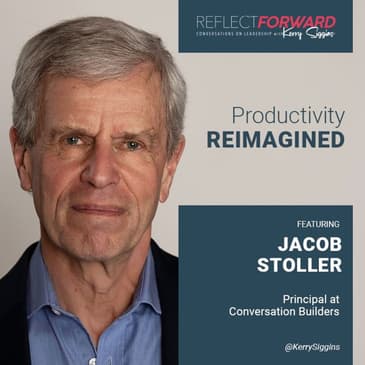

[00:00:11] [SPEAKER_00]: and I'm so glad you are here today. Today my guest is Jacob Stoller, who is a journalist, speaker, facilitator and a single prize winning author of the Lean CEO, which I have read and that's actually how I met him.
[00:00:26] [SPEAKER_00]: He reached out through YPO to find CEOs that had read the Lean CEO and he wanted to pick their brain.
[00:00:35] [SPEAKER_00]: So I threw my name in the hat and we met and we've had several conversations and I just adore him.
[00:00:41] [SPEAKER_00]: His latest book is called Productivity Reimagined, it's coming out on October 8th and Stoller just included in it.
[00:00:48] [SPEAKER_00]: He interviewed to talk about how we look at productivity and lean within Stone Age.
[00:00:53] [SPEAKER_00]: So it was really exciting to be part of the book. So he is absolutely fantastic. You're going to learn all about productivity and why it's so important, not just from a numbers perspective but from a team and cultural perspective.
[00:01:06] [SPEAKER_00]: That's why I just love this conversation. So hang tight and I will be right back with Jacob.
[00:01:18] [SPEAKER_00]: Hi everyone, welcome back. I have my dear friend, Jacob Stoller here with me. We're going to talk all about productivity and leadership and I'm so excited to have you on the show, Jacob.
[00:01:27] [SPEAKER_03]: Thank you for joining me. Well, thank you for having me carried great to be here.
[00:01:32] [SPEAKER_00]: So why don't you share a little bit about your background and what conversations builders is and then we'll jump into your book but give us a little bit of background about who you are and what you do.
[00:01:43] [SPEAKER_03]: Sure. Okay. My background originally is as a technology sales rep. I was working for high tech companies, HP and companies like that selling solution software and that kind of thing.
[00:01:55] [SPEAKER_03]: And the part I like best about that job was the dialogue because I really got to talk with customers about their businesses and their business problems and how those problems could be solved.
[00:02:06] [SPEAKER_03]: I was very fortunate to be able to turn that whole conversation part of what I did into a career.
[00:02:11] [SPEAKER_03]: So instead of being a sales rep, I became a journalist, a consultant, a speaker, a various kinds of roles.
[00:02:17] [SPEAKER_03]: I got to do a lot of the things I had always wanted to do writing research reports and interviewing lots and lots of people in getting great stories.
[00:02:27] [SPEAKER_03]: And by accident, I stumbled upon lean management.
[00:02:31] [SPEAKER_03]: And I know that was his topic of my first book and also to a large degree. My second one as well.
[00:02:36] [SPEAKER_03]: But what excited me about lean was that here's was a community of people that were really doing the right thing. They were doing well for their employees, they were doing well for their customers, they were doing well for their communities around them.
[00:02:51] [SPEAKER_03]: And they had a system management way of doing that. So I began to write a lot about that and I started to work with lean companies helping them communicate their messages and eventually helping them write books.
[00:03:04] [SPEAKER_03]: And that evolved to me writing the lean CEO, which is how you and I met because I know you went read that book. So we fast forward to today where I was looking at lean a little more deeply and I found that the kind of thinking that happens in lean companies.
[00:03:22] [SPEAKER_03]: I began to see other people talking about the same kinds of things people doing environmental projects.
[00:03:28] [SPEAKER_03]: People trying to get technology integrated in their companies. There was a lot of what I thought was lean thinking, but they weren't talking about lean. So there was some basic fundamentals behind lean taking I got interested in and I discovered that the common thread to all this was productivity.
[00:03:47] [SPEAKER_03]: Everybody was trying to produce more on a company white basis with existing or less resources. So it was about doing more with less.
[00:03:59] [SPEAKER_03]: And when companies really focused on that, they wound up using their people a lot more because people are just wonderful at being innovative and finding ways to do more with less.
[00:04:09] [SPEAKER_03]: And that's what led me to you and the ownership mindset and all that because that's a wonderful way of approaching it.
[00:04:17] [SPEAKER_00]: Wonderful. Thank you for that background. And yes, I remember reading the lean CEO. I think I was actually on my way where you call it a baby moon. I was pregnant with my son and I remember we were in Carmel and like Monterey over there in California.
[00:04:28] [SPEAKER_00]: And that's when I read your book. And so I remember very clearly I was pregnant when I read it. So I had s vurned my memory, but it was really inspiring and we implemented so many lean practices. We don't use the lean terminology because we're Stone Age and we use the Stone Age terminology.
[00:04:44] [SPEAKER_00]: But it is so incredibly helpful when you have that mindset of continuous improvement, especially with idea of focusing on how do you make work easier for your employees.
[00:04:56] [SPEAKER_00]: People hate it when they're frustrated because they don't have the tools that they need or they solve the same problems over and over again or they run into processes that are broken and don't have a good way to fix it.
[00:05:05] [SPEAKER_00]: So I think that idea of productivity really tying to engagement is an incredibly important conversation.
[00:05:12] [SPEAKER_00]: As you're writing lean CEO and then now your new book, productivity reimagined how do you see productivity and engagement tying together within companies?
[00:05:21] [SPEAKER_03]: Here's how I see it. I really believe this that people do want to be productive. They want to be productive members of the workforce. I think that's a human need.
[00:05:29] [SPEAKER_03]: But if you look at what happens in the average company, there's somehow a disconnect between people's desire to be productive and what they're able to actually do.
[00:05:39] [SPEAKER_03]: Even though I think any company would like their people to be productive but there's some barrier, some disconnect between the two.
[00:05:47] [SPEAKER_03]: I'm really interested in that disconnect and I believe that there are systemic barriers that get set up in traditionally hierarchical management.
[00:05:57] [SPEAKER_03]: So I've come up with five business myths that kind of reinforce that and these are things that just people automatically believe without thinking but they create great barriers to the way companies move forward.
[00:06:11] [SPEAKER_03]: And so I'd like to give you an example from a quote from yourself because it, it highlights one of the myths if you don't mind.
[00:06:20] [SPEAKER_03]: And it's about private equity and you said the problem with private equity is that most of them have never been operators before.
[00:06:28] [SPEAKER_03]: You have super smart analysts who are taught how to look at financials and extract the last bit of value, but they're not operators.
[00:06:37] [SPEAKER_03]: They actually have no idea of the intricacies of running the company and then look at everything as just resource allocation.
[00:06:44] [SPEAKER_03]: Okay, there's a myth that I can take your company or anybody's company and I can reduce it to a bunch of asset.
[00:06:52] [SPEAKER_03]: I can write and ask blocks on a piece of paper and I can say these are assets and they're interchangeable.
[00:06:58] [SPEAKER_03]: I can move them around, I can say I can put this asset somewhere else in another company or I can exchange this for that.
[00:07:05] [SPEAKER_03]: And they don't look at how the assets depend on each other and interact with each other and that's what they call the complex adaptive system.
[00:07:14] [SPEAKER_03]: I think a company is much more organic and much more human than it would look like on an orc chart.
[00:07:21] [SPEAKER_03]: So this orc chart mentality is something I call the myth of segmented success.
[00:07:27] [SPEAKER_03]: The idea is I can take anyone piece and if that's successful and all the other pieces are just crystal, it's all going to add up.
[00:07:34] [SPEAKER_03]: And I think what we find with lean and with many things with the Deming principles is that it doesn't work out that way.
[00:07:41] [SPEAKER_03]: If you're expecting that, you wind up with people managers fighting fires, people always trying to get things to fit to don't fit and general frustration in the workplace.
[00:07:53] [SPEAKER_00]: Yeah, I completely agree with you.
[00:07:55] [SPEAKER_00]: And so give us an example of a way to solve that through the lens of productivity.
[00:07:59] [SPEAKER_03]: I'll just tell you a great story. One of my case studies is Paula Marshall and she's CEO of the company called Bama Foods.
[00:08:09] [SPEAKER_03]: And actually, you and her have some things in common. She also dealt with some various challenges and came up on top and resulted in being the kind of person that really wants to help others be successful.
[00:08:21] [SPEAKER_03]: She understands how work can affect people and really wants to make a difference.
[00:08:26] [SPEAKER_03]: But anyway, Paula is the only existing CEO that actually got advice directly from the famous William Edward Deming.
[00:08:37] [SPEAKER_03]: And she met him early on. Bama Foods makes apple pie.
[00:08:42] [SPEAKER_03]: These are the little apple pies for make on. I'm sure we've all had we've all had.
[00:08:45] [SPEAKER_03]: Oh yeah. They're delicious.
[00:08:47] [SPEAKER_03]: They're good. Yeah, they're it's a family business and she actually wound up through various circumstances at the top of the company as a young woman not expecting to be in that role.
[00:08:58] [SPEAKER_03]: But very smart and worked hard at it fast forward. The company was having some quality issues.
[00:09:04] [SPEAKER_03]: Their main client was McDonald's and someone at McDonald's said, let's go to this Deming seminar. She said to he basically dragged him to this seminar.
[00:09:13] [SPEAKER_03]: And she was absolutely amazed at what Deming talked about. He was talking about management in a completely different way than what she had learned and what business schools taught.
[00:09:23] [SPEAKER_03]: That kind of thing.
[00:09:25] [SPEAKER_03]: And at the end of the session, Deming asked how many people in this audience are CEOs and only two hands went up and hers was one of them. Paul was hand. So he said, I'd like to talk to you and he spoke with her and asked her to join this sort of a study group.
[00:09:40] [SPEAKER_03]: In the study group, Deming started to ask her about how she managed and one of the things she had done was she had implemented a employee sort of assessment or measurement system.
[00:09:53] [SPEAKER_03]: It was a system for rating and ranking employees and it was very expensive. It was done by a management consultant that she spent over a million dollars on this thing.
[00:10:03] [SPEAKER_03]: And when she first met with Deming and started to talk about what she did, Deming said, I think you should get rid of that. She said, well, it spent all this money. It's supposed to get rid of this thing. She couldn't do it but they tried to adjust it.
[00:10:17] [SPEAKER_03]: They tried to play around with it. She said she was always compensating for it because she didn't want to give employees a bad ranking didn't want them to feel bad and it was all sorts of things that weren't working.
[00:10:28] [SPEAKER_03]: And in the end, when they started to meet and talk about it, it turned out that everybody hated it. So eventually she dropped the system and the work that she did with Deming started to really take off just as a result of not having this rating or ranking system.
[00:10:45] [SPEAKER_03]: So now they have this wonderful culture at Mammothoons. They've really learned how everybody depends on each other, how everybody interacts and they get visitors.
[00:10:56] [SPEAKER_03]: People come in, they want to see how the company is doing and then they say, how do you do this?
[00:11:02] [SPEAKER_03]: And she says, get rid of your ranking systems and your rating systems and she said the CEOs just walk out that don't want to have anything to do with it.
[00:11:10] [SPEAKER_00]: So it's that's a productivity story. I love it and I can play the agree with her. Nobody wants to be reduced to a number.
[00:11:20] [SPEAKER_00]: And so we do three as I talk about my book three own it chats that are empty led reviews and it's always about, okay, what are you working on? How do you feel connected? Do you feel connected to the vision to the mission?
[00:11:34] [SPEAKER_00]: How do you feel connected to your teammates? As I as a manager can be doing better to help you achieve your goals and your vision for your life. And it's just such a much better conversation rather than on a scale of one to five, I think you're performing a nobody ever wants to pick a four right a four point five or three and a half and yeah.
[00:11:52] [SPEAKER_00]: And yeah, it just isn't effective. It doesn't make anybody feel good unless you get a five and then you have people will be like, oh, I'd never give anybody five's no one is perfect.
[00:12:02] [SPEAKER_00]: It's just such an ineffective way to motivate people and obviously if you have motivated people, you're going to have more productive people. So I think performance review systems and HRS systems are such an important attribute to productivity.
[00:12:16] [SPEAKER_00]: So I'm really glad that you brought that up because I don't think a lot of people think about that. They think about, okay, how am I going to manage my production floor, my manufacturing facility? And it's not it's really about optimizing human performance.
[00:12:29] [SPEAKER_03]: It is and I like to add it a little element to that one of the one of my sources is Rich Sheridan and I think you may know Rich, but he has a company called Menlow Innovations. It's a software firm.
[00:12:41] [SPEAKER_03]: But they are very much into a collaborative culture and he's worked really, really hard to do that. But he says if you walk into his office, it's not a whole bunch of people all plugged in and in separate offices doing their creative work. It's an open office with people milling around talking to each other.
[00:13:00] [SPEAKER_03]: And you look at the programmers, they're working in pairs, sharing the same mouse and keyboard. It's something called paired programming but he's really made that into the way they work. So he says he gets visitors and they wonder what's going on and he says the visitors will say wouldn't it be more efficient to each one of those people had a computer?
[00:13:20] [SPEAKER_03]: And he explains the cross-training that he gets and by the way, he switches the pairs every week. So people are always learning from each other. They're always collaborating and the amount of checking and cross-training he says phenomenal.
[00:13:33] [SPEAKER_03]: He says maybe I'll get 30 cross-training benefits that I didn't even know about from this is just incredible. But then comes the question of a productivity. People will ask Rich, how do you measure personal productivity?
[00:13:47] [SPEAKER_03]: And he says I don't care.
[00:13:51] [SPEAKER_03]: What you don't care how can you not care? And he says he explains that team productivity is what he gets and that's what he measures and that's what he really needs.
[00:14:01] [SPEAKER_03]: So I think the story around productivity is really all about teamwork.
[00:14:05] [SPEAKER_00]: Yeah, it reminds me of something that we've done here as in our history because our history is making nozzles that screw on the end of hose for industrial cleaning.
[00:14:14] [SPEAKER_00]: We could always have one engineer working on a project because it wasn't particularly complicated and even though it was different applications were using generally the same internal technology.
[00:14:26] [SPEAKER_00]: But as we started to transition to building mechanized and then semi-automated and now autonomous cleaning systems, you can't just have one engineer working on a project.
[00:14:36] [SPEAKER_00]: And that was a really big shift that I had to make mentally because, oh, we have 20 engineers. We should be able to work on 20 different projects.
[00:14:44] [SPEAKER_00]: But what we have found is that we actually slowed down our product development process because we didn't have that collaboration that crossed the learning from each other and being able to work on multiple complex parts of the product design.
[00:14:58] [SPEAKER_00]: And we've restructured our engineering team and in the process of really doing that to work at a group on these particular products.
[00:15:04] [SPEAKER_00]: And there was a lot of concern about that scene. We're going to slow down our product launch velocity and what we're really seeing is that through that collaboration we're getting better product design.
[00:15:15] [SPEAKER_00]: We're having better conversations about what the potential downfalls and issues are much more creativity going into the whole process.
[00:15:22] [SPEAKER_00]: And we're actually going to speed up because that team can move a product through the development phase so much faster than they could individually.
[00:15:29] [SPEAKER_00]: And then of course you have the ripple effect of trying to push multiple products through your product development and new product introduction process. So I'm really glad that you shared that story because I really have learned to see that benefit especially when you're developing something much more complex than simple widgets and working together as a team is so much more effective.
[00:15:49] [SPEAKER_03]: Yeah, for sure, for sure. And I think team productivity plays out in many different ways in different organizations like can be an enalich company or it can certainly be on the manufacturing floor or especially in something like healthcare where you really need the doctors and the orderlies and everybody collaborating because the patient moved through so many different phases.
[00:16:13] [SPEAKER_03]: And the only productivity that matters is how many patients can we get from entering our facility to being satisfactorily dispatched where they feel their problems been solved. You know, where they are to do that and it takes a lot of people in a team to do that.
[00:16:32] [SPEAKER_03]: Absolutely. Absolutely essential to that.
[00:16:34] [SPEAKER_00]: So let me ask you and all of the leaders and companies that you interview is part of both of your books because I love that you have such a people focus on this and talking about team and talking about culture.
[00:16:46] [SPEAKER_00]: But again, I think that sometimes a lot of people have misconceptions about what lean is and what productivity is and that it's much more about a process rather than the people side of things.
[00:16:57] [SPEAKER_00]: And did you notice in the companies that were really highly productive? Did they all talk about teamwork and culture? Did you run into any that it was just really much more follow the process.
[00:17:09] [SPEAKER_00]: Do the process, what did you find in those companies?
[00:17:12] [SPEAKER_03]: All it was pretty consistent carry on on teamwork. I think the ones I got to of course I've been cherry picked who I interviewed.
[00:17:20] [SPEAKER_03]: There are a lot of companies out there they take lean tool sets and they say we're doing lean or whatever.
[00:17:26] [SPEAKER_03]: I think it was pretty universal but I think what I did find interesting is that there are companies that really put the people part first before they even get into lean and I think that was really important to me.
[00:17:40] [SPEAKER_03]: I think one of the ones that people talk about a lot is Bob Chapman with very way-miller and Bob started on something he calls the guiding principles of leadership, which was about treating people like family.
[00:17:54] [SPEAKER_03]: And he came to that because he was very successful already as a business. So he knew how to make money, he knew how to grow the company but there was something that told him wasn't quite right. He didn't feel that the company atmosphere in his companies where the kinds of places that he would want his kids to work.
[00:18:12] [SPEAKER_03]: He's very much a family man. So he began to develop these guiding principles of leadership, but what he needed was kind of a way of operationalizing that.
[00:18:23] [SPEAKER_03]: So just by happens dance they acquired a company called Markwip Ward United which had a very good lean program and it was run by a gentleman named Jerry Solomon, very capable guy.
[00:18:37] [SPEAKER_03]: But when Jerry and Bob Chapman got together Jerry said, Bob I love your guiding principles of leadership and we have the perfect match because this is something that's missing in most lean transformation.
[00:18:51] [SPEAKER_03]: And at the same time, lean could provide a real delivery mechanism. He called it. Delivery mechanism for the guiding principles of leadership.
[00:19:02] [SPEAKER_03]: It was sort of a marriage of the two ideas that allowed this thing to really take off it very way-miller.
[00:19:08] [SPEAKER_03]: But you see the culture and the impetus to treat people right with there at the beginning. So many companies I think started the lean thing as a sort of an engineering thing.
[00:19:18] [SPEAKER_03]: And from there, then they realized oh, oh now we've got trouble. We're going to have to do something about the people. So I think a lot of companies have avoided that by going with the culture first.
[00:19:28] [SPEAKER_00]: And I love that we're having these conversations about culture.
[00:19:31] [SPEAKER_00]: I remember years ago when I would describe myself as a culture focused CEO, not a finance or innovation even though I'm all of those things but people maybe pooped that a little bit or didn't take it as seriously.
[00:19:46] [SPEAKER_00]: If you don't have an MBA from some sort of pedigree or Ivy League school. And then COVID hit and it's the great resignation and all of these leaders are trying to figure out how do I attract and retain employees when people are quitting left and right.
[00:20:00] [SPEAKER_00]: It was very validating that people were coming to me saying hey, how did you build this great culture at Stone Age? You have such a people first culture.
[00:20:06] [SPEAKER_00]: And it's interesting to listen to you talk about how important this is that a company like Barry Waimiller, which I want to have the opportunity to visit.
[00:20:15] [SPEAKER_00]: I would love to go on a tour and see what they're doing because it does matter. We're nothing without our people.
[00:20:20] [SPEAKER_00]: And all of these activities like lean or innovation, all of our growth strategies isn't happen unless you have people who are on board who feel good about the work that they're doing and productivity is such a huge part of that.
[00:20:32] [SPEAKER_03]: You know, I'm interesting what you're saying about culture and I just want to pick up on that when people poop who the idea of culture it's seen as something soft and not really bottom line for the business but that's part of that thinking that kind of what I call the hierarchical pyramid command and control.
[00:20:50] [SPEAKER_03]: Because when you look at the organization as a bunch of assets, culture is seen as a cost.
[00:20:58] [SPEAKER_03]: Right? Nobody sees how culture can actually make a company more productive and more successful because that doesn't follow financial logic.
[00:21:08] [SPEAKER_03]: That follows human logic. So it's a very different way of thinking and actually one of the comments I had connects with somebody said it was actually Petrice Bowman who is the senior VP at a large company.
[00:21:20] [SPEAKER_03]: And it's an analysis which which makes batteries. But what he said is that people at high levels in corporations tend to see operations as a black box.
[00:21:31] [SPEAKER_03]: They don't understand what happens in the black box.
[00:21:33] [SPEAKER_03]: They understand all the inputs. They understand okay we got equipment we got materials we got facilities we got labor all these things so they understand that because it all has a price tag.
[00:21:44] [SPEAKER_03]: But they don't understand how those things are combined to maximize productivity and that's all a very human process how you do that.
[00:21:55] [SPEAKER_03]: So it makes sense that people don't respect culture.
[00:22:00] [SPEAKER_03]: They don't respect things like continuous improvement because it doesn't follow the typical lines of financial logic.
[00:22:07] [SPEAKER_00]: But it's so short-sighted. One of my favorite things when customers come to visit is after they take a tour and they say I've never seen people who love their jobs as much as they love their jobs at Stone Age or everybody's so proud of the work that they do. Can I get a job here?
[00:22:23] [SPEAKER_00]: When you have your customers telling you, I want to work for you whether it's ingest or serious.
[00:22:28] [SPEAKER_00]: That's customer loyalty. Those customers stay with Stone Age because they know that we care about helping them solve their problems and that only comes from the feeling that every single person who they interact with, which quite frankly is not me.
[00:22:43] [SPEAKER_00]: It's the people who are closest to our customers in our branch offices building our products, selling our products, supporting our products.
[00:22:50] [SPEAKER_00]: And how they show up matters and you can't just train people to have a certain conversation and have that tone and that care always.
[00:22:56] [SPEAKER_00]: We have to actually truly care for that to be conveyed.
[00:23:01] [SPEAKER_00]: And so that's why I think it's such a short-sighted for leaders to look at because when your employees know that the company cares about them, they're going to care more about their jobs.
[00:23:09] [SPEAKER_00]: It means they care more about your customers and we have all kinds of ways to be able to measure the impact of investing in our culture and what it does for customer loyalty for profitability for supplier preference.
[00:23:23] [SPEAKER_00]: Our suppliers love working for.
[00:23:24] [SPEAKER_00]: Really okay. Yeah, yeah because we treat them instead of just trying to get the lowest costs out of them, we treat them as a partnership.
[00:23:32] [SPEAKER_00]: Here, let us tell you our strategy. Let's work together and that makes me different.
[00:23:38] [SPEAKER_03]: Yeah, I bet you have high-exact retention. Yeah.
[00:23:40] [SPEAKER_00]: We have very high-employed exact low-turned-overs.
[00:23:43] [SPEAKER_03]: Yeah, a lot of people. All of those things are miserable. Yeah, for sure. No, that's wonderful.
[00:23:48] [SPEAKER_03]: But ownership. I want to go back to ownership because I think that's such a wonderful thing and I'm going to tell you just a parallel that another person that commented on ownership in a different context.
[00:23:57] [SPEAKER_03]: But I think it all makes sense here.
[00:23:59] [SPEAKER_03]: And this was Dan McDonald who's worked with very large companies including train and done very large scale lean transformation work.
[00:24:07] [SPEAKER_03]: But he said one of the success stories that we have is that today it's pretty common to see employees take ownership of safety.
[00:24:17] [SPEAKER_03]: Safety used to be an enforcement thing and of course the inspectors were like the cops catching people for violations.
[00:24:24] [SPEAKER_03]: And now people actually it's sinking in in a lot of companies anyway that they say I own safety.
[00:24:29] [SPEAKER_03]: But what Dan is hoping is that in a few years down the road maybe people will take the ownership of quality as well.
[00:24:37] [SPEAKER_03]: And he sees that as kind of the next thing. So I would think with the ownership mindset, that's really what you want.
[00:24:43] [SPEAKER_03]: People to own productivity, to own those customer relationships, to own quality product that we're delivering.
[00:24:50] [SPEAKER_00]: And I think that we see that here at Stone Age our employees care so much and that's a big part of our continuous improvement initiatives.
[00:24:58] [SPEAKER_00]: I think we did a hundred small continuous improvement projects in 2023, I think we're somewhere at 60 some this year so far.
[00:25:07] [SPEAKER_00]: And it's all around that whole quality and it's in every different area of the company like sometimes we might go work in the branches, sometimes it might be in product development.
[00:25:15] [SPEAKER_00]: And it all comes through this whole idea of improving the quality of our product or the quality of our service.
[00:25:21] [SPEAKER_00]: And people look at it through that lens and they hold each other accountable to that kind of quality.
[00:25:27] [SPEAKER_00]: What is the quality of your relationships? What is the quality of your work? What is the quality of the work product that we're putting out to our customers?
[00:25:33] [SPEAKER_00]: And so I do, I think when people own it, when they have that ownership mindset quality is front and center. You can't own it and not care about your work products.
[00:25:44] [SPEAKER_03]: Absolutely, no that's wonderful that you're doing that.
[00:25:48] [SPEAKER_00]: Yeah, it's part of it just our DNA.
[00:25:50] [SPEAKER_00]: Along before I came this whole idea of how do we work together to make sure, I mean, we're in such a dangerous industry.
[00:25:56] [SPEAKER_00]: Our products are incredibly dangerous if they're not used properly and so.
[00:26:00] [SPEAKER_00]: Okay, interesting. So safety is big then yeah safety is big and you have 40,000 PSI running through equipment and a tool and something goes wrong.
[00:26:11] [SPEAKER_00]: It can kill people and so it is built into everything that we do.
[00:26:16] [SPEAKER_00]: We can't ever not be vigilant in making sure that quality is there because it's directly tied to safety.
[00:26:23] [SPEAKER_00]: Let's talk a little bit more about your book.
[00:26:24] [SPEAKER_00]: So what other a has did you have when you were writing productivity reimagined?
[00:26:30] [SPEAKER_03]: Well, I think there was a how's about technology and I think we have this kind of idea and I've been writing about technology now for years and years.
[00:26:39] [SPEAKER_03]: So I keep up to date on things but we've always had this idea that technology can solve every problem that we have.
[00:26:46] [SPEAKER_03]: We have this kind of optimism and I interviewed some people about that and one of my sources said all we hear about a success stories in technology.
[00:26:55] [SPEAKER_03]: They don't publish their failures, which is I think understanding failures and learning from them is a very important way of moving forward.
[00:27:03] [SPEAKER_03]: So there's that I'm also fascinated by the evolution of robotics because what's happened is you think of robots as these fixed fence-dend machines that will carve bodies and.
[00:27:16] [SPEAKER_03]: Ultra high speed now the fastest growing area in robotics is collaborative robotics which work next to workers.
[00:27:25] [SPEAKER_03]: The bottom line is that machines robots are become tools because people on the lines can program them now because they've got user friendly interfaces.
[00:27:35] [SPEAKER_03]: So you're using a robot to make a human worker more productive crisis productive.
[00:27:41] [SPEAKER_03]: Maybe they're doing some welding and then there's a high-up spot that's dangerous and you can get the the welder to do that part.
[00:27:47] [SPEAKER_03]: But the worker is always there to supervise the work but we're at a kind of an era I think where manufacturers are having to change all the time.
[00:27:56] [SPEAKER_03]: But we're using a volume our decreasing and the mix of products that people have to make are increasing.
[00:28:01] [SPEAKER_03]: It's getting more and more that you need more human intervention in the manufacturing because you're just changing things all the time.
[00:28:07] [SPEAKER_03]: If you have something that's exactly the same, you can completely automate it but it's just so we think it's changed.
[00:28:13] [SPEAKER_03]: So it's really fascinating that the people in robotics are very aware of lean processes and talking about using automation to actually make a process more effective.
[00:28:23] [SPEAKER_03]: We're not saying let's take this chunk and let's replace it with machines.
[00:28:28] [SPEAKER_03]: They're saying let's use these machines as tools so that we can make the process a better process that has less waste waste waste full steps.
[00:28:39] [SPEAKER_03]: And also is less dangerous for people.
[00:28:43] [SPEAKER_00]: Well, let's face it like all of the things that were easy to replace humans with robots has happened.
[00:28:48] [SPEAKER_00]: Now we're getting into the much tougher applications where you do need humans.
[00:28:55] [SPEAKER_00]: I mean that's our industry.
[00:28:57] [SPEAKER_00]: I don't know that there'll ever be a time that you just put a robot on to do cleaning and walk away because there's just so many intricacies that require some sort of human knowledge and understanding and being able to watch and know what's going on.
[00:29:11] [SPEAKER_00]: And see what happens but you can certainly automate a lot of those processes and make things safer.
[00:29:17] [SPEAKER_00]: But that's I think where we're at in this point in technology it's now it's how do humans and robots work together because you still need the human aspect for some of the activity and the robots can do other parts of it very well.
[00:29:30] [SPEAKER_00]: And I just I see that evolution happening and we talked about it in our industry anything that was easy like it's been done.
[00:29:37] [SPEAKER_00]: Now comes the hard stuff and that's where you need the human and juniority and the creativity to design products and processes that go together that can use robotics to make it easier but still require humans to be part of the solution.
[00:29:54] [SPEAKER_03]: Yeah, you know a couple people I talked to one of the first things they do is when robotics is being considered they at least ask the question.
[00:30:02] [SPEAKER_03]: Could we make this process better without automating and often they haven't really looked at the process they haven't looked at all the steps that connect the process in Parker handifence one of these companies and what they do.
[00:30:14] [SPEAKER_03]: There's he'll divide the research group into two teams one team will try to improve the process without automation and the other will do it with robotics and then give them each a week and then see who wins.
[00:30:27] [SPEAKER_03]: It says and just it's often the team that use robots you shouldn't automatically assume that robotics or any kind of automation is going to solve the problem.
[00:30:36] [SPEAKER_00]: I just finished while trying to Isaac and spoke on Elon.
[00:30:39] [SPEAKER_00]: Okay, that was one of my biggest takeaways from it well there was lots of takeaways from it fascinating he did great job on that biography he's a brilliant writer but one of the things that he conveyed that Elon learned who went down the whole automate everything path.
[00:30:54] [SPEAKER_00]: Was a wait that's actually slower and way more expensive and so he went through the whole process in all of his factories both on the Tesla side in the space outside going.
[00:31:05] [SPEAKER_00]: Yeah.
[00:31:05] [SPEAKER_00]: Take away automation wherever it does not make sense and they would wheel away big huge robots and pieces of automated equipment because actually humans can do that faster and better.
[00:31:16] [SPEAKER_00]: I really like that you brought that up because I thought that was an interesting aspect of his book as his pendulum swung so far the automation way.
[00:31:24] [SPEAKER_00]: Yeah, yeah, yeah, that was great.
[00:31:26] [SPEAKER_03]: Great case study for sure.
[00:31:29] [SPEAKER_03]: Yeah, and then we forget that a lot of the things humans do are pretty complex but we should have all is true long time to be able to do those things.
[00:31:38] [SPEAKER_00]: Absolutely.
[00:31:39] [SPEAKER_00]: All right, so two more questions.
[00:31:42] [SPEAKER_00]: So if a leader is looking to focus on more productivity especially through the lens of teams and culture.
[00:31:50] [SPEAKER_00]: How should they get started? What advice do you have for them?
[00:31:53] [SPEAKER_03]: Obviously I'd like to recommend my book by in my book.
[00:31:55] [SPEAKER_03]: Yes, but I recommend is that first they go and visit companies like yours.
[00:32:01] [SPEAKER_03]: And I think that's got to be the first start based on that I think you need to assess what you look like in relation to those companies and you need to come up with a kind of
[00:32:24] [SPEAKER_03]: On that point, I think you really need to start with people. You need to maybe work with a coach but you need to come up with a plan for how you're going to get to this goal that you want.
[00:32:38] [SPEAKER_03]: But you're going to say we want to be the best manufacturer in a certain category.
[00:32:43] [SPEAKER_03]: You've got to say how is that going to be? How are we going to be the best? We're going to have the best delivery times.
[00:32:48] [SPEAKER_03]: We're going to be fastest to market with products or whatever.
[00:32:52] [SPEAKER_03]: Then you have to look at what are the barriers that stand in the way of doing those things.
[00:32:56] [SPEAKER_03]: So you need a very kind of strategic clarity on that.
[00:33:00] [SPEAKER_03]: And then you need to start to talk to employees about the barriers that need to be overcome and how you get there.
[00:33:06] [SPEAKER_03]: Eventually, you start using leading tools but not until you've really got people buying into your purpose because people really are motivated by purpose.
[00:33:17] [SPEAKER_03]: So you got to get that in place and then the tools or something that's going to help you get to that place.
[00:33:23] [SPEAKER_00]: Yeah, and I like what you said too.
[00:33:25] [SPEAKER_00]: I think that a lot of times people can feel like it's overwhelming when you have so much you need to change.
[00:33:30] [SPEAKER_00]: This is what you want to be and pick that one thing and work on that first because I think that makes it a lot easier to just say,
[00:33:36] [SPEAKER_00]: Okay, we're going to get good at this and then you can move on to the next thing. That's certainly what we have found.
[00:33:40] [SPEAKER_00]: We have got to be a 50 different things that we need to improve upon how do we get them all done.
[00:33:44] [SPEAKER_00]: Pick the one that's going to make the biggest impact or below is hanging through the easiest to get people to buy in to it and go start just chunking them off and smaller bites than just trying to change everything at once.
[00:33:56] [SPEAKER_03]: Yeah, then of course productivity gets always measured in the context of that right it's in the context of moving towards your goal.
[00:34:04] [SPEAKER_03]: If you do much of work that doesn't help customers and doesn't go anywhere I don't care how many hours you're working that may not be productive.
[00:34:11] [SPEAKER_03]: But being able to map productivity to where you want to go takes a lot of discipline and a lot of hard work.
[00:34:18] [SPEAKER_00]: Yeah, you're right absolutely.
[00:34:20] [SPEAKER_00]: All right, final question. So the name of this podcast is reflect forward.
[00:34:24] [SPEAKER_00]: What does reflect forward mean to you in the context of the conversation that we've had today about productivity?
[00:34:30] [SPEAKER_03]: Oh my, it says it's where do we want to go?
[00:34:33] [SPEAKER_03]: I think we need to be looking at the future.
[00:34:35] [SPEAKER_03]: There's lots of problems in this world right now. Lots of people suffering and I think we need to be thinking how can we help more people? How can we make a better world?
[00:34:44] [SPEAKER_03]: And I think we need more people like you doing that kind of thing.
[00:34:50] [SPEAKER_03]: And I'm hoping that what I've shared in the book will encourage more people to follow in that path.
[00:34:56] [SPEAKER_00]: Yeah, thank you and thank you for sharing all your wisdom today.
[00:34:59] [SPEAKER_00]: How can people find you? How can people find the book? Give us that information.
[00:35:03] [SPEAKER_03]: Okay, well, I website jacobstooler.com and that has a link to preorder the book if you're so inclined.
[00:35:11] [SPEAKER_03]: I am Jacob Stoller, JACOB, STOL, L-E-R on LinkedIn and on Twitter slash X.
[00:35:19] [SPEAKER_03]: So that's where to find me and I'm always interested to hear from folks about productivity and et cetera.
[00:35:26] [SPEAKER_00]: Yeah, I know that to be true.
[00:35:28] [SPEAKER_00]: And when is the official launch of productivity reimagined?
[00:35:32] [SPEAKER_03]: It's October 8th.
[00:35:35] [SPEAKER_00]: Fantastic. And if people wanted to get the lean CEO, is that on your website as well?
[00:35:40] [SPEAKER_03]: Yeah, lean CEOs on the website as well.
[00:35:42] [SPEAKER_00]: Yeah. Fantastic. All right. It was a great book. I was so excited when I saw you were looking for people who had read it to join in on the conversation.
[00:35:50] [SPEAKER_00]: So it's a great opportunity to get to know you and meet you and thanks for including me and Stone Age in your book.
[00:35:55] [SPEAKER_03]: Well, thank you for having me on the show, Cari and for all your wisdom.
[00:36:00] [SPEAKER_00]: I really appreciate it. All right, everyone. Hang tight and I'll be right back.
[00:36:12] [SPEAKER_00]: All right, everyone. I hope you enjoyed that conversation.
[00:36:14] [SPEAKER_00]: Please be sure to check out Jacob's new book and if you are CEO, read Lean CEO.
[00:36:18] [SPEAKER_00]: It's really good and it's not just for manufacturing companies.
[00:36:22] [SPEAKER_00]: All right. With that, I will leave you to your day.
[00:36:24] [SPEAKER_00]: I hope you have a fantastic one.
[00:36:25] [SPEAKER_00]: And please be sure to subscribe to this podcast on YouTube or on your favorite podcast platform and share with a friend. Right a review.
[00:36:33] [SPEAKER_00]: I always appreciate it.
[00:36:34] [SPEAKER_00]: Helps the algorithms and it gets these great stories out to the book.
[00:36:38] [SPEAKER_00]: Thanks so much. I will see you next week.