
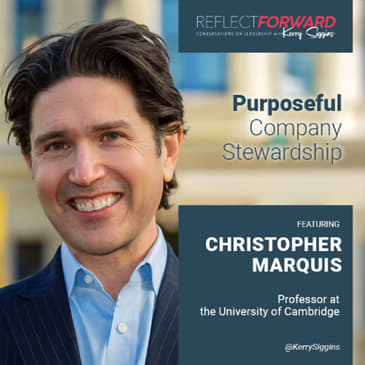

[00:00:10] Hi everyone and welcome back to Reflect Forward. I'm your host, Kerry Siggins, and I'm so glad you are here today. Today my guest is Christopher Marquis. He is the author of The Profiteers, How Business Privatizes Profits and Socializes Costs, which is a book that talks about how businesses profess that they are dedicated to environmental and social justice, but their actions betray that commitment. And so it's a very interesting conversation that we have, and I know you're going to enjoy it.
[00:00:38] But Christopher is brilliant. He is a business professor at the University of Cambridge Judge School of Business, and he is a writer beyond just authoring this book. He's actually authored other books as well, but he writes for Forbes. He's got a regular column there. And he's appeared in all different kinds of publications like The Washington Post, Fortune Time, and many more. I know you're going to enjoy this conversation. It's very insightful. And so hang tight, and I'll be right back with Christopher.
[00:01:13] Hi everyone. Welcome back. I have Chris Marquis with me here today. Chris, thank you so much for joining me on the show.
[00:01:20] Kerry, truly my pleasure. It's great to be with you.
[00:01:23] Absolutely. Well, I'm really excited to dive into your background, your experience. You're a professor at the University of Cambridge, so can you talk a little bit about why you went into academia and what you teach at the University of Cambridge?
[00:01:34] Sure. So why I went into academia? It's sort of interesting. I grew up in the United States. So I'm at Cambridge, but your listeners may realize by now that I'm not English. I'm American. I spent most of my life in the U.S.
[00:01:47] I grew up in Pittsburgh, and my family was not an academic family. When I went to college, I sort of became really interested in the potential of teaching and research. And I worked for a while.
[00:02:02] I didn't actually get into academics originally, but I worked in the financial services for a while. And part of what really interested me is understanding how business and the broader society and environment interact and how business actually can't just be economic extracting, but also giving back in lots of different ways.
[00:02:24] And so I decided to go back to school to get a PhD in that. And for the past 25 years, I've been mostly researching on, back then it was called corporate social responsibility, sustainability, ESG, social impact, social entrepreneurship. Those are the areas that I really focus on quite a bit.
[00:02:46] And I teach at a business school. So it's mostly executives through executive education, like these one week concentrated classes on climate adaptation or sustainability, and then also semester long classes for MBAs on similar topics.
[00:03:03] I love that you are all about impactful businesses. And of course, how we got to know each other was through the ESOP community, the employee ownership community.
[00:03:11] Can you talk a little bit about how you teach this? Walk us through that. How do you get these students, whether they're MBA students or people like me coming in to do continuous education?
[00:03:22] How do you teach this idea that building impactful businesses is something that's really important?
[00:03:28] Yeah, so a couple of things. So on the important side, I think there's a lot of indications this is the way the world is heading.
[00:03:34] You have demographic changes where there's a lot of research that shows maybe younger, millennial, Gen Z consumers are more interested in impactful businesses.
[00:03:45] I think that some of the research isn't fully settled on that yet, but I know that one thing that I have really seen in my students, these are usually MBA students, is where they want to work.
[00:03:55] People want to go work for a place that has purpose, that they can actually be sort of their whole selves, that they're proud of.
[00:04:03] One of my former doctoral students did some research on career choices after getting the MBA.
[00:04:09] And people do not want to work for fossil fuel companies, do not want to work for companies that are not actually treating the sort of environment and society well.
[00:04:17] So one issue is that it just is becoming so important.
[00:04:20] And we have a lot of governmental changes, particularly in the EU, that are focusing more on sustainability.
[00:04:27] The reason why these are so important is because there's so much climate change, disasters, and impacts that are happening.
[00:04:35] When we're recording this just a day or two ago, it was like the hottest day in history.
[00:04:40] So I think on the motivation side, it's like, one, this is an environment your business has got to meet the challenges of in the future.
[00:04:50] Two, it's just the right thing to do.
[00:04:52] You know, if you're a corporate citizen in the world, you should not just be extracting, but actually thinking about ways of giving back.
[00:05:00] And I think many of the leaders that I engage with really want to do that.
[00:05:05] They are really passionate about trying to find ways that their business can have an impact.
[00:05:10] The second part, and that's actually a very short motivation part.
[00:05:14] I mean, you know, we come back to it a couple of times in the classes.
[00:05:17] But where I really try to focus is it's a challenge for companies to do this because so much of the societal systems, even existing regulations, although they're changing, investment markets, private equity, venture capital investors,
[00:05:34] those are all oriented towards short term profit for the most part.
[00:05:40] And so how do you as a business, if all these broader stakeholders are pushing in one direction, actually effectively engage in change?
[00:05:50] And so I work a lot on various governance, strategy, accountability mechanisms in my classes to help businesses push back and actually drive that change into their organization.
[00:06:04] I think that employee ownership is one of those that I think is really important.
[00:06:08] If businesses want to be dedicated to actually doing good, the ownership structure of the firm is an important process to engage in that.
[00:06:15] I like how you write in your book, The Profiteers, which I know just came out this year.
[00:06:19] I really like how you say that blame and shaming corporations doesn't really work.
[00:06:24] And I do agree because I do think that there are such motivations and pressures for those short term profits that it is really tough.
[00:06:32] And so you talk a little bit about, you know, that you have to rethink and transform that entire system.
[00:06:37] And so what does that mean?
[00:06:38] What does that look like?
[00:06:39] So I think a couple of things are really important to think about.
[00:06:43] One is really thinking deeply as a business, like what's your core, you know, impacts.
[00:06:49] So one company that I research in the book is Grove Collaborative, which is a company based in California.
[00:06:56] It produces markets, sells home and sort of health and beauty type of products.
[00:07:02] So things like shampoos, soaps, as well as cleaning products.
[00:07:05] They make their own.
[00:07:06] They also sell sustainable brands like Seventh Generation, Mrs. Meyers.
[00:07:09] And, you know, one of the things when I'm doing research on them that the sort of leaders of the company told me is that they are hugely focused on the issue of plastic.
[00:07:19] That is like their core focus.
[00:07:22] The reason being is because there's a lot of liquids involved in various cleaning solutions or shampoos.
[00:07:28] They need to have a non-porous packaging.
[00:07:31] And plastic is what most companies are doing.
[00:07:34] But what one of the co-founders, a guy named Stu Landsberg, told me, he said, you know, this is our potential biggest negative impact.
[00:07:41] So we really want to internalize this as much as possible.
[00:07:44] And so what this looks like then for a company, and I think this is what is so important to understand, is that they saw this as what they need to focus on.
[00:07:54] And it created this platform for innovation throughout the firm.
[00:07:58] So it led to new product development.
[00:08:00] They created a variety of products that didn't need to be packaged in plastic, for instance, shampoo bars.
[00:08:06] So, you know, I had never seen shampoo bars before.
[00:08:10] Younger people might be more familiar with that.
[00:08:12] But now I only use shampoo bars.
[00:08:14] They work really well.
[00:08:15] And they've won all kinds of awards for their innovation in this sector, gotten great press for doing the right thing.
[00:08:22] And doing the right thing in a way where it's deeply from really trying to understand what their impact can and should be.
[00:08:29] Also business process impacts.
[00:08:32] So they created it on their business managers, P&Ls, actually a plastic cost.
[00:08:39] So this creates incentives for the managers inside the firm to actually be engaged in lowering plastic.
[00:08:46] And then also they created a sort of badging and certification system for consumers.
[00:08:51] So consumers can know how this product is engaging with plastic, etc.
[00:08:57] So I think that by really deeply examining what the core issues are in the firm and trying to get over those, it's not a constraint necessarily, but actually a spur for innovation.
[00:09:10] And so do you think that it is a special kind of leader?
[00:09:14] And I'm asking this question because I have this vision of creating a thousand millionaires through employee ownership.
[00:09:19] Like that's my passion is wealth creation through employee ownership and how we're doing good for society and building a culture where people really get to thrive and grow and have purpose and meaning and build true wealth.
[00:09:31] So do you think that these companies who are really trying to do good and who are leading these efforts, do you think it takes a special kind of leader?
[00:09:38] Or do you think that leaders can be incentivized even if they don't necessarily have sustainability and businesses for social good at the forefront of their motivation and passion?
[00:09:51] I do think leadership is fundamental to doing this.
[00:09:56] I think that perhaps leaders can be incentivized.
[00:10:00] But I think where I come at this is that, I mean, you're a very special leader.
[00:10:05] Stu Landsberg is a very special leader.
[00:10:07] I don't want to discount sort of purpose driven leaders.
[00:10:09] But I really believe that the idea of having a purpose is much, much more widespread than we give credit to it.
[00:10:18] So many of the leaders I've talked to, this is hundreds now, and I've actually talked to other people about this.
[00:10:24] And I'm curious your perspective too, after I finished my answer, you know, talk about leaders they know.
[00:10:29] People are entrepreneurs because of something deep inside of them and a passion they have.
[00:10:37] I mean, for some people, maybe it's not about just becoming the richest person in the world.
[00:10:42] It's about actually you have a passion and commitment for something deeper.
[00:10:46] I think that gets sidetracked a lot when people bring outside investors on.
[00:10:52] Maybe company goes public.
[00:10:54] I think what's really important is to really think about ways of continuing to foster that.
[00:11:02] Because I think almost it's the natural state of entrepreneurship and leadership is actually making a difference.
[00:11:09] And that it's these broader, you know, investment and legal systems that are actually tramping that down.
[00:11:15] And just the culture that we have that really sort of valorizes these people, you know, like Elon Musk in certain circles or Jeff Bezos that are, you know, billionaires.
[00:11:26] And they may be valorized, but I don't even think them, both of them, when they first got into this, I don't think they necessarily were about, you know, having $200 billion.
[00:11:36] I don't think either of them were.
[00:11:37] Yeah.
[00:11:37] I just finished Walter Isaacson's book on Elon Musk.
[00:11:41] Yeah.
[00:11:42] And it was really good.
[00:11:43] I have mixed feelings on Elon Musk.
[00:11:45] I had the opportunity to interview him a couple of years ago in an interview that has not ever come to fruition, unfortunately.
[00:11:52] But it was a really fascinating conversation.
[00:11:53] And this was before he bought Twitter and had the Twitter belt down.
[00:11:57] And so I've got mixed feelings about him because he's so brilliant.
[00:12:01] But reading that biography was really interesting.
[00:12:04] Like, you know, he, for the vast majority of his career, is as big of a jerk as he can be and hard-charging and obsessive.
[00:12:12] It was always for the greater good of humanity.
[00:12:15] Yeah.
[00:12:15] It was really interesting to see how all of his businesses really fit together.
[00:12:19] And until I read the biography, I didn't really see from the outside how one was spurred by another.
[00:12:24] And so, yeah, even though people would call him a megalomaniac and certainly he has a very huge ego and you probably have to be to do what he's done.
[00:12:34] His mission was always saving humanity.
[00:12:37] Right.
[00:12:37] So it's just really interesting to see, like, even some of these polarizing leaders, when they are purpose and mission driven, the choices that they make to build their companies.
[00:12:49] So it was really insightful.
[00:12:51] Yeah, that's great.
[00:12:51] Thanks.
[00:12:52] I sort of have a mental note to read that.
[00:12:53] I've read a few of Walter Isaacson's other books.
[00:12:55] And certainly, you know, Elon Musk is a fascinating character.
[00:12:58] You know, love him or hate him.
[00:12:59] He's really interesting.
[00:13:00] Super important to our world today.
[00:13:04] Absolutely.
[00:13:05] And that's what I said.
[00:13:06] You know, even though I'm mad at him for several things that he says on Twitter, you're not helping things.
[00:13:10] But I thought, you know, it's really important for us to understand a person who is single-handedly, not single-handedly, right?
[00:13:16] He has got lots of investors and lots of brilliant people who work for him.
[00:13:20] But through his vision and drive, it's changing so much of the way that society works and space works.
[00:13:26] And so I thought, you know, it's pretty important that we understand this because it is easy to criticize and it is easy to point out flaws.
[00:13:34] And all of those things are true.
[00:13:37] At the same time, this idea of being a purpose-driven leader is 100% what drives him.
[00:13:44] And I can appreciate that because I'm a purpose-driven leader too.
[00:13:47] Anyway, I highly recommend it.
[00:13:48] You should read it.
[00:13:49] Will do.
[00:13:50] So let's talk a little bit about gaslighting.
[00:13:53] Gaslighting is all around us.
[00:13:56] And I know that you speak a lot about this and write about it.
[00:13:59] But how are companies using gaslighting to kind of cover up or avoid responsibility for some of their poor business practices?
[00:14:08] And what can we as consumers do about it?
[00:14:12] Yeah.
[00:14:13] So one of the things I try to do in the book, you know, I use this term and gaslighting a little bit loosely.
[00:14:19] The way that I define it as sort of corporate gaslighting is where, you know, companies are trying to redirect responsibility from themselves to us, which are sort of the victims of many of the environmental or societal issues that they create.
[00:14:35] So in some ways, we're the victim and we're sort of questioning whether it's them or us that we should be sort of pointing the finger at.
[00:14:40] And what I try to do is also outline a number of different types of gaslighting that actually are ongoing.
[00:14:50] So one of the stories I tell in the book, well, a couple of examples that you've proved.
[00:14:55] So one is around the fossil fuel companies, which many people are familiar with this, that they've known for decades.
[00:15:04] The carbon emissions had a really close connection to issues of climate change, direct causal relation, but they hid that from us.
[00:15:12] And so then sort of the gaslighting part becomes where BP and some of their colleagues were actually very involved in creating individual carbon footprints and really trying to sort of convince individuals that we should really be thinking about our flights.
[00:15:29] We should be thinking about what we eat, where we drive, and certainly we should be doing these things.
[00:15:35] This is what makes this a really sort of slippery thing because, yeah, we should all be thinking about our own carbon emissions.
[00:15:41] However, if you look at the past, I think it's about 50 years, 70% of carbon emissions are from like 100 companies, all fossil fuel companies.
[00:15:53] So really where the attention should be is on those companies.
[00:15:59] That is where we should be directing our attention, not into their PR, communication, lobbying activities to really convince us that we shouldn't be looking at them or we should be looking at us.
[00:16:10] Other examples are like plastic recycling, glass and aluminum recycling, paper recycling do work a lot better, but plastic recycling, actually very low percentages, anywhere from five to 10% of things you put in the bin actually end up getting recycled.
[00:16:24] However, companies are continually pushing about how they're so involved in plastic recycling.
[00:16:31] For instance, there's one ad I saw that made me so mad.
[00:16:33] I saw it's Coke, Pepsi, and Dr. Pepper representatives, and they were all sort of talking about how they're working together.
[00:16:40] They normally are competing, but for something as important as recycling, they're working together to actually help society be able to deal with this.
[00:16:46] And I'm like, no, actually that is not the right thing because that just pushes the responsibility onto the individual consumer, not on various beverage companies in how you deliver and produce your products.
[00:17:01] And so there's a variety of different tactics they use, communication, PR type tactics.
[00:17:08] And I think it's really important for these to be communicated about and discussed so we can recognize them because it's sort of the default now in the culture.
[00:17:16] Yeah, I know.
[00:17:17] Well, we wouldn't make it if people didn't buy it, right?
[00:17:19] Exactly.
[00:17:20] We have to supply it.
[00:17:21] Right, exactly.
[00:17:22] That's the root gaslighting.
[00:17:24] Yeah.
[00:17:25] Exactly, exactly.
[00:17:26] So this whole conversation reminds me of a book by Dan Heath called Upstream, and I loved it because he talks about tackling challenges, not at the symptoms.
[00:17:37] After the cascade has happened and now we're dealing with the fallout, how do we deal with systemic issues at the root cause?
[00:17:44] And so this very compelling research about what happens when you're like, all right, let's back up and let's actually really figure out where this is coming from and what if we stop it.
[00:17:53] But nobody wants to pay for that because it's hard to measure.
[00:17:57] So when you go from, you know, making a dramatic change to say, okay, this is not happening anymore.
[00:18:02] All right, well, that's great.
[00:18:04] But people don't want to go back and say, okay, we're going to go pay to stop this from happening when it's so difficult to be able to measure.
[00:18:11] And I think that that's, you know, part of this idea of corporate responsibility, especially when you're looking at business practices and the products that businesses are making is how do we start forcing ourselves to go upstream and think about how do we solve this problem instead of just saying, I just make it because consumers want it.
[00:18:31] Well, yeah, because that's what we're making.
[00:18:33] But if we went upstream and we started figuring out about how do we solve this problem in a different way and then we provided those products, consumers would have that option and may even completely move over to it.
[00:18:46] And so I think that more business leaders need to employ that upstream thinking rather than just pushing it downstream.
[00:18:53] Yeah, fantastic.
[00:18:54] I have not read that.
[00:18:55] I know of Dan and his brother Chip's work, like Made to Stick, and they have a few others of those.
[00:19:02] I wish I had actually read that before writing my book because it sounds really spot on.
[00:19:06] Yeah, maybe you'll get to read it and then be able to reference it into your next book.
[00:19:10] Will do.
[00:19:10] Will do, yeah.
[00:19:12] I love that.
[00:19:13] So, you know, what would be the number one takeaway?
[00:19:16] Whether you're leading a team here within a company or a CEO who's listening to this, what would be your key takeaway that you want them to get from this podcast?
[00:19:25] About caring about corporate social responsibility.
[00:19:28] Wow.
[00:19:29] The one takeaway.
[00:19:30] I should actually have a little crisper.
[00:19:32] Yeah.
[00:19:33] The core concept in the book, which is actually highlighted in the subtitle, is called How Business Privatizes Profit Socializes Costs.
[00:19:42] And I think that this idea of externalities, just the way that our societal and market systems are set up, makes it very easy for companies to not actually take responsibility for the cost that they're putting on society.
[00:19:57] That's why I really like that Grove collaborative plastic example.
[00:20:00] Yeah.
[00:20:01] So I think the one thing I would ask corporate leaders to do is really do a deep dive in thinking about your company, because so much of the discourse around social responsibility nowadays is around stakeholders.
[00:20:14] And it's so important to examine stakeholders, you know, and your employees, your consumers or communities, whatever.
[00:20:21] But actually sometimes that can mask with the underlying real issues are an example I give in the book on this is Pepsi.
[00:20:28] Pepsi actually wins awards for its work in stakeholder capitalism, just all these various things around regenerative agriculture and various employee benefits.
[00:20:39] But it actually is deeply complicit in the way it produces products in our obesity epidemic, in a variety of plastic pollution issues.
[00:20:49] So it actually may be doing good things on these variety of stakeholder metrics, but actually the core of its business is transferring a lot of those externality costs onto the broader society.
[00:21:00] And so I know this is a little bit abstract, but I really encourage leaders to think deeply about the core business model they have and how through reformulating that, maybe looking upstream in some ways, that's what Grove Collab Grove is doing.
[00:21:17] They're thinking about how can we avoid these materials from entering our value chain.
[00:21:22] So this would be the one thing that I would really hope that people would do.
[00:21:26] And it's not probably an easy thing to do.
[00:21:28] There might be some sort of workshops and work to do internally, but I think if you really want to be a responsible leader, you need to get to those root causes.
[00:21:37] This is why I really like employee ownership because so many companies are doing great things on employee impact, but actually doesn't get to the root cause of inequality and financial security for employees and employee ownership does.
[00:21:53] And so I think digging deep into some of the societal and environmental issues the company might be involved in is really where I hope that companies can work.
[00:22:04] Yeah.
[00:22:04] And I think to your point that, you know, like Pepsi, for example, like they're doing some really great things in certain areas and not so great things in other areas.
[00:22:12] And what is Pepsi if it's not making soda?
[00:22:14] Right.
[00:22:15] Those are very tough existential questions that you have to grapple with as an organization.
[00:22:22] And I think it's really important that you start somewhere.
[00:22:25] I know this for myself is that I feel really overwhelmed.
[00:22:28] I mean, our products support industrial cleaning across every single different industry.
[00:22:33] But a big piece of that is oil and gas.
[00:22:35] And I struggle with that because I know that oil and gas is part of climate change and that we need to be going to a more sustainable future.
[00:22:42] I think that it has to be a partnership with government and big oil and technology companies that instead of demonizing and hating, we really figure out a sustainable path forward.
[00:22:53] I think that's just such a much more productive way to be able to implement change.
[00:22:57] But I grapple with that, that we certainly keep the supply chain running for all kinds of dirty industries.
[00:23:04] And that's an existential question for us.
[00:23:06] Right.
[00:23:06] If we aren't building water blast tools to do this, what are we doing?
[00:23:10] And so I get why business leaders have to be able to grapple with it.
[00:23:14] Where I've been able to put my focus on is, OK, how do we use less water?
[00:23:18] How do we do this more efficiently?
[00:23:20] How do we become greener?
[00:23:21] How do we make it safer?
[00:23:23] While we're studying other ways to be able to grow our business, that we can be part of a larger solution as we move away towards fossil fuels.
[00:23:32] But then I also have this other passion of employee ownership and knowing that we're doing really good in that place, too, and that we're creating these jobs for a lot of people and making jobs for people who are doing this work significantly safer.
[00:23:44] And it's always going to be part of that transition.
[00:23:47] But it doesn't mean that you don't pick something to work on, even though you're not going to solve it overnight.
[00:23:52] Pepsi isn't going to not sell soda overnight or it goes away.
[00:23:56] And nobody's going to be happy about that.
[00:23:58] Right.
[00:23:58] Shareholders are going to be happy about that.
[00:24:00] But how do you start to really look at it, own it?
[00:24:03] Like, I don't deny that I'm part of the system.
[00:24:07] And owning it is that first step and then saying, OK, how do we change our business model so that way we can do this better in the industries that we serve and then ultimately move upstream and start to impact change in a way that is in a partnership with our industry and with our customers that we're in this together.
[00:24:28] So that's my big vision, whether or not it can happen.
[00:24:31] But I don't know if I was president of the United States, that's what I would do.
[00:24:34] Instead of demonizing any industry, I would say, OK, we have to figure out how to partner together to make this happen.
[00:24:41] We see the damage that it does when coal leaves and there's no other industry to be able to backfill those jobs and it creates all kinds of social issues.
[00:24:52] And so it is not just black and white.
[00:24:54] That's very intersectional, so to speak.
[00:24:56] But those are the challenges that we have to face and we can only do it when we own it.
[00:25:00] And we just sit down and we say, OK, I'd have a conversation about this.
[00:25:03] And how is it going to change over this next decade?
[00:25:06] Yeah, totally agree.
[00:25:08] All right.
[00:25:09] Well, as we wrap things up, I want to ask you my signature question.
[00:25:13] OK.
[00:25:13] So the name of my podcast is Reflect Forward.
[00:25:16] What does Reflect Forward mean to you?
[00:25:19] OK, so Reflect Forward, I would say the first thing that jumped to my mind, my students.
[00:25:26] You know, I'm not an entrepreneur.
[00:25:28] My broader sort of impact, maybe I'll create a, was it a thousand or how many millionaires?
[00:25:33] A thousand millionaires.
[00:25:33] A thousand millionaires.
[00:25:34] A thousand millionaires.
[00:25:35] I don't know if I'll create that, but I do hope through the students, the hundreds of students I've now had,
[00:25:40] I can actually help them sort of reflect forward and shift their lives a bit.
[00:25:46] So as I think about, it's not so, I mean, I think you're asking more about the term,
[00:25:51] but I'm thinking about it more in terms of my own work is, is helping shift mindsets and, you know,
[00:25:58] thinking patterns of my students to be more sustainable.
[00:26:02] So when they go on in their work, they can actually, you know, help make the world that they themselves.
[00:26:09] I love that.
[00:26:10] That's what your work is influencing, helping people become critical thinkers and see things from a different perspective
[00:26:16] and go on to the world and do great things with it.
[00:26:20] Great.
[00:26:20] Well, I hope so.
[00:26:23] Wonderful.
[00:26:23] Well, Chris, thank you so much for coming on the show today.
[00:26:26] This has been so much fun and you and I are kindred souls and I'm so glad that I had the opportunity to meet you
[00:26:32] and I can't wait to work with you again in the future.
[00:26:35] Thanks for coming on the show today.
[00:26:36] Yeah, true, true, true, true.
[00:26:37] My pleasure.
[00:26:37] Really, really enjoyed a good discussion, Carrie.
[00:26:40] Absolutely.
[00:26:41] All right.
[00:26:41] Hang tight, everyone.
[00:26:41] I'll be right back.
[00:26:50] All right, everyone.
[00:26:51] I'm back.
[00:26:51] I hope that you enjoyed that.
[00:26:53] Be sure to check out his book.
[00:26:59] And if you like this podcast, please share it with a friend, write a review, subscribe to it on YouTube or on your favorite podcast platform.
[00:27:06] It helps get these great interviews out to the rest of the world.
[00:27:10] Thank you so much.
[00:27:10] We'll see you next week.