
[00:00:00] What foresight can do for organizations is help them improve their relationship with uncertainty, to be able to get into conversations that they've never had before. Hi everyone and welcome back. We are Reflecting Forward and I'm your host, Kerry Siggins. And today we're going to have a fun conversation about foresight. Now this is not like foresight, like a psychic, although that would be super fun to have. This is more about how do you have strategic foresight?
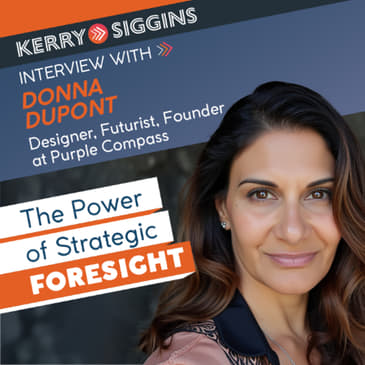
[00:00:27] How do you make decisions today that help you be able to respond what the future is going to look like? So my guest is Donna DuPont, who is an award-winning designer, futurist, and founder of the Purple Compass, which I love. She talks about how she came up with the name of Purple Compass. It's fantastic. And she is all about helping leaders gain foresight so that they can make better decisions to prepare them for what the future is going to bring.
[00:00:54] This is a fascinating conversation. I know you're going to enjoy it. So hang tight and I will be right back with Donna. Welcome back, everyone. I have Donna DuPont with me, who is the founder and chief strategist of Purple Compass. Donna, welcome to the show. I'm so glad you're here. Thank you, Kerry. I'm excited to be on your podcast. So I love the name Purple Compass. Tell us how you came up with that name. Early on, when I started this journey of foresight, I didn't think I would jump right into consulting.
[00:01:24] I thought I would just ease into the field very gradually, but I had an opportunity. And so I jumped in very quickly to help out other organizations that were wanting to embrace foresight and design. But in the background, I had always thought about what does it mean to me? What kind of work do I want to do? How do I want to support leaders and organizations? And there were certain words that kept coming up in terms of I'm helping them navigate through a lot of the complexity,
[00:01:52] the uncertainty that tends to have people really confused or it keeps them just not able to make decisions. I'm also wanting to be a guide. And so for me, I thought, OK, so there's navigation, there's guiding. And then for me, color. I love colors and the power of colors and symbols and how it makes you feel. So for me, that whole journey of moving through disruption, moving through turbulence towards a vision of transformation,
[00:02:21] very much aligns with that color purple, which is all about change and transformation. So that's how it started with Purple Compass. It's the North Star towards change and transformation. And that's been my guiding set of values and principles for the work that I've been doing for the last seven years. I love the name. Purple's my favorite color. It is such a transformative color. So I was just really curious when I saw the name of your company, where that came from. Thank you for sharing that. Now, tell us a little bit about what it means to have foresight.
[00:02:50] You said that you didn't start this company and initially thinking, OK, I'm going to be a consultant, but you're passionate about strategy and having strategic foresight. So can you tell us a little bit about what that means and why you're so passionate about it? Passion started when I was working for government and the public sector. I was an emergency manager, very reactive in terms of responding to crisis. But we always had to anticipate what was going to happen, how things were evolving so that we can make decisions.
[00:03:18] Our time frame was very short, 24 hours or maybe 48 hours. But this idea of anticipation was really powerful to me. And I thought, if we can do this in short time horizons, what if we can understand in a longer time horizon, we could make such powerful decisions regarding the future. We could have more insight in where to invest, where we need to build, what we want to shape. And that was the whole start of the conversation.
[00:03:47] I didn't know foresight existed at the time, but I had this idea of how can I acquire this set of skills. And a lot of conversations led me to learning about foresight. There's a lot of misunderstandings around the world of foresight and futures thinking. And a lot of times people think, because I also am technically part of the Association of Professional Futurists, that they think I can predict the future. They think foresight is forecasting.
[00:04:15] And this is a common misunderstanding all the time. And I always have to explain the difference. Forecasting is all about understanding the past and having evidence or information to then project forward. But typically forecasting is based on information and stable parameters of change. But foresight is different. Foresight is all about understanding what's changing in the environment and how things are evolving.
[00:04:44] And it's all about uncertainty. And so you want to understand the evolution of things so that you know that where you need to move or pivot going forward, if it's strategically or if you want to shape new opportunities. So it's a different way of understanding the future. And there's a lot more agency. It asks questions about how do you want to shape the future? What actions do you want to take? And so it's a very empowering type of practice.
[00:05:13] Especially because I do think a lot of people think not just about forecasting, but about being psychic. Being able to tell what the future is. And it reminds me of a practice that I do. And I would love to hear your take on this, but around future priming. Trying to imagine what the future is going to look like, different scenarios. And then you start to see patterns that could help you say, oh, that's happening. Or, oh, what I thought might happen isn't happening because I'm seeing a different pattern.
[00:05:39] So I always do a future priming exercise every year as part of my prepping for the incoming year. And looking at what did I get right and what did I get wrong? So maybe you could talk a little bit about how leaders can gain more foresight. How do they practice that foresight? So I love your exercise because that is a very important part of the foresight and futures work. For those leaders that want to strengthen their anticipatory thinking skills,
[00:06:06] it really starts with paying attention to what's changing in the environment and starting to understand not just trends, but more of the subtle changes in terms of what are new things that are emerging that we haven't seen before? What are step changes in the system, whether it's new innovations or new policies, new ways of doing things that we've never experienced before? And starting to ask questions about how is this pattern evolving?
[00:06:34] How can this intersect with other things that are emerging in the system? And asking what if questions. So it can look like scenarios. Typically, when I work with clients, we do a lot of systems work to understand not just the trends, but what's emerging. So we call it a bit of a horizon scan across different dimensions. But then you're engaging in strategic conversations about parts of the system where you don't have much knowledge. There's uncertainty.
[00:07:03] And you want to engage in conversations to provoke dialogue so that you can get some new insight into those areas. And if you're doing them across a number of strategic areas, you can really gain new insights. And you can see perhaps different pieces of knowledge that holds true across multiple scenarios that can help you develop robust strategy. And that's really where you want to go when you're in situations of deep uncertainty about the future.
[00:07:33] You want to feel that the things we're going to invest in are robust and that they will work in multiple environments. You'll still have to be agile and adapt, but you want to know that the foundation and the idea is strong. So that's some of the thinking that a lot of executives are interested in. This so resonates with me. So in 2018, I got the feedback that people thought that I was changing my mind too much or chasing shiny objects, which I hate. I hate that terminology because it feels like so ditzy.
[00:08:02] But I can understand why they felt that way because I was 15 steps ahead of everyone trying to anticipate what I thought the future was going to look like in our industry. And so while I was making decisions that got us there, sometimes the dots weren't connected. And so I needed to do a better job of that. So I wrote down what the future looks like. It's literally like the title of my document is what the future looks like. And I said, in 20 years, I think this is what the industry is going to look like. And here's not just how we fit into it, but here's how we drive it.
[00:08:32] And then every year I've gone back and I've updated it with decisions that we've made, what we got right, what we got wrong. And so we use this today. It is a guiding light to our overall strategy. And by having that document, it has really allowed us to make these big, bold moves. I predicted that, okay, it's not like this was hard to predict in 2018, but water is a precious resource. We make industrial cleaning equipment that uses water. Labor is going to continue to be an issue. Nobody's going to want to do this work.
[00:09:00] Technology is going to have to supplement and help people. And so we started making these very bold strategic decisions. That were really uncomfortable because it got away from what people thought is our core. And I started doing things that we haven't done before that the industry hadn't seen. And it was risky. I made some very significant strategic moves to prepare us for what 2038 was going to look like. And it was so incredibly helpful to do that.
[00:09:27] And I was so grateful for the feedback because it forced me to sit down and write that document, which we still use today. And help me start to connect those dots and also then have a way to go back and analyze. What did I get right? What did we get wrong? And how do we continue to shape our industry? I love that. That's a really great exercise. And what you've done is you went many years into the future, so 10 plus years. And you made some assumptions based on current patterns. And then you did a bit of a leap. What if?
[00:09:56] And so it allows you to explore those areas and decide, okay, what are some strategic decisions we need to make today to avoid some of these challenges? So it's not so much about predicting the future, but it's about what can we do today? And I like the fact that you come back and you re-examine those insights annually or as frequently as you need to because you're right. Things are going to happen that we can't anticipate.
[00:10:22] And certain things might, new opportunities might become available that we didn't know, right? New innovations that could change how we approach or get to that future. So I love that you've considered a future scenario what you want to build towards and you've backcasted some steps and then you're always iterating. That's bringing the foresight with strategic thinking and having that ongoing anticipatory check-in to make sure, are we on path?
[00:10:51] Do we need to make some adjustments? Because that's normal. You always have to make adjustments to any strategy. So that's a really great practice you've established. Yeah. Look at AI, right? I had no idea back when I started this how AI was going to change things. So it's interesting that some of the things that I said I wanted to do tie in perfectly and AI is going to be able to make it happen a lot faster and easier than what I anticipated.
[00:11:17] But I had none of that terminology or that idea in my mind until 2023. And so a lot has changed because of it. It's so nice having that record of, oh, hey, yeah, like this is how you can connect that dot or, oh, this is going to look very different because of how technology has really moved things forward so much faster than what I expected. So yeah, a lot has changed because of it. But I think we're just in such a much better place to be able to take advantage of the power
[00:11:46] because we've started thinking about it many, many years in advance of knowing what might actually be possible. That's right. And it sounds like in your organization, it's almost like a cultural practice now and a way of thinking, which is perfect. This is what you want. Because sometimes some organizations have foresight, but it's more of an exercise that they do once in a while. They have a report. Maybe they integrate some of those insights. Maybe they don't.
[00:12:12] But if you embed it and integrate into your organization and have it as a regular type of way of thinking or a cultural practice, then you're able to extract more insights and be more agile and adapt when environments are changing. You will see those opportunities sooner than someone who's maybe doing it passively. So if a CEO or leader, team leader, business leader hasn't created this kind of culture or
[00:12:40] hasn't done this type of anticipatory strategic thinking, how do they get started? The first way to get started is just to become familiar with what it is and explore how you can start to integrate it in small ways within your organization. A lot of organizations, especially businesses, tend to link foresight with strategy. It tends to have a better fit there and it helps them to plan for the future or know where
[00:13:08] they need to invest new capabilities, new investments, or perhaps where they may need to let go of certain lines of operation. So that can be the first place. And you can do small little tests at first. You don't have to fully integrate. You can start to build your foundational knowledge, learn how you can integrate or collaborate across different parts of your organization that are interested in foresight.
[00:13:34] And then do small little tests to begin with to see how you are working with the ideas, the concepts, and then frame it in terms of if you want to work on a specific topic or area or part of the organization's priority, part of the strategy. It makes it easier because then it's focused. You can learn. You can see how you want to integrate it in your organization and then customize it. And then you can expand.
[00:14:03] So that's usually the best way to do it. You want to also have some sort of metric to monitor. And it doesn't have to be necessarily a KPI. It can be more about what you're learning, the value that you're receiving from the actual experiences working with foresight. What insights are you capturing and integrating? And how you are moving that knowledge, mobilizing it within your strategy. I love that.
[00:14:33] Start small. We use the Jim Collins terminology around here. So it's shoot a bullet before a cannibal. I've definitely shot some cannibals, some of which have worked and some of which haven't. And having the disciplined approach of testing out your ideas, I think has been very beneficial to prove out, okay, yeah, this is something that we want to invest in. And so what you just described there reminds me a little bit of that of just start small, take a particular area, a product or service, an operational problem that you're having
[00:15:01] and focus around that, especially as you're trying to teach your brain a new way of thinking. Take that bullet instead of a cannibal. I love that. This is such a disruptive time on the planet and in business. How does foresight really help leaders navigate these uncertain times and all the chaos that's happening around us? It can be very helpful because what foresight does is it helps you to explore uncertainty.
[00:15:27] With the amount of disruption happening today, and there's a lot of chaos, there's a lot of confusion, the uncertainty is amplified. And in some cases, the uncertainty is quite deep because you have intersecting type of issues that are very difficult to navigate. When you have this level of uncertainty, some people will be very anxious. They may not want to explore new ideas or they may not want innovation because it feels very
[00:15:55] unknown, very scary. They want to move towards certainty in what they know. That's a very common reaction. And certainly when you're in a system of chaos and a lot of confusion, it can be overwhelming for people because we're not used to handling that much complexity and certainty. So what foresight can do for organizations is help them improve their relationship with uncertainty, to be able to get into conversations that they've never had before.
[00:16:24] And you can do it in a very inclusive and diverse way with a lot of different people with different expertise to really explore a particular challenge, a scenario, a problem set, and be able to let go of the constraints of day to day and get into some really incredible conversations about the future, about what they would do in those situations. What would work? What probably wouldn't work if there were any constraints?
[00:16:53] Where would they invest? What new opportunities are available? And when I see executives and different leaders getting those kinds of conversations, their energy just goes up because all of a sudden they're entering into this free flow of ideas that they've hardly get opportunities to do with others. And the ideas and the insights that come out of these sessions, they're incredible. And so what you want to do is you want to capture that.
[00:17:20] And you want to be able to then move those insights into a process to see what you can work with moving forward. So that is, for me, the power of foresight in times of deep uncertainty. It's about really opening up opportunities for dialogue and new conversations with a select group of people around the topic area to really find out how do we want to move forward and how can we start to take action
[00:17:47] where right now where it feels like there's a lot of lack of clarity and confusion in the world. I think a lot of leaders want to put their head in the sand. I'll give you an example. I sit on several boards and one board that I'm on, manufacturing company, we were talking about the price of steel. And if we go into a recession, how that's going to impact their business. And it was an uncomfortable conversation. In fact, we were going to talk something that was a longer term strategic conversation during this board meeting. And in that moment, I said, you know what maybe we need to focus on? How do we get through the next six months?
[00:18:18] Because there's going to be so much that changes. A five-year strategy could potentially change everything that we're doing. So let's just talk about what do we need to do in the next six months? If steel prices go up 50%, 100%, 200%, what are we going to do? If federal funding goes away and people aren't getting grants, what are we going to do? If people stop eating out at restaurants, and that's a core part of our market, what are we going to do? And so we had this very strategic conversation around that.
[00:18:44] And then we started putting tactics together around, okay, right now, this is what we're going to focus on for the next six months. And it was such a powerful conversation. And it refocused us. How do we handle this current disruption that we are potentially facing right now so that we're not scrambling? If these things happen, we already have a plan in place that we can begin to execute if steel prices go up, if this funding is lost. If we go into a recession, here's what we're going to do.
[00:19:12] And we made some anticipatory moves because of it, both in cost control and in how we were going to focus our sales efforts. And it was such an energizing conversation, even though it was hard to talk about those problems. At the beginning, people would have just preferred to be like, we just don't know. Why are we going to talk about it? We'll just deal with it if it happens. But we got to pull our head out of the sand and say, no, these things could happen. And wouldn't it be better if we have a plan rather than be reacting and having to scramble? Absolutely.
[00:19:39] That's great that you're doing that because what I like about your example is you're not necessarily going far into the future because there's so much change that's happening week to week. There's a lot of change happening. So you're moving from today in terms of what's happening today, the disruption and those big challenge areas and opening up dialogue and conversation around it, which is really important. And any time you're having systems shift or things are breaking down,
[00:20:06] there's opportunities for new ways of working, new ways of maneuvering into the future. So it's a great way to start the anticipatory conversation. And I think it goes to something else that you talk a lot about and you work with your clients on, and that is around confirmation bias and that we want to believe what we want to believe. And so we're looking for things to be able to confirm. Okay, I don't really think that's going to happen. So I read this news article who says that blah, blah, blah. And that can be such a dangerous place for us to be.
[00:20:35] And so we have to challenge our beliefs and assumptions. So can you talk a little bit more about how leaders can hold themselves accountable to doing that? It's part of the process of foresight, but it can also be anytime you're making any kind of decision, you typically document assumptions. But if you don't, you should. That helps you to see or to get clarity on what's behind your decision. And you want to ask yourself, is that true? Because things are changing and it might be just one perspective.
[00:21:04] You might want to get a few other perspectives to help shed some light on whether or not that is, in fact, still accurate. And it's not that it's wrong, but these things are changing. So it might not hold true anymore. And it might be a limited way of seeing the world. So you just give that freedom for that decision. But in foresight, that is something that is openly welcomed, is to challenge assumptions. So again, it comes back to culture. And are you allowed to challenge certain assumptions?
[00:21:34] Are there certain conversations that are off limits? Those are some of the internal conversations that are important to have, because a lot of times culture will really interfere with ideas that can move forward for strategy. You really want to take a step back and just consider your decisions. What are some assumptions? What are some beliefs about the future? How inclusive is that vision, that belief, that ideal? And it doesn't hold true.
[00:22:00] When you allow for conversation, then you'll be pleasantly surprised what you learn. I wrote in my book, The Ownership Minds, I have a whole chapter on don't believe everything you think. Just because you think it does not make it true. And I love this conversation because I think a lot of leaders feel the pressure of being right, of having all the answers. And the reality is that we don't. And our answer to a problem is just one way to go about solving it. It doesn't mean it's the right way, the only way. It doesn't mean that it's the truth.
[00:22:30] The more that you can analyze your own thinking, that having that opposable mind to question your thoughts, I think the more powerful, not only thinker you can be, but leader you can be, because you're more willing to change your mind, which is a really important leadership trait. Like the ability to say, you know what? I used to think that. But now that I have this piece of information and I see this, I don't think that way anymore. I think that's a really powerful thing. But it causes some discomfort. That's for sure. It does.
[00:22:56] So this is where the lens of how you are making decisions and how you're understanding the broader environment is so important. Because if you're operating from a very operational or status quo type of mindset of, this is how it's always been in the past and this is how we operate in the future, maybe that will hold true in certain circumstances. But if you start to think about it from the 30,000 foot view and you're seeing the big picture, you're going to have a very different perspective of what's changing.
[00:23:25] And that could shift your decisions about what actions you choose to take moving forward. And I think the key to all of this is it takes courage. It does. And that is the hardest part about challenging status quo, about making a decision when you don't know what that outcome is going to be. That courage is something that is so incredibly important. Peering over the edge, going, oh, I'm not 100% sure if this is the right thing, but I've got to take action. It takes a lot of courage. It does. It absolutely does.
[00:23:55] Because you're stepping outside your comfort zone. You're doing something new. And it's a little bit of an innovator's mindset that you're embracing. It can be exciting, but also it takes a lot of courage. But you can also de-risk those types of activities. And you can take small steps. And you can become more aware of if you're interested in moving in a particular direction, whether it's in technology. You can just start small. Don't try to make big shifts all at once, but start small and start to build your knowledge
[00:24:24] and your intelligence and then scale. There's never been an act of courage without vulnerability. Not that in any example that I can think of. And I think that's the heart of it. And why starting small allows, I think, you to be more comfortable with having that vulnerability of, I'm not really sure, shooting the bullet instead of the cannonball. Because that is really fundamentally what comes down to having to make these decisions in times of uncertainty. It's knowing that it's a vulnerable place to be. What if I get it wrong?
[00:24:54] What if I don't act and something happens? What if I do act and it's the wrong decision? That creates a really uncomfortable place of vulnerability. And to me, that's where the heart of courage really comes from. Are you willing to be vulnerable to say, I'm not 100% sure, but we're going to take it. We're going to de-risk it as much as we can, but we're going to have to take the leap. You're absolutely right. It puts people in a vulnerable position where they're doing something new. But what you've said just reminded me of the importance of embracing a learning mindset.
[00:25:24] Yeah. You won't know it all. You're not going to get it perfect. That's okay. But you're going to go in with learning and then iterating and getting better and better. And that's the growth pattern and process of innovation. Sometimes it's hard for those that are not used to it, but that is the type of growth mindset and learning mindset that you need when times are disruptive and rapidly changing. And I think that there has to be the understanding that it's going to be messy.
[00:25:52] And innovation is messy. And I know from my experience here of building disruptive technology, people are uncomfortable with it. We're doing things we've never done before and we want to put out a perfect product, but there's no way that you can put out a perfect product when you're doing something that you have never done before. And so there's that balance of what's good enough, but also we've got to put it out there. We've got to try. And there are certain people within an organization, certain teams in an organization that causes a
[00:26:21] lot of discomfort. Sales, for example, they're selling a new product and we know that we're iterating and iterating, but if it has problems, makes them really uncomfortable about this product. It's not ready for prime time. It's never going to be ready for prime time if we don't put it out there and we don't learn. And so what I talk to my team about on a regular basis is the messiness of innovation. Somebody on my team used the example of our latest technology. It needs to work like an iPhone. And I said that as a completely unrealistic example.
[00:26:50] Number one, we're not Apple with trillions of dollars. We're a small little company compared to them. And we do not have that kind of money to invest with perfecting. And the iPhone is decades in the making, decades and decades in the making. If these companies, especially the ones that came before Apple doing the iPhone, were too afraid to put out products that didn't quite work well and that we had to learn and we had to iterate with those customers, we would never have had the iPhone.
[00:27:20] So it's messy and it takes a long time. And it's real easy to have short-term memory just to think that this is how it always was. But it wasn't. It wasn't that long ago that we were typing on a BlackBerry keyboard, right? True. And they were afraid to innovate and look at where the people are always going to want the tactile of a keyboard. And BlackBerry could have owned the market and they didn't. That was the big assumption they made. It was. A big assumption that they made and they got it wrong. And it was because they were uncomfortable with changing the way that they were anticipating
[00:27:50] what the future could look like. And so I try to remind my team with these examples of when we're in the discomfort and the messiness of innovation. But this is how companies come up with great technology. This is how they do great things. And we can't afraid to get a little bit dirty. You're absolutely right. And it's all about change. And change is not easy. And for someone like me who studied pretty much foresight is all about uncertainty and being comfortable with certainty. Even I've noticed myself with small things and I like things I'm comfortable with and
[00:28:20] familiar with. And sometimes I have to force myself to step into the unknown and try something new. There's a learning curve. And I think it takes more energy and effort in the beginning. But once you understand it, then you're like, wow, it opens up a whole new realm of opportunity. Last question before I ask you my signature question. I think that this can feel overwhelming for people. All of the uncertainty that we're facing and literally things being changed hour by hour
[00:28:46] and not knowing how to be able to respond or to react and what the future looks like. And that can be very overwhelming for people and cause people to lose hope. But I know that you believe hope is such an important aspect of leadership and of disruption and foresight. How can leaders find that hope to reframe and reimagine what future can look like when they're feeling so overwhelmed and maybe a little disheartened? It can be overwhelming with everything that's happening.
[00:29:15] And I think, first of all, as an individual, no matter if you're in a leadership role, at what level in your organization, or if you're part of a leadership team, it's important to be aware of how you're feeling internally in terms of everything is happening. And it's okay if you're overwhelmed and you need a moment to unplug, set, take care of you. I think that's normal and expected. And sometimes we don't feel like we can admit when we need to take care of ourselves and make
[00:29:43] sure that we're emotionally regulated. I think that would be the first thing is just check in with yourself and give yourself breaks and maybe watch how much news you're exposed to sometimes. It can be a little bit much. So that would be my first step. And then the second would be to really come with a curiosity and a neutral mindset towards what's happening and try to observe. You can't take it all in because there's so much happening.
[00:30:10] So pick those one or two things that are really important to you and zoom in on that and really pay attention to what's shifting and connect in with those within your network so that you can exchange intelligence, knowledge, that kind of insight of how people are collectively seeing it, working together and figuring out how maybe you could collaborate around those areas.
[00:30:34] But in terms of your mindset and your orientation, you really want to not fall into fear. So being hopeful about the future, it's an orientation towards life and the future. And it's a willingness to look for the opportunity and to be optimistic that you're going to continuously look, find a way and not give up. Because if we fall into fear, then we'll disconnect and disengage.
[00:31:01] And that doesn't allow for conversations that will create a better future. So it's about being aware of where you're at internally and consciously trying to be optimistic, but also be willing to find pathways forward. I always think back to the half a dozen or so really tough things that I've gone through, whether personally or professionally, especially running my company. And I look at how I got through those.
[00:31:31] So as we were talking about in the pre-show, getting through COVID was so incredibly scary and hard. And I had to make some very difficult decisions. And I had no idea if those decisions were going to be right, how long it was going to last. And my goal was, I just got to make sure that the company can survive this. And the decisions that we made turned out to be really good ones. And we were able to really bounce forward from COVID.
[00:31:54] But I remember sitting on my patio, staring at the sky as there's no chemtrails or airplane trails there because nobody was traveling going, oh my God, this is so scary. How am I going to get through this? What helps me right now in these times of uncertainty is to think through moments like that. Okay. That was one of the scariest times of my leadership. We got hacked and I had no idea if we were going to survive that. And we came out a better, stronger company. I made a really tough strategic decision to change our business model.
[00:32:22] And it was hard and we made a lot of mistakes and it was very uncomfortable, but it set us on this new strategy. I go back and look at those things and say, okay, how did I get through those? How did I run the company? How did I make decisions? What did I learn from that? What went well? What didn't? I know I can get through this too. And that's where I can find that not falling into the fear of how am I going to get through this? That's right. But I get it. It's exhausting, right? Things have not been normal since COVID. Every year has been disruptive and crazy and it can get overwhelming.
[00:32:51] But that's what I do to help myself have hope. This is a moment in time and we're going to get through it. I love that. I love that.
[00:32:58] I love that. I think about learning from the past.
[00:33:28] So just what we were talking about, it's going back to different experiences. No matter if they were positive or very disruptive or difficult. Each of those experiences allows us to learn something new about ourselves. And so for me, those experiences are very powerful because then we can take that knowledge and bring it forward into our future and decide how do we want to bring that forward to shape a better future for ourselves personally.
[00:33:57] When I think of reflect forward, I think of how can I take the best and how can I take what I'm learning today to shape a personal future for myself that will open up new opportunity and hopefully be exciting and perhaps even allow me to uncover a new part of myself. I love that. What a great answer. Thank you for sharing. All right. So how can people find you? So you can find me at purplecompass.ca.
[00:34:24] I've been doing a lot of work within my company to develop a new model called the Future Intelligence Lab. And it has a lot of different services for those that are interested in learning and exploring foresight from beginner all the way to mastery. So I'd encourage you to take a look. And I've also just launched the Future Minds Coaching Collective, which is a monthly coaching program for those that are interested and want to learn more about the practical aspects of foresight. That's wonderful. And they can find all of that information on your website? Yes. Perfect.
[00:34:54] I'll include all that in the show notes. And Donna, this has been such a great conversation. I could talk to you all day about foresight and strategy and growth mindset. It's been a lot of fun having this conversation. So thank you for coming on the show. Thank you, Keri, for the invitation. I loved our conversation. Wonderful. All right. Hang tight, everyone. I'll be right back. I hope you enjoyed that conversation. So much fun. If you think of a leader who could benefit from future proofing, from anticipating the future,
[00:35:21] from building out their strategic foresight, please share this episode with them. And of course, if you like this podcast, subscribe to it on YouTube or your favorite podcast platform. Write a review. Send it to a friend. All of those things help get these amazing stories out into the world. So with that, I will leave you to your week. I hope you have a fantastic one. And I look forward to hosting you next week. Take care.