
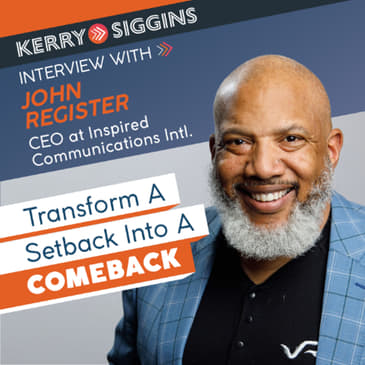
[00:00:00] If we're always feeling stressed and burned out, we got to shift the environment because somebody is telling us to be stressed. Hi everyone and welcome back to Reflect Forward. I'm your host Kerry Siggins and I'm so glad you are here today. Today my guest is John Register who is a force of nature. I met him at the Real Leaders Unite Summit in La Jolla, California outside of San Diego a couple of months ago.
[00:00:28] And I knew he had to come on and share his story of leaning into his adversity, not overcoming it, but making something of his life after he lost his leg. Now he's a keynote speaker, but he's done all kinds of amazing things that have supported people who have lost to their limbs due to trauma or some sort of accident. And he's been very involved in the military and the Olympics and the Paralympics and he's just an amazing human being.
[00:00:54] And I know you're going to absolutely love this story of being a catalyst for change as you challenge yourself to think bigger, push harder and transform your setbacks into very powerful comebacks. So hang tight and I'll be back with John. All right, everyone. I am back with my guest today who I happened to meet when I was in San Diego a few months ago. John Register. John, thank you so much for joining me on the show today.
[00:01:22] I am so excited. It was great meeting you out in La Jolla. Wow. What an amazing experience. And I'm just enthralled by you. So of course, I'm going to say yes to you and to come on for you and your guests. I felt the same exact way about you. You have such an amazing story. And I'm so glad to have you here to share with my listeners about your story of overcoming adversity and not overcoming adversity, as you say, but I'll let you tell that story and reinventing yourself.
[00:01:49] But before we get started, you're the CEO of Inspired Communications International. So could you talk a little bit about what you do and how you help leaders? Our company really works on three prongs. And the first is keynote speaking. So we go around the globe talking about resilience, how we frame it, how we move through it. Secondarily, then we coach on it as well.
[00:02:12] So I have a group of athletes that were the Olympic and Paralympic athletes that have come through some type of challenge and they have something to teach about. So they're all real lived experiences. What we're really building out now from the coaching is being able to have these retreats. We haven't done one yet, but that's where we're headed with it.
[00:02:31] It's important from being a CEO, not only just with my small little company here, but when I was the CEO of the Amputee Coalition, I saw a lot of times, including myself, when you close that door for the first time as an executive, you're like, what the heck did I just get myself into? So in that first question, I think we have to give ourselves space and grace to grow.
[00:02:54] And doing that and not feeling isolated in that moment and having a community built around it really does help me, helps others that are in those leadership positions to know that you're not alone. And why would we ever build something alone? As Sonia Dumas says to one of my great mentor friends, why should we get to the sweet C-suite spot and be alone? We should be building all along the way. Shame on us if we feel alone at the top. So that is something that we focus on to not make people feel alone when they get there.
[00:03:24] Can you talk a little bit about what the Amputee Coalition is and then why you left to start your own company? Yeah. So the Amputee Coalition is a national organization that really serves the limb loss and limb difference community. So limb loss, of course, is somebody that had their leg or appendage amputated through trauma. Limb difference is from congenitals from birth. We're like the first line of defense for when someone goes through that trauma.
[00:03:49] So whether you're a veteran or whether you just had a motorcycle accident or you lost one of your limbs to trauma, whatever it might be, we serve in that capacity. So we have peer mentors that go into groups, into hospitals. We have affiliations with hospitals, of course, with the VA. So we service that population. We did get hit during the current administration's cutback. So we can't service our veteran population like we used to because of our funding cuts.
[00:04:16] But we're still going to be thriving and we're still going to do the best that we can with what we have. The company was actually started before that because I was asked to go in as a board of directors person on the board of directors to be the acting CEO of the coalition. And I did that for about six, seven months so we can get a real CEO up in there. And so we did. She's doing a fantastic job with the organization. So my company goes through the entire process. I wanted to make sure that I had something viable for the family. I understand.
[00:04:44] OK, so you are an amputee and you run Olympic hopeful. So can you share a little bit about your story and how you lost your leg? Sure. I ran track for the University of Arkansas, was a three-time track and field All-American. That means you finish up top six in the nation. I went on to the Olympic trials, went to two Olympic trials, went to the high hurdles, the long jump, and then the 400-meter hurdles. 400-meter hurdles came in 1992. I was a soldier for six years and I was on the Army's world-class athlete program.
[00:05:12] I came back without a scratch and I was training for my third Olympic trials in the 400-meter hurdles. I misstepped one of the hurdles, landed awkwardly, dislocated my left knee, severed the artery behind my kneecap, and then seven days later had the tough decision to either keep my leg and use a walker or a wheelchair for the rest of my life or take the amputation and use a prosthesis. So you can imagine the choice that comes after losing two careers, my military career and my athletic career, all within one wrong step.
[00:05:42] So I was going down a downward spiral. I chose the amputation and I was licking my wounds and had an identity crisis. Who am I now in this moment? Everything I have worked for is no longer there. How do you shift in this moment? And the whole weight of that, it didn't come down at different times. It came down at one time. Who am I now? What's my identity? Is my wife going to stay around? Is my son going to still see me as his dad? Do I still have a job in the military? Can I support my family? My Olympic dreams are over.
[00:06:10] All these things came within 30 minutes and I was just under a press. And it was Alice. She saw me struggling with that. She knew something was wrong. I was in a wheelchair, went out to an inaccessible playground. I parked watching my wife and my son play the swing and I couldn't push myself out of that chair. With those flood of thoughts, she comes running over, wraps her arms around me and says, you know what, John, we're going to get through this together. It's just our new normal.
[00:06:37] And when she spoke those words, she really baselined my entire existence at that moment. She really was breathing oxygen back into my environment where oxygen was being taken away. And as I started wiping those tears away from my eyes, John Jr. jumps off the swings, hits the ground, comes running over those five and a half year old legs and says, hey mom, you see my big jump? And I realized in that moment that the only thing that's really changed is my leg is gone.
[00:07:04] Everybody else is still seeing me for who I am in their life. It's me, the one that's having the problem with this. Now there are some others that did. There's some friends that couldn't call anymore because they didn't know what to say. And I understand that as well. But for those that were around, they were great. They uplifted me. They were lifting me when I couldn't lift myself. And they were encouraging me when I didn't have any encouragement. So that was really what was going on in my head. And that's how I lost the leg. And then how my wife helped me retool.
[00:07:33] Lots to unpack here. And thank you for sharing. I think that the over-identification that we have with our vocation or our strengths or our skills, it is such an interesting place to be. I've definitely over-identified as a CEO earlier in my career. And I've had to really work on letting that go because it's unhealthy, right? When we have such an attachment to what we do as if that's who we are. You are the same exact person that you were before.
[00:08:03] Maybe not the same exact person, but the same soul, right? The same heart, the same hopes and dreams you had before you lost your leg. But when you over-identify with, I am an athlete, I am an Olympian, I am a soldier. Did you feel like you had some of that over-identification? And how did you move through that? I did have over-identification. But I also had some other things that I think made the landing softer because I'm a musician. I had my college degree.
[00:08:29] I had things in my life that were placed in there, either known or unbeknownst to me that I had put in there, that these folks were not going to allow me to fail when I couldn't take care of myself. What I think about was your share there, Kerry, is when I talk with professional athletes now, and they have over-identified in their athleticism and have a hard time leaving the football field
[00:08:54] or the NBA or wherever they might be and going back into the civilian life or life before they were professional. Or the military, senior military leader who has commanded troops all the way for 30 years, and now they have to go back to a household that doesn't really know them. They've commanded hundreds of thousands of people, and now they're going back to a household of, what, five people? And all they did was pack up and move when you moved, and you had to go to work all the time.
[00:09:21] So there really is a sense of identity that they are beholden to, and it makes it very tough to say, what else do I have in my kit bag so that I can move forward when this transition actually happened? So mine happened abruptly, right? It was a snap. It was a break right away. But others, it takes over time. My friend April Holmes called it, training for your transition. My coach, Remy Courtemney, said, everything is training. If we can understand that everything is training, we're always preparing for the next thing coming up,
[00:09:50] then I believe that we will always be prepared. Because there is an embarkation or a point where those two roads meet, whether it's through trauma or whether it's through your choosing to lead, when you actually make the commitment to do it. One is chosen, one is you choose. But the choice comes. And you don't get back what you desire to have back once that choice has been made. It's gone. You cannot go back to the way it used to be. And that's scary because you're no longer the expert in that new space.
[00:10:20] And even though you have those skill sets, your mindset says, I'm no longer this person. You still are that person in your heart. And you just have to figure out the shift. And of course, that all comes down to mindset, which I know you speak a lot about. And I wrote a book on the ownership mindset. I had to do a massive shift of mindset in my life when I used to be a victim and blame other people for my life situation until I accidentally overdosed on Labor Day of 2006 and then had to say, every decision you made puts you in this spot.
[00:10:49] And it's time to start owning it. So I'm a huge believer in mindset. And I've witnessed firsthand how profoundly it can change your life. So talk a little bit about your journey in shifting your mindset. Because as you say, losing my leg wasn't the hardest part. The challenge was adopting my mindset to be able to embrace this change. How did you go about doing that? Yeah, I think it's a continuous journey. And it didn't all the way come together.
[00:11:15] But I remember the first episode of when the mindset had to change. That was my baseline. Alice was one of them because that was a mindset that I was in of loss and job and loss and what I was capable of doing. But the real fight was coming up that I had no idea was coming. So my injury happened on May 17, 1994. One month after is June 17th.
[00:11:40] And on June 17th, I'm in the worst pain of my life. The leg is now gone. The leg is trying to heal internally, externally. I can't get any rest. Tears are just falling. You can't stand up. You can't sit down. You can't lay down. You can't roll over. Nothing that you eat or don't eat. No medicine. No medication. Nothing is working. And I am so much in pain. And then about 530 that evening, as I'm on my cousin's couch, sitting down, getting up,
[00:12:09] getting down, a white Bronco starts going down the I-405 freeway out of LA. And everybody's glued to their set. No matter where you are, you probably know what I'm talking about right now. OJ Simpson is in the back of this white Bronco being followed by a herd of police cars. I don't call it a chase. I call it follow because they're going 55 miles an hour. No one knows what's happening with OJ at this time. All we know was the suicide notice being read over and over again on the news air.
[00:12:36] And as I'm in this tremendous pain, I'm thinking to myself, oh my gosh, what's going on with the juice? Here's a Heisman trophy winner. He's in all these commercials. He's beloved by America. He's, he's, uh, you know, the Hertz commercial. We know him from these movies and all these things. And he's this Hollywood celebrity, but something's going on with him. And we don't know at this time. And I made a point at that moment. I said, John, this is going to get a lot worse before it gets better.
[00:13:05] But I'm not checking out. And that was the first mindset shift that I'm going to walk through this, even though I cannot see the end of the tunnel because we're still going down the tunnel. We haven't hit the bottom yet. And that's the internal fortitude to fight through because you're looking at something on the other end that maybe this helps somebody else later on. But you can't even see that because you're fighting through this period of time. So fast forward, I retool, I get up, I'll go through this quick and we go back and unpack it.
[00:13:35] But I swim for physical therapy. I make the Paralympic swim team. I see athletes running with, on the track with artificial legs, then have a leg made for running, make the Paralympic track and field team, win silver medal, the long jump in Sydney, Australia from that mindset shift. And from there, people kept asking me, how did you overcome the amputation? And I never had an answer for it. I couldn't figure it out. I didn't know how I over, and it wasn't until I was about to do a TEDx talk on the story. I'm saying everything else that everybody else is saying.
[00:14:04] I have my faith, my family, my friendships. I didn't know how my freedom. I was like, that's not how it happened. Even though that's true, it's not really the process. And when I was in a heated debate with my friend who was telling me, stay in the TEDx. I'm like, no, I'm going to get out. He said, what you did overcome, you won the silver medal. You went to the Paralympic Games. You overcame everything that was before you. And I said, I didn't. Because had I overcome my amputation, I would have my leg back. And that became the response of almost everybody that I shared it with afterwards.
[00:14:34] And that became the first thread in what I call my resilience action model. So we go through a point of reckoning. The reckoning is realizing we don't get back. We desire to have back when some type of trauma impacts our life. Through a revision, I can cast a new vision now. But I have to get past three opposing forces, other people, society, and myself. And then I get into the renewal, which begins with a rebirth, which is the hardest part of
[00:15:01] the model because that means a commitment has been made to the vision. And I have to give myself space and grace to grow in the new. So I'm no longer the expert. And that equals my resolution. And that equals my freedom, my liberation. I can give myself the reward. But a great leader, they don't stop there. Great leader starts looking for the next reckoning because it's coming whether you want to or not. So you better be prepared for it by start scanning and preparing your people for what's coming up next.
[00:15:29] And that's the model that we began teaching with Inspired Communications, the company. So let's go back and unpack this a little bit. Whenever we have a big loss in our life or we are making some big, huge change in our life, we almost have to grieve the past. So do you feel like you had to go through a grieving process, obviously grieving your leg, but grieving like what you were, knowing that it was going to be very different going forward? What was that like for you? It happened really fast.
[00:15:57] And I believe it's because I had so many other things in my life that could cushion that fall. I just wasn't one dimensional. I was very good at several different things, but all my eggs, so to speak, weren't in one basket. I could shift quickly to something else. I could see the pathway faster, but that doesn't mean I didn't grieve the loss of my leg. I was out there in the playground. Like I said, just everything was just flowing out of me. And that was the big grief.
[00:16:25] It just came at one time where I didn't think I had anything left in me. You come out and you can't use the restroom when you're in the hospital. And so they got to give you an enema. Yeah, that's like the lowest part of my life, right? It's embarrassing. Here I'm this athlete, this soldier, and you can't even take care of yourself. Those are the things that I began grieving, I think, in those moments.
[00:16:48] But having the friends that were there, my family that was there, the faith that was there to say, no, you're more than this. And Alice being the trigger to unlock that flow for me to make sure that I could see the value.
[00:17:01] And so I think when I look at how soldiers healed from the battlefield, Iraq and Afghanistan, and I started building the Paralympic military sport program later on, these soldier athletes would come into Walter Reed or Brooklyn Medical Center or San Diego, Ebola Hospital, and they were all in the same firefight. And even though they lost some battle buddies in those firefights, they also knew the group that was ahead of them that were in another firefight.
[00:17:31] And so they were all healing underneath this one umbrella, and they were all pushing each other to excellence. So it's the environment that we really find ourselves in. If we stay isolated and we're listening to negativity, we will start turning negative. And if we had a propensity to negativity in the first place, that will happen faster. So we have to look at who do we get ourselves around that can lift us as we need to be lifted because we can't lift ourselves in the moment.
[00:18:00] Who's our friends that are not going to allow us to fail, in other words? And I had that, right? So I went through the grieving process, but I went through it pretty quickly. Yeah, the network is such an important aspect. When I decided that I was going to change my life after my overdose, I came home to my mom. That was the first place that I knew that I needed to be with the kind of support and love and the unconditional. I accept you for who you are, even though I don't agree with your choices.
[00:18:27] I needed that and was able to then start to build that network out around it. I would not have ever would not be sitting here today if I wouldn't have had that. So that really resonates. And I think that a lot of people feel like I don't have that, but you do. You have at least one person that you can start to lean on to say, OK, I need help to be able to see past this trauma or this inadequacy that I feel or whatever it is that is causing you to crumble. And you're right.
[00:18:55] And that's oftentimes is the first line of defense or I don't want to accept it because I don't have a network. And you said so eloquently. Yes, you do have a network. You just probably haven't tapped into it, you know, where you can't see it. But there's a network that's there that will support you. And maybe this is the time where it has to come forward for that time of support that you now need.
[00:19:17] So tell me about how you made the decision that you were going to race again, that you're going to get a leg that allows you to run and that you're going to go for the Paralympics and make that happen. Yeah, this story is so wild. I knew nothing about Paralympic sport, Paralympic games. I was trying to be an Olympic class athlete. I qualified, right? So it's like less than 1% actually qualified for trials.
[00:19:40] I was swimming for physical therapy and my coach found out about the Paralympic games, my track and field coach, and said, hey, you should trial for the swim team because he was swimming. And now he didn't think I was going to make the team. I didn't think I was going to make the team. What he was doing was giving me an azimuth to shoot for so I could get myself in a mindset to push. I went across the pool for the first time. I went 25 yards about passed out, right? It was horrible. But I said, okay, now I'm going to do two laps the next time. I'm going to do four laps. I'm going to do eight laps.
[00:20:10] So I just kept pushing myself. And there was a little lifeguard in there. She helped me work on my stroke. And I swam before, but she was helping me because you got to reach and pull. So I got faster and faster in the water, but I still need to shave off seven seconds to make the trial standard in the 100-meter freestyle. Not going to happen. But I wound up actually shaving off 6.99 seconds. And I couldn't believe it. I was like, I almost made the trial standard.
[00:20:37] So I went home from the trials and I got a call from Coach Cal from Catholic University. And he says, why did you leave before the team was announced? I said, well, I didn't make it. You know, I almost made it. And he said, in the 100-meter freestyle, at the 50-meter mark, when you flip turn, we count that time as a real time. And your time was underneath the Paralympic standard. And so we picked you up for our relay team. I was like, are you kidding me? I'm going to Atlanta as a swimmer? Here are a training as a 40-meter hurdler and I'm going as a swimmer now?
[00:21:06] I couldn't speak for like 30 seconds. I was totally floored. And talk about ignorance, right? What we don't know can probably kill us if we don't know. So here I am in my office going to the Paralympic Games. And I have this amazing experience that's there in Atlanta. But it was there that I saw athletes running with artificial legs. And that's when I knew I could return to the track. So I do. I have a leg made for running and four years later I make the Paralympic Team. But this time I'm on a mission because I know how to run.
[00:21:34] I just don't know how to run on an artificial leg. So I just figured this thing out. I'm good because I know all about biomechanics. I know about the training. I know about training cycles. I know all this stuff. So it was just a matter of learning how to run. And I still had some blind spots that I just didn't know. Yeah, after four years, I win the silver medal in the long show in Sydney and placed fifth in the 200-meter dashes. It's just crazy, right? And I was thrilled. I was thrilled to win silver.
[00:22:03] No one goes and steps on the starting line for the silver medal. Everybody wants the gold, but there's only one top spot. And I had to beat the two-time Paralympic champion, Lucas Christen. I pushed him. He jumped 5.42. What's his previous world record? And so I jumped 5.41. And he was going to have to either tie his world record or break it to beat me, right? And he was behind me. So he did. I had nothing to jump left. He wins the competition. And I get silver right behind the guy. And no one else had even jumped 5 meters.
[00:22:31] We're the only two in the competition to jump over 5 meters. I pushed him to the limit, right? I am not just satisfied with that. It talks about this whole culmination. Can you get it back? How many people actually make an Olympic trials? Less than 1% that start out trying to do so. How many have an injury and come back and make two Paralympic teams, and then want a silver medal? Less than 0.0005% do something like that.
[00:22:58] And so it's not just about have one dream. That dream gets deferred or taken away, and then you shift lanes, and you get on another path, you revision it, and you have another thing that happens. And I think that's what we want to teach people, that when one thing stops, you have to look for the parallel paths because it's easy to stay back and stay complacent. You've got to lean into it and say, where's my next move? Because there are multiple moves that we just open our eyes up for them. You're an Olympic athlete.
[00:23:27] And yes, the path to getting there was very different than what you imagined, but you still found that path. And I think that's such a powerful story. So many people stop because how they envisioned themselves getting to that endpoint isn't how they get there. And so they think, oh, no, I'm never going to achieve that dream. When really life just has something else in store for you, and you can still achieve what you set out to achieve,
[00:23:56] even if the journey is a different journey than the one you anticipated. It will be. Yeah. Right? So the question just becomes, what would you tell your younger self? That question really doesn't tell me anything because my younger self doesn't have all the experiences up to the point I am right now to make those decisions. So the best thing to do is ask a question, where do you see yourself 20 years from now? 30 years from now? And then come back and build a roadmap to where that is. The best map that you can get.
[00:24:26] But it's going to be with hills and valleys, it's not going to work out the way that you want it to work out. There's going to be struggle and there's going to be triumph. It's like the stock market, right? Since 36, it goes up. The line keeps going up. But it goes up. There are valleys, there hills, peaks, valleys, peaks, valleys. And it's the same thing in life. But the line keeps going up. We're always going to go towards that destination, even though we're going to have some struggles along the way. And life can take you in a different journey. Did you know that you wanted to be a keynote speaker and a coach before you lost your leg?
[00:24:55] There are people that saw some things in me, but I never thought it was going to be that. And even when I was doing it, when I first started out, even though I was speaking stories and people were saying, you should do this. I was having so much fun building programs. I didn't want to do that. This was building out that Paralympic military sport program for wounded, injured veterans use sports as a tool for the rehabilitation. That turned into warrior games that the DOD still runs and the Invictus games that Prince Harry still runs.
[00:25:23] So what I was doing, one life can make a tremendous difference. But we're so much focused on the 99% of stuff. Oh, I can't get this done and get that done. If we're going to focus on the less than 1%, we can really change the world. Yeah, I love that. It's so beautiful. It's just such a great story. One of the things that really stands out for me is this idea of control or trying to orchestrate outcomes.
[00:25:49] I had lived my life very much as a person who tried to orchestrate outcomes. And I certainly have orchestrated so many great outcomes at a cost. And what I really realized, you have to dance that fine dance between making things happen and letting things happen. You really have to be adaptable. You can have this vision for yourself, but you have to be able to adapt to things that life throws at you, right? You didn't know you were going to lose your leg. A small misstep changed the trajectory of your life.
[00:26:16] And maybe you thought before that, I have control of this. I'm orchestrating this outcome when really you don't. So how do you look at that? How do you look at control and adaptability and going after your vision, knowing that journey might be a little bit different than what you anticipate? I think you said it just right. You have to have a target. You have to have a goal that's in your mind. Maybe it's broader than a goal. Because I don't think we ever get there, but then we're looking for something next or else we're dissatisfied with where we are.
[00:26:42] So you want the vision that's out there so far that's like when the horizon meets the sea, right? You're never going to get there, but you're going in that direction. And the ability to know, like in resilience, we talk about resilience. I look at that resilience as 10 letters of a word, and each letter represents a hurdle. But before the hurdle race begins, the announcer says, quiet for the start. And embedded in those 10 letters of resilience is the word silence.
[00:27:12] How do we hear our own voice first before we start moving out to begin helping others? The ups and downs are going to come in our life. And attack is the word that I use because hurdlers don't run over hurdles. They don't jump hurdles. Hurdlers attack hurdles. You are pushing into it with all the force that you have. And the parabolic curve will take care of itself after you leave the ground. But you have to commit to the hurdle. You attack the hurdle, but you do have to leave the ground.
[00:27:40] So you're trying to get back on the ground as fast as possible because those are the steps that you can control. You're controlling the rhythm in between each one. And then when you attack the next one, you're in flight. And you don't know what's going to happen on the other side, but you're in flight. You come down and you hit the next one, the next one, next one, next one. And you keep getting faster and faster. The rhythm gets faster and faster until you hit the finish line. But we don't know what's going to happen from the takeoff to the touchdown. And that's where the ambiguity comes.
[00:28:06] Even though you're trying to control the body movement and everything because you're getting better at doing it, there's no guarantee that it's going to come down the same way that you just took off. And you have to trust. I think that's such an important aspect. Like you have to trust in yourself. Like peering over the edge when you're making any major life decision. You're peering over the edge and you're not 100% sure what's on the other side, but you just have to trust that when you take that step that there's going to be something there that catches you.
[00:28:32] Like you trust in yourself and you trust in the universe or God or whatever your faith is. And I think that's so hard for people. They don't want to take that step over the edge. And I love your analogy because it's such a great visual to be able to see. Like you're trusting yourself as you're running, but you got to trust yourself even when you don't have control, when you leave the ground. And that's a difficult thing for people to wrap their head around. And you said a word in faith, right?
[00:28:59] Faith is believing that something is going to happen before it happens. It's a story that we're telling ourselves and it's actually on the way. So it's a physical thing that's coming into our existence. If we're willing to wait for it to show up in our existence, we want it. We want to control it, right? We want to control when the faith actually shows up until it's actually concrete. But we don't get to control that. It's going to show up when it shows up. So we're looking for a future state.
[00:29:24] So in that, can you be patient and wait for the thing that you know is coming to actually show up into your existence? There's two things that I do to help myself with my impatience because I do like to orchestrate outcomes. One is that maybe I don't always know what's best. And so I just have to trust that if it doesn't work out that way, it's because life has something in store for me that's better.
[00:29:49] Or that I have to learn that lesson and be able to trust like, okay, it didn't work out the way it's supposed to be, but some other door is going to open. I definitely experienced that as I rebuilt my life in my 20s when I hit rock bottom and I didn't possibly think that I could ever be where I am today. I had to take those small steps at a time. And I picked up my life and I moved back to Durango, Colorado. I was living in Austin, Texas at the time. And I was so scared. I had no job, a huge amount of debt. I was leaving all my friends to go back and live with my mom at 28 years old.
[00:30:19] I have no idea what's on the other side, but I just have to trust that life has something that's better for me in store. Even if I don't know what that is, life closed a huge door in my face only to open up another one. It's really hard to see that when you're in the shit because that's basically what you were in when I was in. It was like, oh, this is shitty. There's no better word to describe it than that. To give some hope, right, for someone that might be out there right now.
[00:30:49] One of my ways where I am in life or if I'm on the right path in the right direction, I begin looking for echo moments. So ripples go out from us. We throw a stone in the water, the ripples go out. But echoes come back. So think like a dolphin in the water. They send out sonar so they know where the fish are. They know where the predators are because they know that the sound ecosystem that comes back to them. People who are blind or visually impaired use echolocation to know how big a room is or how small a room is.
[00:31:19] They're able to navigate around things. And you see the best ones, they can navigate a room if you think they can actually see. But they click and they hear the bounce come off and they can tell where things are in the room. So their ears become their eyes. And so if we take that into the realm of how we can course correct or we're validated, I remember having a major echo moment that happened. This is before I began really looking for them. When I wasn't being my best self.
[00:31:47] I just wanted some peace and quiet. I was on a train in Dulles Airport. And I was with a woman named Carrie. She's above and below in the amputee. We're going to amputee camp. And another woman's talking to her. She's talking to my friend Carrie. I got my headphones on. I just want 15 minutes apiece. And as she's talking to her, she begins telling the story about this man who was an amputee, who had an injury. He lost his leg.
[00:32:16] And then he came back. He became a swimmer. Then he won the Paralympic Summer Medal. And Carrie's like, oh my gosh. She's talking about Jesus Christ. So you have to understand what Carrie is. Carrie's a person that she wants to eat the popcorn. She wants to tell him that story. And she wants to, she's looking. She wants to see what the exchange is going to be. As she's telling it, I'm saying, you don't even know what Paralympics are. You probably think it's Special Olympics. But now she's defensive. So she tried to show and tell me that she knows this.
[00:32:45] And then the train ride is over. We go upstairs. I take a picture. I hand her my card. Not to really give her my card. But it was to go to the next thing. It was my exit strategy to move to the next thing. Like I said, not my best moment. Two years later, I'm walking across the street in Colorado Springs. And I'm going to a veteran. Lunchtime to get a hot dog. My cell phone rings. I don't recognize the number. But it's in the Washington, D.C. area. I usually don't answer those types of numbers. But some of the lunch break, I'm in a good mood. Answer the phone. This lady. I really don't remember her.
[00:33:15] But she's trying to get me to remember the conversation. I'm saying, yeah, I just want to remember this thing. And then she wanted to tell me the rest of the story. Because she didn't get a chance for that day because of me. She says that she was watching a program called It's a Miracle with host Richard Thomas. And she kept seeing my program come on when I was on this show about going through this adversity and how I got to the other side and became a medalist.
[00:33:41] And if I could amputate my leg, she was considering going through a double mastectomy because of cancer that was in her life. And one of her cohorts, her boss or confidant, was facing the same thing. So they're going through this whole thing together. And she was encouraged by my story to go through with the operation. Her cohort didn't do it and wound up passing away. And what she wanted to tell me on that train that day was that my story may have saved her life.
[00:34:11] And then it came flooding back. The headphones, how disrespectful I was being, all those things. And I said to myself, how dare I? God's given me this story that is releasing people when I don't even know it is. I'm not even in the room. I don't know this person.
[00:34:30] But somewhere, someone's being so inspired that they're having a double mastectomy from cancer so that they can live without what she calls appendages that are not necessary. And that shifted me to say I'm always going to show up and breathe life into people. Because as my creator, my God has breathed life into me so that I become a living being.
[00:34:57] It's my duty, my obligation, my responsibility to breathe that life into others. Because if I'm not, if I'm not breathing that life, what's the alternative? I'm taking breath away. When I take breath away, the result is people panic. They become unclear. They become uncertain. They start freaking out. They don't know which direction to turn. They're ambiguous. All these things. They have burnouts.
[00:35:26] They don't know which direction to turn. They don't know which direction to turn. And the stress just goes to a different level. So we can tell when we're in those environments if we're feeling that way. If we're always feeling stressed and burned out, we got to shift the environment. Because somebody is telling us to be stressed. There's only two things. Either somebody's giving you life or someone's taking it away. When you water a flower, it's either growing. If you don't, it's dying. There is no in between.
[00:35:55] We want to be watered with the breath that comes from other individuals. And that moment is what I determined what I was going to be doing for the rest of my life. And that is the quintessential example of leadership. Are we inspiring people to be their very best? Are we inspiring them to love themselves, to take those risks, to be courageous? Or are we not?
[00:36:22] And what an amazing example to come back to you two years later. Remarkable. It is remarkable. I mean, she wanted to save the card because she wanted to call me. And she put it in a napkin for safekeeping. And she couldn't find it. So here it was. She's cleaning her room out two years later and finds the card. Unbelievable. Wow. Unbelievable. Thank you for sharing such a powerful story. And I think it's a perfect segue into my final question for you.
[00:36:50] And it's my signature question, which is the name of this podcast is Reflect Forward. In the context of these stories that you shared around resilience and understanding how you impact others and how you show up, what does Reflect Forward mean to you? I believe it is that question that I asked earlier instead of looking backward to try to change something. It's looking into the future and coming back to where you are right now to build the pathway to what is next.
[00:37:19] There is only one vision that you can have. And you own it. There is the one thing that drives you to the essence of who you are. Most people are searching for it all their lives. But I believe there's only one thing that you are supposed to do because you're like a fingerprint. You're like a strand of hair. There's no one else that's created like you. And so lots of times we're looking to what other people are doing to validate or see what we should be doing.
[00:37:44] We really need to sit with ourselves and find out what's the one thing I've been created to do. And I'm going to tell you, it's not to tear other people down. You can get rid of that one off the table. It is not to tear. If you're tearing other people down, you're on the wrong mission. I guarantee you that right now. Because you're building a garden and a harvest that's coming of nothing but negativity. You said that you had to own who you had become. We all have to own who we're becoming.
[00:38:12] Because we're planting those seeds. And those seeds are yielding a harvest. Let's plant the great seeds as we are reflecting on. Such a great answer. Thank you for sharing. All right, John. So how can people find you? Yeah, two ways. One is the website. It's just johnregister.com. There's a booking link on there if you want to do that. It's common spelling. J-O-H-N-R-E-G-I-S-T-E-R. If you want to know what I'm up to, we have these executive leadership lessons that we do once a month.
[00:38:42] We do executive coaching. And it's just, you know, everybody shows up. We got people from Denmark and we got folks that just show up that have businesses. And we take a topic and we just go deep dive on that topic. To get in there, yes, johnregister.beehive.com. And you can get in there and we have just great conversations.
[00:39:05] We post on Saturday afternoon and Tuesday this afternoon will be an accountability that I always have to put in accountability. And then on Wednesday, we have another guest. So I would love to have you on the show. I extract three things that I learned from you and we put that on the Saturday show. We're always interviewing leaders and what their thought is. And we call that Elevate Podcast, Success Podcast. So my first question is always, what did you have to amputate in order to elevate to your success?
[00:39:32] Well, I'd be happy to come on and I will share all of this in the show notes so people can just get more of your goodness. And I so appreciate you coming on and sharing your story with my audience. It's just so inspiring. You really have such a powerful message. So thank you. Oh, thank you. Thanks for the opportunity. Absolutely. All right. Hang tight and I'll be right back. All right, everyone. I hope you enjoyed that podcast interview. John is such a great human being, such an inspiring story and just an ultimate comeback.
[00:40:02] That's for sure. So with that, I will leave you to your day. If you like this episode and think someone could benefit from it, please feel free to share it. And if you like this podcast overall, please subscribe to it on your favorite podcast platform or on YouTube. Send it to a friend. Write a review. Rate it. It always helps with the algorithms and it gets these amazing stories out to the world. Thanks so much and we'll see you next week. Bye.