
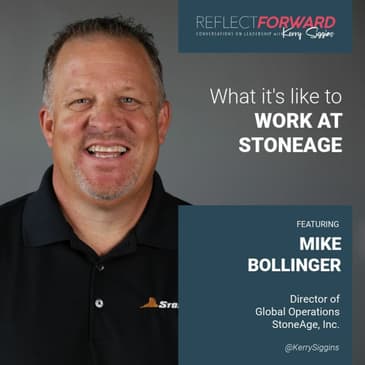

[00:00:00] Hi, everyone. And welcome back to Reflect Forward. I'm your host, Kerry Siggins. And
[00:00:13] I'm so glad you are here today. Today my guest is Mike Bollinger. He is the director of operations
[00:00:19] here at Stone Age. And I just thought it would be really fun for you all to hear what it's like
[00:00:25] working at an employee-owned company at Stone Age. You listen to me every week, talk about what
[00:00:31] we're doing here, whether that's woven into an interview or in one of my advice from CEO episodes.
[00:00:36] And Mike is just a remarkable example of somebody who's grown so much with this organization
[00:00:41] and has developed into a tremendous leader. And I thought it would be fun for you to hear
[00:00:46] from somebody here who is in the trenches with me. So hang tight and I'll be right back with Mike.
[00:00:59] All right, everyone. Welcome back. I have the one and only Mike Bollinger. I'm sure there's other
[00:01:03] Mike Bollinger in the world, but there is no other Mike Bollinger like this Mike Bollinger,
[00:01:08] like the Mike Bollinger, who is the director of operations here at Stone Age. And we wanted to
[00:01:14] give you an insight peek of what it's like to work here. So Mike, thank you so much for joining me
[00:01:18] on the show today. You're welcome. Awesome. All right. So maybe tell a little bit about yourself
[00:01:24] and why you decided to come to Stone Age, like what about a decade ago? Yeah, almost 11 years.
[00:01:30] Now, the story starts back coming out of college in 1990 out of issue. I'm going to try to fast forward
[00:01:36] and work for a number of different companies anywhere from the electronics and I will
[00:01:41] to airbag manufacturing automotive industry, which is very high-paced high stress
[00:01:47] to a little bit more job shop for rockford fuzz gate and I've owned a couple of businesses on my own.
[00:01:52] But really what led me to come to Durango, Colorado and people like why do you want to go
[00:01:57] into a little town after you leave Phoenix? Well, Long story short, I was born in four cones, Colorado
[00:02:02] and it wasn't because I wanted to come back to Colorado. I wanted to find a company that actually
[00:02:08] cared about their employees and where I could go making difference in my everyday work and influence
[00:02:16] not only the company, but build the relationships that it takes to actually run a successful company.
[00:02:22] So I didn't choose the mountains. I chose the company and I actually moved away from my family
[00:02:28] and everything I knew and all my friends that I had known since I was 10 years old. So
[00:02:33] I gave up basically my core of my life because I knew that I wanted to work for a company that cared
[00:02:40] about their employees and that's how I ended up at Stone Age. And did you know of Stone Age before
[00:02:46] you started the process of searching for a new job or did you start to learn about Stone Age once
[00:02:51] you had your first interview? Really after I had my first interview, it was kind of funny. I told
[00:02:56] my wife I said I'm tired of working corporate America and I took her to lunch and there was this
[00:03:03] burrito called the Durango and I actually ordered it and I told her I'd put it for a job in Durango
[00:03:12] Colorado. And that afternoon on our way home, I got a call for an interview. So I know that seems
[00:03:19] made up but that is a true story and I just told my wife I wanted to do something different and I
[00:03:25] figured that in a small town maybe there was that difference because when I did work for Rockford
[00:03:31] Fosgate, it was a family owned business. So I wanted to get back to that kind of core but no,
[00:03:37] I didn't learn about Stone Age until I actually started interviewing. Did you take a title cut and
[00:03:43] a pay cut to come here? I did. I was a director of manufacturing at a company and yes, I took a
[00:03:50] hefty pay cut and a title cut which if you know what do you think about me, it's not about the title.
[00:03:56] I really do not care about titles. I care about the impact and the relationships and that I can come
[00:04:03] to work every day and have fun but yeah, it was financially the smartest thing but in the long run
[00:04:11] it was a slump. And why is that? I get to make a difference. I get to come to work or get to have fun.
[00:04:19] I have relationships. I feel like I work with a group of employees but not only that it's an
[00:04:25] extension. We're all owners. It's not just what I add to the company. It's what we as a collective
[00:04:33] team do and it doesn't feel like departmentalized and silos. It's about the business and the better
[00:04:39] good of the employees and the companies and ultimately what we're doing and delivering for our
[00:04:45] customers to be safe in what they do in the industry. So it sounds like you found maybe a little
[00:04:51] bit more purpose in your work when you came here. Would you say that's accurate? Yes, very accurate.
[00:04:56] I feel like when you're a corporate America, you're just making it through eight hours in the day or
[00:05:00] 10 or 12 or 14 depending on where you're working. Where today I feel like there is purpose.
[00:05:07] I don't count the hours of when I get to go home. I work until I'm ready to go home but a lot of
[00:05:13] times you'll find yourself in and start out and you're just so passionate about what you're
[00:05:18] involved in and doing that doesn't feel like work. I was told one day if you find something that
[00:05:23] you love, you will never work a day in your life and I feel that's what I found is so much.
[00:05:28] That's awesome. It makes me make me cry. Long time I cry, we're good.
[00:05:36] I don't think I've ever seen you cry in the 11 years I've worked with you.
[00:05:39] No, no. I don't think so. Well my goal is to not make you cry unless it's tears of joy and happiness.
[00:05:46] Exactly.
[00:05:49] So you had several different positions. I think that's one of the really cool things about working
[00:05:53] at Stone Age is that we really try to help our employees get a lot of different experiences
[00:05:58] and try different things. So can you talk a little bit about what that experience was like?
[00:06:02] That you've done lots of different roles in operations and you went into sales for a bit now
[00:06:07] leading operations and continuing to grow and going to get a promotion soon and all of that fun
[00:06:11] stuff. So what has that been like with all the different types of roles you've held here?
[00:06:16] At first it was like, what do you mean you want to offer me an hourly position?
[00:06:22] Literally I've been working in my career for a long time and held director roles and they wanted
[00:06:27] to hire me hourly and I couldn't understand. No, we need to negotiate salary. Well if I would have
[00:06:33] known what I know now, I should have with the hour lead because I was like, hours just trying
[00:06:38] to get up to speed. But I started an order fulfillment lead I believe it was. I had three employees
[00:06:44] two in shipping, one in receiving. I think about later I still have the same role but I took over
[00:06:49] him and for me and had a whopping nine employees at that point. And then I got an opportunity
[00:06:54] that KP gave me to go and run the sewer division from a sales standpoint and that was to go travel
[00:07:02] Europe for a year and open up dealers. Our first trip was 19 days, 17 different hotel rooms
[00:07:09] and seven countries. So yeah we didn't start slow. It was very interesting it was eye-opening
[00:07:15] and I enjoyed it for a whole year so I went into that role. I learned a lot about company
[00:07:21] from a customer standpoint which I really think helped frame me as a leader moving forward in
[00:07:27] the organization. I remember getting ready to leave for Germany on my last trip KP catches me.
[00:07:32] Hey what do you think about coming back and running ops when you get down with this trip?
[00:07:36] So that was obviously something to think about for another three weeks but then when I came back
[00:07:42] we opened up, we went direct and we opened up our branches so I got an opportunity to go and physically
[00:07:49] find buildings and put Rackie in and build inventory and build a team around our North American
[00:07:55] branch offices because at that point we didn't have our global or our European branches stood up yet.
[00:08:02] So getting it back to the roots of operations but running all of operations and including branches
[00:08:09] was something new to me because it has that sales piece of it but I think it fits nicely with
[00:08:15] starting an ops, getting the sales experience then blending back into ops with branch operations.
[00:08:23] From there we grew globally and we had our European locations in the Netherlands and the UK
[00:08:31] and they were being ran by the one the only lower Ellis which I like to call him.
[00:08:36] But Steve Ellis had the sales department and all the branches over there.
[00:08:40] What we migrated that it gave us a global chance to pull operations together as a whole so
[00:08:46] again growth. I had never ran operations in other countries so I think by doing the sales bit
[00:08:55] and traveling, learning the cultures then getting an opportunity to actually have employees in those
[00:09:01] regions was super cool but it was all a progression of going from operations to sales and back
[00:09:08] that I think has really formed me as a leader and really give me the skill set to do what I do today.
[00:09:14] You know I think your journey is such a good example of how careers are truly built.
[00:09:18] I think a lot of people think oh I'm going to climb the ladder it's this step and this step and
[00:09:22] this step and this step and in fact I even had a conversation with one of our employees about that
[00:09:27] like I want to know what my career path is you know my response to him was get really good at your
[00:09:32] job and then take an opportunity to go do something different and get well-rounded experience.
[00:09:37] The more that you know about the company, the more you know about different roles, the more valuable
[00:09:41] that you're going to be. It's not like oh I'm going to be a XYZ and then go into an XYZ
[00:09:46] supervisor and then XYZ. I mean some people take that path but I think getting that kind of different
[00:09:51] experience to really help you understand what your leadership skills are like, what you enjoy doing,
[00:09:57] how it helps the business grow and that's what makes a great executive. So I love your example
[00:10:03] of how you were able to do different things and take on different roles and really be able to
[00:10:07] grow with the company as you added more value to our customers and to our team. So I think it's
[00:10:14] a great example. Yeah, I think one of the things was don't be afraid to say yes because sales,
[00:10:20] sewer, sure. I remember the conversation yeah let's do this and you're like time out go home and talk
[00:10:26] to your wife first but I think it's being willing to put yourself out there do something that stretches
[00:10:36] beyond your comfort zone which is not very comfortable. That's why they call it stretching beyond
[00:10:43] but I do think that if you do that, that will open up opportunities but it says a lot about the
[00:10:49] company and being able to take those chances hopefully have success but also have some failures
[00:10:56] and then to learn from those failures and then learn where your skill sets actually align better.
[00:11:01] Yes, could I have maybe stayed in sales? Yes, it would have been a stretch, it would have been work
[00:11:06] but really where my skills landed is an operation and that's where they should.
[00:11:11] Yeah, I think what's really good about it is a lot of ops leaders there's an inherent conflict
[00:11:16] tension between sales and ops and that tension can be healthy or it can be unhealthy but I think you
[00:11:22] having that understanding of well our customers go through how we really do make their lives easier
[00:11:28] when we deliver on the Stone Age Assurance Promise to make sure that they go home safely to their
[00:11:32] families and to make sure that they can do their jobs on time. It helps you care or more about
[00:11:37] why you're doing the job that you're doing and I think that's really important like you need to be
[00:11:42] connected to that greater purpose of the company and that experience gave you a little bit
[00:11:46] of a taste of that. I think it helped you be able to bring that back to the rest of your ops team.
[00:11:50] I agree, understanding what sales is going through kind of puts up in perspective.
[00:11:55] Definitely. Okay, so let's talk about your leadership and how your leadership style has changed
[00:12:00] to sense working at Stone Age. Now what were you like before you came here? What were some of the
[00:12:05] missteps that you had and how would you describe your leadership style now? I would say I was probably
[00:12:10] a typical leader that would overreact to things, would get emotional, would let the stress level
[00:12:17] be seen amongst my team. I was a gas pedal full down, no break, wake up bodies behind me getting
[00:12:24] shit done. But I think you coined Bolognian Chinese all and that was me, but I was getting stuff done
[00:12:32] and in a lot of companies that is how you get rewarded and you get promoted. It's not about the wake
[00:12:39] of bodies you leave behind you. It's what are you getting done? So I think Laurie that this company
[00:12:44] was different and it cared about the employees and knowing when to slow down and how to slow down
[00:12:50] and not only slow down but bring the people along for the journey knowing that the time spent
[00:12:55] upfront explaining the why during the change management actually would allow you to move faster
[00:13:01] going forward than just running through walls. Because if you're running through the wall by yourself
[00:13:06] but you're not bringing the rest of the team along, you're not going to be successful. Today,
[00:13:11] CoolCon collect, there's nothing that really gets me too wild up. It's just not worth it in the
[00:13:17] grand scheme of things. You still have the same problem, you still have the same issues, same
[00:13:21] opportunity, you gotta go solve but you can be seen as a cool, calm, collective leader or you can
[00:13:28] be seen as Bolognian, a Chinese op, which leader do you want to follow? And it really came to that
[00:13:34] and a lot of it's through the coaching that I've gotten through Stone Age. A lot of it's due to
[00:13:40] UKP just spending time investing in us as leaders. And if I am wound up, I know when I'm in a low level
[00:13:48] health and I just don't interact in those situations. There's times where you don't have to have
[00:13:54] a conversation. You can choose to pause, walk away, catch your breath, come back in a better level
[00:14:01] health. I think that's really important. A lot of leaders look at this first layer of how do people
[00:14:08] experience me as a leader and cool, common collected or a Bolognian, a tiner shop or as the feedback
[00:14:14] that I once got erratic. And that's important. That's an important piece of leadership but to take it
[00:14:20] really to the next level, it's how do people experience themselves under your leadership?
[00:14:28] And I think that's a really important transition that leaders have to make. And one that I think
[00:14:33] that you've done an excellent job of because you've built such a strong team here at Stone Age is
[00:14:38] that you want people to be their best version of themselves. How do they step up to the opportunity?
[00:14:44] How do they say yes to those challenges rather than back away from it because of your failure?
[00:14:51] And I think that's a really remarkable thing that you've done and how I've watched you grow over
[00:14:55] the last 10 years is that before was get shit done and how people experienced you was a Bolognian
[00:15:01] and a tiner shop. And then as you matured and really developed your leadership style,
[00:15:05] people experienced you differently but now people are experienced real growth within your organization
[00:15:10] and I think that's some important thing is they're looking at how do I experience myself
[00:15:15] under my leadership? And so I think it's a really cool thing. I appreciate it.
[00:15:19] Another thing I admire about you. Yeah. Yeah, I'm going to say I did do a joint coaching session with one
[00:15:25] of my managers that we were C and I to I. And it was kind of game changing for some of my management
[00:15:32] style is individual wanted intent and then wanted me to get out of the way and we had a hard
[00:15:38] conversation though you don't always hit your dates so it's hard for me to give a intent and step
[00:15:43] back. I said, Barth, I'm going to trust that you can do it and your job is to check in with me
[00:15:49] if you need guidance and it worked. And me and that the manager of Ron Thompson, I'll say who it is.
[00:15:57] We have such a better relationship because of it. He was just recently promoted to a senior manager.
[00:16:04] He has grown and he's helped me grow and it's a no-day in my group. If you want to know how to
[00:16:10] manage Mike Goesee, Chris E. Walsh, another one of my senior managers but part of it is how do I
[00:16:17] provide them the leadership but also give them the comfort level to where they can push back and
[00:16:22] manage me because part of it is just being real, humble, having a good relationship with people,
[00:16:31] being motivated, being engaged in building a true relationship, not a surface level.
[00:16:38] But I really do believe the success that I've been able to have is due to that relationship
[00:16:43] of building peace of it and building trust within the organization, which I didn't have at the beginning.
[00:16:50] Yeah, you have to earn it right? You have to earn it. You got to come in and figure out how to fit into this
[00:16:55] messy ownership culture that we have. It's super fun but not always easy. Yes, exactly.
[00:17:02] I think feedback is another piece of it. You are one of the easiest people to give feedback to.
[00:17:08] I think you really consider it. You handle it well, you take action and obviously the story that
[00:17:13] you just told about Ron giving you feedback and really being able to turn the relationship around
[00:17:18] because of modifications that you made based on the feedback that he gave you and the modifications
[00:17:23] that he made based on the feedback you gave him. But have you always been easy to give feedback to
[00:17:28] what is your relationship with feedback look like? And how do you get good at receiving feedback?
[00:17:33] No, I was terrible at it. Everybody is. If anybody's going to say,
[00:17:37] oh, I'm just great at feedback and it just comes natural.
[00:17:41] I'll just call bullshit on that because I don't believe that. I do think some people are
[00:17:47] inherently better at it. I had to work at it. It's the coaching in the sessions we've done with
[00:17:52] radical candor here at Stone Age. But even then you've got to believe in it and you've got to
[00:17:58] believe in the greater good. And I think that's what the owner of Mike said is about.
[00:18:03] It's what this culture is about. It is not about me. It is not about operations. It is about
[00:18:09] Stone Age and our customers. And once you realize it's about all the other owners and leave the
[00:18:16] eye out of it and put the Wii into it, all of a sudden feedback isn't so bad. And I think
[00:18:21] that's one of the key things. If you always are expecting that people are coming and giving
[00:18:26] feedback because they care and they have good intentions, then feedback's easy.
[00:18:33] But if you put up that wall like we all do it times, you don't hear it. And it's not always
[00:18:39] easy to hear. You know, you know me, I hear feedback. I'll usually kick shit out of myself for
[00:18:45] about a day. And then I'll have a plan on how to address it and change the way that I'm either
[00:18:51] doing something or the way my team is doing something and modify based on that feedback. And I think
[00:18:57] we all have our different processes and how we do that. But short answer, no, it was not always
[00:19:02] easy. It is something that has been learned. And I didn't learn until I came to Stone Age.
[00:19:07] Yeah. Yeah. I told the story in the book of what that went. And I was doing COVID. We're working
[00:19:13] from home and I'm out for a walk and I don't think you're at your home office. And Mike is trying to
[00:19:18] get me to give my opinion on something. And it's just like this awkward conversation as he's trying
[00:19:24] to draw out my opinion. And I was like, what are you doing? He's like, well, I'm practicing my
[00:19:29] coaching. I always want to jump in and solve the problems. And Barb who works for us, I've talked
[00:19:33] about her on the show before she says you need other people solve the problems. And I was like,
[00:19:38] well, that's great. You should totally do that with your team. But I'm gonna solve your problem
[00:19:43] before you just tell me what you want. I'll help you or I'll tell you like, no, that's not a good
[00:19:48] idea. And you're like, oh my god, thank god. Anyway, we had this big laugh about it. But I believe that
[00:19:53] was one of those pivotal moments in our relationship. We always had a good relationship. But just being
[00:19:58] able to have that conversation of like, Mike, I really appreciate the work that you're doing. And yeah,
[00:20:04] you're right. You do need to let your team figure out how to solve their own problems rather than
[00:20:08] just jumping in and doing that. But here's how I need you to work with me. And here's how I'm here
[00:20:14] to help support you, build our relationship, being able to have that very candid conversation.
[00:20:19] And a lot of people think, oh, if I give feedback, I'm gonna damage the relationship. And
[00:20:25] my experience for the most part, that's simply not true. Sometimes it is, but for the most part,
[00:20:29] it's not. Right. So what was that experience like for you? Well, it was awkward at first. I'm walking
[00:20:35] around or remember exactly where I was at. I was out front trying to get my body moving instead of
[00:20:40] sitting in a chair. And I think the turning point for me was when you said, just tell me what you
[00:20:46] don't want. Yeah. Yeah. You said, let it fly. And I'm like, well, I'm afraid if I let it fly too much,
[00:20:52] I'm not gonna have a job and you said, oh, safe space. And it was that day that I told you exactly
[00:20:57] what I did not want. And it was around continuous improvement. And you got it. And you supported it.
[00:21:03] Fine. We can work with that. And to me, it is easier to tell people what you don't want than
[00:21:09] what you do. So I've been trying to use that because it was a pivotal moment. And I do think that our
[00:21:15] relationship was great. But it was so much better after that. I feel like there were no weird awkward
[00:21:22] moments. I could say anything to you. You can say anything to me. And we knew that we were both
[00:21:27] coming with good intentions, no matter what the subject was. Yeah. Yeah. That's a pretty remarkable
[00:21:34] thing to be able to have that kind of relationship. And I don't think a lot of people have that
[00:21:38] relationship with their bosses. And that's what we do try to create here at Stone Age at every little
[00:21:41] not just with me and the executive team. Like how does that trickle down to every single leader
[00:21:47] and manager in this company? How do we create those safe spaces that people can just have a very
[00:21:51] real conversation? Because that's it. Like we're all humans. Our titles are just letters behind
[00:21:56] our names. Like we're all just human beings trying to figure it out. Right? And that is no very much.
[00:22:01] And we're learning and we're evolving and we stumble. And that's what life is about. And we've
[00:22:05] built up these scenarios like I can't be honest with my boss. And certainly there have been cases
[00:22:10] where people get punished for being honest, but that is 100% not how we want to run this company.
[00:22:15] I would want to make it that safe space that you can have these very real conversations about what
[00:22:19] you want or what you don't want. Yeah. I think just being real and realizing life is messy and people
[00:22:25] are messy and we're just trying to figure this thing called life out. And nobody's got to figure it
[00:22:30] out by the way. If they say they do, they're wrong. So realize that we're all going on the
[00:22:36] jury together and we're at different stages. And I think one of the other things is don't ever assume
[00:22:41] you know what someone's going through outside of work because we love to say don't bring your stuff
[00:22:46] outside of work. Well, we're peak. And there are real things going on outside of work. So I think
[00:22:52] just being mindful, giving people a hall pass at times when they need one. Not everybody's going
[00:22:59] to show up great to work every day. And what you can do is try to help that person have a better day.
[00:23:04] And that's one of the things I'd love about the company. Is it perfect all the time? No, no
[00:23:09] places perfect all the time. But I do feel like there are people every day trying to make sure this
[00:23:16] is the best place to work. I've told you before, I don't know how we get half the ship done around
[00:23:21] here. And I figured out it is a secret sauce and it's our people. The thing that we have different
[00:23:28] is our people are different than any other guy. That's why we are able to do things that we do.
[00:23:35] I agree with you completely. So kind of the wrap things up here, they own a mindset. This whole
[00:23:42] idea of ownership in a company. You've owned a couple of your own businesses. So you have a lot
[00:23:47] of ownership and you always have at least in my experience and only develop the deeper ownership
[00:23:52] mentality as you've grown here at Stone Age. But what is that like for you? Like you've spent your
[00:23:57] career in companies doing big things, important things. And then you came to this little tiny company
[00:24:03] and this little tiny town with it's an employee owned company. How has that shaped your thinking on
[00:24:10] businesses and how it's run and how leaders should lead? Yeah, I think back to my corporate
[00:24:15] America days where you just went in your job full of stress, full anxiety, full of watching
[00:24:24] your back making sure you're not going to get stabbed. Always have your resume up today because
[00:24:28] you never know when you're going to get whacked. And that went away and I think it's really that
[00:24:34] own mindset and it's the fact that you can come in and make a difference and people are
[00:24:42] in a cure. They're not just telling you something, it's the truth. They do care about you but I think
[00:24:48] it's what John and Jerry did as founders take care of the customer and everything else will follow
[00:24:55] and just that mindset to start and the evolution of how that's happened through the organization
[00:25:03] and that we do care for people when people get into accidents outside up here. We have done
[00:25:08] remarkable things for our employees that other companies wouldn't do. And to me, that speaks
[00:25:14] volumes that we take care of each other and I know I'm probably going off a little bit on a tangent
[00:25:21] but it's that real life kind of things that tells you this company gives it crap about their employees
[00:25:28] and really does care. And when you realize that you're a part of it, you're part of the success,
[00:25:34] the profits, I mean, profit sharing. Who does an esophane profit sharing? I'll think you're
[00:25:40] looking at companies out there. Now we share in the good and we share on the back. We've been very
[00:25:46] fortunate, not a lot of bad and a lot of good for the fact that we have the ability to help
[00:25:52] bold this company move it forward and we share the rewards of success of Stone Age. White wouldn't
[00:25:59] she want to own a part of that. There's not one person I don't think that works here,
[00:26:04] hasn't dreamed about owning their own company at some point in time. You get to do that here with
[00:26:09] a little less risk. It's amazing. It's why I'm here. I made a few things. I love my boss and
[00:26:16] I love my teammates. My best, I'll call my best colleague friend is a sales guy. Ops and sales
[00:26:25] guys don't get along. Mike and I get along so well and I think the reason a lot of stuff works
[00:26:32] and that why we can lead the company in such a way that we do is because there is that
[00:26:38] relationship. There's relationships at every level of the EMT and I think if you can build that,
[00:26:44] it just goes throughout organization. A lot of it, as I've said, is relationships but I really
[00:26:54] enjoy the fact that we have the own mindset and what that is like. It's not easy for new employees
[00:27:00] just to jump in and understand it. We had a game changing meeting in Canton this last week that I was
[00:27:07] there. We had an owner banner, we talked about what it really meant and the light went on
[00:27:13] and they understood holy crap we were owners. We have a voice in what happens. It took a year
[00:27:20] really to bring them along for that this is real. It was super cool. It was very motivating.
[00:27:29] Awesome. Mike, this has been so fantastic. Thank you so much for coming and sharing your experience.
[00:27:35] I just I thought it would be interesting for people to hear from somebody who's been here for 10
[00:27:40] years building this company alongside of me and the rest of our amazing employee owners and
[00:27:46] here firsthand what it's like to live and breathe the own mindset and to really develop as a leader with
[00:27:52] the intention and focus and sometimes pains that we go through. We're not just developing ourselves
[00:28:00] as better leaders but ideally as better human beings. I agree. Awesome. Thanks for coming on. All right,
[00:28:07] I'm excited. Everybody, I'll be right back. All right, everyone. I hope you enjoyed that
[00:28:19] conversation and that that sneak peek of what it's like here at Stone Age. Mike is such a great
[00:28:23] guy so much fun forking with him. With that, I will leave you to your week. If you like this podcast,
[00:28:29] please write a review share it with a friend, subscribe to it on YouTube or on your favorite podcast
[00:28:34] platform. If you are interested in knowing more about the ownership mindset and what this company
[00:28:40] is like, check out my book, the ownership mindset because it is literally what the last 17 years
[00:28:46] of building this tremendous company has been like and it is literally a handbook to really
[00:28:51] transform your own life and your leadership through the context of owning it. All right, thanks everyone.
[00:28:57] See you next week.