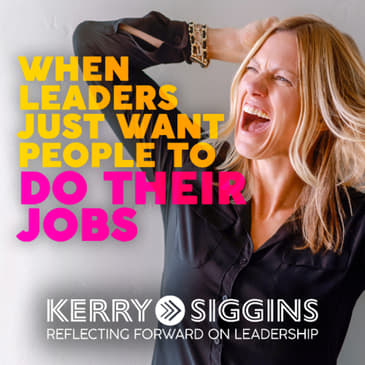
Sometimes leaders just want people to do their jobs. In this episode of Reflect Forward, Kerry Siggins shares a moment from a conversation with a group of CEOs that struck a nerve with everyone in the room. After dealing with workplace drama, she said something out loud that many leaders think but rarely say: sometimes we just need people to do their jobs. The response was immediate. Not frustration. Recognition. This episode explores what was really underneath that moment. Leading in uncertain times creates enormous pressure. Leaders are navigating volatility, economic shifts, and constant decisions while trying to maintain strong cultures. At the same time, employees are experiencing their own uncertainty and stress. When that tension rises, workplaces can easily drift into complaint, narratives, and drama.
Over the past decade, organizations have worked hard to create more human-centered cultures built on empathy, psychological safety, and awareness of people’s lived experiences. Those shifts have been important. But in some environments, the pendulum swings too far, and accountability becomes softened to avoid tension. When that happens, organizations lose sight of the foundation that makes work actually work: contribution. In this conversation, Kerry explores the contract that exists between employees and organizations, why contribution restores agency in uncertain times, and how both leaders and employees play a role in building strong, healthy cultures. Key Takeaways
• Contribution is the foundation of the workplace contract. Employees create value through their work while organizations provide compensation, opportunity, and growth.
• Empathy and standards must rise together. Compassion for people’s experiences should never replace accountability.
• Contribution creates agency in uncertain environments by shifting focus toward what individuals can control.
• Discomfort is often part of growth. Feedback, challenge, and high expectations are not harmful. They are how people and organizations improve.
• Avoidance erodes culture faster than conflict. When accountability is delayed, resentment builds and trust weakens.
Mic Drop Moments
• “The situation is the situation, and how you decide to show up in it is going to be your experience of that situation.”
• “Contribution creates agency. Complaint amplifies helplessness.”
• “In difficult seasons, the question becomes simple. Do we default to narrative, or do we default to ownership?”
• “When uncertainty rises, the need for clarity and reliability rises with it.”
• “Doing your job well is not small. It is stabilizing.” Connect with Kerry Visit her website, kerrysiggins.com, to get more leadership resources or to book her for a speaking engagement Find out more about her book here: https://kerrysiggins.com/the-ownership-mindset/ Connect with Kerry on LinkedIn: https://www.linkedin.com/in/kerry-siggins/