
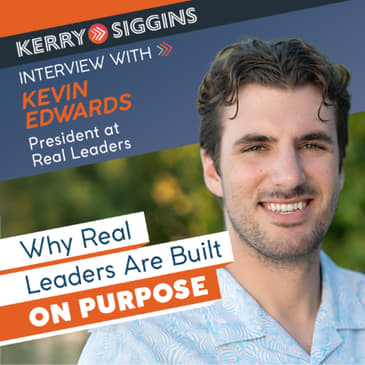

[00:00:00] tell that story that they're being seen and identified as a business owner and entrepreneur, but really they're a mother, they're a father, they're someone who has had their own struggles. Hi everyone and welcome back to Reflect Forward. I'm your host, Kerry Siggins. I'm so glad you are here today. Today my guest is Kevin Edwards. He is the president, about to be CEO and president of Real Leaders, which is an authentic leadership brand that supports people who love leadership, who love what they do.
[00:00:27] And it's his mission to unite better leaders for a better world. And they do that through their magazine, their membership, their podcasts, their events that they do. Kevin has big plans for how he wants to expand the reach of Real Leaders. And I know you're going to just absolutely enjoy this conversation. So hang tight and I'll be right back with Kevin. All right, everybody. I am back with Kevin Edwards and I am so excited to have you on the show.
[00:00:52] I had so much fun when I was on your show a couple of years ago and I'm so glad I get to return the favor and have my audience get to know all about you. So welcome. Kerry, thank you so much. And yeah, crazy to think, gosh, I don't know, maybe three years ago, four years ago on the show. Look at your podcast. It's blowing up. I can't believe like 11K subscribers on YouTube. You're doing something special here. So happy to be a part of it.
[00:01:16] Thank you. Well, you are the master, so I can learn from you and we'll talk a little bit about what you've got going on since I know you're looking at starting another new era of podcasting. So you're the president, about to be CEO of Real Leaders. Yeah, it's kind of the same role, new title, I guess. Julie will be passing the baton here at the end of March. So a couple of days, actually.
[00:01:37] That's awesome. Well, congratulations. So why don't you just tell us a little bit about what Real Leaders does and all the amazing things you do to help other leaders be fantastic. Our founder was like, you know, Forbes is great, but it's like, that's not really how I run my business, which has been about maximizing shareholder value. It hasn't really been just like making money for me. And I, and among many other people in my network, have been very successful in trying to make an impact on people,
[00:02:03] not just the shareholder, but stakeholders, customers, employees, the community. And Real Leaders is really a voice for those leaders, people who have values, have a vision, want to keep it real, want to share things that might not make it in a studded PR press release. I want to give an outlet for leaders to make sure that they didn't feel alone throughout their journey. And so Real Leaders started as a magazine out of YPO, 30,000 CEOs, 135 countries, $9 trillion of spending. So how can we influence that network to make an impact?
[00:02:33] And so that's really where the magazine started out of. Now it's, most people find this care, I think at Delta Sky Lounge, Hudson News, Barnes & Noble, places like that, 4,500 different retailers across the United States and Canada. And then we also have an amazing thriving community of leaders who, again, are kind of alone in their journey. They're trying to make an impact. They want to get their voice out there and connect with other people who are like-minded.
[00:02:55] We provide an outlet for those leaders to get help with whatever's keeping them up at night. And whether that's a peer group, a virtual session, connections, or the event that you were just at called Real Leaders Unite, where we bring in about 120 CEOs. And again, they walk away feeling inspired, we hope, inspired to create change, inspired to create action. It's all about that North Star of making sure leaders don't feel alone and helping them make an impact. How do you define an impact company? What kind of CEOs would be interested in being part of Real Leaders?
[00:03:23] Really, it's the CEO that's trying to transform lives. That's what it means to me. However, why define it? Everyone has their definition of impact. I can tell you, though, what we do look for in impact companies for impact awards. We have an acronym for impact. I is for intention. So someone that has a clear North Star vision, a purpose that's just beyond making money, right? It's why you exist as an organization.
[00:03:47] And then you wrap a business model around it. And as you grow, you solve that problem even more. M is for model. What's your model? How are you innovating for impact? P is for people. How are you treating your employees? It could be employee ownership. It could be employee benefits. It could be just things that you do within your culture to create a really good culture for your people.
[00:04:06] A is for accountability and reporting. Are you reporting on your impact? Are you measuring this? C is for collaboration. So partnerships, collaboration in and outside. And then T is transforming lives. So at the end of the day, are you just another company? Are you just another magazine? Are you just another cookie? Or are you creating another impact in transforming lives, whether it's through the employees you hire, like recidivism? Or is it ingredients that you have in your cookie? Is it naturally sourced? Is it fair trade?
[00:04:34] How much are you actually transforming lives? Those are the things that we look for and impact against this really broad spectrum. We hopefully can try and make it simple by looking at six different ways of how a company can make an impact. That's a great acronym and such a good broad range for people to say, yeah, I can see myself in that. When I first applied to be an impact company with you, we support a dirty industry in as low of an environmental impact way as can possibly happen and keep the supply chain running that way.
[00:05:04] But we also have this amazing culture and employee ownership. And so I thought, you know what? I'm going to put my name in the hat for that. When I was at the Unite conference, they're like, huh, you make water jetting equipment? Like, how is that an impact company? And so I really like the acronym and how you describe it, because there are so many leaders out there who are trying to make a difference, even if they serve what might be considered a dirty industry or heavy industry. They put that box around what it means from an ESG perspective.
[00:05:32] It's hurting the industry more than it's helping. We're not trying to be like the authoritative voice on impact and like what that means. It's really, you know, what it means to that leader and help someone buy into a greater purpose. So this is about what is that purpose that's beyond just making money and beyond just paying your employees and beyond just getting a check. It's something that people need. And so work gives you a purpose.
[00:05:56] And so again, like leaders that understand that their businesses are running better and we want to work with those individuals and support and recognize them versus again, just being in a Forbes, being an Inc magazine, where it's just about who's making the most money. That's why we want to support companies like yours and others. And you won an award, right? You were a finalist for most impactful people. So the environmental impact, maybe for not pressure washing, but for you, it's ownership, right? It's the ownership mindset here. So that's what I think people are missing.
[00:06:26] Who are you to say you're not an impact company? I just don't get that. There's just so many different leaders that are out there that are just doing incredible things and you got to start somewhere. So that's how I think we try and look at it. I love that you talk about purpose. Purpose is something that is very important to me. I have found my purpose and I work hard to help my employees find purpose. Now that you are running Real Leaders, I'd like to really understand how this fits into your purpose. How are you feeding your soul with what you're doing with helping other leaders?
[00:06:53] I started as an intern, right? It's a family owned company. My stepfather's owned it or started in 2010. I was in high school. I didn't even know him at that time, actually. I started doing some stories back in high school and he put me on this entrepreneurial route. And so in college, I wanted to go to a place that had a good entrepreneurship program. Not that college can really do that for you, right? But I went to the University of Arizona and I was doing odd jobs during summer. And he's like, hey, would you want to write some stories for the magazine?
[00:07:19] I said, that's great, but like who my generation reads stories anymore? We're all online watching videos. This is right when Facebook just rolled out their first video platform back in 2016. So I took my best friend in college and we did a road trip. I reached out to about 40 entrepreneurs and said, hey, we'd love to interview you and bring your success story to life to inspire purposeful careers. We did about 40 interviews, really just knocking on any door. The biggest company we interviewed that summer was Hydroflask and that was a huge deal for us.
[00:07:48] And we just delivered awesome videos that inspired a lot of different people and really grew the online presence of real leaders. I'd always ask the question to these entrepreneurs, I don't know what I want to do. I'm in college. Do you have any advice for me? And I think sometimes and you'll find in your podcast journey, I don't know if you'd agree with this, but like the answer's in the question sometimes, right? You intuitively know like what you want to do. And I think I just kind of had a reality moment where I was working for like nationwide insurance. All I could think about was interviewing people.
[00:08:17] All I could think about was constantly learning and constantly being connected and just bringing those brands to life, bringing those leaders to life. And so at that moment, I was like, okay, this is what I want to do. I already knew what I want to do, but this really solidified it for me. And I did some work on the purpose statement too, and it's okay for that to change. But I think mine is to have the most meaningful conversations that transform lives. I try and do that within my personal, my professional, and my relationships.
[00:08:43] And personally, it's with myself, positive comments, remarks, things that you're taking care of yourself, self-empowerment, professionals with the podcast. It could be in forums. I moderate three different CEO forums. It could be public speaking. It could be conversations like this. And in relationships, it could be with God. It could be with my wife. It could be with my family, but being very intentional about reaching out to people within my closest circle to keep those relationships and have more conversations that ultimately
[00:09:13] could impact their life. I just try and keep it simple and just focus on those three things. And that's a well-lived life for me. That's all I need. So coming on after doing this internship and interviewing these 40 people and then deciding to come to work for Real Leaders, what did you bring to Real Leaders? How has it changed with your influence in the company starting out so young? I think just bringing some energy to it. I think it was already an incredible business and incredible concept. So nothing really changed in that way. But I think digitizing it, right?
[00:09:42] Bringing it online. In the media world, you can't get too locked into your medium. Look at Sports Illustrated and look at some of those magazines that don't exist anymore. You need to fall in love with the attention. You need to fall in love with where people are living and consuming information. We knew that like who starts a magazine in 2010 when social media is going on. But I think we can really resurrect the magazines and bring it back and have this contrarian thinking. I've been able to bring it online. I started really in the digital marketing space and was interviewing anyone who we could
[00:10:12] get our hands on. It started with Hydroflask. And then about a couple hundred interviews later, you're interviewing Akon. You're interviewing Pharrell, Gary V, Sage Robbins, Mel Robbins, Tony Robbins, Jay Shetty. So you continue to keep building upon your credibility. That helps build the brand and your podcast, Reflecting Forward, like helping others really see themselves within another leader and being inspired by that. That drives attention. That drives interest from CEOs. And then in 2020, I helped grow the membership network.
[00:10:42] So we got over about 150 CEOs in the network now. And at Unite, I just kind of had like a take back moment where it's like everyone that's here has been on the podcast. Like everyone that's here is a reflection of what myself and our team have been able to do. And that's really cool to see your visions come to reality. And I hope I can help other leaders do that same thing now in this kind of next chapter. So it's going to be interesting to see how AI and technology changes all of this, especially
[00:11:11] since Real Leaders is built around interviewing, which I think is a really interesting concept because you help tell stories through people's own voices. And that's really tough to have AI do that for you. You don't necessarily get that human touch. AI can definitely interview you. I have CatGPT interview me all the time to test my thinking. How do you see AI maybe changing or not changing what you do at Real Leaders? It's already changing. I mean, it's completely disrupting this industry.
[00:11:40] I think it's not going to take my job. I'm going to take the job of somebody else who doesn't know how to use AI. We are not afraid of technology and disruption. We want to work with it. And we know we need to study it, learn it, and we're already using it. But it's been a huge game changer for us from a labor perspective of this has really saved us so much time for so many different individuals. It's really helped us lower our overhead. That's operationally. I think your question is more around the media landscape and how AI will change it.
[00:12:08] Look, I think people on media ultimately are looking for authenticity. It's becoming scarcer and scarcer. That's why you see the street interview being something that, again, I used to do, but is now blowing up because it's authentic. It's like, oh, wait, this person really put themselves out there. It's courageous. It's bold. Those are things that AI can't do right now, maybe in the future. I don't know. But with more AI coming in, people are going to be looking for where's the real authenticity?
[00:12:35] Where, again, where's that the CEO that's behind that PR press release? We want the real leader. One of the magazines I look at as an example of this is the Players' Tribune. It's famous for deer basketball, Kobe Bryant. It's not about the sport. It's about the thing behind the sport. That's what I want to be. I want to have that outlet for that CEO to share those raw emotions, to share what they're currently going through so that other CEOs know they're not alone.
[00:13:04] Because when you're in that position and responsibility, you have to put up a guard sometimes. You have to show up on those days you don't want to and not necessarily put up a facade, but be an example for others. And I think the future of leadership is really leaning into more that raw human emotion of, here's who I am. I'm going to wear it on my sleeve when I come into work so that others can feel like they can too. And I know you do a really good job of that. It's changing the game.
[00:13:31] It's changing the game in terms of the production of the content, the outreach and everything in the marketing. But the actual content itself is increasingly becoming more valuable if it's more real. If people watch and they intuitively know this is authentic. That's what I think we're trying to go for now. I love it. I just put out a podcast on this very topic that said AI is never going to replace leadership as long as you show up as your authentic self.
[00:14:00] Get out from behind the screen, go walk around, build connections with people, be vulnerable, let people get to know you, share the why. That is what people are craving. We've been craving it for so long. And I think as technology continues to integrate in our daily lives more and more, we're going to want that authentic connection and we need it from our leaders. How do you build those relationships and those connections and be authentic? That's how I try to show up. What you see is what you get.
[00:14:27] And some people love it and some people absolutely do not. And that's okay. It's what people are craving. I really just value what you said there because we're not going to replace authentic leadership. I would love to know who doesn't like it. Who doesn't like someone who's just keeping it real with you and the company? Is it just, hey, I'm here to work? What's been your experience with that? I think that sometimes that vulnerability makes people uncomfortable. The fact that I do keep it real.
[00:14:55] I think that some people aren't comfortable with it. And I have had to learn that's not about me. That's about them, even though sometimes it stings. But I think that there are people out there who don't think that a CEO should share openly that they had substance abuse issues or that they should get up in front of their team and say, hey, I don't really know what to do in this situation, but here's how we're going to go solve this problem. I think people want their leaders to have all the answers. And then I think part of it is there's 8 billion people on this planet.
[00:15:24] Not everybody's going to gel with your personality style. So because I think I'm so disruptive and putting myself out there and willing to take risks and be in the messiness of innovation, whether that's innovating products or business models, I don't think that makes everybody comfortable. I wanted to be everybody's cup of tea early in my life. And then I just realized that is an impossible goal and completely futile. So why waste my energy trying to make everybody like me? It's a good point.
[00:15:53] I was actually thinking about this late last night. Can you change people? And my experience answer is no. It's with my brother's drug addictions, like you want to help him so much and you could bend over backward to uproot your life, to help this individual and get them the support and resources you think they need. But ultimately, like they need to make the decision themselves and you need to create space for them to figure that out.
[00:16:20] To add to your point, like you can't appease people. You got to do it for yourself and you got to know that it's not a selfish decision. That's what I've struggled with because it's always been about other people. And you kind of like finally realize it's about self-empowerment and, you know, you're going to empower other people by doing that. Yeah, I've spent many times trying to help people make changes and wound up beating my head against the wall and actually be counterproductive because they have to decide that they want to make that change.
[00:16:48] So now I view it as my job to facilitate, to help create an environment where people can be their very best, where they can believe in themselves, where they experience themselves differently. But I can't make them want that. And I have tried to make people want that. I have worked to help get them there when it's something that they simply either just don't want or they don't believe that they deserve or they don't believe that they can do. And I can't want it for them.
[00:17:15] And so I had some very painful experiences early on in my leadership journey where I invested so much of myself in trying to help somebody and they weren't in the position to be able to help themselves or want it. I think that you facilitate that type of environment that allows people to flourish. That's your job as a leader is to help them gain these skills and to maybe push them a little bit outside their comfort zone when they're not comfortable doing that for themselves, but you can't do it for them. And you can't make them want it.
[00:17:43] And you can't make them like you, even though you have all the best intentions in mind. It's really up to them. It's such an interesting conversation because here we are trying to say, hey, be yourself, be authentic. But like not everyone's leadership style is like yours. It's not like mine. But I do think when you immerse yourself around other leadership styles, you can start to see what you like and what you don't like. I've worked for bosses that are really like top down, military oriented, by the book, if you're not early or you're not in time.
[00:18:12] And then I've got other leaders who are more like players coaches were like, hey, I want you to be yourself around me. And it's just so confusing at first. But then later you're like, wait, I actually like this person even more. I want to work harder for this individual. I want to stay here because I feel like myself and I can be myself and I don't feel like I'm less than, but both could be successful. What is the right style of leadership? Well, ultimately, is it the one that maybe works best for you? I don't know.
[00:18:40] I think you have to be authentic in your leadership style. And I actually talk about this a lot with my team and I've even done a podcast on it too, is that authenticity has to come with accountability. And so you can't just be yourself with no awareness around the impact that you have on other people with no commitment to learning and growing and developing. I think that you have to figure out what works for you and be authentic, but you also have
[00:19:06] to be willing to look at yourself and say, when I show up this way is when it is actually toxic or doesn't work. So a command and control leader, there's lots of successful command and control leaders. It has to be the right culture for that to be able to flourish. And I think that those type of people can really help people grow. They can put a lot of expectations on you and push you. But if they don't realize when they aren't connecting with people or when it's gone too
[00:19:34] far or when somebody needs someone to just listen to them instead of push them, then that's when it overlaps into that toxicity space. And that's where you have to have that accountability and that awareness. Mine is always this inspirational, let's change the world. And not everybody resonates with that. Some people are like, I'm really worried about my job or do I have the skills to be able to take it to the next level? What does this mean for me going into like self-preservation mode that I just don't relate to very well?
[00:20:02] I have to be able to understand and recognize that when my impact, let's change the world is actually causing somebody a lot of stress and it isn't helping them get on board with the vision and see where we're trying to go as a company. So I need to modify myself in that way. It's really around having that awareness and that accountability with your leadership style so that you can bring the very best parts of yourself to your team and to your company, but also recognize where you have those areas to grow or you're negatively impacting people.
[00:20:31] That takes an incredible amount of self-awareness and commitment to understanding others. And I think that's where leaders go wrong. Whether you are an inspiring leader who is more of like that player coach, which can be great and also not great or command and control, which has its pros and cons too. I think for like someone listening to this, it's like, well, what do I do? How do I become a better leader? I think ultimately we can't tell you how to communicate and relate with people. That's something you need to do.
[00:20:59] But there are things that are in common with every leadership style, which is you've got a clear purpose. You've got a clear vision. You know what your skill set and strengths are. You kind of know like what each goals are. And it's your job to work with the other people on the team to achieve that mission. That's what you need to do. But sometimes though, crafting that vision, crafting that mission statement, being very clear on that sort of connects with a bunch of different people. It's extremely difficult.
[00:21:27] I'd love to learn if you've changed the mission at Stone Age. Oh yeah, definitely. Our vision has evolved over time. And I think that is a healthy thing to do, especially with me starting out when I was 28. I had no idea what I was doing. So as my leadership evolved, getting that clarity and being able to communicate with clarity around where we're going as a company and why we're doing what we're doing, it just improved over time.
[00:21:54] Here I think is the crux of the issue is that we don't look at leadership as a vocation. We look at engineering as a vocation or accounting and finance as a vocation, operations as a vocation, but leadership really is a vocation. And so many of us get thrown into it without any kind of real formal training. And some of us are maybe lucky enough to be able to understand that's what we want to do when we go to college, like you choosing to do an entrepreneurial program where they teach you how to think differently. Now I went to engineering school.
[00:22:24] They taught me how to be an engineer and teach me anything about leadership. And so many of us get thrown into leadership without that kind of training. And we're really looking to our leaders to help us. And I had some really poor leaders. I've had a couple of great ones. The poor leaders I had really actually shaped more of my leadership style because I said, I don't want to be like that. I'm not going to be like that.
[00:22:47] But I had no idea when I was 28 taking on this role what I needed to do. It was a lot of trial and error and finding mentors, being part of YPO and stumbling around and making some mistakes. And luckily I was in a safe enough environment that I could stumble around and make some mistakes. And I certainly did and not have my job be at risk. But a lot of people don't have that luxury. Then all of a sudden we're 30 years into our leadership careers and we realized, hey, we have some really toxic traits.
[00:23:16] But we didn't recognize that about ourselves because we learned how to do it from watching other people or for doing things a certain way and not having people correct us and say, hey, you know what? Maybe you shouldn't show up like that. If we looked at leadership more as a vocation and really did more educating around it, especially in middle school, high school, I think that we would find that we would have leaders who are more prepared for the challenges that they have to face when they finally get that opportunity.
[00:23:44] You wonder why it's not looked at as a vocation, but we look at managers as a vocation. So it's like we teach management, which is pretty not easy to do, but it's a little bit more simple, right? There's rules, there's metrics we can agree upon. We have to focus on the bottom line. Do you think it's because there's no like clear ROI for leadership?
[00:24:06] No, I think it's because we have gotten so focused on specialization that specialization is the end all be all. Jack of all trades, that's not something that you really want. In fact, I had somebody tell me that many years ago, I was thinking about leaving Stone Age and I was like, I can go run a much bigger company. I'm so glad I didn't because I'm here forever now, but I didn't know what I was going to do. And I wanted to stretch myself a little bit because I had an engineering background, but
[00:24:36] I got into management. I had someone tell me, oh man, I don't know that your skills are really marketable. You're kind of a jack of all trade and you're really focused on the people culture thing. Like I just don't see it. And that was crushing to me, but I do think that's shifting now. I do think people are realizing that, especially with AI and technology, people who have this ability to pull things together, to lead, to inspire, to connect, those are going to be incredibly valuable skills.
[00:25:04] People who are jacks of all trades, who can pull all these pieces together are going to be really important because AI is going to be able to do a lot of those very specialized things that were valued so much. So I think that there is a hundred percent ROI on leadership development, leadership training. We've proven that investing in our own leadership development program at Stone Age. But I think that at least here in the United States, we were so focused on specialization for
[00:25:28] so long. That was the holy grail instead of broader leadership, this ability to pull things together. Exactly. That's the ultimate challenge we're facing and what we're trying to do here with three leaders. Everyone's focused on management, the bottom line. That's the clear goal that everyone has that a lot of these self-proclaimed leaders are talking about. I don't even know if that's true, though. I feel like most of the CEOs of big corporations are really talking about leadership in the right
[00:25:57] way. It just hasn't really hit yet. So I think what you're talking about, what we're talking about, it's all the same thing, which is a little bit ahead of its time. But it needs to come from people like you. It needs to come from people who have actual real experience. And I think ultimately, it will trump a Milton Friedman who, let's face it, he never ran a business. The sole purpose of a business is to maximize profits for its shareholders, which you can interpret also in the same way that
[00:26:25] you're talking about. That's what you're trying to do. And leadership is the way to that. We're really trying to replace these thought leaders that are out there talking, self-proclaimed, this is how it is. And it really comes from people like you who need to get out there, need to get their voice out there and inspire that next generation of leaders. Because if we don't, we're just going to continue to be in this place where people are going through, I think it's like the average 16 different careers in a lifetime. And then you end with the same amount of money that you
[00:26:55] it's an unfulfilled life for many. And even people who are making a ton of money at private equity, like my wife works at a really awesome tech company who's fast growing. It's like, she doesn't want to stay in the company. Why? Well, she doesn't see herself in anyone that is ahead of her. Right? And so I think that again, to your point about this reflect forward concept, I was thinking a lot about this this morning. I was like, yeah, like you need to see a reflection
[00:27:20] of you in the future. You need to see something that inspires you. Because if it's not, you're just a cog in a wheel. You're a manager. I don't want to get too many managers flack, but it's about a number at the end of the day. I love that. And I think that's such a beautiful way to be able to put leadership is that you want to inspire people to see that version of themselves in themselves. I think so often leaders think about their impact on others. A lot of leaders don't,
[00:27:47] they just are there to maximize shareholder value however they possibly can make sure they get their bonus. The next level of leaders understand that the way they show up impacts others and they're very conscientious of that. But I think where the very powerful leaders come into play is that they understand that it's really about how others experience themselves in the presence of your leadership. Do I believe in myself? Do I see that there is a future for me
[00:28:14] in this company? How am I growing personally? And can I go live my dreams? And can I one day aspire to be this type of person, this type of leader, this type of contributor within my organization? And I think that's where most leaders fall short. They're not creating that vision for people to say, that's what I want to be. That's how I want to be. This is the kind of person I want to be when I'm done working at this company, whether that's in a couple of years or whether if that's when I retire from here.
[00:28:41] Yeah. It's not even about leadership, right? It's about just being a good human being. Exactly. Yeah. Be a good human. I'd be curious to know, what if you're on the wrong path? That's something I really thought about. And I even talked about it a little bit at Unite, where I created this community of awesome people, but it's all really impact-oriented. It's very progressive. But I can't bring, because we've been so targeted, I want to bring in people to show different perspectives and
[00:29:06] different sides. What have I done? The management path is just keep doing that. Just keep managing, just keep targeting individuals who are impact-oriented, and then you'll continue to grow your revenue and continue to grow the business. And then my leadership side of me goes, that's not the ultimate mission, right? The ultimate mission is to Unite Better Leaders for a Better World. That's both sides of the party. How do I do that? Have you ever been a crossroads where it doesn't
[00:29:35] make sense with the business? Where you have a little gut check there and you go, okay, well, here's what we're going to do. I don't know if you've had that experience or not, but would love to learn if you have. I think from a professional standpoint, I've made several business model changes, but it's all been aligned with what I think is best for the business, even though they've been pretty dramatic changes, which luckily so far have all worked out. Not without a lot of hard work
[00:30:03] the intersection that I had to really come to grips with is this idea of building out my personal brand and speaking and doing this podcast. Like even though it's all Stone Age, I had a lot of people question like, what am I doing? Do you even work for Stone Age anymore? It's like, yeah, it's all woven into everything that I do. And I had to really question like going after this personal dream of mine, this something that is so incredibly fulfilling, that is part of my purpose. My purpose is
[00:30:31] absolutely to help expand thought and consciousness and see that there is a different way to lead, to build companies, to inspire people and to live your life through my words, through written, through spoken words, whether I'm running a company or whether I'm doing this podcast or whether I'm writing a book or whether I'm on stage. And I had to really look inside and say, are these two separate things or are they one and together? And I made the decision that they're going to be one and together and that I'm going to go after it. And all those people who are questioning me or are
[00:31:01] naysayers, they don't matter, right? They're not the ones who are living my life. And so I made that decision to go forward. And now here I am five years later, and it's making a profound impact on the employee ownership community, on the leadership community. And I'm so incredibly fulfilled and it has not diminished my role at Stone Age, my leadership of Stone Age. It's only made it better, but I really had
[00:31:26] to question how do those two things come together? How do I make them come together so that they work together rather than competing thing that I'm doing? Gosh, that's such a challenge that every single CEO is asking themselves right now is how do I grow the company in my personal brand? Is it the company or is it the brand? Ultimately, this is a reflection of yourself. You're really just empowering yourself. You are what's helped the company grow in the first place. Now you're just leveraging that opportunity by
[00:31:56] starting a podcast. If people can just see that and that it's really self-empowering that can help take your business to the next level, I would encourage more people to do it. It's been a incredibly fulfilling experience for me. It's not just about the monetization. Monetization is a whole nother beast, but just you don't need to figure that out right now. Most podcasts aren't making money. It's a great way just to make the world's resources relevant to you and build your network, your connections,
[00:32:24] and just continue to be on this path of a growth mindset of continuous learning. I know you probably have just had an incredible, profound experience just by being able to just have some of the best leaders in the world to have a conversation with. Yeah, absolutely. Ultimately, they either become customers or they'll make a connection for you or they'll introduce you to somebody else. That right there, I've had multiple connections that have paid for the podcast indirectly in way different ways,
[00:32:52] which is crazy to think about. Or they simply just make you think about things in a different way that lead you down a new path within your business. You've interviewed probably more people than I have and certainly more big name people who have done really big things than I have. What have you learned from all of your interviews of leaders? I've learned that everyone was basically the same. Just because you're Mel Robbins or Gary Vee doesn't mean you know something more than anybody else. They just, they really put in the work. They really put in the work. And that's something you can,
[00:33:21] they might not talk about, but you can tell on their confidence level when they're talking to you about something, which you can't really understand, like watching a clip or reading a book. That's why a podcast is so inspiring to do something like that. We asked the same question to everybody. What's your definition of a real leader? I mean, we did an analysis on it. The number one characteristic was authenticity, which we talked about earlier. But I think ultimately, it depends on the leader, depends on the industry, depends on their experience. We've interviewed
[00:33:49] everyone from a startup to multi-billion dollar companies or Tony Robbins, right? They all have different takes on leadership. And ultimately, I think re-leader is someone who can connect with a bunch of different people in a bunch of different ways. And if enough people are connected, inherently you have a movement, you have momentum, you've got people working toward the mission. And I've learned a ton through the podcast. I think that's probably the biggest takeaway, but also that at the end of day, like these are just people too. They need an outlet to share that they're also just a human
[00:34:18] being. So I think that's something that inspires me to continue to do is just tell that story that's not being told. Tell that story that they're being seen and identified as a business owner and entrepreneur, but really they're a mother, they're a father, they're someone who has had their own struggles, they're someone who might be at the top, but really they're struggling inside. And they need to know they're not alone. And they need to publish that because other entrepreneurs need to see that. And
[00:34:48] there's a lot of entrepreneurs and business owners that dedicate their entire life, which I'm sure you do as well, to your work, to your purpose. That's really, it's a life you're choosing to go down. You're not choosing a nine to five, right? You're choosing a life of excellence and there's trade-offs with that. I think people just need to share that. So it can inspire other people to either go into it or say, Hey, you know what? That's not for me. And I think that's what the real leaders are trying to do is they're trying to make an impact and help others with their journey.
[00:35:18] That's great. It's such a great mission. And I'm so glad that I can be part of real leaders and your journey and supporting you and making all of this happen. It's really fun to watch. What's next? You're about to become CEO. Maybe it's just a couple of new letters behind your name, but what do you see as what comes next for real leaders? Thank you. Love using the platform to share this. And again, it's something that really hasn't been released yet, but we're really going to challenge the Forbes model. And we're really take a look at
[00:35:46] that playbook and say, how can we build not just thought leaders, but real leaders? How can we find individuals who have real experience are in their arena day to day and provide that outlet for them and turn them into cover stars, turn them into top 100 podcasts, turn them into bestselling books and be a publisher and a platform for those leaders to connect directly with their stakeholders.
[00:36:11] That's something that we're really trying to be at the forefront of, which is different in the past than just growing a CEO membership network, which is focused on peer groups and business development. We're really trying to help them build their brands. And so we're bringing in people right now, like Stedman Graham, John Register, some of the people that are within our network to teach these things who have been doing it for 30, 40, 50 years,
[00:36:37] and can teach these things to bring the content game to these individuals. And no matter where they are, whether they're just starting their brands or maybe like you, you've got a five-year podcast, you don't really need that help. What you need is to figure out maybe how to build the community, how to monetize it, how to achieve your wireless goals and dreams. And we have people on a platform that have experience in doing that. And that's what we want to do. Ultimately, it's getting back to our roots of inspiring the future and helping leaders really see a better version of themselves,
[00:37:06] become the real leader. That's where we're going now. And it took us a long time to get there. And again, another tough decision to say, it makes sense to do this, but instead we're going to do this because it's more aligned with our original intention, purpose, and mission. Very cool. And if people wanted to learn more about real leaders, to find the magazine, how do they go about doing that? Yeah, go to realeaders.com forward slash subscriber, just the homepage. You'll see it right there.
[00:37:34] And then you can subscribe and get a free copy or digital issue of our most recent magazine with Gary V here. It's titled attention getter. That's also in airports across the country. If you're flying, you can find it in Delta Sky Lounge. Again, Hudson News, Sunshine News, a lot of this kind of newsstands are in the airports. Barnes and Noble, of course, go online, get it directly. But yeah, go to realeaders.com forward slash subscribe. And the podcast? Just search realeaders podcast. We've got over 500 plus episodes. We go on YouTube as well,
[00:38:04] and we'll be releasing the one with Gary V here shortly. Wonderful. All right. So you touched on it, but I would love for you just to articulate it because I was loving what you're saying. What does reflect forward mean to you? I originally thought it's about learning from your mistakes and like trying to make sure you learn from your mistakes and then do something different in the future. I think now it's really like there's this trend that's going on with Gen Z where they're like investing a ton into their beauty and ton into their personal health and they're becoming like this amazing looking generation.
[00:38:34] And I think in a sense, like intuitively, this is what we as human beings are trying to do is we're trying to look into the mirror and be, hmm, there's reflection of me, but I see myself as being a better version. It's looking at that reflection of you in the future to say, that's who I want to be. And then you make the world relevant to you. Everything that you do is around that intention
[00:38:59] of becoming better and reflecting forward to me is really about self-empowerment. It's about self-improvement and seeing a better version of yourself. Love it. So true. Kevin, it's been so much fun to have you on the show. Thank you for letting me return the favor and having you come on mine. It's been such a pleasure to chat with you. I could chat with you all day. Well, thanks for having me. And again, just honored to be on your platform. You've done such a cool job. And again, just anyone that actually wants to ask me questions, I was just
[00:39:28] curious. What do you want to know? I'm glad. And thanks for answering my questions too. I'm just naturally curious. I know you can help interview me a little bit too. I couldn't. No, I really couldn't. No, you're fascinating. I like these conversations. They're back and forth. And again, just wishing you the best of success with the platform, the channel. And I think you're going to do a lot of great things. I know you're going to do a lot of great things. Thank you. Well, I look forward to continuing to partner with you. All right. We will wrap things up. Hang tight, everybody. I'll be right back. Hopefully you enjoyed that very fun
[00:39:55] conversation. I just absolutely adore him and really honored to be able to know him and be part of real leaders. With that, I'm going to leave you for your day. If you think someone could benefit from this podcast episode, please be sure to share it with them. It helps get these amazing interviews out. And of course, subscribe to Reflect Forward on my YouTube channel, on your favorite podcast platform, write a review, share it with a friend. It always helps. Thank you so much. We'll see you next week.