
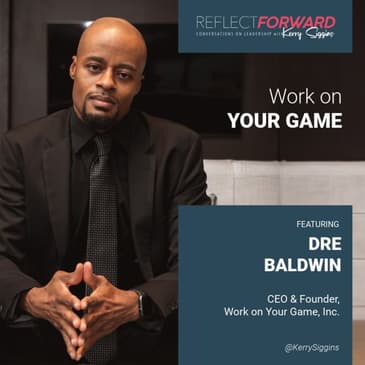

[00:00:01] Hi everyone and welcome back to Reflect Forward. I'm your host Kerry Siggins and I'm so glad you're here today. Today my guest is Dre Baldwin. He is the CEO and founder of Work on Your Game
[00:00:19] Incorporated and he is just so much fun. In five years, Dre went from his high school basketball teams bench to a nine-year professional basketball career and he did it through building a framework of mindset, of discipline, of consistency, of intention and he started putting
[00:00:39] videos of himself practicing on basketball out on YouTube. This was before YouTube blew up. This was pre-2010 and he wanted to be able to see himself practice so that he could continuously get better and then people would come and find his videos and start saying, hey,
[00:00:54] I don't know how to practice like this. What do you do? He's built this whole framework now called Work on Your Game where he helps people build a roadmap in reverse to help them develop
[00:01:05] that mindset, develop strategy, develop accountability and execution in their lives and in their business. This is a super fun conversation. I know you're going to enjoy meeting Dre so hang tight and
[00:01:16] I will be right back with him. All right everyone, I am back with Dre Baldwin. I am so excited to have you on this show today, Dre. Thanks for joining me. I'm excited to be here, Kerry. Thank you for having me on.
[00:01:34] Absolutely. All right. Your company is Work on Your Game. Can you talk a little bit about what Work on Your Game is and how you help CEOs and companies build results? Sure. Work on Your Game is derived from my background in sports and professional sports,
[00:01:49] actually really from my being on YouTube and a bunch of people watching me on YouTube and just asking about the mental tools that they could use to apply the tactical and strategic stuff I was showing them how to do on the court
[00:02:00] and how to actually make it all come together because they realized that they needed the mindset to do that. And then other part of it was Kerry, people just asking about me personally,
[00:02:09] is God willing, play one year high school ball, walk the wrong way, division three college ball with third tier college sports and became a pro athlete. What's the mindset behind somebody who does that? So I extracted those pieces out and started explaining them to people
[00:02:20] and then people who were not athletes like these folks that are looking to your show, they started hearing those messages and saying, hey Dre this stuff applies to us the same way it applies to ball players. So that's when I realized I had an opportunity to expand my
[00:02:34] reach beyond just athletes and that's what I've been doing since, well I stopped playing ball in 2015 so that's what I've been doing ever since really about 2010 but full time since then and it's really about helping the professionals and entrepreneurs use the same tools to help
[00:02:47] athletes get to the top 1% of the sports game and using those same mental and strategic tools to get to the top 1% of your game. I love that. Okay so let's talk a little bit
[00:02:56] about this mindset and how you developed it because going from one year of playing high school ball to D3 ball to professional that takes a lot of gumption, a lot of persistence, practice I'm
[00:03:08] sure. So how did this mindset develop and really help you get to where you were at the top of your game? Well how it developed was really something that I guess you could say somewhat organically
[00:03:18] because it wasn't until the players started asking me about it that I started talking about mindset because really when I first started putting content out 20 years ago I was really just
[00:03:26] showing basketball players how to practice because it it was a surprise to me to find out that most basketball players didn't practice the way that I did because I would go to the gym every day
[00:03:35] carry and just work on my game. I thought that was normal then I realized most players didn't do that so when I kept doing it they would ask me stuff like why do you work out every day?
[00:03:43] How do you bring yourself to do it? Not why but how do you bring yourself to do it because a lot of players they want to do it but they don't actually do it. I'm sure Kerry you talked to a
[00:03:51] lot of people who want to have a podcast but they don't have one or they want to write a book but they never actually wrote it right? They want to do these things but they don't actually do it so
[00:03:59] how did you get yourself to actually do it? What's going on in your head is not going on in my head that's what they were asking. That was the discipline piece then it was okay Dre anybody
[00:04:08] knows anything about sports Kerry knows that you get one chance like you might practice for years like think about the Olympics you practice for four years and get one shot right or
[00:04:16] you're trying off a high school team you practice for 364 days to get one day of an opportunity so how do you get yourself ready and primed to perform when the lights come on? If you're a professional
[00:04:26] speaker or you give a TED talk you go out of practice and you get that 20 minutes 30 minutes to give your speech if you mess up that's it you don't get a chance to do it again
[00:04:33] so that was the confidence piece. The third part was okay you face these setbacks or you just face the circumstances it just seems like nobody becomes successful coming from the background that you come from with your pedigree it doesn't make sense that you got to where you
[00:04:47] got to so how did you keep going when things were simply not working in your favor? And to answer that question that was the mental toughness piece and then the last one was well how do
[00:04:56] you get started even doing these things so I see what you did but how do you even move yourself to know get up off the couch and actually do something how do you move yourself to break
[00:05:06] the inertia of the situation and be that outside force that moves you to action that motivates yourself to action because that's all motivation is just the emphasis that moves you to action
[00:05:14] or how do you get started playing overseas or how do you get your name going on the internet or how do you get yourself booked to speak on the stage as a professional speaker or how do
[00:05:22] you start getting coaching clients all these things that people want to do but they don't actually do it now how do you actually write a book you know it's not like you have to get
[00:05:30] approved by anybody well how do you do it so it was the personal initiative that was the fourth piece so all these pieces I'm telling you they came from these questions that people were asking
[00:05:39] Kerry but I hope you see in the parallels that you could take my situation out of it but these applied all across life all across the board to anything you do absolutely and so I want to dive
[00:05:50] more into that but I'm just curious you know back then when you started what made you decide that you wanted to create your YouTube channel and start creating this type of content and
[00:05:59] teaching people so what happened was since I came out of a division three school no pro basketball team was calling my phone asking me to come play for them so when I graduated from school in 2004
[00:06:12] my first job was not basketball my first job was at foot locker I was a assistant manager then I went and worked at a gym called Valley Total Fitness you remember them oh yeah yeah so they're
[00:06:21] out of business now not because of me I sold a lot of memberships for Valley Total Fitness all right I might be the reason why they went out of business actually because I sold so much
[00:06:28] that their their bad practices got exposed but anyway in 2005 that summer I went to this event called an exposure camp exposure camp is like a job fair everybody knows what that is all right so
[00:06:38] it's a job fair for athletes now at this job fair you don't bring your resume and wear a suit you bring your sneakers and shorts and you play so these are all ball players who think
[00:06:46] they're good enough to play pro but we're not playing right now so we go there to showcase ourselves and hopefully get a new opportunity so it's kind of like a casting call and the
[00:06:54] people in the audience are not just random people off the street these are agents coaches scouts managers from basketball teams all around the globe they come to these events as destination events looking for their next employees I went to one of those events and I played pretty
[00:07:06] well and that's really what became a launchpad in my playing career because the footage from that event was on this thing called a VHS tape you remember those carried VHS yeah all right so
[00:07:16] any Jen Z years listening to this ask your parents or google it you find out what the VHS tape is so that VHS tape was the most important footage of me playing basketball that existed so I
[00:07:26] didn't want to lose it so I took it to an audio visual store and had them put it on a data cd so that I could put it in a digital format and then I uploaded that footage to youtube so that's
[00:07:36] how I started on youtube with that footage I was not trying to showcase myself on youtube I was just putting it there just in case I lost the VHS tape that's the only reason I did it and
[00:07:46] when I got this cheap little hundred dollar camera maybe a year later I would just take the camera with me to the gym and I would just record myself working out and I would just want to see
[00:07:54] myself I just want to see me on camera and see if it looked the way I thought that it looked and I would put a couple videos on but I wasn't trying to get anyone else's attention it was this
[00:08:03] for me but then people saw it and they would leave comments like hey who are you who do you play for and that's when I realized there was an underserved audience of people who wanted to learn
[00:08:12] the game but they didn't have anywhere to learn it and they were going to the internet to get answers whereas if you come from my era or our era Kerry you either knew somebody or you were
[00:08:21] basically out of luck when you came to get knowledge or information about something or I mean I guess you went to the library or something but I don't think you learn basketball in the
[00:08:28] library so they were going to youtube to find this information and they were finding me and they would ask the kind of questions that I'm the type of person my superpower Kerry is being able to
[00:08:39] notice what questions somebody should be asking even if they're not asking it so by the comments they were leaving I realized that they wanted to learn but they didn't know how to ask
[00:08:47] and that's when I said okay I work out every day anyway why not just film myself and put this stuff out and I can help these players out and who knows I get a little bit of attention on this website
[00:08:58] I didn't know it was going to become anything there was no big grand scheme here I wasn't throwing anything I had no products there was no ad revenue there was nothing to gain from
[00:09:05] doing this I just said okay I'm gonna get a little bit of attention it serves my ego they're looking at me like the person who can help them so that's why I started it wasn't till about
[00:09:12] 2009 that the monetization options started to become more clear interesting okay so obviously didn't have this vision of being an entrepreneur and a coach and a teacher you wanted to play basketball so what was your vision for yourself because obviously to go into the gym every single
[00:09:32] day to have that kind of accountability and that personal drive what was the vision that you had for yourself well you gotta go back in the story again let's go back to about 2002 so I was in college
[00:09:42] from 2000 until 04 graduated 04 now in 2002 I responded to a bulletin board posting so again Gen Zers don't know what a bulletin board is it's like the internet but the physical version where you had to actually physically see stuff so I responded to a bulletin board posting that said
[00:09:59] if you want to make some money in the summertime call this number now mind you I'm a college athlete so people who don't understand the college landscape 20 plus years ago it's basically like
[00:10:08] having two jobs because you had to be a full-time student to play and then you have this commitment to the team and at this time there's no name image and likeness deals so you can't make money you
[00:10:17] legally it was against the rules for you to make money based off of your athletic ability so college athletes are really broke college students are broke but college athletes were really broke so we didn't have any money so I responded to that and I want to make some
[00:10:29] money and this guy happened to be a network marketer now I didn't know anything about network marketing but I went to a couple of meetings when I got home to I'm from Philadelphia by the way so I was
[00:10:39] going to school Penn State out sooner I went home to Philadelphia and I went to a couple of meetings and there were two things that happened at that meeting number one the man on the stage was
[00:10:47] talking about principles of money making entrepreneurship that I had never heard before even though I have a business degree so I was thinking to myself why aren't my college professors teaching the stuff that this guy's talking about because I learned more in one hour
[00:10:59] from this guy than I learned in four years of college about entrepreneurship second thing is this guy said when you leave the room there's a table outside with these nice ladies you need to buy the books that they're selling because those books are personal development because you know
[00:11:11] you're on network marketing meetings half the people in the room are already doing the business and half of the people are like me there to guess so he was saying to the people in the
[00:11:19] business if you're going to build a business you ought to build yourself you cannot grow a business anymore than you grow you and I said that makes good that makes a lot of sense I
[00:11:25] never heard anyone say that but it makes sense so that was the first time I heard anyone mention a phrase personal development I'd always been a reader but I didn't know there was a genre
[00:11:33] just for making yourself a more valuable person so I looked at the books on the table was I did not buy because I was a broke house kid remember so I remembered the books though I
[00:11:42] remember the authors it was Jim Rome Brian Tracy Tony Robbins Napoleon Hills Ziggler I never heard of these guys but I said if these books will make me a more valuable person
[00:11:51] I want to get them didn't buy them but I went on eBay when I got back to school now mine's just before Amazon was the place to buy books eBay I went on eBay and I bought a couple
[00:12:01] pirated versions of a couple of the books so I bought thinking over it's by Napoleon Hill that was the first book that showed me that there was a conscious and intentional process you can follow to make yourself a more valuable person you could do it on purpose
[00:12:15] by changing the way you think and the other one was wrist that poor dad by Robert Kiyosaki and that was a book that really in addition to the network marketing meeting started to explain
[00:12:25] that there's a whole other way that you can live professionally besides working a nine to five job and Robert Kiyosaki was explaining the skeleton of it he was really focused on real estate but the principles of entrepreneurship were explained in that book and that's what planted
[00:12:40] the seed in my head here carries so I always knew I was going to be an entrepreneur but after basketball so I'm going to play basketball first then I'm going to be an
[00:12:48] entrepreneur now what happened was there were some gaps in my career in basketball and in those gaps that's when I started to build the entrepreneur so what a great story I love that
[00:13:01] it's just it's always amazing to hear those journeys so before we jump into a little bit more about what you talk about and work on your game and your content what was it like to
[00:13:11] stop playing basketball it was fine for me it was fine for me because I voluntarily stopped playing so it's not like I tell people it was basically three ways you end up out of the game one
[00:13:22] you went out of it because you physically can't play anymore two nobody wants you so you kind of crawl out of it or one day you wake up and realize that your career is over you're the last person
[00:13:31] to find out or three you just choose to walk away because you don't want to do the work that comes with staying at that level and I had gotten to the point where I didn't want to do that
[00:13:42] work anymore and the work being when you're a professional athlete you're working out two three times a day you have to do that in order to stay on par with the rest of the players and I
[00:13:51] knew I wanted to work out every day just not two or three times and I also knew that there were opportunities for me outside of the sports realm because of this other stuff that I had been slowly
[00:14:01] building and I was meeting people who were actually doing those things and I said this is an opportunity for me here and I see more potential for the future of me in this lane than the
[00:14:11] future of me on in basketball because in sports you get old fast by the time you're over 30 and sports are old so I knew I knew in the next 10 years of my entrepreneurial career have more
[00:14:20] potential than the next 10 years of my sports career so I said let me go to entrepreneurial route I'm gonna walk away now so that's why I walked away so it was easy for me wasn't hard
[00:14:28] I know I know when you watch the Lakers play you're like ooh that's what it looks like when you're over 30 and playing right so let's talk a little bit about how you work with your
[00:14:38] clients so can you walk me through the process that you help entrepreneurs and business leaders due to be able to improve their performance sure so our framework is four simple pieces the first
[00:14:47] piece is the mindset that we talked about that already so every piece has sub pieces but the mindset we've already discussed second piece is the strategy strategy is just a plan of
[00:14:56] action and the way we help people strategize is we use what we call the roadmap in reverse where we basically look at where they want to be and we just deconstruct from where they
[00:15:05] want to be back to where we are right now of course we have the factor in contingencies well if this piece doesn't work do we have an alternative do we have another way to go and we basically map
[00:15:13] out in the opposite direction how we're going to get from here to there with the plan the third piece is the system and the system is simply once we find a strategy that works because the
[00:15:24] plan that we map out is not going to go perfect so we have to work through it once we find something that does work or even pieces of it that work we create a system out of that okay so we can
[00:15:32] systematize this piece here this piece over here this piece over there so that we can execute pieces of the strategy over and over and over again and get the exact same result every time so
[00:15:42] the similar to how mcdonald's or starbucks if you go to mcdonald's and starbucks in denver i go to the one in miami you get the same food same coffee not because the people who work there are geniuses
[00:15:52] but because the system is so great that doesn't matter who works there and eventually those people won't work there will be robots different conversations and then the last piece is the accountability and the accountability is how do we make sure that not only the people are
[00:16:05] doing what they're supposed to do because i find carry that high level performers like being held accountable they want to be held accountable and they will seek out accountability because they
[00:16:14] know that's what got them to where they are and what keeps them up but also to make sure that the strategy and the system are doing their jobs because if the strategy is being executed
[00:16:22] properly but we're still not getting the result that means we need to fix the strategy so sometimes it's not the person that needs to be edited sometimes it's the strategy so those are our four pieces the mindset strategy the system and the accountability and the mindset is always
[00:16:35] the foundation is the most important part because what i've found is that until a person changes their mentality their mindset carry they are ineligible to change their actions because people won't change the actions and so they changed their way of thinking so that's why
[00:16:48] the mindset is so important over here yeah i agree with you and do you find that people have a hard time changing that mindset how do you work with them on that how do you help people
[00:16:57] who are really stuck change that mindset that's a great question so there are two schools of thought here and i work with one or the other depending on the situation so actually there's really three
[00:17:06] so let's talk about all three so one is the person who says i'm stuck i can't get out of it and i can't do anything about it and they aren't really open to changing their thought processes
[00:17:17] we try to get those people out of our world all right so you know you have attraction marketing we have rejection marketing so we want to keep those people away from us we don't want
[00:17:24] them in our space then you have the second type of person who says they're stuck and they know they're stuck and they know that what they're doing is not working and they admit to the
[00:17:33] fact that i need help i need to do something different those people have potential those people we can work with and then the third type of person who already believes it they already understand even if they're not stuck i just want someone with me i want someone holding
[00:17:47] me accountable i want someone to keep me sure i'm already at the top i want to stay at the top and i'm willing to invest in staying at the top those are our ideal people those are people
[00:17:55] we most like working with even though i've gone through different mentalities on this over the years but i have enough experience to know that you try to turn too many frogs into princes
[00:18:06] you get tired of kissing frogs and you rather work with the people who already have the mentality and help them go further than try to take people who don't have it and try to
[00:18:16] install it in them because it's a lot more work a lot of times they are resistant a lot of times they don't even appreciate what you're doing because they really don't want to change
[00:18:25] now i'd rather work with people who are already converted than trying to preach to the people who know don't come to church as they say no as they say priests to the choir now the choir
[00:18:34] they came to church don't go outside the church and try to preach to the people standing on the corner across the street they see the church they want to come in they come in
[00:18:41] a couple different ways that i look at it but there are some people who i do work with who are not there yet but they're coachable so as long as they are coachable and they're open-minded
[00:18:49] and this is something i tell them about you need to be coachable you need to be committed and you need to be willing to get uncomfortable because this is going to be part of the game
[00:18:56] as long as they accept that then we can move forward yeah i agree and a lot of people are they think of that mindset space you know when they think like i can't change i can't
[00:19:08] think differently i can't be differently i was actually just having this conversation about like childhood trauma and where does childhood trauma fit in do we have to be defined by it my
[00:19:17] answer is only if you choose to right it's all about the meaning that we choose to place on our experiences that is what either holds us back or allows us to move forward and you can
[00:19:28] choose to put different meaning to that experience and so yeah i'm stuck i've made bad decisions in business and i can't get myself out of it you can absolutely just say i am going to look at that differently and it's so interesting how many people struggle with that
[00:19:44] like how can i what you can just choose to you can say i am going to look at this differently i'm going to attach different meaning to this thought that i'm having it's not easy to do
[00:19:56] but my book ownership mindset like that is 100% what this is about when you take responsibility for everything that happens in your life you empower yourself to change your life that's right it's tough yeah not everybody sees it that way
[00:20:08] agree and it's funny because we had this thing i called the 12 work on your game commandments and first commandment is ownership full ownership you have to take complete responsibility for everything that you touch because when you take responsibility you have the ability to
[00:20:21] respond and that comes to the package deal with power and influence and everybody wants power and influence but then people don't want to take the responsibility that comes with it yep i agree completely all right let's talk a little bit about discipline and consistency
[00:20:33] because you proved that as a professional athlete going from not being a star in high school or playing for a big d1 school to be able to play professional basketball and you talk about the consistency that you have can you talk about discipline and consistency
[00:20:48] in in the business in the workplace and how important it is to success the hallmark of the professional uh the number one attribute that you will notice in the professional is that they are disciplined and their work is consistent
[00:21:03] which means you know exactly what you're going to get from them and why i explain to people is that dictionary definition of a professional is a person who does something as their main
[00:21:12] paid occupation now how can you get paid for something consistently only way you can get paid consistently is you have to deliver consistently so the further extended definition that the work when you're getting definition carry is that the professional is a person who shows up
[00:21:26] and delivers every time regardless of how they're doing because there will be days that you don't really feel like delivering but you still have to we call those days the third day it's all about
[00:21:36] how you show up on that third day and deliver it even when you don't feel like working out you don't feel like practicing you don't feel like putting those leads in a crm you don't feel
[00:21:43] like taking these prospect calls you don't feel like talking to your clients but you do it anyway because it's your job and it's your responsibility especially when you have people who work for you people who are subordinate to you because they're all following your energy
[00:21:55] so if you don't feel like working what are they going to do of course they're not going to show up that's why discipline is so important and if anyone ever asked me jerry what's the most important
[00:22:04] internal attribute that you would say play the biggest role in what i've created the answer is always this a lot of people think there will be confidence but it's not confident discipline because confidence is derived from discipline so that's the biggest thing and
[00:22:17] what we do is this can you go a deeper dive into what you mean by the third day i love this philosophy so describe it more in depth all right let me give you an example so let's
[00:22:25] say somebody who has taken some time away from the gym they haven't worked out for a while and they decide they want to work out again they haven't been there for six months or a year
[00:22:34] and they go hire a personal trainer and they sign up for a boot camp class they got a gym membership they're all excited to go so they go to the gym that first day you know new
[00:22:42] workout gear new workout sneakers everything they got their trainer and they're all ready to go let's do it let's lose this weight let's get this six-pack let's get these muscles whatever it is they want to do and the trainer kicks their butt that first workout because i've
[00:22:54] worked at gyms before so i know what we do this on purpose so when you join the gym and you get the free session that you get with a trainer and any gym we deliberately try to make you feel as out
[00:23:04] of shape as possible so that you realize how badly you need the gym and then we try to sell you personal training while you're tired that's the whole business model and it works
[00:23:13] so the trainer is going to kick your butt the first workout just to show you how badly you need him and you're going to drag yourself home and you look yourself in the mirror you're
[00:23:20] going to say hey i'm doing this it's rough you're tired but you're doing this only the first day of something that you signed up for so the second day drag yourself into the gym or you walk in
[00:23:28] but you're a little bit sore half your body sore from day one because you haven't worked out in a long time and the trainer knows this so he pushed you even harder on the second day
[00:23:35] you drag yourself home and with a little bit less enthusiasm you say hey i'm doing this now by the third day things are already starting to change by the third day your workout
[00:23:45] sneakers feel right they made a cement uh you don't really want to go into the gym gyms usually put a friendly face at the front desk just to know set the tone when you walk in
[00:23:54] you don't want to talk to that person because your energy is not matching their energy that day you don't want to hear your trainer's mouth it's one of those days that really what
[00:24:00] you want to do is roll over in bed and just grab your phone and text your trainer hey i'm not coming just charge me for the session i'm not coming all right that's the third day
[00:24:08] you really don't really want to be there and the third day is not even about the occurrence of this happening because everybody has this happening if you have kids this happened
[00:24:16] of you in a relationship this happened if you have a business it happens any venture that you get into you write a book it happens you hit that wall where you're like uh really don't feel like doing this
[00:24:25] do i even want to keep doing this and the third day is the decision that you make at that moment is the decision and that's why the subtitle of the third day concept is the decision that
[00:24:35] separates the pros from the amateurs so we just talked about what a professional is person who delivers even when they don't feel like whereas an amateur carry they have a luxury of not showing up when they don't feel like it because nobody's paying them see nobody's paying
[00:24:47] you you don't show up though i can't complain but see if they're paying you know you don't show up they can complain and then get their money back so as a professional you are obligated
[00:24:55] as soon as you take the money you're obligated to do the job and the third day is about the decision that you make when you don't feel like fulfilling that obligation but you don't
[00:25:02] have a choice but to fulfill the obligation and what we do is try to give you a strategy and a system for showing up on the third day not just motivation because motivation is not as consistent
[00:25:14] it's unreliable it comes in girls you never know when you're going to have it or not have it but you got to deliver every day oh i love it it's fantastic so that's what's inspired you to write
[00:25:22] the book i mean how many books have you written 35 but who's counting that is impressive 35 books is it third day your most recent book it's technically not the most recent but is the
[00:25:37] one that i talk about the most because it's the one that people most connect with some most popular probably all right so tell me as you're working through with clients who are really interested in improving their performance improving their game improving their business
[00:25:51] growth what is the biggest roadblock what do they trip up on the most is there a common thing that you see it's a good question after mindset i mean everything kind of comes back
[00:26:03] to mindset so who is funny that way it's that people have these it's these false beliefs which is a formal mindset is these things that they think it has to go one way but it doesn't have
[00:26:14] to go that way so it's really about breaking the mental inertia and inertia is just when we get into a certain state it's easier to stay in that state even if it's not serving us then
[00:26:24] it is to change because and especially as we age because the older that we get the more ingrained these habits become when we have habits of thought we have habits of action we have habits
[00:26:33] of response it's it becomes so habitual for us that it's hard to do something different because we're so used to doing the same thing especially if you have some level of success and the funny
[00:26:44] thing is carry the more successful person is the harder is to break their habits person who is less successful but is wanting to be successful they want to be more they're more willing
[00:26:53] to open up and change than someone who has a higher level of outcomes to that point just because they have the false beliefs in your head the funny thing about the question is everything comes back
[00:27:02] to the way a person thinks if you can't change your actions without changing your thoughts every action a result of some sort of thought some chain of thinking that led to that behavior so it's all mindset it just depends on what in the mindset because different people have
[00:27:16] different challenges so some people i work with they have a a business challenge hey i just want to bring in more clients more consistently or another person may want to bring in more clients
[00:27:25] but it's not the ads is that they're afraid to get on the phone and make alcohol and then there's another person who just doesn't know how to build a sales funnel so people can be at so many different
[00:27:34] levels and there are also people who are doing great money wise but then everything else outside of work is suffering because of the greatness of their work so i spend as much time
[00:27:43] with my wife i'm not taking time with my kids i'm gaining weight because i'm not working out anymore so these kind of things can happen as well and then you have i work with serial
[00:27:53] entrepreneurs who are starting another new venture and they're good at doing things on their own but they're not good at their communication skills sometimes great on their teams that are like
[00:28:03] drinking you help me with my language or how i'm talking to people in the way that i'm saying things the way i'm wording thing so they can get across in such a way that they get the point
[00:28:13] but they're not offended and i don't lose them like i don't want to step all over them so we're there no no longer useful so it's so many different challenges that are running to it is not
[00:28:21] even that i hardly see the same things twice believe it or not i'm really glad that you bring up the personal life aspect because i think that is so important i think a lot of people entrepreneurs
[00:28:30] and leaders think like oh work on my game it's all about what i'm doing at work what is my career how am i growing my business but your right well-being is your whole life it's a holistic
[00:28:41] approach and you can be doing great at work but yeah if your family is suffering or your health is suffering are you really on top of your game and the answer is no so i think that's
[00:28:52] just such an important aspect to bring into this is you have to look at the whole picture when you're working on yourself absolutely because your game is affected by everything so what happens
[00:29:02] at work affects home and what happens at home affects work and all those pieces are together especially if you're in a leadership position in either space if you're a leader at home then what's happening at work is going to affect how everybody else at home
[00:29:14] is experiencing you and if you're a leader at work happening at home is going to affect how your work people are going to experience you so it's all interconnected that's why even with our
[00:29:24] program i don't say my program is for any certain type of outcome that we produce for people specifically it is not for a specific type of industry because we have people in all different types of industries
[00:29:34] with all different types of challenges that's great all right so as we wrap things up here i want to ask you my signature question i'm really curious to hear your answer the name of this podcast is reflect forward in the context of everything we've been talking about today
[00:29:47] what does reflect forward mean to you it means thinking about what you would want the person who's 10 years older to say to you now and basically putting yourself in the shoes of the
[00:29:59] ten years from now you with the success that you expect to achieve assuming we have no high achieving people listening to the show and what would 10 years from now you say to you
[00:30:09] today i love it that's great answer thank you all right drae how can people find you well you can find me on all the socials i'm on every social media app everything's public we're pretty active
[00:30:21] on every app probably most active on instagram instagram is just my name at drae baldwin and then you can just go to work on your game university dot com that's where our focus is
[00:30:30] right now wonderful and so what is work on your game university is that like an online platform what are you doing with that yeah that's the place where we do all of our programs are coaching all about consulting everything's under the umbrella of the university so that's
[00:30:43] where our focus is of course we have the books and all that stuff emails we send out and all of that but everything starts and ends with the university wonderful great well i'll include all that in
[00:30:51] the show notes thank you so much for coming on and having this very fun conversation and walking us through your career your experience and your expertise it's been incredibly insightful thank you well thank you care for sharing your platform thanks for the opportunity all right
[00:31:05] everyone hang tight and i'll be right back all right everyone i'm back i hope you enjoyed that interview 35 books that is just so incredibly stunning i mean i've written one imagine 35 but
[00:31:25] maybe someday anyway i hope you enjoyed it be sure to check out his work on your game university and check out some of his books all right with that i will leave you for your day thank
[00:31:34] you for joining me on reflect forward if you like this podcast please write a review share with a friend subscribe to it on your podcast platform on youtube and help me spread the word thanks so much take care we'll see you next week