
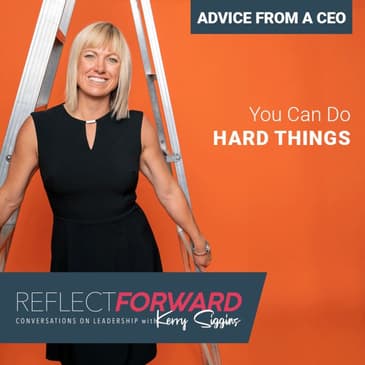

[00:00:10] Hi everyone and welcome back to Reflect Forward. I'm your host Kerry Siggins and I'm so glad
[00:00:14] you are here today. Today I want to talk about how to do hard things. Yes, you can do hard
[00:00:19] things. We can all do hard things. And I've said this before in many episodes. The only
[00:00:24] way to get good at doing hard things is to do hard things. I know that it can
[00:00:29] be uncomfortable to get out of your comfort zone, but if we don't get out of our
[00:00:34] comfort zones, then we don't expand our competency zone. And what I mean by that
[00:00:39] is that by trying new things, by pushing ourselves, we grow. When we get out of our
[00:00:44] comfort zone, we get better at doing things that make us uncomfortable. Take
[00:00:50] being a baby for example. We have to learn how to crawl before we can walk.
[00:00:55] And it's really scary going from crawling to walking, but that's how
[00:00:58] we grow. That's how we get out of our comfort zone. We adults are no
[00:01:02] different, but we have been conditioned to believe that if we look stupid, if we
[00:01:09] fumble, if we're not good at something, if we might fail, then we shouldn't do it.
[00:01:13] And that is a huge mistake because it holds you back from growth. It holds
[00:01:19] you back from building the life you want from going after your dreams for
[00:01:23] dreaming big. This is the one life that we have to live and we do not
[00:01:26] want to play small. So that's what I want to talk about today. And the
[00:01:29] reason I want to talk about it today is because I am just past a hundred days
[00:01:33] of not drinking. I've brought this up in an episode or two about wanting to
[00:01:38] quit drinking. Obviously, I had substance abuse issues in my 20s that was
[00:01:42] never really related to alcohol. It was two different kinds of drugs.
[00:01:45] I've always been able to drink and not have a problem with it. But after
[00:01:49] COVID, it became a daily habit. So it wasn't drinking a lot, but I was
[00:01:53] drinking almost every day. Come home, pour a glass of wine while I
[00:01:57] make dinner and a glass of wine. We turned into two glass of wine. So then it
[00:02:01] just became a habit. And for a couple of years, I was just like, I really
[00:02:05] want to break this habit. And I would do a dry January or a dry July
[00:02:12] and feel great. But then the next thing I would know is fall back into
[00:02:16] my same patterns. And then one day I was listening to a podcast and it
[00:02:19] was talking about the book, The Courage to Be Disliked, How to Free
[00:02:23] Yourself, Change Your Life and Achieve Real Happiness by Ichiro
[00:02:27] Kamishi. I hit Japanese author who writes this very philosophical book
[00:02:31] between a philosopher and a student about the courage to be
[00:02:35] disliked. And the podcast host was talking about how we humans
[00:02:39] can do anything that we want to do. We just have to ask ourselves
[00:02:43] the question, do we really want to do it? So that piqued my
[00:02:46] interest because I had to ask myself that question. I go through
[00:02:48] this whole process of, okay, I really want this. I really
[00:02:50] want this goal. Am I really willing to actually make the
[00:02:53] changes and do what I need to do to make that goal happen? And in
[00:02:57] some areas of my life, absolutely. In other areas, it's
[00:02:59] much harder. So I decided to read this book The Courage to Be
[00:03:03] Disliked because capability has always been something that's
[00:03:05] important to me. It's a deep part of my personality,
[00:03:08] something that I've really had to work on. So I thought
[00:03:10] this sounds like a perfect book for me. And oh my gosh, I
[00:03:12] loved it. So it is a story between the philosopher and a
[00:03:16] young man, and they go through this whole concept of how do
[00:03:19] you live your life for yourself? And it was brilliant. As I got
[00:03:24] into the book, I could really see myself in so much of it. But
[00:03:27] what kept coming up was this whole thing of like, I don't
[00:03:30] want to have my daily drinking habit. And a couple of excerpts
[00:03:34] from the book really motivated me to just do this. And the
[00:03:38] two that really stood out are these. First, your unhappiness
[00:03:41] cannot be blamed on your past or your environment. And it
[00:03:44] isn't that you lack competence, you just lacked
[00:03:47] courage. One might say that you are lacking the courage to be
[00:03:51] happy. And the second one is no experience in itself is a cause of
[00:03:56] our success or failure. We do not suffer from the shock of
[00:04:00] our experiences, the so called trauma. But instead we make them
[00:04:04] out to be whatever suits our purposes. We are not determined
[00:04:07] by our experiences. But the meaning we give them is self
[00:04:11] determining. Okay, so let's unpack that a little bit.
[00:04:14] Your unhappiness cannot be blamed on your past or your
[00:04:17] environment. It is not that you lack competence, it's just
[00:04:21] that you lack courage. And as I've looked at my life, I can see
[00:04:24] these places where I have exhibited so much courage
[00:04:26] leaving Austin, Texas to move to Colorado with no job, a ton
[00:04:29] of debt and no friends that took so much courage to say I
[00:04:33] have to change my life. I cannot blame my situation anymore.
[00:04:37] I cannot blame other people anymore. I have to have the
[00:04:40] courage to go make myself happy. And so I wanted to
[00:04:43] share this with you because if you are wanting to make a
[00:04:45] big change in your life, if there is something that you are
[00:04:48] unhappy whether it was like me of like, okay, I want to break
[00:04:51] my daily glass of wine habit or something else that's
[00:04:54] motivating you, I wanted to encourage you to think about
[00:04:57] I have to have the courage to do this. And that's big
[00:05:00] that is getting outside of your comfort zone. But you can't
[00:05:03] make the changes that you need to make in your life. You
[00:05:06] can't do those hard things if you are not willing to go
[00:05:09] deep inside and summon the courage to make the changes
[00:05:13] that you need to make. So let's unpack the second one. No
[00:05:17] experience in itself is the cause of our success or failure.
[00:05:20] We do not suffer from the shock of our experiences, the
[00:05:23] so called trauma but instead we make them out to whatever
[00:05:25] suits our purposes. So that's basically the stories that we
[00:05:28] tell ourselves when we attach meaning to something that
[00:05:32] is what makes us either happy or sad it's what is going
[00:05:35] to bring us joy or cause us to suffer. We are not
[00:05:37] determined by our experiences but the meaning we give
[00:05:40] them and that is what is self determining. So when we
[00:05:43] say, oh this happened to me and I am a failure because of
[00:05:46] it, it simply is because we are attaching that story of
[00:05:51] failure to it. So how do we turn that around and saying,
[00:05:54] okay, I didn't achieve the outcome that I wanted but
[00:05:57] here's how I'm going to grow from this. This is what
[00:06:00] I've learned. This is the new door that it opened.
[00:06:03] So we are so in control of our mindsets. We are so in
[00:06:07] control of those narratives that we choose to tell
[00:06:10] ourselves and we can tell ourselves a different story
[00:06:13] about anything that has happened in our life and we
[00:06:16] can turn something that is negative into something
[00:06:18] that is positive. It doesn't mean that a negative
[00:06:21] experience didn't happen but we can choose to find the
[00:06:23] goodness in it to find the way that we want to grow
[00:06:26] and learn and how we develop as a human being
[00:06:31] because of those hardships. I love this because
[00:06:34] basically the premise of the book is that we are in
[00:06:36] charge of how we think about everything and when we
[00:06:39] decide that we want to do something, we can do it. We
[00:06:42] just have to have the courage to actually do it. So
[00:06:46] that brings me back to deciding to quit drinking.
[00:06:49] So this was super motivating for me to say, okay, this
[00:06:51] does not make me happy. I want to make this change.
[00:06:54] I just don't have the courage to do it to go
[00:06:56] through the pain of figuring out how to create a
[00:07:00] new habit, how to go out socially without having
[00:07:03] a glass of wine, how to just break that kind of
[00:07:06] crutch that I've had to unwind at the end of the day
[00:07:09] with a glass of wine. And so I decided that's it.
[00:07:12] I'm going to do 100 days without drinking and so I
[00:07:14] have hit my 100 days and I wanted to share this
[00:07:17] with you because it has been so incredibly
[00:07:19] empowering for a couple reasons. One, just not
[00:07:22] drinking alcohol for 100 days. It does so many
[00:07:24] good things to your mind, your body, your brain.
[00:07:26] I've lost like 10 pounds. I feel fantastic.
[00:07:29] I'm sleeping better. I am regulating emotions better.
[00:07:33] It's just so good. And I also am really proud of
[00:07:37] the fact that I did it and I thought it was going
[00:07:39] to be a lot harder than what it was. But once I made
[00:07:42] up my mind that I was just 100% not going to
[00:07:45] drink for 100 days, it did not matter what I
[00:07:48] was able to do it. And so that just brings a
[00:07:50] lot of satisfaction and pride that I was able
[00:07:52] to do something that was hard. And that's why
[00:07:55] I want to do this podcast because we can do
[00:07:57] hard things. So I wanted to share this as an
[00:08:00] inspiration for you not to quit drinking. You can
[00:08:02] do whatever you want. I am actually going to
[00:08:05] quit drinking. I'm going to go for another 100
[00:08:08] days and then another 100 days and another
[00:08:09] 100 days and just see how it all goes because
[00:08:12] I do feel so much better not drinking. But that's
[00:08:15] not the point of this. The point is to inspire
[00:08:17] you to go after some big goal that you want
[00:08:20] to achieve or make some major change in your
[00:08:23] life that has just seemed too hard to do, too
[00:08:27] hard to take that step forward and maybe that
[00:08:30] you haven't found the courage to actually do.
[00:08:33] All right so here is how I approached my
[00:08:36] 100 days of no drinking and I think it's a
[00:08:38] good roadmap for you as you think about
[00:08:39] doing this hard thing that you want to do
[00:08:42] in your life. So the first thing is that
[00:08:44] you have to embrace this kind of growth
[00:08:46] mindset, this belief that you can develop
[00:08:48] your abilities, that you can grow, that you
[00:08:52] can do hard things if you work at it, if
[00:08:54] you stay dedicated to it. Having a growth
[00:08:56] mindset is essential for tackling these
[00:08:59] tough challenges because you have to
[00:09:00] embrace this idea that failure and setbacks
[00:09:03] are not an indication of inadequacy but
[00:09:06] opportunities to learn and to grow and
[00:09:08] to improve and that each challenge that
[00:09:10] you face is a chance to improve and
[00:09:12] expand your capabilities. So that growth
[00:09:14] mindset is really important. There's a
[00:09:16] great book out there by Carol Dwork
[00:09:17] called The Growth Mindset that if you
[00:09:19] are interested in learning the other
[00:09:21] mindset is a fixed mindset where you
[00:09:22] believe that everything that you can do
[00:09:24] today is all that you can ever do but if
[00:09:27] you want to do any of this you've got to
[00:09:29] have that growth mindset. You've got to
[00:09:30] believe that you can change, you've got
[00:09:32] to believe that you can grow. The
[00:09:34] second thing is that I broke it down.
[00:09:36] When you're faced with a daunting task
[00:09:38] it is easy to feel overwhelmed. The
[00:09:40] idea of just quitting drinking
[00:09:42] altogether was 100% overwhelming to
[00:09:45] me and I didn't know if I wanted to
[00:09:46] do it. It came back to that whole
[00:09:48] thing we can do anything we just
[00:09:49] have to actually decide we want to do
[00:09:51] it and so if you're not doing it you
[00:09:53] need to ask yourself the question do I
[00:09:54] really want this? That was a big wake-up
[00:09:56] call for me. So I said okay I'm going to
[00:09:58] do 100 days and the first thing I'm
[00:10:01] going to do is just focus on the first
[00:10:02] 30 and then how do I focus on the first
[00:10:05] 30? Well I'm going to focus on the
[00:10:07] first week and how do I focus on the
[00:10:08] first week? I'm going to focus on each
[00:10:10] day at a time and break it down that
[00:10:12] way. So when you have a daunting
[00:10:15] task don't get overwhelmed instead
[00:10:16] just break it down into smaller
[00:10:18] manageable steps. This approach will
[00:10:20] make the challenge seem less intimidating
[00:10:22] but it also allows you to celebrate
[00:10:24] those small victories along the way.
[00:10:26] Every time you complete that step and
[00:10:28] build momentum you gain confidence
[00:10:30] and that propels you forward. So for me
[00:10:33] I circled the 100 days on a calendar
[00:10:36] I bought a little calendar and then I
[00:10:39] just x out each day that I went and
[00:10:41] then when I got to the end of 30
[00:10:43] days I wrote down 30 days. Yay
[00:10:45] celebrate have a little win and then
[00:10:47] I went okay now it's the next 30 days
[00:10:50] and I broke it down that way and each
[00:10:52] day it got easier but having that x to
[00:10:54] show my progress was super motivating
[00:10:57] and I wanted to make sure that I had
[00:10:59] that x. So figure out a way to
[00:11:01] motivate yourself how do you break down
[00:11:03] your big goal into smaller chunks
[00:11:05] how do you track your progress
[00:11:07] and how do you celebrate how far
[00:11:09] you have come because that's really
[00:11:12] what we need to look at. Instead of
[00:11:14] looking at oh gosh okay I just hurt
[00:11:16] 30 days I have 60 more to go
[00:11:18] I celebrated the fact that I hit 30 days
[00:11:22] that's awesome and when I hit the next
[00:11:23] day it's going to be 31 and that's
[00:11:25] awesome. And so my next podcast is
[00:11:27] going to be on this idea of the gap
[00:11:30] in the game. I talked about this in the
[00:11:31] last advice from a CEO episode how
[00:11:33] you want to measure yourself on the
[00:11:34] progress you've made versus how far
[00:11:36] you still have left to go. I really
[00:11:38] did this in this goal by breaking it
[00:11:40] down and being able to celebrate
[00:11:41] those small successes it absolutely
[00:11:44] helped me stay motivated and I could
[00:11:46] be proud of myself for this so figure
[00:11:48] out that way to do that for yourself
[00:11:50] too. The next thing is to visualize
[00:11:51] success. Visualization is so incredibly
[00:11:55] powerful and a lot of people think it's
[00:11:57] woo-woo but it's not. When you
[00:11:59] visualize yourself achieving your goal
[00:12:02] it helps you build confidence. So spend
[00:12:05] a few minutes each day visualizing
[00:12:06] yourself successfully completing this
[00:12:09] hard task at hand and don't just
[00:12:11] visualize yourself completing it
[00:12:13] visualize yourself having to overcome
[00:12:15] roadblocks. So each morning when I would
[00:12:17] do my visualization exercises I imagined
[00:12:20] myself coming home really wanting a
[00:12:22] glass of wine and saying no and
[00:12:24] instead making myself a mocktail and that
[00:12:28] really helped it's not just about
[00:12:29] visualizing the wind but it's
[00:12:31] visualizing yourself doing the hard
[00:12:33] thing keeping at whatever your goal is
[00:12:37] that is a key to visualization to help
[00:12:39] you and a lot of people don't talk
[00:12:40] about that they just talk about
[00:12:42] visualize what the end looks like well
[00:12:43] no visualize yourself overcoming those
[00:12:45] obstacles to get to the end so that you
[00:12:48] are better prepared to be able to push
[00:12:49] through those obstacles as you run into
[00:12:51] them because you're going to whether
[00:12:53] that is something that's out of your
[00:12:54] control or something that's in your
[00:12:55] control you're going to have roadblocks
[00:12:57] along the way. So imagine what those
[00:12:59] are going to be and visualize that
[00:13:01] process and those challenges that you're
[00:13:02] going to face and the satisfaction
[00:13:04] of overcoming them and it can really
[00:13:06] help you reduce anxiety and it
[00:13:08] increases your self-assurance and it
[00:13:10] primes your mind for success. When we
[00:13:11] are trying to do hard things it is all
[00:13:13] in our minds we have to be able to
[00:13:17] figure out how to hack our minds and
[00:13:19] visualization is a key way to be able
[00:13:22] to do that. The fourth thing is to focus
[00:13:24] on your why why are you trying to make
[00:13:26] this change why is this your goal
[00:13:28] when you understand the deeper reasons
[00:13:30] behind why you want something that can
[00:13:33] be a really strong motivator that
[00:13:35] might be personal growth that might
[00:13:36] be family or a long-term dream
[00:13:38] when you connect your actions to
[00:13:40] that meaningful purpose it provides
[00:13:42] the view the fuel to keep going. So for
[00:13:44] me I wanted to break that habit so that
[00:13:46] I could stop that guilt cycle that I
[00:13:49] was in which wasn't helping with
[00:13:51] anxiety which wasn't making me feel
[00:13:52] good and so I wanted to feel better so
[00:13:55] that was a big goal. I also was like
[00:13:56] I'd like to lose a little bit of weight
[00:13:58] and I know that drinking a glass or two
[00:14:00] of wine every day does not help me
[00:14:01] lose any weight so I want to feel
[00:14:03] strong and beautiful as I'm going
[00:14:05] into my 46th year on this planet. I
[00:14:08] knew that I would feel better I would
[00:14:10] show up as a better mom as wife and a
[00:14:12] leader if I wasn't drinking and that I
[00:14:15] would feel better about myself because
[00:14:16] I wasn't putting poison into my body.
[00:14:18] So those were my whys and I suggest
[00:14:21] that you find yours when you really
[00:14:23] want to do something hard or go after
[00:14:26] a big goal reflect on why you're
[00:14:28] doing it and that will help you keep
[00:14:30] going especially when the going gets
[00:14:32] tough because it will and then
[00:14:33] reflect often on this why when you
[00:14:36] do your visualizations it'll help
[00:14:38] you overcome when you feel that tug and
[00:14:40] the pull to fall into your same patterns
[00:14:42] or to give up because you think it's
[00:14:45] just too hard. The next thing is to stay
[00:14:47] consistent. Consistency matters.
[00:14:50] You've heard me say this many times but
[00:14:51] consistency is the most underrated
[00:14:53] leadership trait on the planet and
[00:14:56] when you're trying to make a change
[00:14:57] in your life and go after a big goal
[00:14:59] that proves to be true as well.
[00:15:02] Consistency is key when you're trying
[00:15:03] to build that confidence and to
[00:15:05] increase your motivation. So on days when
[00:15:08] you don't feel motivated to do the hard
[00:15:10] things that you need to do to achieve
[00:15:11] your goal or to make the change
[00:15:13] you've got to remember that each small
[00:15:15] step that you take is actually helping
[00:15:17] propel you to that goal and those
[00:15:20] small steps they add up one day at a
[00:15:23] time every day I checked off a
[00:15:25] calendar day with an X that was one
[00:15:27] day of no drinking it's one day out of
[00:15:30] a hundred it'll be one day out of
[00:15:31] 200 and 300 eventually as I continue
[00:15:34] down this journey so that consistency
[00:15:36] really matters and consistent effort
[00:15:38] over time creates that habit to
[00:15:41] reinforce your ability to tackle those
[00:15:43] challenges to tackle that goal to make
[00:15:45] those changes and it'll make it feel
[00:15:47] less daunting so just be consistent a
[00:15:49] small step every single day really does
[00:15:52] make a difference. The next thing is
[00:15:54] to build a support system you've got
[00:15:56] to surround yourself with supportive
[00:15:57] people who can provide the
[00:15:58] encouragement that you need to keep
[00:16:00] going I told several people I told
[00:16:02] my husband and my son I'm gonna do a
[00:16:04] hundred days of no drinking I told my
[00:16:06] coworkers because we've had lots and
[00:16:08] lots of activities around here we had
[00:16:10] all of our global employees come from
[00:16:13] around the world to celebrate being
[00:16:16] part of Stone Age and I knew that was
[00:16:18] going to be tough to be going out and
[00:16:19] to not have a glass of wine with my
[00:16:22] fellow coworkers and everybody else
[00:16:23] was going to be having a beer or
[00:16:25] cocktail so I needed that support
[00:16:27] system so I told several of my
[00:16:29] colleagues my executive management team
[00:16:31] look I'm doing this hundred days of no
[00:16:33] drinking and I really would like your
[00:16:35] support and so when you see me not
[00:16:37] ordering a glass of wine please don't
[00:16:38] make a big deal out of it and they
[00:16:40] were so incredibly supportive and this
[00:16:43] was awesome. I also started listening
[00:16:45] to this great podcast called Sober
[00:16:47] Powered by Jillian Teetz I think
[00:16:49] is how you say her name I love this
[00:16:51] podcast and she provides weekly
[00:16:53] motivation for anybody who is going
[00:16:55] through a dry January or a hundred
[00:16:57] days or just trying to stay sober
[00:16:59] and so having that motivation was
[00:17:02] really helpful as she shared her
[00:17:03] stories and all kinds of
[00:17:05] informations on how to either
[00:17:07] moderate or stop drinking and that's
[00:17:09] how I built my support system so for
[00:17:11] you as you are thinking about this
[00:17:13] big goal that you are trying to
[00:17:15] achieve or this major change that you
[00:17:16] want to make in your life what does
[00:17:18] your support system look like?
[00:17:19] How are you going to lean on people
[00:17:21] who you trust and who are your
[00:17:23] closest to who will support you
[00:17:25] in achieving this big goal?
[00:17:27] What kind of podcasts can you listen to?
[00:17:30] What kind of books can you read?
[00:17:31] What and who do you need to surround
[00:17:33] yourself with so that you can have a
[00:17:35] support system that will keep
[00:17:36] encouraging you to push forward
[00:17:38] even when you're feeling self-doubt?
[00:17:41] The next thing is to celebrate
[00:17:42] progress not perfection.
[00:17:44] We're going to stumble along the way
[00:17:45] and it goes back to this whole gap
[00:17:47] in the game how are you measuring
[00:17:48] yourself?
[00:17:49] So it's easy to get caught up in
[00:17:51] striving for perfection like I'm not
[00:17:52] a perfectionist so I don't have this
[00:17:54] issue. Progress is good enough for me
[00:17:56] but a lot of you out there do think
[00:17:58] that you have to be perfect and if you
[00:17:59] can't be perfect it's not worth doing.
[00:18:01] Well that's not the case you just need
[00:18:03] to make progress as you're going forward
[00:18:05] and trying to achieve your goal or
[00:18:07] making a big change like you might
[00:18:08] have doubts, you might take a step
[00:18:10] backwards, you might falter,
[00:18:12] you might quit for a little bit but
[00:18:13] that's okay.
[00:18:14] That's just part of life it doesn't
[00:18:16] mean that you have to give up.
[00:18:17] Celebrate the progress that you've
[00:18:19] made. If you are striving for
[00:18:21] perfection then you're going to
[00:18:22] be frustrated and is going to be a
[00:18:24] motivator. So focus on that progress
[00:18:26] celebrate those small wins recognize how
[00:18:28] far you've come even if you haven't
[00:18:30] reached your goal yet even if you have
[00:18:32] taken a few steps backward from reaching
[00:18:34] your goal that is how we learn and
[00:18:36] there's so much to learn in those
[00:18:37] setbacks if we choose to look at it
[00:18:39] that way.
[00:18:40] And finally practice self-compassion
[00:18:42] what I've learned through this
[00:18:44] hundred days and what I've learned
[00:18:45] through my entire journey of
[00:18:47] rebuilding my life and figuring out
[00:18:49] how to be a leader who is worth
[00:18:51] following and building a company and
[00:18:53] making mistakes and going through the
[00:18:55] uncomfortableness of growing
[00:18:57] is that the kinder I am to myself
[00:18:59] the better my life is
[00:19:00] and I really want to encourage you to
[00:19:02] consider the same thing.
[00:19:04] There is no point in beating yourself
[00:19:06] up it does not help you
[00:19:08] do anything all it does is hold you
[00:19:11] back
[00:19:11] we are literally on this planet to
[00:19:14] grow to
[00:19:15] learn new things to expand our
[00:19:17] consciousness and that happens
[00:19:18] from making progress and it also
[00:19:20] happens
[00:19:21] from taking step backwards and from
[00:19:23] failure that is how we learned
[00:19:24] if you want to do hard things do hard
[00:19:27] things
[00:19:27] but practice that self-compassion
[00:19:29] it's okay to feel uncertain it's okay
[00:19:31] to struggle at times that is literally
[00:19:33] part of the process
[00:19:35] but when you maintain that healthy
[00:19:36] mindset of like okay you know what
[00:19:38] I'm going to give myself some grace
[00:19:39] here this wasn't perfect
[00:19:40] I could have done this better
[00:19:42] I quit for a little bit but I'm
[00:19:44] going to pick back up and get back on
[00:19:46] the wagon do this again
[00:19:47] it allows you to bounce back
[00:19:49] and ideally not just bounce back
[00:19:50] but to bounce forward and that is how
[00:19:53] we build resilience so
[00:19:55] that self-criticism it's not helping
[00:19:57] you
[00:19:58] and I understand it's really tough to
[00:20:00] kick
[00:20:00] every time you hear yourself putting
[00:20:02] yourself down say stop
[00:20:03] I'm gonna say something really
[00:20:05] positive about myself instead
[00:20:06] that's how you practice self-compassion
[00:20:08] so those are my tips on how to do
[00:20:11] hard things
[00:20:11] and hopefully you could see yourself
[00:20:14] in this podcast as
[00:20:15] you were thinking about some major
[00:20:17] change or goal that you want to go
[00:20:18] after in your life
[00:20:19] and hopefully inspired you to
[00:20:22] motivate yourself and to build the
[00:20:24] confidence that you need to be able to
[00:20:25] do this hard thing
[00:20:26] and remember that this is a journey
[00:20:28] it's not a one-time effort right
[00:20:30] our whole lives are a journey
[00:20:32] and it's like this
[00:20:34] ebbs and it flows
[00:20:35] and the best way to do this
[00:20:37] is to think of it as a process
[00:20:39] so
[00:20:39] I'll repeat again just to summarize
[00:20:42] this for you
[00:20:42] 1. Embrace a growth mindset
[00:20:45] 2. Break down your goal
[00:20:47] 3. Visualize success
[00:20:49] and not just success but overcoming
[00:20:51] the challenges that you're going to face
[00:20:53] as you are pursuing your goal
[00:20:55] or making this change
[00:20:57] 4. Focus on your why
[00:20:59] why are you doing this
[00:21:00] 5. Stay consistent
[00:21:02] consistency is key
[00:21:03] little tiny progress equals big progress
[00:21:06] if you do it every day
[00:21:08] 6. Build that support system
[00:21:09] make sure that you surround yourself
[00:21:11] with people who are going to encourage
[00:21:12] you along the way
[00:21:13] 7. Celebrate progress
[00:21:15] don't worry about perfection
[00:21:16] perfection is a fallacy
[00:21:18] and 8. Practice self-compassion
[00:21:20] you can make these changes in your life
[00:21:21] you can achieve that big goal
[00:21:23] using these strategies
[00:21:24] you will find that you are capable of
[00:21:26] achieving more than you ever thought possible
[00:21:29] all right that's it for today's podcast
[00:21:31] hopefully you found some good takeaways
[00:21:33] in there some nuggets
[00:21:33] some inspiration for you to go
[00:21:36] do the hard things that you want to do
[00:21:37] in your life as well
[00:21:39] so with that I will leave you
[00:21:41] for your day
[00:21:42] if you like this podcast
[00:21:43] please share it with a friend
[00:21:44] write a review
[00:21:45] subscribe to it on youtube
[00:21:47] I help skip the message out
[00:21:48] and help you with the algorithms
[00:21:50] and I really appreciate it
[00:21:51] thanks so much
[00:21:52] we'll see you next week