
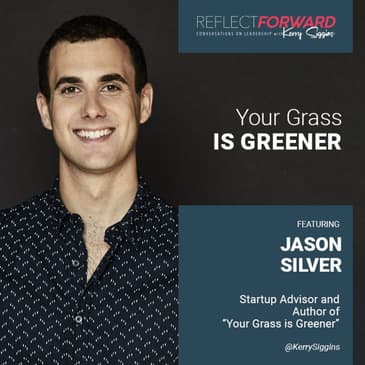

[00:00:12] and I hope you're having a great day today. Today, my guess is Jason Silver. He is a startup advisor.
[00:00:19] He has founded several different types of companies. He's worked in all kinds of startups. He was at Airbnb at the beginning.
[00:00:26] So he knows a lot about the hard work that goes into founding a company going through those initial startup years and how difficult it is.
[00:00:35] And how miserable it can be. And so he recently wrote a book called The Grass's Greener and it's all about how to find more joy in your work,
[00:00:45] whether you're an entrepreneur, a founder of a startup or a person who is just trying to figure out how to enjoy his or her job more.
[00:00:53] He has all kinds of amazing tips in his book The Grass's Greener that came out on September 2nd.
[00:00:59] And I know that you are going to just really appreciate his passion and his stories around finding more joy in what you do every day.
[00:01:09] So hang tight, and I'll be right back with Jason.
[00:01:19] Alright everyone, I am back with Jason Silver. I'm so excited to have you on the show today to talk about your new book.
[00:01:26] Can you just tell the audience a little bit about yourself and a little bit about your book The Grass's Greener?
[00:01:31] Thanks a ton for having me. So a little bit about me. I'm a type, I think by nature I love to achieve and that hasn't changed or is necessarily all that uncommon.
[00:01:41] But I think there's this really common you can't have your cake in either two mentality, meaning you can't enjoy yourself and do great things at the same time.
[00:01:50] And I've become really passionate about showing high achievers people that care about accomplishing things in their lives. It's not only can you enjoy something and push for big things in your cheek.
[00:02:00] But actually the more you enjoy it, the more you achieve it. And I find often we think about enjoying it as like fluff and really I think enjoyment is the fuel for the things that we all want to accomplish.
[00:02:12] And that's what the book's all about is really how to enjoy your job more. Why you share about that.
[00:02:18] Cauling create tactical steps and how it leads to better outcomes.
[00:02:21] Yeah, I completely agree before I moved to Colorado and took over running Stone Age. I was so miserable in my job and I was unhappy but I worked hard and I played hard.
[00:02:33] I was making unhealthy decisions which doesn't ever help it is all just that vicious cycle of being unhappy and into a field of work and then numbing yourself to your unhappiness.
[00:02:42] But happiness, especially my 20s was not even part of the you know my ethos. It was just work hard work hard, work hard achieve achieve achieve I'm a higher G or two.
[00:02:53] Now move up the corporate ladder and it was so miserable. So I am really glad that you wrote this book and I'm excited to dive into it.
[00:03:02] But before we do that let's talk a little bit about what you do because your start of advisor correct. So can you share just a little bit about your professional background as well.
[00:03:10] Yeah, sure. Engineer by training realized pretty quickly that you know I loved kind of technical problem solving but I really love the business side of problem solving.
[00:03:20] So relatively quickly after doing my masters in engineering I started really getting interested in business.
[00:03:26] Started focusing on like how do you build out companies join to start up in a very early days got to see what that was like founded to my own companies crashed one of them wound up at Airbnb and it's earlier days.
[00:03:37] So I got to really experience what the unmitigated up into the right success looks like then built an AI company back before it was the coolest thing on the planet to do.
[00:03:48] And so I've been very fortunate to see all sorts of ups, downs, raising money, crashing companies, success and failures will have you.
[00:03:55] And now I spend my time working with CEOs, their executive teams, their leadership teams helping them build their companies with a lens towards how are you going to build a great company and how do you make sure that people actually want to work for it because that's the thing that is going to make it as best as it can possibly be.
[00:04:13] So I like to think I do a lot of strategic regular stuff and I kind of sneak into message of your an entrepreneur you're an executive or leader.
[00:04:19] It can be a great time along the way it doesn't just have to feel like a grind all the time and it's going to lead to better outcome so I sneak those two thoughts in along with the traditional.
[00:04:29] Let's set your okay hours and figure out how to solve whatever major challenges going on.
[00:04:33] Yeah, and I like that because I think a lot of entrepreneurs especially founders can get just caught up in their vision and the mission of the company and burn themselves out.
[00:04:43] So do you find that this idea of you can have fun while building this company resonates and if it does, can they actually do it.
[00:04:55] Yeah, yeah, and I think that probably brings me to an important first point.
[00:04:58] I think it's often I find that we confuse the words I can join into and fun and they're different and I think the difference is nuance, but it's really important people will always say to me, Jack, I can't have fun in my job.
[00:05:10] That's good for so and so, but I'm the CEO, I'm the CEO, I'm the chief whatever I have a team of however many people were trying to accomplish whatever whatever whatever.
[00:05:18] But I think what we tend to forget is that fun is always enjoyable, but enjoyment is not always fun.
[00:05:26] You know, super simple example, you know, I love running that like last mile when I'm running is not fun.
[00:05:34] I'm tired, I'm pushing myself to go faster, I'm in a lot of pain, it's not fun, but I enjoy the entirety of the run.
[00:05:44] And similarly, some of the times in my career that I've enjoyed the most are when I'm trying to accomplish something really, really hard, there's a crazy deadline we've hit some kind of a major impediment or something.
[00:05:56] It's not fun in the moment, but I enjoy it overall because of the way that we were approaching this specific day and so I don't try to help people see that hey your job can be fun all the time.
[00:06:07] I think that's untrue, that's why there's a word for fun and a word for work like they're different.
[00:06:12] But I think just because something's challenging, just because it's hard, just because you might be having to grind through a particular thing in a particular time.
[00:06:19] Doesn't mean that you can't approach it in a way that you will overall enjoy like the last mile of a marathon or whatever else it might be.
[00:06:28] So really trying to focus people on what are we trying to accomplish? How do you want it to feel? And how can we bring some more enjoyment into it so that it isn't grinding you down?
[00:06:37] I don't know the time. Yeah, I agree. I completely am with you. I enjoy doing hard things too. Maybe to an extreme, but I think that the challenge is what makes it exciting and I think that probably a lot of higher achievers can fill that way as well, where it's like I enjoy doing hard things.
[00:06:53] I enjoy the challenge. I enjoy solving the tough problem. I have an enjoy screen out because I know that it's going to be learning, but obviously that takes time and maturing as an entrepreneur as a leader to figure out that just because it's hard or challenging or even bad.
[00:07:11] That there's not that learning moment in it that you can find enjoyment or appreciation for what you're going through.
[00:07:18] Yeah, I think the big thing I try to push people on is something that we shock and they don't spend a lot of time on and it often comes very naturally to think about what we're trying to accomplish.
[00:07:29] We build out a plan, we think about our goals, we're going to do this in this and this and this and this.
[00:07:34] We spend almost no time thinking about how do we want it to feel as we're going through this process.
[00:07:39] I find that this can be very, very helpful for teams. There are times when it's like hey we're trying to hit this goal the next two to four weeks. It's not going to feel great.
[00:07:48] Like we're going to be in the office really late, we're pushing on some stuff. There's not going to be a lot of fun at the moment on this kind of stuff.
[00:07:54] What I think this does is that the team knows oh man, this is rough. I can organize my life around it. I know it's going to be really challenging and we're all kind of in it together.
[00:08:02] And I also know that there's a line at the end of this tunnel. This isn't the norm. It's a period of time we're going through, but alternatively when a leader takes his time and says okay here is the plan.
[00:08:12] They spend 10% of their planning time saying I want this to feel like it's fun for people like this should feel fun.
[00:08:18] There's going to be some creative stuff in here and I want to make sure that that feeling is part of the process just taking a little bit of time to think that through and infuse it in as you go has a huge, huge impact.
[00:08:29] So just taking a little bit of time is like how do I want this journey to feel what should the experience feel like for my people.
[00:08:36] It can have a big, big impact and I find you can go do corporate planning, you got a quarterly planning, you do it 100 times.
[00:08:43] That will maybe come up on its own once twice maximum, like it's very, very, very uncommon.
[00:08:48] But that small little snippet can have a massive impact on how your team is feeling as they go through it. And as a result, the likelihood that you hit the outcomes that you're trying to achieve.
[00:08:57] Yeah, leaders set the tone for their organization. I advise a company and the CEO and owner is a super high stress person and is kind of at that grind burnout phase.
[00:09:12] And I try to help him see like you are studying the tone for this and because you are so miserable.
[00:09:18] You're making all of your employees, miserable too because you set that tone if you can figure out a way to bring some fun and bring some joy into the work and lead that way.
[00:09:27] Everybody else, the temperature is going to go down too. And it's just so obvious especially in a small company when you see
[00:09:35] The impact that the leader or the founders attitude sense of well-being or misery really does affect the team and I talk a lot in my podcast about the power of role modeling
[00:09:45] and I think that leaders have to role model that and figure out a way to find joy in what they're doing so that their employees can find joy in what they're doing too,
[00:09:54] especially in those hard early days of startups.
[00:09:57] And I think that if find a joy, there's something we all say and not like I love it but it's overlooked you have to find it.
[00:10:04] It's not just there. You know usually fun is just there. I'm going to the beach to play whatever with my kids. That's going to be fun because there's fun stuff about
[00:10:12] It's a lot harder to think about. We have to do quarterly planning or we have to grow the number of customers. How are we going to make that enjoyable?
[00:10:19] You have to go and find it what I wanted to show people is you can be just as tactical about that stuff.
[00:10:24] It is just as impactful if not more impactful than a lot of the other rhetoric that's out there.
[00:10:29] And the big pushback I used to get was, well I have to do X, Y and Z. I don't have a choice. Therefore it can't be enjoyable.
[00:10:37] And what I try to show people is it's not about what you're trying to accomplish. It's about the way you're trying to accomplish.
[00:10:43] Some very small tweaks to the way you're trying to accomplish things will have a big impact on how successful they are and how much you enjoy it along the way.
[00:10:53] That was kind of the genesis of the book is like nine of the most common challenges at work.
[00:10:57] Nine incredibly simple tactics. My role as if you can talk or type, you should be able to try everything in the book.
[00:11:03] And I wanted to show people that this isn't just big philosophical like you can't do anything with it.
[00:11:08] Kuhm Bai'a goes sitting the hells and grow a beer and I'm not about that stuff. This is hugely based in performative work.
[00:11:15] How do you make a tactical? And that was what I found to be one of the more challenging things of the project was just, it's not easy to take these big concepts like
[00:11:25] to find the joy into your job and make that practical. So someone can say, ah, there are concrete steps I can take here for the moment when it's not naturally enjoyable.
[00:11:34] Yeah, I think it starts with your mindset. I wrote a book this past year called The Ownership mindset.
[00:11:39] And I think it's one of the most powerful mindsets that you have when you say, I am responsible for everything that happens in my life.
[00:11:45] That being happens to me. It happens because of me, all right happens for me and I'm responsible for how I show up whether that is with my attitude with my effort
[00:11:56] With the quality of my relationships. I think that being able to go find the joy and implement some of these other nine recommendations that you have like the beginning part is you got to decide that you want to do it that you're going to do it that it's worthwhile doing it that mindset is such a tremendous asset
[00:12:14] And really the foundation for making any of these kinds of changes happen and actually stick couldn't agree more and not to keep like playing in the book, but you're like perfectly teaching me up for some stuff.
[00:12:26] The primary challenge I see people have is it's easy to be an unbelievable about this stuff and I was at first two and it's usually because we're so busy.
[00:12:33] And that's why I made the first third of the book. Tactics are going to help you enjoy your job or by removing time from your day to day because I think some of these things are not that hard when we give them some space.
[00:12:47] The biggest challenge I think most of us have is we have absolutely no space. You can't do a lot of this work off the side of your desk.
[00:12:53] You're not going to think about what you're really great at and how you can enjoy some of the tasks that you're doing on a more regular basis.
[00:13:00] When you're like shutting your laptop at midnight on your way to try to go to bed, it's like you need to carve out an hour in the middle of your day when you have a lot of other stuff going on.
[00:13:09] And so the first third of the book is totally dedicated to how you do five days of work in four without changing a number of hours. It's working without changing your impact, right?
[00:13:18] And it feels like a myth that it's possible but shockingly I really is not.
[00:13:24] It really is when you start paying attention to what you actually spend time on. So share us some of your tips on getting five days worth of work done in four.
[00:13:32] Yeah, we go in lots of different directions but no one that kind of folks did. They you have on the podcast maybe one that would be something that comes up for me pretty much every team I work with all of my companies in the past had something like this.
[00:13:46] It's this idea of decision making.
[00:13:49] It's incredibly critically important.
[00:13:51] Every company is making decisions pretty much everything you do all day long is a decision. You have to decide what things are going to do and when you're going to do them and how you're going to do them.
[00:13:59] Shockingly nobody really teaches decision making as a discipline.
[00:14:04] It just kind of exists there as like a thing around the periphery and in a lot of cases our decision making discipline is not great.
[00:14:13] And that leads to things like decisions take a lot of the wrong.
[00:14:16] So, it can be this awesome survey a while back.
[00:14:20] They found out that managers are self reporting that they're wasting a full day every week on slow or unnecessary decision making processes and I don't mean they're spending a full day every week on decision making in general.
[00:14:35] The study showed that of all the time they spent on decision making roughly half of it was wasted which worked out to roughly eight hours every single day.
[00:14:46] So, if you can find a way to speed up decision making, you make the same decisions faster you can gain back a full day every single week.
[00:14:54] Now the primary pushback I get here every time I bring up this conversation is, well my company is making really high risk decisions.
[00:15:02] My company is making very challenging decisions, very cross-functional decisions and all that stuff is true.
[00:15:09] Until I stop and point to an example of some of the fastest decision making and that's the Apollo mission from the 60s.
[00:15:16] Today we're obviously trying to put people on the moon and a very, very short time to make this happen.
[00:15:22] And the team was massive about 400,000 people over 200 billion dollar budgets they had no phones, no internet, no nothing until facilitate their communications.
[00:15:30] This team of people regularly made decisions in a single day.
[00:15:36] From the moment that the decision was brought up is like, oh this is a thing we need to decide until the moment that the decision was made, resource and ready to action was one single business day.
[00:15:48] Most people listening like imaginative most of your decisions could be made in a day.
[00:15:53] And so when people tell me we can't do it because I point to this example of like, this is a government organization in the 60s making decisions that could kill people on top of technology that didn't even exist.
[00:16:05] They were coming up with it at the time and they had to send people to the moon and back on a computer that is less powerful than the phone I walk around with it might pocket right now.
[00:16:14] You find the more risky less complicated decision that good luck.
[00:16:18] And that's usually people say let's see what we can do here.
[00:16:22] The challenge is we're building teams that result in slower decisions.
[00:16:28] It's a bit of a catch 20 to and it's something that feels obvious when I say it out loud, but we tend to miss it.
[00:16:34] We're building teams for more diversity, which is awesome.
[00:16:37] That's exactly what we should be doing.
[00:16:39] We probably don't need to spend any time on this podcast talking about the value of diverse thinking on teams.
[00:16:44] You want that if you don't believe it, go Google and you'll find all the great research out there that shows it.
[00:16:51] The challenge is that the more people we have and the more diverse thinking we're bringing in, the more likely we are to disagree.
[00:16:59] And we suck at disagree.
[00:17:01] We're terrible at it.
[00:17:02] We're kind of wired to agree with each other.
[00:17:05] Nobody wants to be the member of the tribe who's like everyone saying we should go laugh and you're like, no, no, no, no, let's go right.
[00:17:10] It's scary.
[00:17:11] It's hard to do it.
[00:17:12] It feels like you're not fitting yet.
[00:17:14] It's really, really challenging.
[00:17:16] And so the secret to faster decision making is that we absolutely do not need to agree.
[00:17:22] The best teams who can make the fastest decisions know that they just need to align, not agree with each other.
[00:17:28] And so better decision making, faster decision making is all about better disagreements.
[00:17:33] But we could talk about how, but that is a lot of like, here's the problem.
[00:17:36] I want to see which direction you want to go.
[00:17:38] I love it.
[00:17:39] I think that it's so true and it's one of the most frustrating things that I hear from people is somebody make a decision.
[00:17:47] And so yeah, I would love to hear the house because I think that that is a great concept and a lot of leaders probably are like, no, we have to have consensus.
[00:17:54] So yeah, share a little bit of the how because I think people will be interested in that.
[00:17:58] Yeah, when you flip the equation on a 10 and you stop thinking, how are we going to agree?
[00:18:04] You and I are having a big argument about whatever it is we want to get accomplished.
[00:18:09] Most of the time we're putting our energy naturally into how am I going to get carried away with me?
[00:18:14] How am I going to get the group to agree?
[00:18:16] And I'm saying throw that in the garbage.
[00:18:19] The question is, how do I get carried to a line?
[00:18:22] And there's usually like two things that we need here.
[00:18:25] The first team so simple again people won't believe me.
[00:18:27] This will catch you most of the way there.
[00:18:29] The first point is, if you're going to disagree, you're going to have to know how.
[00:18:33] So before you debate the decision decide who's going to decide.
[00:18:37] I ran a workshop not too long ago.
[00:18:38] We put 70 managers on a zoom call.
[00:18:41] The least conducive place to make a fast decision.
[00:18:44] And we made a very important business decision with all 70 of them aligned in under 20 minutes on a zoom.
[00:18:51] And it's all because usually what happens is we have a decision to make.
[00:18:55] We dive into it and we immediately start debating the decision itself.
[00:18:59] But we haven't decided who's going to decide.
[00:19:02] Is carrying in a decide?
[00:19:03] Is Jake going to decide?
[00:19:04] Are we going to vote?
[00:19:06] Nothing wrong with him?
[00:19:07] Consensus is not my recommended path, but at least it's stated explicitly.
[00:19:11] Hey everybody, this is something that we all have to agree with.
[00:19:15] Otherwise we can't move forward with it.
[00:19:16] That's probably the minority of cases.
[00:19:19] But it winds up being the majority because we haven't called it out.
[00:19:22] So the first thing you want to do is you want to say,
[00:19:24] this is a decision we need to make.
[00:19:26] You'll hear immediately people are going to start debating the decision.
[00:19:30] Raise your hand.
[00:19:31] Hang on a second everybody, who's actually going to make this decision?
[00:19:34] And what that lets us do is know if it's carry.
[00:19:38] She's going to listen to the debate.
[00:19:39] People are going to argue back and forth as they should.
[00:19:41] That's exactly what we want.
[00:19:43] And when carry has heard enough information to make the decision,
[00:19:45] she says, okay everybody, I'm good.
[00:19:48] I got this in this.
[00:19:49] I'm ready to make the decision.
[00:19:50] Let's go.
[00:19:51] Or if we're going to take a vote,
[00:19:52] it's next Tuesday we're going to get a room in the vote.
[00:19:55] Let's argue it like crazy for now until next Tuesday.
[00:19:58] But when next Tuesday comes, all four all against decision made were done and we move on.
[00:20:04] So this is the thing you can look out for is just you have a decision to make.
[00:20:07] You will see the first thing that will start happening
[00:20:09] as people are going to debate the decision itself.
[00:20:12] Stop and ask who's deciding and have that debate.
[00:20:15] It takes five or ten minutes.
[00:20:16] That five or ten minutes will save you eight hours a week.
[00:20:20] You're incredible, incredible investment.
[00:20:22] Try it out and you'll see how much faster it goes when you lie down.
[00:20:25] When the expectations are clear up front,
[00:20:28] it makes everything easier because then people understand, okay,
[00:20:32] this is the framework that I need to be in.
[00:20:34] I'm a big believer in that.
[00:20:36] I'm always like let's just talk about how this is going to work.
[00:20:38] I'm intentionally have been kind of doing that same thing because I see so often
[00:20:42] when there is confusion about expectations and what you're supposed to do.
[00:20:47] It's so much waste of time.
[00:20:48] Whether it's decision making or working on a project or trying to figure out how
[00:20:53] to get to some outcome, if people don't understand the what?
[00:20:57] They can be responsible for the hell.
[00:20:59] But if they don't understand the what there is so much waste of time.
[00:21:02] Yeah, and this again, I mean, it's almost as if I've written you bullets
[00:21:06] to like tee up the next thought in my head.
[00:21:09] So thank you.
[00:21:10] And this is the cheat code after the you've decided who's going to decide.
[00:21:13] So if you decide who's going to decide and then that person's you,
[00:21:17] even if it's not you can use this as much easier for me to describe it when
[00:21:21] when you are the decision maker.
[00:21:23] It will primarily feel like you need everybody to agree because of what we talked about earlier.
[00:21:27] You're going to think I have to get this person to agree to move forward.
[00:21:31] You don't.
[00:21:32] You need them to align.
[00:21:34] So the cheat code, like the single most powerful question after who's decision is this
[00:21:39] in decision making that I found is let's say I'm working on a decision.
[00:21:42] I have to decide care is not agreeing with me.
[00:21:44] We've had a big debate back and forth.
[00:21:46] I have all the information I need from her.
[00:21:48] We're not agreeing with each other.
[00:21:50] One of the best questions you can ask in that situation is something like
[00:21:54] Carey, what would need to be true for you to support this decision even though you can't agree with it?
[00:22:00] And the language is intentional.
[00:22:02] I'm asking you to support it, not agree.
[00:22:05] And I'm saying that you cannot agree with it.
[00:22:07] So we've decided you're not going to agree with me.
[00:22:10] That's okay.
[00:22:11] We haven't been debate.
[00:22:12] I got lots of great information from you.
[00:22:15] We're not agreeing.
[00:22:16] Let's put that behind us to how?
[00:22:18] How are we going to align?
[00:22:20] And usually when you ask somebody a question like that,
[00:22:22] how they're going to support the decision, they quickly think it through.
[00:22:26] And it comes down to either,
[00:22:27] I want to make sure that you heard my thoughts and they were part of your decision-making process.
[00:22:32] Carey, I heard you?
[00:22:33] You said X, Y, and Z?
[00:22:35] Valid points?
[00:22:37] They're part of my decision-making process.
[00:22:38] I'm just making a different decision than the one you would like.
[00:22:41] Okay, Carey knows that she was part of the decision.
[00:22:43] That's great.
[00:22:44] Other times, a couple times out of time,
[00:22:46] Carey will have something she wants.
[00:22:47] Hey, can we track this over the next month?
[00:22:49] And I'd like to follow up in a month just to make sure,
[00:22:51] but she's telling us things that she needs to support this decision.
[00:22:56] Not things that she needs to agree with it because we're done with that.
[00:23:00] And that question right there will just close out the back and forth,
[00:23:03] trying to get people to agree and get you into position where everybody's eyes are moving forward.
[00:23:07] And when you do this with your team,
[00:23:09] you will say, you and everybody else around.
[00:23:11] You are full day every single week,
[00:23:14] and nothing is more frustrating for people than really slow decision-making.
[00:23:17] It just takes the win out of their sales like crazy.
[00:23:20] I love that.
[00:23:20] Great example.
[00:23:21] All right, how about something more on the personal side of enjoying your day-to-day work without quitting your job?
[00:23:29] It's funny, you know, you write a book and you think,
[00:23:32] I'm going to come up with these thoughts that are so unbelievable.
[00:23:35] And then you write out the sentence, you're like, this is so simple and almost stupid.
[00:23:41] And for me, the big realization, again, which feels a little bit ridiculous,
[00:23:47] but if you want to enjoy your job more, do more things that you enjoy.
[00:23:51] So how did I get there?
[00:23:53] How much time do you actually spend doing things that you enjoy?
[00:23:58] And when I ask people this question,
[00:24:00] it's usually the blank stare back of, oh, I don't really know.
[00:24:03] And that right there is where the problem starts.
[00:24:07] I like to do an exercise with folks that people can do at home if they want to.
[00:24:11] You get a piece of paper, on the left side of the paper,
[00:24:14] write a list of activities that work that you really enjoy doing.
[00:24:17] If you like giving presentations, maybe like meeting people for one-on-ones,
[00:24:23] maybe you really like sitting down with an Excel spreadsheet and figuring out,
[00:24:26] you got to find an answer, whatever it might be, to each zone.
[00:24:30] You write down a list of all the things you really enjoy doing.
[00:24:33] And then open up your calendar, look it last week,
[00:24:37] and write down the things you actually did.
[00:24:39] It'll probably be a longer list.
[00:24:41] And then draw a line from the things in the left column that you really enjoy doing
[00:24:44] to the things you actually did in the right column.
[00:24:47] Ideally, it looks like a plate of spaghetti.
[00:24:49] Like just lines are all over the place.
[00:24:51] Most of the time, there's like one line.
[00:24:54] How likely are you two to be enjoying your job day-to-day
[00:24:57] if you're not doing any of the things that you enjoy?
[00:25:01] And what tends to fall down for us is there's this idea of best practices
[00:25:05] that I think is really dangerous.
[00:25:07] What's best for you is not going to be best for me and vice versa.
[00:25:13] And so what we're trying to do is say,
[00:25:14] of course, you have to do the things that we're in your calendar.
[00:25:18] You have to have the board meeting,
[00:25:20] you have to do the all-hands meeting with the team,
[00:25:23] you have to figure out the financial report.
[00:25:25] I'm not saying throw those things in the garbage.
[00:25:27] They have to be done, that's why it's called work
[00:25:29] and not fun or beach time.
[00:25:31] But be more intentional about the way you're accomplishing them.
[00:25:35] If you really like giving presentations,
[00:25:37] and you have to give a report to the entire team
[00:25:40] about how a certain project is going, build a presentation.
[00:25:44] If you're more analytical and you really like doing data stuff,
[00:25:48] pull the data, go through the Excel sheet,
[00:25:50] send it to the team in advance,
[00:25:52] and tell them to come to the meeting with questions.
[00:25:53] Both of those approaches accomplish the job that needs to be done.
[00:25:59] They just accomplish them in two different ways,
[00:26:02] and they'll be best for two completely different people.
[00:26:04] And it's very hard to intentionally spend more time working in a way
[00:26:08] that you enjoy when you haven't started by even defining.
[00:26:12] Hey, here are three or four things that I really enjoy.
[00:26:15] How do I get that into more of my day-to-day task?
[00:26:18] Not changing my day-to-day tasks,
[00:26:19] but just approaching them more in a way of,
[00:26:23] okay great.
[00:26:24] I have to do this thing.
[00:26:25] These are some things I enjoy.
[00:26:26] That's going to change the tactics I use
[00:26:28] to make this thing happen.
[00:26:29] It's going to change the way I accomplish it.
[00:26:32] And when you write that out this down,
[00:26:33] if you want to get a cheat card a quick tip,
[00:26:35] I'll go do a thing that's going to make a difference.
[00:26:38] Take your list, pick one thing from it,
[00:26:41] and tomorrow spend five minutes finding a way to do that
[00:26:45] one thing a little bit more.
[00:26:47] That's honestly all it takes, small step.
[00:26:49] I love it.
[00:26:50] I think that's great advice.
[00:26:52] And I also think that we also need to have the courage
[00:26:56] to speak up when we are doing work that isn't in alignment
[00:27:00] with things that we enjoy.
[00:27:02] So yes, maybe you can figure out these different ways
[00:27:05] to be happier in your job by just changing
[00:27:08] how you're going to approach it.
[00:27:10] I also think that we need to have more courage
[00:27:12] to speak up and say,
[00:27:13] I feel like I could be so much more valuable
[00:27:17] to the team in company.
[00:27:18] If I had a little bit more of this on my plate,
[00:27:21] because this is what I'm really good at.
[00:27:22] And this is what I really enjoy doing.
[00:27:24] Now, obviously not every organization makes it safe
[00:27:27] to be able to do that, which is really unfortunate
[00:27:29] because they're missing out on higher levels of engagement
[00:27:32] and employee satisfaction.
[00:27:34] But I do think it's really important to be able
[00:27:36] to have those conversations.
[00:27:36] I had an employee who was in a leadership position
[00:27:39] and he was not thriving,
[00:27:41] but he didn't want to let it go because
[00:27:43] you worked those hards to get up into a leadership position
[00:27:45] and managing people.
[00:27:47] And he came to me and he said,
[00:27:48] I'm not happy.
[00:27:50] I want to just do the work.
[00:27:52] And every time I have to grow and develop
[00:27:55] and stop into troubleshoot or help
[00:27:58] if frustrates me.
[00:27:59] I was like, okay, well, then I think that we need
[00:28:00] to have a conversation about what is the right
[00:28:03] position for you and perhaps it's not
[00:28:05] in a leadership role.
[00:28:07] And we ultimately worked it out so that he would
[00:28:09] leave that role and move into a different one.
[00:28:11] And he's so much happier.
[00:28:13] Even though his ego had to go through
[00:28:15] this whole thing of walking away from
[00:28:17] this thing that he thought that he wanted
[00:28:19] to actually going back to doing a role
[00:28:22] where he was really happy.
[00:28:24] But he is in such a much better place now.
[00:28:26] And so I think that having the courage
[00:28:28] to be able to say, I'm just doing things
[00:28:31] that I'm not good at and that I don't like,
[00:28:33] also makes you a lot happier.
[00:28:35] And that's not necessarily a safe place to be either.
[00:28:38] But having that courage to speak up
[00:28:40] about what makes you happy,
[00:28:41] but it's something that every single human
[00:28:43] should be able to do in their work.
[00:28:46] It is definitely not your boss's job
[00:28:48] to tell you how to enjoy your job.
[00:28:50] It's your boss's job to help you understand
[00:28:52] what needs to get done and in what order
[00:28:54] or in of course if there are good boss
[00:28:56] they're going to be thinking a lot about
[00:28:58] how to make it the best possible environment for you.
[00:29:00] But one of the best things you can do
[00:29:02] for your managers is to say to them, hey,
[00:29:03] I was thinking about this.
[00:29:05] Here are some things I really enjoyed doing.
[00:29:07] I'd like to find a way to incorporate
[00:29:09] this more into what my day-to-day looks like
[00:29:11] my week-to-week looks like.
[00:29:12] If you have people that work for you,
[00:29:14] ask them to do the exercise that I just told you about.
[00:29:17] They're going to love that you're asking them about
[00:29:19] what kinds of things do you enjoy doing.
[00:29:22] It's going to be like, wow,
[00:29:23] this is nice that they care about this.
[00:29:26] And then when you get that list,
[00:29:27] it's four or five things.
[00:29:29] You can do such a huge favor for them by saying,
[00:29:31] yep, we've got to get that TPS report done.
[00:29:34] I know that Jay really likes data analysis.
[00:29:36] I'm going to give him that job.
[00:29:38] And I'm going to funnel things around in a slightly different way,
[00:29:41] because I'm thinking about not just what needs to get done,
[00:29:43] but who's the best to do it?
[00:29:44] Who's going to enjoy it the most?
[00:29:46] It's hard as a manager to figure that stuff out
[00:29:48] on your own for people.
[00:29:50] You can ask them,
[00:29:51] but it's a great way to build rapport with folks at work.
[00:29:54] For you, it's just showing them that for you,
[00:29:55] it's not just about what we're trying to get accomplished.
[00:29:58] Hey, tell me what kinds of things you're enjoying.
[00:30:01] They will usually give you tasks.
[00:30:04] What we're looking for are the way they're doing tasks.
[00:30:07] I really like problem solving.
[00:30:09] That's different than telling you the problem that they recently solved.
[00:30:13] I really like data analysis.
[00:30:15] I really like meeting new people.
[00:30:17] That's what we're trying to get at.
[00:30:18] So when they tell you,
[00:30:19] I like last week when I solved this problem,
[00:30:22] what is it about it that you liked?
[00:30:24] Did you like that you were sitting and thinking on your own?
[00:30:26] Did you like that you were getting an interact with carry
[00:30:28] and some other people?
[00:30:30] You just want to get down to that level of what's the core activity here?
[00:30:34] That they're really enjoying?
[00:30:35] What are three or four of those?
[00:30:37] It will really help you manage your people to get to their peak.
[00:30:41] You don't have to think about burnout as much as,
[00:30:43] I mean, I don't know the technical definition of burnout,
[00:30:46] but I think it's physically impossible to burn out at something you're enjoying.
[00:30:50] And so I think it's helpful all the way around.
[00:30:53] So I love this book.
[00:30:55] I'm so excited.
[00:30:55] Can't wait to get it.
[00:30:56] So when did it launch?
[00:30:57] When did it come out?
[00:30:58] Well, came out September 2nd.
[00:31:00] Super exciting to have it out into the world and be out of the book writing stage.
[00:31:04] Oh, I know. I remember those days.
[00:31:07] It's a possible congratulations.
[00:31:08] It's a hard write book.
[00:31:09] And then before I ask you my final question,
[00:31:12] what inspired you do this?
[00:31:13] Clearly you're so passionate about finding more joy in your work
[00:31:18] and the benefits that that brings to your overall well-being.
[00:31:21] But what is it that triggered you to really explore this
[00:31:23] in yourself and write this book?
[00:31:25] Yeah, there was an accident.
[00:31:27] Seems kind of all until fall accidentally into writing a book.
[00:31:30] I still sit here and people are like, oh, here's Jay's an author
[00:31:34] wrote this book and I'm like looking for the person behind me.
[00:31:36] I don't feel like an author.
[00:31:39] And unfortunately the origin story in my book is a terrible one.
[00:31:42] It came out of tragedy in my life.
[00:31:45] It was back when I was building an AI company.
[00:31:47] I was the CEO over there.
[00:31:49] We had raised a lot of money.
[00:31:50] We were building the company's scaling very quickly.
[00:31:52] I had one young kid.
[00:31:55] And my sister was out of nowhere.
[00:31:57] Diagnosed with cancer.
[00:31:58] She went in one day to the doctor's office for regular checkup.
[00:32:02] Dr. Senter to the emergency room and said, I think you got to get a scan.
[00:32:06] She walked all the way there.
[00:32:08] You know, just to give you an idea of how she was feeling.
[00:32:10] There was no physical symptoms that she was necessarily aware of.
[00:32:15] And it became very clear very quickly that she had a very, very late stage,
[00:32:19] very, very aggressive form of cancer.
[00:32:22] She fought it like crazy.
[00:32:23] Unfortunately nine months after that.
[00:32:25] But for she turned 40.
[00:32:27] She lost her bottle of cancer.
[00:32:29] She passed away.
[00:32:31] That was five years ago.
[00:32:34] Sometimes I can talk about it and it comes out like I'm telling you what I had for breakfast.
[00:32:38] And at other times, I can barely get it out of my mouth properly.
[00:32:41] For a long time dealt with a lot of guilt because coming out of that,
[00:32:46] I realized that first of all the grief was terrible and I was crashing really hard.
[00:32:53] There were a lot of people relying on me and I could tell I wasn't coping.
[00:32:56] But I didn't know what to do.
[00:32:58] And the result was I just threw out all my preconceptions and I tried to collect everything.
[00:33:02] If someone said somewhere, I read somewhere that something would help me have is like,
[00:33:06] Gideop, let's try that thing.
[00:33:08] Therapy, meditation, cold plunges, productivity hacks.
[00:33:11] You name it all of them.
[00:33:13] And over time things got better and better and better.
[00:33:15] And this process of trial and error is what eventually led to the things in the book.
[00:33:19] And I was dealing with all this grief because I started to realize
[00:33:23] I was feeling better and living the best version of my life.
[00:33:27] And somehow I was doing better than when my sister was alive.
[00:33:31] And it fell wrong.
[00:33:33] And now you mentioned the passion and I think it's the right work.
[00:33:36] Like I'm so fired up about it because I've seen the benefits of some of the things that I've learned
[00:33:41] and be to not talk about it, to not embrace the fact that it happened.
[00:33:45] I think we're doing as long as to service.
[00:33:47] If I could change everything I've learned to bring her back like,
[00:33:50] that's an old brainer I would do it and I can't.
[00:33:53] So instead of the thing I can do is say, okay, there was a very, very small silver lining here.
[00:34:01] And I'm going to milk that for all of its worth and do it within what I can in my life
[00:34:06] and spread it out into other people's as much as I possibly can as well.
[00:34:10] That's the definition of resiliency right there is to be able to take something that's really devastating
[00:34:17] and hard in your life and turn it into something that positively impacts you,
[00:34:22] but even more so, can positively impact other people.
[00:34:25] And I'm sure your sister would be so incredibly proud of you.
[00:34:28] So thank you for sharing this story.
[00:34:29] I make me get emotional too.
[00:34:32] But I really appreciate you sharing that deeply personal story.
[00:34:36] And I think that it will help people understand why this is something that is so important to you
[00:34:40] because yeah, you've got to live your life and this is the one time that we have on this planet.
[00:34:46] I think what I just really realized is because I was in that type of achievement moment.
[00:34:51] It was like enjoying me to something to have later.
[00:34:55] After you retire and I realized that I was just completely over-invested in the future and entirely under-invested in the moment.
[00:35:02] And so I really wanted to show people that there's a way where you can still be incredibly hard driving and it's
[00:35:08] I've never been more impactful with a unit of my time than I am right now.
[00:35:12] And I've never been happier and enjoying myself more than I am right now.
[00:35:16] And I never would have believed that those two things could be simultaneous, sweet real.
[00:35:20] And that's what the book is really meant to do.
[00:35:23] That's awesome. I can't wait for people to buy it.
[00:35:25] I'm a team.
[00:35:26] All right, last question. The name of this podcast is reflect forward.
[00:35:30] So I'm in the context of enjoying your life more.
[00:35:32] But what is reflect forward mean to you?
[00:35:34] I think it makes me think of anti-regret, which is a term I really like.
[00:35:39] I love the idea of picturing where something's going to be at some point in the future.
[00:35:45] And then looking back from that vantage point and saying, okay, what kinds of decisions am I going to make?
[00:35:51] What's that kind of feel like to get there?
[00:35:52] Something like a pre-mortem if it goes terribly wrong why.
[00:35:56] I really like the juxtaposition of reflect, which usually makes me think backwards and forward, which is making me think ahead.
[00:36:03] So yeah, something around the idea of thinking about anti-regret or a pre-mortem or something like that.
[00:36:10] It's a fun term I really like it.
[00:36:12] I love it. Great answer. Thank you.
[00:36:14] All right. So I'm sure people can find your book on Amazon or there are other places that people can go to learn more about you.
[00:36:21] Books on Amazon and all the places that you buy books.
[00:36:24] I'm lucky to have a great publisher. If you want to check it out specifically, you want to read more about me,
[00:36:28] which is a book's more interesting than I am. You can go to yourgrassysgreener.com.
[00:36:32] That's the website for the book. You find all the stuff there. You can get in touch with me there.
[00:36:37] I would love people to pick it up and would love to hear what people think about it and how it changes things for you.
[00:36:43] Wonderful. I will share all that in the show notes and congratulations on a huge milestone and a huge accomplishment.
[00:36:50] It is not easy to write a book, publish a book, market a book, so congratulations.
[00:36:56] Thank you. Definitely not easy, but I've got to be great people here like you.
[00:36:59] I'm grateful for the time today and I'm grateful for everybody's time who made it all the way through the episode with us today.
[00:37:04] It was great. It was great. It was great. Absolutely. All right. Hang tight. Everybody, I'll be right back.
[00:37:12] All right, everyone. I hope you enjoyed that interview. Be sure to check out his book on Amazon or on his website.
[00:37:22] All that's in the show notes. I hope you really enjoyed this episode and thank you for joining me.
[00:37:27] If you like his podcast, please write a review, subscribe to it on YouTube or your favorite podcast channel.
[00:37:33] Share it with a friend. It helps get these amazing stories out like Jason's.
[00:37:37] That's it, so we'll see you next week. Take care. Bye.