
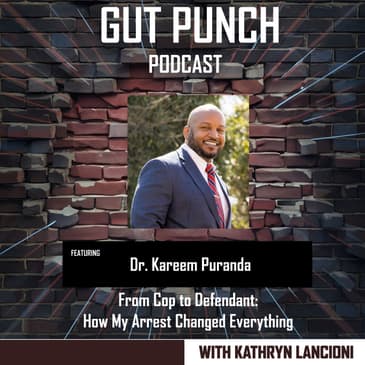

From Cop to Defendant How My Arrest Changed Everything (S3 -E3 )
Host: Kathryn Lancioni
Guest: Dr. Kareem Puranda
Episode Overview:
In this compelling episode of Gut Punch, Kathryn Lancioni sits down with Dr. Kareem Puranda-a former police officer, football player, and now a mental health professional and community advocate. Dr. Puranda shares his raw, personal journey from growing up in a high-poverty neighborhood in the Bronx, to finding purpose through football, to facing lawsuits and indictments as a police officer, and ultimately transforming his pain into a passion for helping others heal. Through honest stories of adversity, trauma, resilience, and redemption, this conversation is a powerful reminder that we can rewrite our stories and emerge stronger after life's gut punches.
5 Key Lessons from This Episode:
1. Trauma Often Hides in Plain Sight
Dr. Puranda explains how the experiences of violence, poverty, and loss in his youth were normalized, making it difficult to recognize them as trauma at the time. It was only in retrospect that he understood how these formative experiences shaped his behavior, responses, and coping mechanisms, highlighting the importance of recognizing and naming past pain in order to heal.
2. Purpose and Belonging Can Change a Life’s Trajectory
Football offered Kareem more than just an athletic opportunity; it became his lifeline. Being part of a team gave him structure, community, and a space to channel anger constructively, ultimately setting him on a path toward higher education and away from environments that could have led to much darker outcomes.
3. Ego Can Be Both Armor and Obstacle
The episode reveals how ego protected Kareem from feelings of inadequacy and pain for years, especially during his law enforcement career. Yet, it also led to destructive behaviors and critical setbacks-until deep reflection in the lowest moments allowed him to recognize, confront, and ultimately move beyond the limits imposed by his ego.
4. True Strength Lies in Vulnerability and Self-Awareness
Shifting from a mindset driven by accolades, toughness, and suppression of emotions, Kareem learned that real courage is found in vulnerability. Admitting hurt, seeking help, making amends, and practicing self-reflection brought him to a place of authenticity and healing, showing listeners how honest introspection is the bedrock of transformation.
5. Your Narrative Isn’t Set in Stone
Through the metaphor of the “four Vs” -violation, victim, villain, and victorious- Dr. Puranda encourages us to examine how we respond to adversity. We all have power to choose whether we become a victim, a villain, or victorious after life’s gut punches. Changing our mindset and consciously authoring our own story creates the possibility for growth, redemption, and impact.
If you're interested in learning more about Dr. Kareem Puranda’s work and the positive impact he’s making, be sure to check out his website. There, you'll find information about his training sessions, keynote talks—including his signature “Patrolling Your Purpose” program for law enforcement and the community—as well as resources from his private practice, Self Talk Counseling and Consulting. Whether you’re seeking guidance, inspiration, or resources for personal growth, don’t hesitate to reach out and see how his services might benefit you or someone you know.
Connect with Dr. Kareem Puranda:
- LinkedIn: https://www.linkedin.com/in/kareem-puranda/
- Instagram: https://www.instagram.com/drkareemp/
Produced by the Digital Transformation Broadcast Network.
[00:00:00] Welcome to Gut Punch, the podcast that explores life-changing moments. Hosted by Kathryn Lancioni, a seasoned educator with personal insights into resilience. Kathryn shares how life can change in an instant, shaping our path forward. Each episode features inspiring guests who face their own gut punch moments. Guests share their journeys through loss, upheaval, and triumph. What to expect, honest conversations, lessons in resilience, inspiration for growth.
[00:00:30] Join Kathryn as she highlights courage and perseverance in every story. Gut Punch is a reminder that there is always a path forward. Be part of the conversation. Register now to join Kathryn for today's journey. Hello, everyone. Welcome to another episode of the Gut Punch podcast. I'm Kathryn Lancioni, and I'll be your host for this week's episode. Today, we're joined by Dr. Kareem Paranda, who is coming to us from South Carolina.
[00:01:00] North Carolina. North Carolina. My Carolina's all messed up, but he's going to come just from North Carolina. And he is going to share his backstory with us and talk about where he is today and all the good stuff he's doing for the world. So, Kareem, great to have you on the show. Great to be here. Thank you so much for that awesome segue into my introduction. Yes, please. So, before we get into the gut punch, if you could share a little bit about yourself, you know, your backstory, that'd be great. Then we can get right into it.
[00:01:27] Surely. So, I'm originally from Bronx, New York. I gotta always put that out there for my New Yorkers. Yes, you do. I'm a New York guy hard, right? So, I come from the Bronx, and I earned a football scholarship to the South, Livingstone College, which I like to reference it as the Harvard of the South in Salisbury, North Carolina, to play football. And I ended up doing four years there. Then I became a police officer for eight years, right out of college. And then I transitioned from law enforcement to the clinical mental health space.
[00:01:57] Right now, I own and operate my own practice, self-taught counseling and consulting. I have a speaking company under Dr. Kareem Paranda and also a nonprofit called Achieving Success on Purpose, or ASOP for short, where we work with kids who are deemed at risk or underserved that come from communities that are in need of support because of violence and being impacted by trauma. Working with kids ages 12 to 17, overcome challenges.
[00:02:24] Wow, that's amazing. And I should tell you that we're going to be doing a conference probably in November focused on youth mental health. That's definitely something that I'd love to have you involved with. Sure. Yeah. So, all right. So, you played, first of all, amazingly, you played football for four years in college. I think it's a stat like less than 3% of high school athletes get to play on the collegiate level. So, that's amazing. And I have to ask you, what position did you play? I'm a huge fan. I was a running back. I was a running back.
[00:03:17] Okay. So, I like to tell clients that I work with today that crazy people do not come to therapy. Rather, people who have been through some crazy stuff come to therapy to figure out how to manage life on life terms. Now, I got to go back to my crazy stuff when I was a kid, right? Because ultimately, football saved my life because I was a child who grew up in a single parent household, grew up in a high poverty, high crime neighborhood.
[00:03:43] But here's the thing. The high poverty and the high crime and the things that came with that, the violence, the drug usage, the things that I witnessed either directly or vicariously, these things were normalized. So, we didn't know it to be called trauma. It was just a normal thing, everyday thing. Someone got shot. Someone got stabbed. We heard gunshots regularly. So much so that we didn't even duck because we understood by the way it sounded, it wasn't coming near us. If we were, we just had that kind of intuitive understanding growing up in an environment like that.
[00:04:12] You know, so when I would take what I learned from the people who were available to me, right? My mom, a beautiful woman from Jamaica, worked three jobs, two to three jobs most oftentimes just to make ends meet. And she was not always available to supervise me. So, I used to leave the house and I would go outside and hang out with people who were available. And sometimes the learning and the values that those individuals would teach were not the best. And so, I would take those value systems because they kept me safe in that environment to school.
[00:04:42] And I would go to school and I would get suspended over and over and over again for doing things that were inappropriate as it relates to fighting, being disrespectful towards the people in authority such as teachers and whoever else. And it was just the nature of the environment that I grew up in. And I didn't know it was a problem until it became a problem for me in 10th grade when I got retained twice. I was kicked out of one school, expelled from one school because of some poor behavior, poor choices.
[00:05:08] And then the school that I went to in the Bronx, New Child's High School back in the 90s, was deemed the second worst high school in the Bronx. Wow. And I got left back there again because I used to just like to fight. And the reason I used to enjoy fighting, or at least I'd say enjoy today, but looking back on it in retrospect, the reason it was enjoyable for me because it was a stress reliever. It helped me to cope with the pain and the hurt that I did not know how to label. And so, anger was my primary default.
[00:05:36] Every time I felt triggered, every time I felt insignificant, or if my self-worth was, my dignity was challenged in any way, you're going to get the worst side of me. And I never knew or recognized how my behavioral patterns were creating the conditions that would cause me to be triggered in the first place because of how my trauma was woven. My trauma started with the realization that I was a kid who didn't have a father figure,
[00:06:04] that I always wanted to be available to me. So that grief, the anger and the depression from that grief is what impacted a lot of my decision-making that caused me to get retained twice in the 10th grade. Now, the second retention is where a police officer stepped in, or they stepped in multiple times, but it was at this one time Officer Merrill said to me, Hey, man, you got so much anger. You like to fight so much. Why don't you take, why don't you go box? Why don't you go wrestle? Why don't you go play to get that energy out in a more productive way? And I said, you know what?
[00:06:33] That might not be a bad idea. I tried all three of them and I fell in love with football. Football was the main one that I said, oh man, I love this. And little did I know that it was going to earn me a scholarship. I gave my all to football. And the reason I gave my all to it was because it provided me with a sense of value and self-worth that I wasn't able to achieve up until that particular point. And I didn't get in trouble. I didn't get in trouble for it. You know, a sense of purpose. Yes. Yes.
[00:07:02] And probably a community and a sense of belonging. You got it. There's a lot, there's a lot to be said for that. It's super important. Bingo. So football was never, I mean, I wasn't a natural athlete, but I worked at becoming a good athlete because it was what rewarded me with everything you said, the community, the camaraderie, the fellowship, the positive male mentorship and role models versus doing stuff that was going to put me in the prison or the grave prematurely. I now found something that could be constructive.
[00:07:32] And I took my team to its first winning season since the 70s and the 90s and a 72 record. And we just missed the playoffs by one game. I broke a rushing record. It was an amazing, amazing time of my life that created a pivot for me. Do you think, you know, so this was, you were in 10th grade. So you were like, what, 14, 15 years old? 15, 16, going on 17. Something like that, right? Do you, do you, do you, is it only in retrospect that you appreciate what football gave you?
[00:08:02] Or did you realize that at the time? No, it's in retrospect. All of this that I'm, that I'm sharing with you today is in retrospect because while I was in it, I had no clue what, what it was all about. Yeah. I think so often that's the case. Like, you know, you're in something doing something and you just go through the motions and do it or dig hard, you know, dig deep to work that like you do with football. And then afterwards you realize how transformative it was, you know, and sounds like that was the case for you. All right.
[00:08:28] So you get recruited to play college football. What was that like? It was amazing. It was confusing in the beginning because I didn't really understand the dynamics of college. I never really even thought about college, but it was an amazing opportunity where I sent off my tape and the coach at the time was like what he saw. They were looking to fill that running back slot. And I and several others were recruited during that year to fill that spot of a guy who ended up going pro, by the way, the previous year, phenomenal running back.
[00:08:57] And so it was, it was a great opportunity to get me out of New York. I truly believe that this opportunity was nothing more than a divine intervention to allow me to leave New York. Because again, that environment wasn't the greatest for me. If I would have hung on, if I would have stayed around with the folks that I was growing up with, there's no telling what direction my path would have taken. I don't know if I would have had the intelligence independently to not pivot from some of the connections that were solid for me back then. Yeah.
[00:09:23] So I had to, I had to have a new environment where there were people that I found at Livingstone College that cared about me, that were genuine and were able to give me insight that was different from the insight I got from the folks that I grew up around. Who, when you were, when you were playing football, what motivated you? Because it can be tough. I mean, I know for my college athletes and my classes, it's tough. What, what helped you get through those tough moments? So I would say that a desire to escape, a desire to, you know, they talk about fight,
[00:09:52] fight and freeze when you're in survival mode. And I was in survival mode my entire life until I left law enforcement. The desire to escape the thoughts that were connected to my survival mode. So I would always go to the weight room. I would always go find a workout to do or something connected to football that would take my mind away from the stuff that I did not want to think about that I had never addressed, such as the abandonment, such as, you know, feelings of growing up in poverty.
[00:10:18] Some of the things that I resented that I had to live through as a kid growing up in poverty and things that my mom really did her best to navigate. And I'm not going to say that her best wasn't good enough. It was good enough. But at the time as a kid growing up, I wanted it to be better and she wasn't able to afford better. And so dealing with those things that no one ever walked me through until I went to therapy much, much, much later to figure out how to resolve some of these things that followed me into adulthood. So it was really about the escape. I just found things.
[00:10:48] I used football. I used women. I used girls to, you know, I had one for like every day of the week, once upon a time. And it was all about taking my mind away from the stuff that I did not want to deal with. I'm going to be truly, truly honest about it. So how did you get from football into the police force? How did that happen? Yeah. So a gentleman, the chief, he was the first African-American chief of police, I believe, for that agency. He was also an adjunct professor at Livingstone for criminal justice.
[00:11:15] I was a criminal justice major and I took two of his courses. And man, I just thought the world of this guy. I said, man, he's a chief of police. He's got, he's in a position of power. And in the hood where I'm from, it's all about power, respect, and money. And I didn't have money, but I knew how to get power and some respect because of my fighting skills. And so I looked at him as a, as a, as a representation of that, a black male role model who had power, legal power. And I'm like, man, I could do that job. And he inspired me to become a police officer.
[00:11:45] And he was the main reason why I wanted to do law enforcement because I really, I didn't have a fond memory, any fond memories of law enforcement in my neighborhood. They were always usually the ones that came into the neighborhood and took people away that I cared about by putting them, putting them in jail. And then rightfully so, because some, some of the folks I grew up with didn't do, didn't do right. So they had to suffer those consequences. Law enforcement was always deemed the adversary to our community. They just came in and arrested people, but they didn't give us any solutions on how to get
[00:12:14] ourselves out of this mess, poverty and crime that we were all experiencing back in the eighties. You know, when crack was hitting pretty tough in New York. I think, I think that's part of the challenge that, I mean, it's all separate conversation, but I think that's part of the part of the challenge that law enforcement faces. We are preconditioned to fear them, right? Just by the nature of growing up. I mean, I don't care. No, I know that, you know, it's like, oh my God, there's a policeman, you know, in Jersey, like high every other day. It seems like there's five of them on the highway and all they're trying to do is bus you
[00:12:44] for driving too fast. I remember the first time I actually went up to a policeman and asked a question and they were so nice. I was like, I think that's part of the problem is like, you know, we're, we're, I don't know what means to, but we're raised knowing that in most cases, law enforcement only comes to give you what to get for speeding or whatever, but they can be, you know, they can be super helpful.
[00:13:08] So what was it like for you going from being a kid in the Bronx, you know, where you saw your friends getting picked up by cops constantly for doing stuff they shouldn't be doing to actually being a cop? Like, what was that like? Yeah, it was, it was amazing. I would tell you it was amazing because it was a phenomenal accomplishment for me because I didn't know what I wanted to do with my life. And I was always, always wired back then to chase an accolade or chase an award.
[00:13:35] And so achieving law enforcement or getting into the field was like an award. Like I had arrived, I was in a career, I was in a job that like, you know, the job security was going to be like etched in stone. You know, they're always going to need cops because someone's always going to break the law was the ideology. And then, you know, I also saw that it was, you know, there's a lot of quantifiable stuff that I could do that would give me accolades, but you know, that, that rush for accolades, how many great quality arrests I can make, how many drug busts, how many DYs I can,
[00:14:05] you know, all these different things. And, you know, so I became really focused on what accomplishments, what, what, what, what promotions I can achieve while in the profession. And so when I transitioned into it, you know, it's interesting, you know, my career only lasted for about eight years. And what's interesting is that as we progress, as I progressed in law enforcement, I realized that some of the mentality that I had growing up followed me into the profession as well.
[00:14:33] The whole subscription to disrespect, like not tolerating disrespect and those things were triggers for me. And so when I was in law enforcement and I got assigned to the communities as an African American officer, the theory was if you put someone like me in a community that's predominantly African American, which is also predominantly high crime, high poverty, it doesn't look like racial profiling when I go and make an arrest.
[00:14:59] Or if I go hold the community accountable for any kind of illegal behaviors that they may exhibit. And I get the theory of it, but it also puts me in a predicament because I get called the sellout. I get called the traitor. I get called all the things that are undesirable before they even meet me. And back then I didn't have the intelligence to understand that they were speaking about the uniform and what it represents and not necessarily me. Yeah. I took it personal because of my baggage from my childhood.
[00:15:25] And then I ended up getting into a lot of use of forces, a lot of complaints whenever I would patrol those neighborhoods trying to do my job. No, I understand that. What was it like? I mean, this is what was it like when you first arrested someone? Like, what did that feel like? You know, the first thing that comes to my mind was an incident that happened during my field training, the third phase of my field training. And the way field training works, you get out of the academy and then you get paired
[00:15:52] with a field training officer, usually on each shift, you know, mid shift. Someone else who has a beat. Is that right? Like, so it's like you're paired up with someone who has a beat in a certain neighborhood where you're learning. Yeah. And they've got experience. They got some time on and they could show you the ropes, if you will. And one of the cliche statements, they would always say, forget everything you learned in BLET or basic law enforcement training. I'm going to show you what real policing is like, right? That's what FTOs are responsible for, field training officers.
[00:16:18] So in my third phase, which is the phase right before you get released, if you pass it to go now be independent and go do your thing, we checked out with a vehicle that was broken down on the side of the entrance ramp to the highway. And so we're thinking that we're going to be good Samaritan cops and just help out this guy who just, you know, broke down for some reason. And we get out with him and we check him out. And he's like, hey, man, you had a car to stop. It won't start. All right. So we're getting ready to roll him a tow truck. But well, my FTO was on the phone talking to his girlfriend, I guess, or whoever he's on the phone.
[00:16:47] He was what we call caking. And he's on the phone talking to his girl. And then he comes to me and says, hey, man, hook him, which means arrest this guy. Right. And I'm like, for what? You know, because you're just out here waiting for this tow truck to come to get him transportation, get him on his way. But come to find out that the vehicle, the tag on the vehicle was stolen or reported stolen. And so it came back to a channel that I wasn't on or I wasn't monitoring as a rookie. And my FTO said, hey, hook him. So he's on the phone talking to whoever he's talking to. He's telling me to hook him.
[00:17:16] And I'm looking at him. The guy's looking at me. And then I go to grab him. The guy takes off running. And so I have to go foot chase. And fortunately, I was young. I had about five years back then. I could get him. I called him. And then he and I got into a fight. And I ended up knocking him out and then putting him in cuffs. That was my first arrest in my law enforcement experience during my third phase of FTO training. Now, I'll tell you this. Back in the early 2000s, the culture of law enforcement, at least I think it was a dying
[00:17:43] culture because, you know, you now started to have what they call in-car dash cams. And then now they have the body-worn cameras. You know, use of forces were plentiful back then, but they were never recorded, right, back then. And now we were getting into the era where, you know, a lot of older guys wanted to see the new blood be like the older generation, tough on crime, right? And so when I got into a fight with this guy and I, you know, I thumped him and was able
[00:18:09] to put him in cuffs, my FTO celebrated like there was no other time in his life. He said, man, this rookie's got squabbles. And it made news around the agency how great I was at handling myself during this resistant or this person who's resisting arrest. And I was celebrated for that. And so I had no reason to believe that what I did or how I approached law enforcement with a heavy hand was wrong until it became wrong. And so that's how my career started with the first arrest. Yeah, it's so interesting.
[00:18:39] That really, really is. And then, so what's the catalyst for you to decide to step away from law enforcement? Yeah. So I like to preface it that I didn't manage my mental health properly. My career ended with me experiencing four lawsuits that were all back to back. All of this were using excessive force. And then two indictments eventually came as a result of two incidents where I've stopped cars, guys ran, and we got into a fisticuff. And, you know, they deemed it excessive force because these guys, one of them had to go to
[00:19:09] the hospital before we booked them. And then the other one was just, was knocked out. And so I got in trouble for those things. And as a result, my career ended because I didn't manage my mental health properly. Regrets there from your perspective? Well, I do regret, right? Because I remember going through that whole process. I left law enforcement in 2010. And in 2012, around Christmas time is when the federal agents and the state bureau investigative
[00:19:38] agent came by and dropped off the indictment papers. And I thought, like, you know, I left law enforcement two years prior. Like, why would they still come after me? But they felt like they had a case to put me in prison for 10 years. And so when I, this is right before Christmas, my last two kids, I got four kids. The last two were born. I was a stay-at-home dad because I couldn't, I wasn't hireable. No one would hire me while this investigation was active. Yeah. Supermarket wouldn't hire me.
[00:20:06] The gas station wouldn't hire me because I was overqualified. I had a master's degree and they thought I was overqualified for their positions. So I was, I was unemployable. And so I was a stay-at-home dad for those two years. And, um, 2013, I turned myself in, in January, second week of January or something like that. And I was arrested for the first time in my life. I was told to put my hands behind my back and I was cuffed and escorted to the holding cell.
[00:20:31] And in that moment, when you asked the question about regrets, when I was transported by the federal marshals, I had to turn myself in at the federal courthouse in the state. They transported me to the holding cell. That's when the regret hit me. And the regret was for every single arrest I ever made. Uh, I understood why everybody ran for me. I understood why people didn't want to come to this holding cell or this experience. And it was like a privilege that I did not understand I had until I was put in a predicament
[00:21:01] to where I had my privilege of freedom removed in that moment. And so I regretted every single arrest I ever made because had I known my career that I was, that I would sacrifice my life for would do this to me, I would have never approached law enforcement the way that I was conditioned to approach it. Did you go to prison? No, I went, I went to, uh, that holding cell. I was there for my first appearance for about seven hours in the holding cell. I was released on pretrial probation. I was, you know, supervised.
[00:21:28] And then I went to trial in April of that year, four day trial. And I was found unanimously not guilty because I was finally able to tell my side of the story regarding these arrests against these individuals that were not the most desirable individuals, but for some reason, the state thought that they were legitimate charges, I guess. So looking back on that whole experience, I mean, that's, that's crazy. How did it change you? Like even those seven hours in the holding cell, I would think like something like that.
[00:21:55] Like you said, it definitely made you regret arresting people, but beyond that, like personally, how did that change you? Catherine, let me tell you something. It was in that jail cell. That was like a blessing in disguise, right? As much as I hated it, as much as I hated that whole process. What I discovered in that moment when I had all that seven hours to reflect on how the heck did I end up here? Because I was a rookie police officer of the year. I was, I was on the SWAT team, top gun on the SWAT team. I had all these accolades and my career ended here instead of a chief's chair.
[00:22:23] I wanted to be a chief one day and it ended in a jail cell, right? And what I discovered was that I was operating according to an ego my entire life. It's been a front, a facade, fraud, all for the sake of making sure that I stayed safe and make sure that I avoided all the vulnerabilities connected to my pain points of inadequacies, feeling like I wasn't good enough and all these other things.
[00:22:48] My ego was the thing that I used to protect me from that stuff, but it also became the thing that caused me to lose more than I gained with it. Wow. So that, that's the beauty of what I learned from that pain point. So, all right. So it was ego that was driving you. I mean, I can't even imagine like the, you know, kind of the WTF moment that you must have had when you were in that holding cell. Like, you know, I, I, cause as you point, you get all these, like you were trying to
[00:23:17] serve the public by joining law enforcement. Yeah. You did your best when you were in the job. You got rookie of the year. You had this accolade, that accolade. You arrested the quote unquote bad guys. And ultimately it was the bad guys that made you look like a bad guy. Like that's so messed up. Exactly. Perfectly said. Exactly. I couldn't understand it myself. No. It's like, what? It's like, good. WTF. Yeah. So, I mean, we, we laugh about it now, but like going through it.
[00:23:46] Oh my Lord. So you, you get through that. You get to go to trial. You get to share your side of the story, clear your name, obviously. How did you feel after that? Man, in court, I'll never forget it. I cried several times in court. Matter of fact, I guess that people didn't really know it, but until the, until the day that they read the verdict, because for that entire time I had to stay quiet. I just had to be quiet and just go through the motions of court and whatnot. And there were several officers that testified against me. Now, here's the thing about these officers.
[00:24:14] I would have given my life for each and every one of them had it come down to it. Right. And to, to, to hear officers testify against me who I would have given my life for, it really crushed me. It broke me. I remember, I remember it might've been the second day of trial during the recess. I went back to the chambers where my, me and my attorney were hanging out and talking about what was going on in the case. And I just started crying and I couldn't stop it. I couldn't stop crying because I was, I felt, I felt betrayed. I felt blindsided.
[00:24:43] I felt a lot of different emotions that I couldn't really understand at that particular time, but it was, it was just hurt. I just put it under the umbrella of hurt. And then the second time I cried in that trial was the day that they read my verdict, which was unanimously not guilty on both counts. And when I say the feeling of weight lifted off of me, it just, it just brought me to tears of joy, tears of thank you. I'm glad it's over. And I couldn't stop sobbing there. It took me a while to stop.
[00:25:12] And then, you know, what was so really powerful was when I left the courthouse, kudos to all those guys up there that work at that building, the marshals. And when I got downstairs to the lobby and I was getting ready to exit the building with my wife and my attorney, there was like a, it was like a line of officers, of marshals that when I came out the elevator, they just started applauding me and they all gave me a hug. When I talk about a hero's welcome and the goosebumps, I mean, I'm even getting goosebumps now as I think about it. I'm getting goosebumps hearing it. Yeah. Wow.
[00:25:39] It felt so good because the whole time they were so stoic. They weren't talking to me. They were just all about business. And I saw the human side of them as they saw the human side of me. And it was just, it's just an amazing embrace. And until this day, I still keep in touch with some of those guys, checking now and again with them now that I do this work, letting them know that I'm available. Hey man, if you got any things that you got going on, man, don't hesitate to reach out. I'm here for you. They must have such respect for you. I mean, yeah, yeah, yeah.
[00:26:08] You know, cause you went through something that like, if I would imagine if you were a cop, like what you went through is any cop's nightmare, but you did it and you got through it. One thousand. Yeah. Okay. So, all right. So you got to stay home and spend time with the kids, which is, I think is a privilege, really, truly a privilege. It was, it was. Yes. Yeah. You know, like, so, you know, taking a shower can be problematic when you have little kids, but you know, you get beyond that. So how did you, you, you, how did you fall into the mental health space now and your coaching, your leadership work that you're doing?
[00:26:38] How did that all result from what you'd been through? Yes. So when I, when I left that experience with law enforcement and I realized how my ego played a significant part my entire life, creating a lot of problems and challenges. Even when I got left back twice in the 10th grade, my ego is all ego stuff. Right. And I was just amazed at how this thing that I engineered, I created it to keep me safe was the same thing that was also messing me up.
[00:27:04] And my idea was that I'm going to eliminate the ego and be totally 100% transparent, be totally 100% true to myself. I'm going to leave this world in a better condition than the one that I created or put it in when my ego was operable. Right. And so I made sure I made amends with as many people as I could, that I could think of. I apologized to people who I needed to apologize to because of my ego. My ego may have did something back then. Oh yeah. I got to call that person. I got to let them know. Hey, listen, that wasn't me. I'm changed. I'm different.
[00:27:33] I apologize for what happened back then. And, and so I made, I did my rounds. Right. And, um, I felt really good about that. Were people receptive to that when you made those phone calls? Yes, they were surprisingly. So there was something that I was kind of like, I don't know if I want to do that, but I did it anyway, because this type of courage to say that I need help or to say that, Hey, something's wrong with me, or I need to go back and correct something that I did wrong. It's a different type of courage. Like I didn't have any problems going after the bad guy. They got guns in his shoes. I'm going right to it.
[00:28:03] There's a fight over there. I'm going right to it. That courage is different. I would say the courage to say that, Hey, I need help or the courage to overcome some type of inadequacy or vulnerability is, is a more significant level of courage than that, you know, going to where the gunshots are coming from. And, and that's what I embrace now that courage. I love that. Well, cause when you're, when you were going after the bad guys, right? It's like, it's like a superhero thing. Like you're going after them. Like, you know, you learned how to fight. You have your gun, whatever.
[00:28:32] Um, and I would think too, that there's a bit of a, not, not like a dopamine reaction, but something like that. Like you're going after that. Right. Like that's, that's amazing. Cause like we, we need that. But you hit on something that I, that I, it's so true. I say this all the time. Being vulnerable is terrifying. Vulnerability is scary. And asking for help or admitting that your ego is leading you. You're making your, you're like, it's like, okay, vulnerability with a capital V right here. A lot of people aren't willing to do that.
[00:29:02] They're not because it's, it's, it, it could be soul crushing because you don't know what the reaction that everyone around you is going to be like, are they going to have respect? Which it sounds like you encountered, which is amazing. Are they going to call your bluff and say, we don't believe you. We think you're full of, you know, poppycock, shall we say? Um, and, and we just go away. Like, so it sounds, I give you credit because that's not the easy path to take, you know? And I think, cause you know, being vulnerable is scary.
[00:29:31] You know, we interviewed a guest, um, a couple of weeks ago who has a movie that's made about her life. And I said to her, I said, what was it like for you to watch the film? She said, terrifying. Because it's all there. She said, I'm putting it all out there and people judge. And I'm like, yeah. But she said, but it's also so healing, like so comforting because she, she said, if my story just helps one person and her story is going to help more than one person, but she's like, if my story just helps one person, she goes, it was all worth it.
[00:30:00] And I think if your, your thing is the same case, like saying like, look, like my ego was leading me. My ego was motivating me. And, and that, you know, yeah, I helped the world by arresting some bad guys, but my, my mentally, my brain was not the right place. That's a huge thing to do. So I commend you for doing that. I really do. Appreciate it. Yeah. One of the things about vulnerabilities is that you don't want to be exposed. A lot of the things that are shame based according to whatever your ideologies are of who you are.
[00:30:26] You know, for me being a masculine, masculine man, you know, saying that, Hey, my feelings are hurt. What? Like, what are you talking about? We're a football player former cop saying that. Exactly. The jock of jocks, right? Like, what are you talking about? Right? Exactly. And so, but the reality is that we all, no matter how muscular, how masculine we are, there is a emotional and a sensitive component to each and every one of us. It's called humanity, right? Being able to feel and be present with your emotions, which is something.
[00:30:56] I never did. According to my ego, ego was just all surface, all masculine, you know, and, and, and little did I know that man, I'm just a baby behind all that anger. Anger is a secondary emotion to hurt. And, you know, so the hurt was really what's present. The greater the anger, the greater the hurt. And so my hurt was so significant that it earned me the respect of being an angry guy to a fault, to the point where I lost more than I gained with that anger. Well, I should have been saying, Hey, I'm hurt. Can someone tell me how to heal these wounds?
[00:31:25] It's, it's funny because you just touch on a personal experience that I had with someone and their hurt became anger and their anger became, drove them to say things, whatever that they regretted that, you know, thereafter. But hurt can translate into anger, which can turn into uncontrollable rage. And in that people act in different ways. Some people say things, some people physically do things, whatever. And I remember as I was on the receding end of this hurt slash anger.
[00:31:54] And when these things were being yelled, I just sat and listened and just listened because I knew that the person that was saying what they were saying, that wasn't who they were truly. It was like they had been overtaken by this demon that we'll call hurt. Right. And I knew fundamentally that this person was a good person. And I knew fundamentally, because I'd known this person for a long time, that they did not mean it. But it doesn't make it that it was any easier to take.
[00:32:18] It just meant that I, as the receiver, had to take the high road and acknowledge, I'm sorry, you know, apologize. I'm sorry you're hurt, blah, blah, blah. But, you know, I don't deserve these words that are being yelled at me. But that's not easy to do either. So it's hard to be vulnerable, right? A, hard to be vulnerable because you put yourself out there. And it's also hard to be a punching bag. And I think, and it's hard to admit you screw up sometimes. And the fact that you went to people and said that your ego was driving you, I just commend you for that. I really, really do.
[00:32:48] So talk about the work that you're doing now. And I'm curious, like, what you learned from all these experiences? How has that, how does that come into your work? How does that present itself in the stuff that you do? Well, I definitely, I will tell you that it makes me extremely relatable. And I, the beautiful thing about what I've gone through and what I've given myself permission to introspectively investigate within me how I became who I was. And then now who I am today and becoming, it's this idea of, I know how to read through behaviors
[00:33:17] and I know how to put words to emotions that people don't have. I remember when I was in my early twenties, I got, I got this tattoo and I got this tattoo around my neck, a lock and chain. Yeah. And I remember when I went to- Well, that's really, that's really saying something, a lock and chain. Believe me when I tell you. Now, I didn't know it back then, Catherine, but I, but like when I, when I, when I learned how to put words to what I was feeling, these tattoos represent all of it.
[00:33:44] It was a, it was a, it was the idea of the real me being trapped and held hostage. Yeah. And also the idea of stay away, stay out to whoever was outside of me. I didn't want you to get too close to me. And it was, it was, I remember describing it as a, um, indescribable feeling and I didn't know how to put words to it and that it was the tattoos. Right. And so even though these tattoos are not valid, uh, as, as from a spiritual or, or like a
[00:34:09] meaning standpoint today, other than a point in time in my journey, they represent a story. They add to the story that I tell the people whenever I connect with them, especially a first responders who usually when they come to see me, they, they question whether or not I know what it's like to be a cop. And Hey, I was a cop and I couldn't handle it because now I'm doing therapy work. No, no, no. You don't understand my path, man. So I got to bring it down to them. And then now there's a connection, especially with those hard officers, because a troubled
[00:34:37] officer is not going to say, Hey, I need help because the concern is if I say I got emotional challenges or I got psychological challenges, they're going to take my badge and my gun. And if this is my livelihood, that'll mess me up. I'm trying to make it to retirement as best as I can. And so they're going to stay quiet about it. Silent suffering is what we call it. And I suffered in silence. So I know what it looks like and I know how it plays out. And I'm able to articulate in a way what people don't know how to put together in words for themselves. Yep. Yep. So, and I, you know, it's funny.
[00:35:07] I've been in situations before, like I went to journalism school, right. And it's a different parallel, but it's kind of the same. I went to journalism school and I was a PR person by trade, so I'm a PR person and who worked with journalists. And so sometimes the journalists are giving you crap about something. And I'm like, wait, I was you. Like I worked as a journalist. I went to J school. Like I get it. So it's funny that it happens. Okay. So I would think that all of these experiences that you've had, like, obviously, as you said, make you relatable.
[00:35:36] How does it help you be sympathetic and where possible empathetic with the kids or the adults that you work with? Yeah. I'll tell you, there are two parts to it, especially as a therapist. You have to be careful with the sympathy and the empathy, right? Not blending them too much. But as a human being, yes, there is some sympathy and there is also empathy. You know, growing up in an impoverished neighborhood, which is why I'm so passionate about helping kids
[00:36:02] with the ASAP program where we work with those underserved youth, I know what it's like. I made a lot of poor decisions because no one understood. No one understood how to connect with me. And so there was no teacher. Everyone thought I was a problem and I was a nuisance. When really in my actions, I was just a kid asking for help without saying I needed help. So I might've asked for help by hitting this kid or getting into this fight. And I just really wanted help to understand how to manage life without a male role model
[00:36:30] that I expected to be there, but probably who was not capable of being there. But it didn't erase my expectations of what I thought I should have had access to when I didn't have access to it. And a lot of the kids have a similar avatar where they're growing up in a single parent household. They're growing up with someone who's not their biological parents and they're angry. They're not angry. They're hurt. They're hurt. But they don't realize, I don't think, I mean, did you realize that like you were hurt? No, not at all. And that's the point.
[00:37:00] That's what makes us different, me different when I, when I approach most of these cases, I understand what it is. And I know that they're making decisions from their pain points, which is why they disrespect their caretakers. They disrespect the teachers. They disrespect the cops. They disrespect the law because no one has cared for them the way that they want to be cared for. So now they don't care. They disrespect because they were disrespected once upon a time when they were younger growing up. No one entertained them. No one listened to them. They were, they were dismissed. They were neglected.
[00:37:28] Now they disrespect and they neglect other people. They neglect their freedom. They neglect their life. And so when someone can connect with them on that level, it is such a powerful experience to see that child like, man, I like you. And they don't say that to anybody. No, they don't. Other than people who understand them and get them. Yeah, they, they, um, it really must, uh, take them back, give them pause when they meet someone that actually gets them. Somebody that can truly be, you know, empathetic.
[00:37:56] Like, oh my God, like this guy actually understands me. Did you ever meet your dad? Yeah. Oh yeah. Oh yeah. Me and my dad are really cool today. I recognize after having a converse, several conversations with him, my dad grew up really rough too. And my dad made a statement to me in my early twenties when I called him to ask him why he wasn't there for me. He said that his dad wasn't there for him either. And he turned out okay. Now I felt like that was a dismissive statement back then, but it was, it was, it was my, my dad's thinking.
[00:38:24] He was not equipped to be the kind of dad that I expected him to be no shade or no slight to him. He just wasn't groomed, wasn't prepared to be that kind of father to my expectations. And so, you know, my dad taught me a lot, even though he wasn't there, he taught me what not to do. And he taught me how I should be with my own kids. So I am an available parent to my four children and whatever they need from me, I'm able to give them everything that I didn't know back then. I'm able to educate them on what I now know today so that they can make better decisions
[00:38:54] than I did. So it worked out. It's great that you have a relationship with him. It really is. Because that's, you're lucky. That's not always the case. Correct. No. And I think, you know, I was going to ask you like, how did that impact you as a parent? But you kind of, you kind of, you know. Yeah. I learned what not to do. Started there. And then my kids taught me what to do. Well, and you also probably, you learned what not to do, but you also, there were certain things that you didn't have because you didn't have a two parent household.
[00:39:20] So there were certain things that you probably needed, have realized you needed. And I would imagine that you infuse that into the way that you parent. That's fair to say. Okay. So looking back on all of this, where's your ego these days? You know, you said your ego was like the big driver back in the day. Where's the ego now? Because we have to have some bit of an ego, right? No, no, no. The reason I say this is I am criticized for being, people are going to laugh when I say this, but people have told me I am too humble.
[00:39:49] Look, Catherine, you have to accept the compliment. I hate accepting the compliment. I'm really not very good at it. But, you know, what I've realized in doing the show and just in doing speaking gigs that I do and stuff like that, that like, you have to have a certain level of confidence to go up and speak in front of group or to have a podcast that has your name on it or to have a coaching business like you do that has your name on it. So, so there is, there is a little bit of, of, I'm not going to call it ego. I'm going to call it knowing yourself, right?
[00:40:18] Because I think, I think ego is a bad word because people, they're, they're, you know, they're, they're, they're arrogant, but they're, they, they know their stuff. They're confident, you know? And to quote this, I always quote this guy. I took a spin instructor once, you know, they say those motivational phrases. So Matt's spin instructor said, there's a fine line between confident and cocky. And Matt is right. There is a fine line between confident and cocky. So my point is, my question is, you realize that, that back in the day when you were, you know, the football player, then cop, that ego was a driver.
[00:40:48] Ego was like a huge part of you. And then you went through a period where your ego was crushed. I would imagine when you, you know, were in that holding cell and you come out of it. Where are you now with yourself? Like, how do you feel? How do you keep yourself in check? How do you know when to leave with confidence? But how do you know how to regulate that? Yeah, those, that's a great question. I would say that you ever heard the term hurt people, hurt people? Yes. So that energy, right?
[00:41:14] That I once used with the ego because I was hurt to hurt people. It's the same energy. It's just now used to help people. And so I don't, my default is not looking at ways. How do I hurt them before they hurt me? It's more so now, how can I help them? How can I be of service? How can I add value to them? It's the same energy. It's just now with a different focus. You know, the ego is now more, more so pride. I have pride in what I do because I'm adding benefit.
[00:41:43] I'm adding value to people, to any space that I go in. My goal is to add value and not take away from, because I did so much of that with the ego. The critical thing about putting the ego and time out is making sure that I have an alternative of a default to go to, or I go back to that. So I have to stick to the person that I want to become, which is what my, what my mind is constantly focused on. Who can I become? And how can I make my best better than what it was yesterday by the interactions I have today?
[00:42:12] And so I'm always assessing that, right? Because I know, I know how delicate he was back then, making sure that I stay strong in the, in the, in the push towards becoming something greater than I've ever been. I love that. And I, I think that, you know, trying to help everyone like, you know, discover themselves and moving the needle forward as opposed to letting the needle slip back. I think, I think that's, that's so important. Um, you know, I was actually on a podcast earlier today and the guy asked me, he's like, what's, what are you working towards? I don't know. I said, I'm just working.
[00:42:42] I said, he started to laugh. I'm like, no, I'm serious. I said, because like my whole, my whole thing has always been in my whole thing thing is that I think that you just got to put yourself out there, right. And see kind of what opportunities come to you. And I check out everything that comes to me unless I've like gotten that same email before and I won't like pick on a certain population that contacts me on LinkedIn, but there are certain people that you get emails from every day with opportunities. You're like, all right, I got that same email from somebody else. No. No.
[00:43:12] But like for the most part, like I try to check out stuff. As I say, I peek around the corner, right? Because I think when you peek, you learn. And I, you know, from, from experiences I've had, I've learned, you know, you could only move in one direction and that's forward. You can't go back. And every day, you know, I say there are 24 hours in a day. Hopefully I sleep eight of them. That gives me 16 other hours to do stuff with. And some days like I'm my best version of myself. Other days I'm not. And that's okay.
[00:43:40] Because we can't be the best versions of ourselves every day. Because then we're really not the best versions of ourselves. We're just caught in like monotony and whatever. So my whole thing is like, I just move forward and I try stuff and some of it works out and some of it doesn't. And in my opinion, you learn more from the stuff that doesn't work and the stuff that does. Like you talk to me, you've had seven hours in a holding cell, seven hours. There are 24 hours in a day. You had 17 other hours, but it was those seven hours that kind of changed your life. Big time.
[00:44:10] I mean, that's crazy. Yeah. Crazy people don't come to see me. People have been through some crazy stuff, right? Come to see you, right? Yeah. What I went through was crazy, right? But here's the thing. And you hit on it. You hit it right on the head. That with time, which is the only currency that we don't get back, we're either using it wisely or we're wasting it. And I'm with you. I believe in trial and error. I've learned so much more from my failures than anybody, any mentor, anybody could have ever taught me.
[00:44:40] And so even though it didn't work out the way that I thought it was going to work out, the time it took to figure that out. And now, okay, I now know one way not to go. I can go this way. I now have, I can leverage that time, not wasted, but usefully I can use it to now navigate the next seven hours, if you will. Yeah. On how I'm going to spend my time. Well, you know, I said something this morning that I think is worth sharing because it makes
[00:45:04] sense here, true failure is not acknowledging the time that stuff didn't work out. Right. Sess is acknowledging the ups and the downs and what you learn from that. Because that, that, that really is it. Because, you know, we live in this society now where like everything is filtered and everything is angled. And, you know, that is not life. Like that is not, that is not the way that it works. Right. And, you know, people get all caught, talk about ego.
[00:45:33] People get all caught up in the number of followers, the likes, the shares, blah, blah, blah, blah, blah. Of this, as we, as you and I both know, at the end of the day, it doesn't matter. Like when you're those pearly gates, like God is not going to say how many Instagram followers did you have? How long was your streak on? Like your streak? No one cares. It doesn't matter. That's right. But what does matter is what you just, what you said earlier, like, you know, the idea of helping others move forward. And the idea, I think, of helping other people appreciate that there are 24 hours in a day and you ultimately control them. It's funny though.
[00:46:03] I have a girlfriend who, very, very dear friend of mine, I've known her forever. And we were having lunch last week and she goes, you know, that 24 hour thing that you say, like what? I mean that there are 24 hours in a day and you can control them. She's like, yes. She's like, ever since you said that on your podcast, like I've been thinking about that constantly. And I was like, oh my God, seriously. It's true. That's right. Right. You know? So Creamy, here's my question for you. So if there's someone who's listening to the show that is just feeling like they are so
[00:46:29] stuck or at their bottom, like I would imagine your rock bottom was probably when you were in that holding cell. What's your advice for them to try to move forward, especially if they're feeling like they're at their low? Yes. The first step is self-awareness. I truly believe that if you're not aware of how your life experiences have caused you to look at the world or make decisions in this world, you may be participating in a behavioral pattern that's setting you up to be stuck.
[00:46:58] Some people can become addicted to worry, anxiety, depression because of how their mindset is wired. And so you have to have a level of self-awareness about what you're thinking, what you're doing that may be causing some of this cyclic behavioral patterns that you can't seem to break or shake from. Insanity is doing the same thing over and over again, expecting different results. There's a quote by Albert Einstein that I love. He says, you cannot solve a problem with the same thinking that created it. And I'm like, Ooh, that's juicy.
[00:47:26] You know, if we, if we change the mindset that now contributed to some of this, some of these outcomes, and believe it or not, there's something that we did do that is an ingredient into the outcome that we're now currently facing. If we pivot or change those ingredients, we'll get different outcomes. So I like to start off with self-awareness. The first thing is I have this framework with the four V's that I love to share with my folks. Yeah. So you went through a violation. Let's say you had a violation that occurred, right? Throughout your life.
[00:47:55] Maybe there were multiple. From that violation or violations, you either become a victim, you either become a villain or someone who's victorious. I love that. It's so good. Villain, victim, victorious. And I always like to ask, which one are you? Because everyone's writing their narrative, right? Everyone's creating their story. And when you sit down and think about it, depending upon what definitions you subscribe to, villain, victim, and victorious, you're going to come up with an answer.
[00:48:21] And that gives us a great bedrock or framework to build from, to create the victorious mindset that's going to hopefully benefit the person in whatever context their life is currently in. But it begins with self-awareness. Yeah, it does begin with self-awareness. And I think, you know, what I, again, go back to what you said earlier, which is self-awareness. And that was how you realized that it was your ego that was driving you. Yeah. And I, you know, there's this, you quote Albert Einstein, I'll quote Beyonce.
[00:48:52] Okay. I tell you, I've quoted Beyonce, the specific quote in some, in some rooms, it's the people that are like Einstein. They're like, oh my God, she quotes Beyonce. And Beyonce has been noted for saying that like when something goes wrong, she doesn't blame the world around her. Stops and thinks about what could she have done differently. It is. And say outcome, right? Queen B only. There, there is a so much, yes, there's a lot that's not in our control, right? But there is so much that is actually in our control.
[00:49:19] And I know my whole podcast is based on a near death thing that I went through two years ago. I was, came down with a horrible bacterial infection and they thought I was going to die. I was put into a medically induced coma and I woke up and didn't know where I was, didn't know what had happened. And it was, it was a lot of didn'ts, right? But what I knew was that I was alive when I woke up. I didn't know where I was. I was like, what is going on? I didn't realize I had lost some of my three weeks of my life, but I did because I was sleeping.
[00:49:47] What I realized kind of, you know, after I kind of fully came to it was like, I was at my low. So that was like my version of your holding cell, I think. And I knew that I didn't know how this had happened, but it was reality. And the only person that could move the needle was me. Bingo. Right. And it was nothing that I had done. It just kind of random unlucky, you know, card in the deck of hands. But it did happen.
[00:50:15] And okay, you know, you look around the room and you're like, all right, I'm breathing. Like, I think I'm, you know, I don't know how I got here. I don't know how this happened, but I know that I have it in me to get better. And, you know, it took months. Um, but what motivated me, and this goes back to kind of the little bit of part I was talking about teaching was I, um, I had been a college professor since 2009.
[00:50:41] And I really at the core of, you know, kind of how I see myself or define myself, it's, it's being an academic. When I woke up from the coma, the doctor comes in and tells me a little bit, not, not everything, but just kind of where I was. And I said, whispered, cause I didn't have voice. Cause I had been intubated. What do I need to do to be back in the classroom in September? And he looked at me and laughed, of course. Um, and then said, well, you know, you have to do what I do. You have to be kind to yourself. You have to listen to what I say and you just have to be patient. Right.
[00:51:08] And I did all those things and I was back in the classroom in September, but the way that I got from, you know, laying in that hospital bed, not knowing where I was to back on the classroom was I gave myself permission and I motivated myself. And, you know, it, it goes back to what you talked about, very different scenario, but you gave yourself permission when you were in that holding cell to really, realize that like, okay, how you got there was really not your plan, but you did.
[00:51:36] And you were going to get yourself out of there and you did, and you got yourself through that situation. And then you went on and that's so incredibly important because I feel like so many people are afraid to be self-aware. Yes. And that's why they don't move the needle. That's why they try to blame everybody in the world for their why, why they're stuck. The reality is, you know, as I have said, we are our greatest friend and our worst enemy.
[00:52:02] And if you give yourself permission to move on, you will. Yes. Spot on. And that's what I call a victim mindset, right? When we blame everybody else for why we can't do what we're capable of doing. We just don't, we're not focused on that. So you're spot on. Spot on. Yeah. And it's, it's, I mean, that word permission, like it is just, I think it's so, I don't think it's used enough and I think it needs to be. So maybe that's on the podcast. I'll use it in every episode.
[00:52:29] So if people start using it, but I just think it's so important because, you know, we, I don't know what people are, people are afraid that it gives us whole good, the vulnerability thing we were talking about before. People are afraid to give themselves permission to be who they are, to move forward, to accept blame. There's so much. And I think if we could be in, it's hard, right? Cause we all get to this place of realizing what permission is and why it's important through different paths.
[00:52:56] But I think once you get there, that's when this whole idea, as you have gone through and I've gone through, this whole idea of self-discovery and self-awareness comes into play. Big time. You know, I think, you know, to add to your point about, you know, the fear that people have regarding their lives, I think it does come down to like the idea of control, having power and control over one's future. So much so that many people are living their past and the present, which doesn't allow them to connect to their future because they know what they're going to get if they can
[00:53:25] control the variables and what they're familiar with. And so many people are getting outcomes that are not really good for them, but it's what they can control. It's what they're familiar with. And the unknown is what's frightening because people have failed to give themselves permission to construct something for the unknown, hence their future, which is why, you know, the past and the future are the two biggest adversaries of each other because either we're living our past and the present, we're not working on our future.
[00:53:51] Or if we decide to do the future, we're now abandoning everything connected to this past to make sense out of how to do this thing in the future, which in my opinion, it connects you to a higher maturity level than the one you're coming from as it relates to your past. So if people understood how to release the Kung Fu grip on some of these experiences that we got back there, they'll be all right. You know what I mean? That's right. Karl Lagerfeld, who passed away years ago, we used to be the head designer for Chanel.
[00:54:19] So I'm interviewed once and he said, I don't care about the past and I know nothing about the future. All I can control is now. Right now. And yeah, you know, it's, it's, it's, it's so true. So, you know, and like I said, this conversation this morning that I had, you know, asked me like what, what I'm like, I don't know. It just like, it is literally to, to focus on the present. And as you were saying earlier, like, I think what I love is like, it's so important. It's just try to support and help, you know, people in the world around you. All right. Last question.
[00:54:45] So we talk a lot on the show about got punches and crazy stuff people have been through and how they've come through it for you. What's one thing every day that brings a smile to your face? You know, what, what helps you get through those tough moments? Yeah. Tough moments. They never, they never go away. They're always going to last. I like to say that, you know, tough moments never go away, but you know, we learned how to manage them better. You know, like, you know, I remember when I had a hard time with mathematics, like I didn't understand math really well, word problems.
[00:55:13] But once I understood the keywords and all that jazz, it became easy. Yeah. But prior to that knowledge or know-how, I struggled. And, you know, one of the things I look forward to in life are the hard situations because I know I'm going to learn something from it that I didn't know prior to the hard situation come that presented itself. And so I look forward to things and challenges in life that will elevate me or teach me something
[00:55:39] that I didn't know about myself without this experience taking place. I look forward to those things. I look forward to teaching others about or from that space, especially my children. Seeing my kids grow up with an available parent and seeing what that looks like in a child. I never witnessed this before. Yeah. And so it's like, it's refreshing to see this thing unfold in the way that it's unfolding. Gratitude.
[00:56:04] Having immense gratitude of life and knowing that I get to do this is really, really fulfilling now that I'm on the other side of the experience that, you know, some might say should have taken me out, but it wasn't strong enough to do so. That's why I'm here. That's why I'm here. Yeah. Yeah. I love that. I love that. Oh my God. I love that. So first of all, thank you for being on the show. So appreciated. Love, love, love, love the conversation. Like we have to figure out a way to meet in person. Cause I just love it. It's infectious.
[00:56:33] And I can only imagine the work you do with, with people. I just must be incredible. Speaking of which, if people want to get ahold of you, what is the best way to do so? Yes. So they can go to my website at drkareemparanda.com. I do trainings. I do keynotes. I do talks. I do a lot of my, my signature talk or trainings, patrolling your purpose for law enforcement. But I also have one tailored for the community as well. So I'm on all social media. I have two businesses.
[00:57:01] I got the Dr. Kareem P on Instagram. And I also have self-talk CC, which is my private practice where we work with people from the community on both sides of the law, manage their mental health. That's great. Thank you. Well, there you go, ladies and gentlemen, another fantastic conversation. But again, thank you. It was, it was so fun. Loved it. Love your story. Same here. Well, and thanks to all of you for listening to another episode of the Gut Punch podcast. We'll catch you here next week. Bye-bye everybody. Peace. That's it for today's episode of Gut Punch.
[00:57:30] I hope you found inspiration because no matter how hard life hits, there's always a way forward. Make sure to follow or subscribe to Gut Punch on your favorite podcast platform. If you know someone who could use a little inspiration, share this episode with them. Thanks for listening. And until next time, stay strong. See you in the next episode.