
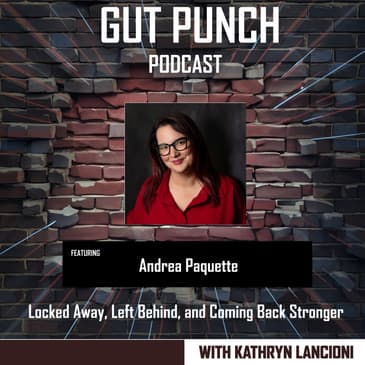

Locked Away, Left Behind, and Coming Back Stronger (S3 -E7 )
Host: Kathryn Lancioni
Guest: Andrea Parquette
Episode Overview:
Kathryn Lancioni sits down with Andrea Parquette, the president and founder of the Stigma Free Mental Health Society. Andrea shares her deeply personal journey, from her first brush with psychosis and a life-changing diagnosis of bipolar disorder, to hitting rock bottom and eventually using her experience to help others. Through moments of darkness, stigma, and uncertainty, Andrea’s story is one of hope, transformation, and unbreakable resilience. The episode is a testament to the power of vulnerability, purpose, and rebuilding against all odds.
5 Key Lessons from This Episode:
1. You Are Not Your Diagnosis
Andrea emphasizes the critical difference between having a mental health condition and allowing that condition to define you. Her turning point came when she realized she “may have bipolar disorder, but I am not bipolar disorder, and I can live an extraordinary life.” This self-acceptance paved the way for empowerment and healing, moving her beyond stigma and shame.
2. Support Can Come from Unexpected Places
When Andrea faced homelessness after being discharged from the hospital, she found kindness and understanding in a stranger who became her roommate. Despite fear and stigma from others, one woman’s acceptance provided her with a safe place to start rebuilding her life. Andrea’s experience reminds us that a single act of compassion can be life-changing.
3. Listening to Yourself Matters
Andrea’s decision to move back to Canada was guided by an unexpected sense of peace she felt in Victoria’s harbor. She recognized the importance of listening to her own instincts and emotional cues, even when it defied logic or previous vows. Trusting oneself can often be the first step toward healing and growth.
4. Transformation is Possible Through Vulnerability and Sharing
Stepping onto a public stage for the first time, Andrea shared her truth and let go of internalized guilt and stigma. By speaking out, she not only liberated herself but also laid the groundwork for helping others. Her willingness to be vulnerable became the catalyst for founding her charity and making a difference in countless lives.
5. Purpose Grows from Pain
Andrea's struggles inspired the creation of the Stigma Free Mental Health Society and its impactful programs for youth, educators, and rural communities. Through determination and networking, she turned her experiences into meaningful action. Her journey shows that enduring a "gut punch" can spark purpose and a passion to serve others facing similar challenges.
When life delivers its hardest blows, recovery can feel impossible. But as Andrea’s story reveals, every gut punch holds the potential for reinvention, connection, and new purpose. Hitting bottom is not the end—it's the beginning of a different journey. If you or someone you know is struggling, remember that healing is possible, and there is always a path to rebuild with courage and hope.
Connect with Andrea Parquette:
If you're inspired by Andrea Parquette's story and want to learn more or get involved, be sure to visit Stigma-Free Mental Health. There you’ll find resources on mental health, information about the Stigma Free Mental Health Society’s programs—including educational toolkits, school presentations, and support networks—and even their new docu-series on caregivers. Whether you're an educator, a parent, or simply someone who cares about reducing mental health stigma, this site is a great hub to connect with the work Andrea Parquette is so passionate about.
- LinkedIn: https://www.linkedin.com/in/andrea-paquette-45474a1a
- Website: https://www.bipolarbabe.com/
- Company: https://stigmafreementalhealth.com/
Produced by the Digital Transformation Broadcast Network.
[00:00:00] Welcome to Gut Punch, the podcast that explores life-changing moments. Hosted by Kathryn Lancioni, a seasoned educator with personal insights into resilience. Kathryn shares how life can change in an instant, shaping our path forward. Each episode features inspiring guests who face their own gut punch moments. Guests share their journeys through loss, upheaval, and triumph.
[00:00:24] What to expect, honest conversations, lessons in resilience, inspiration for growth. Join Kathryn as she highlights courage and perseverance in every story. Gut Punch is a reminder that there is always a path forward. Be part of the conversation. Register now to join Kathryn for today's journey. Hello, everyone. Welcome to another episode of the Gut Punch Podcast. My name is Kathryn Lancioni, and I'm your host for today's show.
[00:00:52] Today, we are joined by Andrea Paquette, who is just, I don't know, an incredible human, someone that's dealt with a rather amazing gut punch, and most importantly, someone that has done amazing things from navigating, you know, kind of this unexpected life hurdle. And she's the president, and I believe the founder of the Stigma-Free Mental Health Foundation. Andrea, welcome. Thanks for joining us today. Thank you so much. I'm absolutely thrilled to be here. What an honor. Thank you.
[00:01:20] Oh, it's my absolute pleasure. So, Andrea, first of all, you're up in Canada today, right? That's my home. Yeah, definitely. I'm in Saskatchewan. I live in a little town called Moose Jaw. I do a lot of traveling for work, so I do like coming back to my little community here in Canada. Love that. Love that. It's Moose Jaw, like as in moose and jaw together. Yep. That's a good one. I like that. I know. It might be the smallest, the smallest place that someone has been from so far on the show, but that's great. Yeah.
[00:01:48] I always love Canada. Anyway, so, all right, so let's get right into it. So, if you could tell us a little bit about yourself, the work that you're doing, and then we can talk about your gut punch. That would be fantastic. Thank you so much. Well, I'm president and original founder of Stigma Free Mental Health Society, but we renamed in 2016 from the Bipolar Disorder Society. Same organization, but with an evolution with my co-founder, Dave Richardson.
[00:02:14] And so, I lead up operations for the charity, very passionate about lived experience and bring that into all facets of our organization in schools, and also programming peer support training in rural communities. And I have a lot of personal passions, too, but I'm sure we'll dig into that in a bit. We will. Yes. And I have to say that, you know, when we did our pre-call and you were talking about the work that you're doing in the rural parts, I just find fascinating. So, I would love to talk about that as well today.
[00:02:44] So, what happened? What was your gut punch? Okay. Back in 2005, so it was a little bit ago, I was living the high life, you know, partying all the time, lots of friends, had moved to Ottawa, which is the capital here in Canada, big city. I'd driven across the country to pursue my political dreams as I have a degree in political science, and I also ran for nomination for the Member of Parliament when I was 25. Wow. Wow. Yeah.
[00:03:11] So, I had some great connections and wanted to work in the House of Commons. So, as I drove across the country, I was so excited for my new life. But when I arrived, it seemed all those connections fell away and weren't really interested in hiring me, or even being around me much at all. But that's not the gut punch. The gut punch is definitely when I couldn't find a job, so I, you know, served food and trying to get by in life.
[00:03:39] But pretty much suddenly, I ended up going into a major psychosis where I was believing things, hearing things, and I did not know I was sick. What ended up coming out of that situation is I was experiencing a major mania, which is a diagnosis later of bipolar disorder, and mania being high, high energy, no ability to make wise decisions,
[00:04:09] fast-talking, feeling so connected to people. It's overwhelming. But again, I thought I was just on an amazing journey. So, you just thought you were being like uber productive, basically. You were interpreting it. Not even just productive, but I wasn't in a solid job at that time. It was more about, you know, and my strange behavior got me fired from that serving job. I just felt connected to people. I'd walk into coffee shops and be like, Hey, I'm Andrea. Would you like to have a coffee? Just to total strangers.
[00:04:37] And I even gave my diamond ring away to a man in a wheelchair out of empathy, which was from my grandmother. My gosh. And yeah, as time unfolded, that breakdown was very scary. I saw the devil's head dance in front of my face in that mad psychosis. Wow. Imagining somebody knocking on the door. Nobody was there. So, I called the police thinking the house was being invaded. And they came and got me. I talked to the police for about 20 minutes.
[00:05:08] And yeah, he suggested I take an ambulance to the hospital and get checked out. So, hold on. So, how long did this, how long did the period last before you called, before you went and got a check out? I was experiencing this for a good month. Oh. Yeah. And did any friends or family, like, think anything was wrong? Or no, because I was house sitting for a friend. So, I was on my own with her three cats. So, nobody saw. I was not going to say.
[00:05:38] Yeah, nobody saw. But when I did visit my friend thinking she was murdered, she did step back and say, right, she stood back and said, what is wrong? Are you okay? Funny enough, she met me at the hospital, was one of the few friends I had. And I'll always remember this nurse putting her hand on my shoulder and saying, hon, you're coming with us. And I was hospitalized for the first time. How long were you in the hospital for the first time? A month. Wow. A month.
[00:06:06] I was diagnosed in a matter of two weeks. It was very fast and very obvious what was going on with me. My mother had been diagnosed with bipolar disorder. So, there was the family thread. Yep. Yep. Yeah. So, you're in the hospital. You're there for a month. You get discharged? Or did you say, hey, I'm ready to go? Like, how does that work? Well, it was interesting what happened while I was in the hospital. My roommates that I was living with at the time basically took my key and said, you can't come back.
[00:06:35] Because they were extremely afraid of me having a mental illness and the stigma was pervasive in their minds. And they were afraid of me. I understand stigma is prevalent, but it was a cruel thing to do. Yeah. So, I had spent all of my money thinking the prime minister was infusing my bank account with endless money. So, I was giving away $5 bills and multiples of dozens while I was out of the hospital before I was admitted. So, I had no money.
[00:07:03] And I was extremely lucky that a social worker took an interest in me and said, I'll give you $400 for rent. Right. But that's all we can do. And you have to get this form signed. And it was social assistance. And I thought, wow, a newly minted bipolar diagnosis and a form to sign saying I'm on welfare and trying to convince a new landlord that I'd be a good tenant. Oh, God. That's crazy. So, take us from there. What happened after that? So, you know what?
[00:07:33] There was no internet in the hospital. So, it was a good old newspaper. And I pulled out the newspaper and I thought to myself, still, you know, stable, but not fully stable. But stable enough to be able to do, you know, these things. Make a phone call. Talk to people. And there was one ad that really caught my eye for a place to live. All the rest of them said $600 for one room in a house or, you know, $500. I only had $400.
[00:08:03] But one place said rent negotiable. And I was like, I was in politics. I can negotiate this. Okay. So, you go. And I talked to her on the phone. Her name was Heather. She was an amazingly cool human being. Very nice. She said, why don't I give you a ride? Because my house is so hard to find. And I can help you out. We can meet. We can have tea at my house. It was very casual and legit. But I did.
[00:08:29] When I went to tell her where to pick me up, my home, I realized I lived at the psych ward. So, how would it go over if Heather was to pick me up at the hospital at a psych ward? Knowing my story. But she came by and picked me by the hospital. And I just simply didn't tell her what was happening at the time. We went to her place. Had tea. It was just beautiful. She had all these pictures of angels. And it was just so warm and inviting.
[00:08:57] And I sat with her and I said, I have to tell you something. And she says, I want to be completely authentic with you. And I told her my story. For the first time, I shared what I had truly been through. And she looked at me and she said, Andrea, I think you'd make a great roommate. Let's do this. Oh, I love that. Yeah. So, I ended up moving into her place after I was discharged after one month. I went and gathered my dresser and the little things that I did have because I'd recently moved to Ottawa.
[00:09:27] So, I didn't have very much from my old roommate's place. There was a lot of hostility and it felt very uncomfortable. But I thought I was embarking on a new life and that things would get better. But little did I know, they would only get worse. What happened next? I tried to rebuild. I would go to a dance club with friends, but the lights were so overwhelming and piercing that I couldn't even stand to be there.
[00:09:51] I started experiencing intense paranoia and I believed it was all from my medication that they had put me on. However, I didn't take into account that, you know what, you just had a major, major breakdown. So, I just really didn't blame it on that. So, I decided, okay, I need a job. The gas tank was running empty. And I got a job at Boston Pizza here at one of the chain restaurants as a server.
[00:10:18] And I managed to garner enough dollars together to go back to Victoria, which was my home before Ottawa in British Columbia, Westside. When I got to Victoria, I felt like perhaps I could start over. But little did I know as time would go on that I would start falling apart. I went off of my medication because I felt like it was negatively affecting me. And the side effects were really unbearable.
[00:10:44] I lost, I gained, sorry, 30 pounds in three months. I had cystic acne so bad I didn't even recognize myself anymore. I was a very fit person who was very confident. And I felt like I was being robbed of who I was. Well, it's not, I was going to interject here. It's like you see yourself as one person and then through this medication that's supposed to make you better, how you see yourself is worse.
[00:11:13] And every time you look in the mirror and that I would imagine that must have been very, very hard. Yeah, I didn't recognize myself in the mirror anymore. I was wondering if things were actually going to get better. I ended up getting a job. I couldn't find employment. I was even fired from another serving job when I landed in Victoria because I looked too depressed. And so they let me go. So I found a job in a call center collecting debt, which was the most, the saddest and most depressing job that anyone I think could ever have, at least for me.
[00:11:42] It just wasn't enjoyable in that cubicle hell. And then one day I called in sick to work one morning and I had enough. And I just said, you know, I'm not coming in. And I went back to my bedroom and I sat there and wrote a note talking about, you know, it wasn't worth it anymore. And this is the best choice. I didn't think of family and friends in that moment or anyone else. I just couldn't escape the pain. I just wanted the pain to stop.
[00:12:08] So I swallowed a very big bottle of medication. And yeah, I don't remember too much, just what pieces of what people have told me. But I ended up in the intensive care unit for three days. So do you know how you even got to the intensive care unit? Who found you? I discovered my friend, Diane. And she never really comes to my house very much because we always went to her place. But she had a gut feeling that something was wrong. Wow.
[00:12:38] And because I wasn't answering my house phone, I'd lost my cell phone weeks earlier. The house phone was ringing and I had these roommates that I never really talked to. They were like Asian exchange students who were okay, but we never communicated. Yeah. And she asked Miyoko, the lady, she said, is Andrea there? Oh, she's sleeping. And it was 5 p.m. So Diane just had this feeling that she had to rush over. And she found me. And I do remember one small glimpse of seeing her.
[00:13:07] And she told me she thought I was joking. Like, what's going on? This can't be real. Like, what are you talking about? She was just bewildered and couldn't understand what was happening. But I fell to the floor. And I don't want to get too detailed, but I was definitely a big guy. Wow. Thank God she came. Thank God she came. So you were in intensive care for three days. Um, and then did they discharge you after that? Or did you go into like the regular?
[00:13:33] Definitely not discharging me after that because with a suicide attempt immediately when I did wake, I was pulling the cords out of me. I didn't understand what was happening and I was lost and confused. Nobody was there except the nurse saw what I was doing when she walked by. And she looked at me like an angry school teacher and was like, stop doing that. They don't like it when people try to pull the cords out. So I ended up getting escorted to a little room just down the way, down the hall.
[00:14:01] And I noticed this woman was sitting there reading this magazine and sitting beside me. And just like not saying anything. Didn't even say hello. And I'm like, who? What's going on here? And this is 24 hour suicide watch person. And I was like, whoa, this does exist. Oh, I didn't know that. Wow. Yeah. So me being the assertive person that I am, I went up to the doctor and I said, remove her from my room. This is ridiculous. What do you think I'm going to do?
[00:14:28] Jump through the window or hang myself with my, you know, my pajama on my closet bar? Like this isn't, this isn't going to happen. And she looked at me and she said, okay, you promise you'll behave. You won't do anything. And I was like, yes, I do commit to that. And she removed that person from my room. But I was a few days later, I was escorted in a little van and the little van from the ICU or the main hospital takes you into that van.
[00:14:55] And it drives down to this psych ward. And it was called the Eric Martin Pavilion, the most, the most absolutely notorious building in all of Victoria. So I've never been in a psych ward. I've seen, seen pictures on TV. It doesn't look like it's very pleasant. It's very dry, very clinical. You know, the squeaky, shiny floors that never end and the beeping from the nurse's station.
[00:15:23] It's just, it's just probably like any other part of the hospital. But the thing is, when I showed up, the first doctor that I sat with, I just felt like a drowned rat. And I looked terrible with knotted hair. And she just really wasn't kind to me. There was no feeling, no empathy. And she said, I'm going to send you upstairs to the fourth floor where you can be with Dr. Song, who is another psychiatrist and very well known, actually, nationally and globally. And he was good.
[00:15:52] And I didn't know that. But when I ended up on the fourth floor, I was completely broken. And I had my hands in my, you know, holding my face. And I was just completely devastated. But this hand was on my shoulder all of a sudden. And I looked up and this very, you know, this man just said, are you okay? Can I talk to you? And he was so initially this feeling of warmth and kindness.
[00:16:21] And he was my new psychiatrist. And he really, really helped change things for me. Wow. So how long were you in the psych ward for that time? That seems to be the magic number. So you get out, then what? But one thing I did want to say too about being in the psych ward, it's so boring. And they don't let you sleep during the day. So they're like, you have to get out. And like, they won't even let you rest during the day. They have this kind of schedule. And the only thing I could do is smoke cigarettes.
[00:16:49] It was really boring. Like, I didn't know what I was going to do with myself. There was no therapy. There was no groups. Nobody told me about any type of cognitive behavioral therapy or art. All they did do, though, was go through my belongings. When I did arrive, my friend brought a bag. They grabbed my razor that I would, and they said, you cannot shave your legs here. And they took all the things that I could potentially hurt myself with, which is understandable. But it was a shock. It was a big shock. Yeah. Yeah.
[00:17:18] I can only imagine. Very dehumanizing, I would think. Yeah. Very dehumanizing. Okay. So you're out for the second time. You're in Victoria. Yeah. And, well, I had to walk home and it was hilarious because they give you the Eric Martin plastic bag and everyone knows what it looks like. And I'm carrying it down the road. My home at the time was only a few blocks down. So I said, I'll walk home.
[00:17:42] And I have to tell you, it was a defining moment where I realized, what are you going to do with your life now? What now? And I looked up to the sky and I was asking this question and I really didn't know at that time. When I got back to my home, the only thing that really greeted me was my suicide note. So I crumpled it up because I, yeah, I really wanted to live at that point.
[00:18:09] I've been through a lot of talking with Dr. Song and he recognized my intelligence and my drive, my bachelor's in political science and the run for nomination for member of parliament. And he said, you are smart and capable. You can do this. Yes. He believed in me. Were you like, when you're walking down the street with your bag and you get to the house and you find the suicide note, is that rock bottom for you or was that rock bottom for you? No, that was the beginning of something better.
[00:18:38] The rock bottom was the suicide attempt. Being in that hospital in the ICU, that was the gut punch and that was the rock bottom. But there was only room to go up from there. Love that. All right. So, all right. So take us on the journey. Where did we, where did we go? Yeah. So my friend, Shauna, she's amazing. She was living in South Korea at the time and she was a children's teacher, what's called a hagwon, which is a academy for these kids. And they go to learn English.
[00:19:08] She just called to see how I was doing. She heard I had been hospitalized and she was worried about me. We then discussed that I needed a new start. I needed some purpose in my life. And she said, why don't you just come to South Korea? And she said, I could get you a job. She says, my recruiter, you have a bachelor's, Andrea. You're a woman. They love women teachers with bachelor degrees. Like you would have no problem. I'm like, in political science? She's like, it doesn't matter.
[00:19:37] I was like, okay. So I contacted the recruiter in a matter of a week. I was approved to head to the Ishi-shi Hongwan Academy in Gwangju, South Korea. And I was to leave in a month. In a month. So I told, it's amazing, right? Yeah. Love that. Yeah. So I told Dr. Song about it. And instead of shaming me and saying I couldn't do it, he prescribed me six months of my medication,
[00:20:06] which I was committed to taking as he convinced me that it was a good idea. He put me on some different medication. It wasn't perfect. And it would take some time, a long time to really adjust, but it was better. I was functional and I could live a better life. Yeah. Yeah. Sold my car, that 1996 green neon car. I just decided it was time to let it go. It was the car that drove me to Ottawa. It had been with me through the smoky cigarettes.
[00:20:35] Like it was time to let it go. And I had enough money. And then Shauna even lent me a little bit more money, like $1,000 to help make it happen. She was amazing. She believed in me. So I'll always remember stepping off the plane, heading into the airport. In Guangzhou. And she met me there with the headmaster, as they call it. And we took his car and drove through the city. And it was amazing. All the lights.
[00:21:04] It was like Vegas on steroids. And it was just so jaw-dropping. I was there at that hagwon for about, I would say, six months. But I kind of had fallings out with a lot of the people around me. I was drinking heavily. My bipolar disorder was out of control. The boy that I had really fallen for dumped me over email. Things just weren't great. My behavior, people turned on me.
[00:21:32] And I understand why now. However, I talked to the headmaster. And I said, I'm going to quit if you do not transfer me to the Mokpo school on the East Coast. To the new school. Because I can't be here anymore. It's just not working for me. And eventually, he agreed. So when I got to Mokpo, all these new friends. I'm going to do it right. And I did. And I was there for a year and a half. And I loved it. I loved it. I learned how to talk to these kids. You know, Iliwa means come here. Anja, sit down.
[00:22:02] I learned all of these words. And I felt amazing when I ended up getting also a contract for the last year of it as a university professor. At Moulin University. Yeah. That's amazing. That's amazing. So, love this story. And so you spend, what, about two years in South Korea? Is that about right? Yes. And then what brought you back to Canada?
[00:22:25] Well, I took a little vacation for a couple of weeks near the end of the second year. There was about a few months left. And I had all this vacation time because as a university professor, you get quite a bit. And it was, what was I going to do but go home? Swore I would never move back to Canada. It was forever dead to me because of everything that had happened. It's understandable. Yes. Yeah. Yeah.
[00:22:51] And, but when I went and visited, it was, I saw some friends, saw some family. It wasn't wonderful. I'm not going to lie. It was pretty decent. But the one thing that really wanted me to move back is when I walked down the beautiful harbor in Victoria. It's a gorgeous city. It is. And as I walked down the harbor looking at the boats by myself, I had to pause for a minute because I realized, wow, it doesn't feel bad anymore. It actually feels really peaceful.
[00:23:21] So I decided I'm going to go to South Korea, finish off my contract and come back. And I did. I moved back in a couple of months. What I love about that is something that we've talked with other guests about is like that importance of listening to yourself, you know, that importance of your body tells you things, your mind tells you things. And in listening to that, which you did, I love that. So you, so you eventually moved back. Yeah. Yeah. And then, and then take us through what happened after that. For sure.
[00:23:50] So when I was in Korea, just a quick reflection, I was, I had this dream to create a charity, a charity that would help people. And I brought that dream with me to Canada. Something, I don't know. I contacted some people in my world who may know how to do that, how to create a charity. I had no idea. I even sketched out names like the Bipolar Mental Health Foundation and just what would I do and writing in that hot apartment in my journal.
[00:24:14] And I, I just knew deep seated feeling that this had to be done. Yeah. But I didn't know how. And I just let it go. Not the dream, but the process of trying to force it. And I ended up instead during that time. And I focused in on taking this seminar called the Landmark Forum. Okay. And it's a wonderful seminar, three days long. And it's not self-help.
[00:24:40] It's more about discovering about who you are, in a sense, and what you want to do, perhaps, with your life. It's what you make it. And I'll always remember on the third evening, there was all the family and friends of the people who took the course, all the participants. There was 500 people in this gymnasium. And they were sharing about the course on the stage. But they wanted people to share as well, who had been through it.
[00:25:07] I'll always remember this, that facilitator looking me in the eye and saying, hey, Andrea, would you like to come to the microphone and share what you got out of the Landmark Forum? Wow. I had never spoken to one person, even in university. We didn't have like maybe three people. I don't know. It just, I really didn't have that skill. And it was petrifying. But I went up to the microphone, looked around, lifted my head high. And I said, hi, everybody.
[00:25:37] My name is Andrea. And I've realized in this seminar that I may have bipolar disorder, but I'm not bipolar disorder. And I can live an extraordinary life. And that moment, all that inner stigma, that shame, it just, boom, left me. It was even, it gives me shivers even talking about it right now because it was so profound and was my turning point. That was the moment. Yes. I understand that.
[00:26:06] And I can only imagine being on the receiving end of it, people hearing it. It's like, that was like a drop the mic moment. I mean, that really, you are so simple yet so tremendous. Yeah. And that's how your organization was born, it sounds like. Well, it was a little bit more than that, if you don't mind me going into it. Yeah. Yeah. So I continued on with Landmark Farm. They had this project seminar where you do a project and engage people in your community, something you're passionate about.
[00:26:35] And I had a friend who was creating t-shirts around mental health at that time. Funny little slogans like, the problem with being bipolar is that everybody else isn't. Or just cute little sayings. And I was like, I have my t-shirt. She's like, what is it? And I said, it's pink. It's cute. It's going to have a little superhero. And it's going to say, bipolar babe. And that is my t-shirt. And that is my brand. And she laughed so hard.
[00:27:03] She's like, so you're going to wear a bipolar babe t-shirt into the grocery store? You're going to wear this? And I said, yeah. You know why? Because it's so taboo. So everything's dark and black and horrible. And nobody talks about mental health in a positive way. What we can do. In a nine, nobody wanted to discuss this subject. I was definitely coming out of the shadows. So I had my t-shirt and I created my project, a website.
[00:27:30] I met an amazing woman who was a website developer who also had bipolar disorder just through friends. And yeah, right. Not coincidence. And we worked together to create the website. And then I started putting out into the world. I always call this like when you put things out into the world, you're speaking life, life into your dreams. And I started doing that everywhere I went. I started sharing. I want to speak. I want to share my story. I want to create a charity. And then what would you know?
[00:27:59] I started getting invitations to speak at various community groups just to even 10 people. I then found amazing people who wanted to form the board of directors for this charity. And an older man who became one of my best friends and happened to be a charity specialist. Oh my gosh. Like I didn't even know that existed. That's amazing. That was his business. He helped people build charities. However, I didn't have to pay a penny because when we went out for lunch, he said, I shared
[00:28:28] my story. And he said, well, why should I help you, Andrea? I don't really know you. And I said, Robin, I think you believe in me. And I think we could do something great together. And he said, okay, kiddo, let's do it. It's incredible. I love that. Talk about us. I mean, it's what your story is so, I mean, it's so uplifting. I mean, because I think a lot of people that listen to this show, you know, always look
[00:28:53] for inspiration for how do you roll with the punches and how do you just get up and keep moving on. And oh my God, like you are such a testimony to that now that I love that. All right. So let's talk about the work that the foundation does. Yeah, this is a perfect segue. Love that. Yeah. Yeah. Okay. So it was amazing. I had my board of directors. I talked to Robin and I said, what do we do next? He says, well, we incorporate as a society with the province and that's the first step.
[00:29:22] And you are the president. But it's like, okay, what does that mean? He's like, well, you're just head of the board. Because obviously I was working, you know, for the government as a policy analyst in BC and I couldn't stand it. I was there for six years. It was extremely depressing being again in those cubicles. Wasn't very fulfilling work. No, never really. Paid well, paid well, but that was about it. Right. Yeah.
[00:29:45] And we incorporated in 2010, January as the Bipolar Disorder Society of British Columbia. And that was the baby right there. For a couple of years, I just went to schools. I started getting invited into schools. Young, one young girl was very passionate about mental health. And I'd heard my story. And she said, you've got to come into my school.
[00:30:10] So I started presenting to like 80 kids at a time without even knowing how to do that outreach to get that audience. But it just started rolling. And within the third year and by that time, we had full registration from the Canadian Revenue Agency, which is like the IRS in the States, when you register with the government to be able to issue tax receipts. So this was a huge win. We got it in six months. It usually takes two years. My God.
[00:30:40] Yeah. Yeah. And during those years, they were formative. They were passionate. And by the third year, I knew, wow, I was doing one day charity, four days government. The next year, two days charity, three days government. And then the year after in 2013, I realized this has to be my full time job. I love it. It's not a job. It's a passion. I need to build this with Robin. I have to give it my all my focus.
[00:31:08] But that meant leaving the government job and not being paid full time as I had been, but only three days a week for my charity job. But I did it because I knew it would work out. I ended up meeting an amazing woman from a research network at the University of British Columbia called Crest BD. And this was her baby. And she said, let's collaborate. Let's do a project together.
[00:31:32] Well, it was the best decision I ever made because we ended up securing $159,000 grant from the Vancouver Foundation, which then was allowable for wages as well and bumped me up to full time as executive director at that time. And I have been doing this full time ever since 2013. It's been such a journey to be able to call this my work. And so we got our first grant of $18,000.
[00:32:01] It was so overwhelming and so amazing from one of the biggest telecommunications companies, TELUS, here in Canada. And they said, we believe in what you're doing and we want to help. So we got our first grant and they believed in me. I went in there with one of our board members and shared what we want to do and the reason why it's needed. And what the problem is that we're trying to address is that nobody was talking about mental
[00:32:28] health, but it's there, especially with our young people, which was our focus. Did that for a few years. Very passionate, building the charity in various ways. And then I started winning all these awards. It was amazing and unexpected. It was very close with this amazing, amazing man. He was the chair of the TELUS Community Board, Mel Cooper. He's one of the most well-known people in Victoria because he's a great philanthropist and a good person.
[00:32:56] And he said, I want to nominate you for the Courage to Come Back Award. And I was like, what is that? And he's like, well, it's given by Coast Mental Health, which is one of the biggest nonprofits for mental health in the whole province of British Columbia up here. And what do you know? I won. And they brought me to Vancouver and I spoke in front of 1500 people giving my acceptance speech. I was much more comfortable by this time with speaking in front of people.
[00:33:26] And I didn't feel nervous. I felt empowered. I felt celebrated. And I felt seen. And when I was giving my speech, I strategically said, because I knew all these people there were from Vancouver, which is the big city here. And I met this man, Dave Richardson, who was introduced to me by my good mentor, Mel. And he ran up to me and he said, I want to make stigma-free zones with you. And he shook my hand and I thought, wow, what's that?
[00:33:56] And then we ended up meeting. He was in France all summer, but we talked. And he pledged 25 grand that night to me. Wow. So you were just like, you know, as you said, you kind of put it out there in the universe and all of this just great stuff just kind of prominent. That's incredible. Yeah. Yeah. And so as time would unfold with Dave, he gave that donation to the charity and he became
[00:34:20] very much engaged in helping with program ideas, introducing me to other potential donors. And in a matter of two years, he then became the board chairman. And we co-founded what at the time was Stigma Free Society, which is now Stigma Free Mental Health Society with more focus. And it was the same incorporation number, same charity, but just a rename and a refresh and an evolution.
[00:34:47] So we became amazing co-founders and still are to this day, 16 years later from the date of inception from this charity. So talk and just talk about some of the work that the charity does. I think that's helpful to hear. I would love to share about the work of the charity. My Cherish program is the Stigma Free School program. It has quite a few facets to it. So as an example, we created a student mental health toolkit.
[00:35:15] We created this during the pandemic because there was a lot and a surge of mental health issues. We wanted to help teachers feel more equipped. This toolkit is for educators, school counselors, and even parents, caregivers, and guardians, and for students themselves who want to learn about mental health and wellness strategies. It's packed with comic books and it has animations and documentaries.
[00:35:41] It's very robust, added to all the time, improved, and it's one of our babies. Visited 27,000 unique users a year. Yeah. And then the very much prized flagship, I call it, program within is the stigma-free presentations in schools. So you know how I was doing all those presentations? It's nice that it's not just about me anymore.
[00:36:08] This is about 25 presenters who are sharing their lived experiences across Canada virtually and in person. We last year reached seventh. It was, it is amazing. And I am so proud of all of them for being courageous. We even have Miss Canada on our team and she shares about her story with body image and, you know, the importance of loving yourself and how that's good for your mental health as an example. We also started recently stigma-free clubs.
[00:36:38] We did a pilot at one school and it was highly successful and sustainable where it's student-led clubs where young people themselves are taking action to create stigma-free strategies, teaching the young ones about mental health, being mentors, and having this club that fundraises for any organization they feel passionate about, not just stigma-free. And we also do professional development days.
[00:37:04] So we meet with teachers online or in person and show them our tools and how best to utilize them in the classroom, answer any questions they have. So that's the baby, the stigma-free school program. But Dave's big passion, and I'm passionate about it too, but he's even more passionate. And I'd have to say really the brainchild, the push behind the Rural Minds Matter program. And that is for agricultural and rural communities.
[00:37:31] We have a toolkit, the Rural Mental Wellness Toolkit, which again, isn't as robust and massive and impacting and visited as much, but 9,000 people annually, unique users do visit it a year and utilize it. Yeah. So, and then lastly, we just conducted a cohort of Rural Minds Matter peer support training.
[00:37:54] And you have 30 seats, and we filled 28 of the 30 seats and only 28 because three people didn't show up with their bursary. But that's pretty good. That is. That is. I just love what you're doing. And I love how the tentacles are like in so many different facets of society. I think that's just so incredibly important. Yeah. So what's next? Like, is there another like potential project down the road for you guys? Like, what are you thinking? 100%.
[00:38:24] I went to the Real Mental Health Foundation New York Summit, as you know, and I was very inspired by Sean Lesser and what he's been able to create in the States. And there's so many amazing connections that I'm making with the allies and the ambassadors being on the executive of The Real. And I'm passionate about expansion. And so is Dave. We were talking recently and just brainstorming and thinking it would be a very wise idea to
[00:38:52] make an even bigger impact in the U.S. So my dream and want is to open a chapter in the United States. We would need, obviously, to attract donations and supporters and letters and make a case to the government. But I believe it is achievable because when I have a dream, I'll tell you, I'll do anything I can to make it happen. And I think we can make a difference in the States as well.
[00:39:19] And lastly, it's very interesting when we look at the geography uptake of the Student Mental Health Toolkit, 34% is from the U.S. Really? Well, I understand why. You know, I hear from so many of my students, you know, that I teach about mental health challenges they face. And we were actually, I was just talking to a group of them about it yesterday. Like they feel like there's so many people talking about the challenges that Gen Z faces
[00:39:47] mental health, but they feel like there's so few people doing anything about it, which I thought was really interesting feedback. So what I love is that you and your organization are actually doing something about it. And I know just from my own conversations, you know, in the classroom in the U.S. with Gen Z, there's so much opportunity to make a difference here. And I, you know, think that what you're doing, have been doing is incredible. And as you and I've talked about, like, I'll do whatever I can to help you make a, to make a splash here.
[00:40:16] And I should, I should mention that, you know, Sean Lesser's The Real Mental Health Network is a group that, you know, we talk about a lot on this show because, you know, as, as ally with that group, as, as are you and you're an executive ally and a few of the other guests. And I think, you know, where he is going with what he is doing is, is phenomenal. I mean, he's been a guest on the show as well. So I'm excited for what we're all going to do together. So, yeah.
[00:40:42] Well, Andrea, I, first of all, want to thank you for being so honest and so raw about your own experience. And I, you know, I've learned so much and I'm sure our listeners have learned so much. It was one of those conversations where you, I mean, I know I'll think about it a lot and learn so much more than I already did when I think about it. So I just really want to thank you for that. It was a really powerful discussion. If people want to get ahold of you, what's the best way to do that? Very simple. I always say centralized is easiest. Give one place to go.
[00:41:11] There are a lot. But, you know, the best place is stigmafreementalhealth.com. You can find everything there from our contact tab, which goes directly to me and our administrative assistant as well. All our social media links are on there too. And so, yeah, that's the hub. You will find all the links to our programs, our podcast, our docu-series. We just have a new one released on caregivers. So that's the best place to go, that hub. Love that. And you're also on LinkedIn, of course, as well. Oh, yes.
[00:41:41] And that link is from our website as well. Perfect. All right. Well, thanks so much for being on the show. And again, I learned so much and everyone else learned so much. So just thank you. It was great stuff. Thank you. I'm glad that you were good. That is probably the most important thing to me. So I'm glad you're good. Thank you. Thank you, Mya. My pleasure. And thanks, everyone, for listening today to another episode of the Gut Punch podcast. We'll talk to you next week. Bye-bye.
[00:42:09] That's it for today's episode of Gut Punch. I hope you found inspiration because no matter how hard life hits, there's always a way forward. Make sure to follow or subscribe to Gut Punch on your favorite podcast platform. If you know someone who could use a little inspiration, share this episode with them. Thanks for listening. And until next time, stay strong. See you in the next episode.