
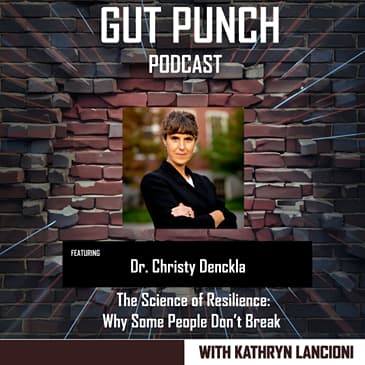

The Science of Resilience: Why Some People Don’t Break (S4 -E10 )
Host: Kathryn Lancioni
Guest: Christy Denckla
Episode Overview:
Kathryn Lancioni welcomes back Christy Denckla, a researcher at the Harvard School of Public Health, for a candid conversation about the personal experiences and scientific insights that fuel her work at the intersection of grief, trauma, and resilience. Christy Denckla opens up about losing her father as a child and how the lack of open dialogue around grief shaped her professional calling. Together, Kathryn Lancioni and Christy Denckla explore why grief remains difficult to discuss, the cultural forces at play, and the ways in which people can navigate, process, and even grow after profound loss.
5 Key Lessons from This Episode:
1. Grief Is Deeply Individual, Yet Universally Felt
Christy highlights that, although every person’s grief experience is unique, there is a profound sense of commonality in the struggles we all carry. Beneath the surface, few people are ever truly “okay”—recognizing this can help us feel less isolated during difficult times.
2. Talking About Difficult Experiences Can Be Transformative
Kathryn and Christy both emphasize that discussing grief openly is a powerful step toward healing. When people are given space and permission to share, connections are formed and a sense of relief or validation can emerge, which is often lacking in our grief-avoidant culture.
3. The Circumstances of Loss Shape Our Healing
Christy explains that the “gut punch” of an unexpected loss often results in greater psychological distress compared to losses that are anticipated. Opportunities to say goodbye or honor loved ones, such as attending memorials, can ease the process and support emotional recovery.
4. Social Support Is a Powerful Protective Factor
Both Kathryn and Christy stress the importance of actively maintaining social ties during times of loss. Research shows that even modest connections with family, friends, or community act as major protective factors for mental and physical well-being, helping us manage grief’s long-term impact.
5. Facing, Not Avoiding, Fear and Grief Enables Growth
Christy points out that while avoidance might protect us in the short term, true healing happens when we face our grief directly. Talking about loss, seeking support, and working through difficult emotions are necessary steps in building resilience and discovering strength after trauma.
A central message resounding through this episode is that even after a “gut punch” moment—be it the loss of a loved one, a sudden life change, or personal trauma—rebuilding is possible. Kathryn and Christy remind us that grief is not an endpoint, but a process that, while deeply personal and often isolating, can ultimately connect us to others and ourselves in profound new ways. Whatever the source of hurt, there is hope, especially when we dare to talk about it and seek the support we deserve.
Connect with Christy Denckla:
Listeners would benefit from connecting with Christy Denckla due to her deep expertise in grief, trauma, and resilience, as well as her ability to translate scientific research into practical insights for navigating loss. Her personal story and research illuminate how grief uniquely shapes individuals and offer guidance on healthier coping mechanisms and support systems.
- 𝗟𝗶𝗻𝗸𝗲𝗱𝗜𝗻: https://www.linkedin.com/in/christy-denckla-phd-146bb11b7/
- 𝗪𝗲𝗯𝘀𝗶𝘁𝗲: https://hsph.harvard.edu/profile/christy-denckla/
Produced by the Digital Transformation Broadcast Network.