
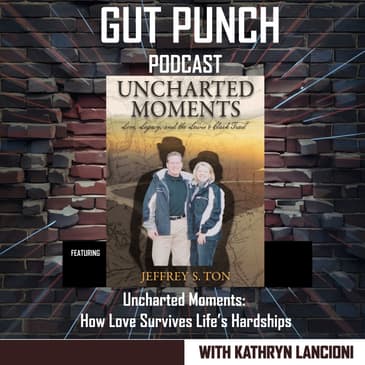

Uncharted Moments: How Love Survives Life’s Hardships (S3 -E4 )
Host: Kathryn Lancioni
Guest: Jeff Ton
Episode Overview:
What happens when the world changes overnight—and every single day after? In Season 3, Episode 4 of Gut Punch, host Kathryn Lancioni reconnects with Jeff Ton, a beloved returning guest, as he shares the raw, deeply moving story of his wife Carmen’s battle with Multiple System Atrophy (MSA). Together, they speak candidly about rare disease diagnosis, the challenges of caregiving, redefining roles, and finding light in even the hardest moments. It’s a powerful episode about love, loss, resilience—and the extraordinary humanity that emerges when life delivers its hardest blows.
5 Key Lessons from This Episode:
1. The Road to Diagnosis Is Anything But Straightforward
Jeff opens up about the long, winding journey it took to finally get Carmen’s diagnosis. The uncertainty and repeated visits to specialists highlight how rare diseases can leave even experts stumped. But the lesson is that persistence is critical—advocating for answers, no matter how elusive, is a form of love and courage in itself.
2. Life Changes Overnight—and Never Stops Changing
The moment Carmen was diagnosed, everything shifted for Jeff and his family. He made the difficult choice to set aside his own thriving business to become a full-time caregiver. This transition was not just about logistics, but about reimagining what it means to be a partner, supporter, and, above all, present for the person you love.
3. Resilience Isn’t Just for Patients—It’s for Caregivers, Too
Jeff’s story reveals the hidden toll and quiet resilience of caregiving. With every new daily challenge, from helping Carmen stand to inventing tech solutions so they can communicate, Jeff demonstrates that showing up—sometimes laughing, sometimes crying, always adapting—is a true act of love. And acknowledging when you need help takes real strength.
4. Shared Experiences and Support Networks Are Lifelines
Throughout Carmen’s illness, the smallest gestures from friends and neighbors—like a home-cooked meal or shoveling the driveway—became beacons of hope. Jeff learned that even far-flung connections and old friends could step forward in meaningful ways, and that asking for help is not weakness, but community in action.
5. Love and Legacy Outlast Disease
Inspired by his journey with Carmen, Jeff began writing about their adventures together—including their “Uncharted Moments” on the Lewis and Clark trail. Chronicling their story helped Jeff remember who Carmen is beyond the disease. It’s a vivid reminder that life is bigger than any diagnosis, and that love and shared memories carry forward in powerful ways.
During the episode, Jeff Ton shared about his book, Uncharted Moments: Love, Legacy and the Lewis and Clark Trail, released on May 14. This memoir weaves together the adventures he and Carmen experienced while following the Lewis and Clark trail and the powerful lessons learned along the way. If you’re interested in exploring stories of resilience, connection, and uncharted journeys, be sure to look for the book on Amazon and major online retailers in paperback, ebook, and audiobook formats. You can also visit his website to read his moving blog posts—including “The Post I Never Wanted to Write”—and sign up for his newsletter for updates and behind-the-scenes insights. Don’t miss the chance to delve deeper into their inspiring story.
Connect with Jeff Ton:
- LinkedIn: https://www.linkedin.com/in/jtonindy/
- Website: https://jeffreyston.com/
- Unchartered Moments: https://www.amazon.com/Uncharted-Moments-Legacy-Lewis-Clark/dp/1735309087
- Blog Post: https://jeffreyston.com/2026/01/13/the-post-i-never-wanted-to-write/
Produced by the Digital Transformation Broadcast Network.
[00:00:00] Welcome to Gut Punch, the podcast that explores life-changing moments. Hosted by Kathryn Lancioni, a seasoned educator with personal insights into resilience. Kathryn shares how life can change in an instant, shaping our path forward. Each episode features inspiring guests who face their own gut punch moments. Guests share their journeys through loss, upheaval and triumph. What to expect, honest conversations, lessons in resilience, inspiration for growth.
[00:00:30] Join Kathryn as she highlights courage and perseverance in every story. Gut Punch is a reminder that there is always a path forward. Be part of the conversation. Register now to join Kathryn for today's journey. Hello everyone. Welcome to another episode of the Gut Punch Podcast. My name is Kathryn Lancioni and I'm your host for today's episode. Today we are joined by Jeff Tan, who is no stranger to the Gut Punch Podcast audience.
[00:00:59] Jeff was on our first season and shared this the crazy story of his mother and the horrific life event that she went through and how she so elegantly managed to survive and thrive thereafter. And I know from our season and I know from our season one listeners, it was one of the most popular episodes that we had. So Jeff, thanks for being here today. I appreciate it.
[00:01:21] I am so excited to well as we go through the story, maybe not excited isn't the right word. I'm so honored to be back on the show again. How's that? I appreciate that. No, and I'm truly honored, absolutely honored to have you on. So, you know, let's talk about, so, you know, season one, when we shared your story, it was about your mom. And, you know, the crazy, crazy fire that she was in and survived and, you know, how she used to call herself the crispy critter. I'll never forget that.
[00:01:47] Yes. And, you know, how that affected you. So today, we're not here to talk about your mom. We're here to talk about other things. So, you know, I always say life is like standing at the end of that place by the beach where the waves just keep crashing on your ankles, your knees, or sometimes they drag you under the water. So why don't we talk about this gut punch and who's involved and we'll go from there.
[00:02:16] So just to get us into the story, my wife, Carmen, was diagnosed with a very rare progressive degenerative neurological disease. The diagnosis came in in August of 23. The disease has a life expectancy of five to 10 years. There's really no treatment. There is no cure. What's it called?
[00:02:42] It's called the multiple system atrophy cerebellar. Physiology, physiologically, what's happening is her cerebellum is shrinking and the cerebellum is the muscle control center of your brain. It's the thing that sends the signals to the muscles, receive the feedback from the muscles, and that's not working right.
[00:03:03] So the disease manifests itself several ways. The first one that we first noticed, she first noticed, was she was having trouble walking. She called it a fishbowl head, that her head was like sloshing around all the time.
[00:03:20] And, you know, it took a long time because it is a very rare disease. I forget what the statistics are, like two in 250,000 or some ridiculous number like that. So it took a long time for us to get the diagnosis. But we've been obviously dealing with that every day since. Every day is a new adventure. Sometimes the gut punch hits you once and sometimes it hits you every single day, right? Repetitively.
[00:03:48] And so that's what we're dealing with and trying to navigate our way through that on a day-to-day basis. Yeah, and I can only imagine because every day, you know, you wake up not knowing what challenges the day is going to bring. And, you know, I know from my own experience when you have something, like I don't know what it is, they just treat the symptoms that prevent themselves on that day.
[00:04:13] Yeah. And that makes it tough because they're like, well, what about this? And what about that? Because that was here yesterday. They were like, well, today you don't have that, you know? Yeah, yeah, yeah, yeah. There's no treatment plan because they don't really know how to treat it. So they just try. And that's hard because it's not like things that are more common that have a treatment protocol. Here, they're just trying to help you and Carmen navigate it. Yeah. That's a good point to itself.
[00:04:41] Well, you know, we saw, I lost track of the number of doctors we saw in the first eight months of 2023. First one was a balance expert and he thought it was maybe migraines that were causing dizziness, tibular migraines, I think is what they called them.
[00:05:00] And it ended up not being that, obviously. Then we went to a different neurologist and a different one and a different one. And finally, a neurologist, we live in Indianapolis and a neurologist here in town looked at us and said, no one in town is going to be able to help you. You need to either go to Mayo Clinic or Cleveland Clinic because there's no one here that will be able to figure out what's going on. So let me just interject. When he said that to you, how did you feel?
[00:05:25] Like, oh my God, what is rare thing that no one's ever heard of is going on here that this esteemed neurologist here in town couldn't identify it. So we chose Cleveland Clinic because it's a couple hours closer to us than Mayo. And we sat down with this wonderful doctor in Cleveland, Dr. Thakur.
[00:05:47] He examined her. He talked to her. We had sent him all the notes from all the previous visits we had. And he says, I don't want to read them yet. I want to hear from you what's going on. And she explained it and he did the exam and we call it jokingly. We call it the stupid human tricks that they make you do. Like when you may never have had this experience, but when you get pulled over at night and they make you do this and walk a straight line and do all those kinds of things.
[00:06:16] Unfortunately, I had that experience once a million years ago, but that's what they do. They have you do the stupid human tricks and she failed. She could not walk in a straight line. She could not touch her nose. They had her hold her arms over her chest and close her eyes and stand still. And she was doing this. And I'm just like, yeah. And finally he says, well, I want to look at your MRI. So he pulls up her MRI and he's looking and he's looking and he says, your cerebellum impresses me.
[00:06:43] And I looked at him and I said, I don't think we want her cerebellum to impress you. And he said, no, you don't. Wow. Yeah. And at that point it was, it was one of two things. It was MSAC or it was another disease, SCA, spinocerebellar ataxia. One is genetic and one is not. Right. So now we go through all these genetic tests. Yeah.
[00:07:06] To rule, to rule out the SCA side. And it ends up being, it ends up, she's tried a couple of different doctors. We finally got one close to home. Coincidentally, we had, she had discovered that the medical center at the University of Chicago was an ataxia center of excellence. So we went there. Okay.
[00:07:26] And saw Dr. Gomez and Dr. Gomez says, hey, one of the experts in MSAC is actually moving to Indianapolis. His wife got transferred there. And so he's moving his practice to Indianapolis. So we finally got in with Dr. Barboy and that's been her neurologist ever since. But again, Catherine, there's really, there's really nothing that they can do. You know, there's drug trials going on and things like that.
[00:07:51] But aside from managing the symptoms that she has, which continue to grow every day, there's really not a lot that they can do for it. So it's not genetic, right? To clarify, this is not genetic. It is not genetic, right? The strain that she has is not genetic. So this is just one of those things that randomly occurs. They have no idea. No idea what causes it. You know, Carmen is like, oh my God, was there something I did to myself? Yes, yes.
[00:08:20] Cause this, you know, you know that from, from your illness, it's like, what did I do to, to do this? And, and the answer may be absolutely freaking nothing. It often is, you know, I've, I've, you know, I find the term and, and I have said this to many people, I find the term modern medicine sort of ironic. There, there's so much that we don't know, you know, especially when it comes to the brain, right. And the neurosystem.
[00:08:48] That's right. That's right. You know, you know, I know when I share my story publicly, you know, to, to conference groups or whatever, the logical answer or the logical question that's asked is, so where did you get it? Where'd you pick it up? Right. Yeah. People just say it like, so, so casually I'm like, no one knows. Yeah. What do you mean? No one knows. I'm like, literally no one knows. Like God exposed to it when my bloodstream almost killed me. Like it is that simple.
[00:09:14] So, you know, and, and, and I think that scares a lot of people. And I know for me, I also went through the same thing that Carmen did, which was, was there anything I could have done differently? Yeah. Yeah. In my case, and it sounds on your case too, the only thing I could have done differently in my case was not go to the hospital. Cause if I hadn't gone to the hospital, I would be dead. Right. Right. Right. And in Carmen's case, had you guys not found, you know, people to help you figure it out, it just would have gotten worse and worse and worse than no explanation.
[00:09:45] So it's hard when you're doing all that you can do, but it doesn't remedy the situation. Yeah. You still don't like the answers, right? That's right. I mean, we searched so long for the answer. In fact, even after the diagnosis in 2020, we went to two or three other neurologists just to make sure. Right. Yeah.
[00:10:04] Um, and, um, what, one guy, he walks into the office, takes one look at Carmen and said, you don't have MSAC. You're not sick enough. What bedside manner was that? Holy crap. Maybe it's just early. Right. Which is, it turns out it was. So, so yeah, you're hoping for a different diagnosis. You're hoping that they're wrong. Yeah.
[00:10:24] And then, and then you have to, you have to accept that this is our life. Um, and you know, we've got the life expectancy. I think now what they say, five to seven to maybe 10 years from start of symptoms. From. Well, she was having symptoms a long time before August of 23. So we could be four years into this already with a very short timeline.
[00:10:51] So talk to me a little bit about kind of, you know, this horrible, like the whole diagnosis. It's can't treat it really. Right. You know, things aren't going to change. So how has life changed as a result for, for, for the two of you as a result of this?
[00:11:05] Yeah. Life, life has changed dramatically. So in August of 23, I had a thriving business, um, you know, mid, uh, mid six figure income from a business that I had started. Um, and I shut it all down. I had to, uh, I'm her full-time caregiver. There was no time to, I have one client left, but that I still service.
[00:11:31] But as far as my day-to-day activities, it's, it's, it's upstairs. Uh, that's, that's my focus. Um, you know, it's, what does she need next? Yeah. Are you okay for the next hour while I go talk to Catherine on the podcast kind of thing? Right. Make sure that she's settled in immediately when we're done, I'll go upstairs and just see what she needs.
[00:11:54] Because depending on the day and depending on the time of day, she might not be able to get up out of her chair and use a rollator. She may be sitting in her office chair and not be able to get up. Yeah. Yeah. And so I need to help her up. There are other times when she can, uh, depends on the day, depends on the timing of the day, how tired she is. Um, you know, and it's just, it's new things every day.
[00:12:16] So my day has gone from coaching and consulting and speaking and traveling to cooking three meals a day, doing the laundry, all the household chores. And I can hear all the women out there saying, well, we've been doing that our whole lives. Right. That's a male. We all love that.
[00:12:35] You know, and, uh, I get that. I was not trained in the nuances of women's laundry. I'm still learning that. Uh, I think, I think my next, uh, task is, uh, hair and makeup. Okay. I'll have to learn how to do that for her. Um, and, uh, and all the other things. And sometimes the care gets, uh, real personal, right?
[00:13:01] I'm sure. What's been, uh, hard as a caregiver, and I'm going to caveat that and say, Oh my God, I can't imagine going through what Carmen is going through. I don't think I would handle it near as well as, as, as she is doing. But what's been hard for me is that as her world shrinks, so does mine. When was the last time I was out of the house? It was like two days ago.
[00:13:27] Yeah. Right. And, um, you know, her world has shrunk to our main floor. She can't get down here where my office is in the, in the basement. She can't get up to the guest rooms on our second floor. She's stuck on that. Thank God we have a main floor master, but that's her world, right? That's her world. Can she leave the, does she leave the house? I guess to go to the doctor.
[00:13:49] She does. She uses a powered wheelchair when she leaves the house. Had a, uh, we had a, uh, a lift vertical platform lift. Think elevator, but it only moves 22 inches. Yeah. Uh, so that she can roll in her wheelchair out into the garage, lower down to the garage level. And then I help her transition from the wheelchair to the car.
[00:14:10] So we go, uh, we go to grandson's basketball games in the wheelchair. We devise something that you don't think about, right? I'm standing, she's sitting, I'm behind her a lot. I can no longer hear her talk. Right. Because she's down here. You can't have that easy side by side conversation.
[00:14:28] Right. And her voice, part of this disease affects her voice. So she sounds like she's 90. That has that strained elderly tin, uh, tinny sound to her voice and she can't project. So this is about as loud as she gets anymore.
[00:14:44] And so I can't hear her. So I took my wireless microphone and stuff from my speaker kit and I gave her the wireless mic and I'm a recording engineer listening in on an earpiece. I look like I'm part of the secret service. One of those, one of those curly things, but she can talk and I can hear her and she doesn't have to string it. Right. So you, you, you try to find these workarounds that help. Yeah. It's the, it's the only thing you can do to keep life somewhat sane.
[00:15:12] Yeah. And it's all these like little life hacks. I mean, you know, you, every, you know, every day is a new challenge and every day with the challenge comes the experiment. And yeah, I would imagine that with some things, the two of you just laugh. And I would imagine with some things, the two of you just cry. And there's probably a lot of moments, you know, in between the laugh and crying.
[00:15:30] Yeah. It's, uh, we go, we go, we go from laughter to tears pretty quickly, depending on what, on what's going on. Uh, sometimes it's a faux pas on my part that we start laughing about. Other times it's, uh, you know, some whatever that's going on that it's like, oh, this is, you're in, uh, you're in, uh, you're in, again, fairly personal space. Then even as husband and wife, you really don't get into. Right. And then all of a sudden you are.
[00:16:00] The balance didn't extend there initially and now they do. Yeah. Yeah. Yeah. Yeah. The only thing you can do is laugh. Yeah. Yeah. Well, yeah. Well, I had, I won't detail them, but I had a few moments when I was going through my whole thing that I had to ask my husband to help me with stuff that I never expected. And I was like, what? Sorry. I was like, sorry. He's like, no, it's okay. You know? Yeah, exactly. Yeah. Yeah.
[00:16:23] But it's, you know, honestly, like being on, it's hard to ask. And I'm sure for Carmen, it's been hard to ask too, because like, we all think we can still do stuff. And then the problem is, you know, you have that moment where you realize you can't do it. And what's hard for her is like, unfortunately, like, and this is terrible. She's not going to get better. She's only going to continue to get worse.
[00:16:48] Today's the best day that she'll have. Right. Right. And you're right. She'll, she'll try to forget or want to try something. And it's just, you know, writing a check to pay a bill. She can no longer write a check because you can't read her handwriting. Yeah. That's another one. It's those, it's the motor skill and she just can't, she can't do it. She'll write a note and she has no idea what it says.
[00:17:12] Yeah. And it's, it's just, it's heartbreaking. We're going through something similar actually with my parents. You know, my father has been in and out of the hospital for, he's older for the past year. He perceives that he could still do stuff now that he did last year and he can't, you know, and having to have that conversation with him is not easy. You know, he's a good old Italian, stubborn Italian man.
[00:17:37] So he still believes, you know, that he could do all the stuff he did last March before he fell and he can't. And it is, you know, I, I'm like, I try to be the voice of reason and I try to be Switzerland and kind of explain, and I try to share, you know, relate it to what I went through and all that. And he doesn't like what I'm hearing, but unfortunately, you know, it, it is what it is, but it is so hard to accept that. Yeah, it is.
[00:18:30] Do it yourself. Yeah. Give her the choice. Because I, I, I get that. I get that you want to be able to do it yourself. And so, you know, it may take 20 minutes to do something that should take two, but that's okay. But I'm also here if you want help. Yeah.
[00:18:47] I'll get that for you. I'll pick that up off the floor for you while you're trying to do it. We call them unauthorized moves. There's unauthorized moves. You are not allowed to do that, right? Because the last thing we want is, is for her to be on the floor.
[00:19:31] Yeah. You're not allowed to be one person able to do X, Y, and Z. And then you can't. And in my case, what helped me get better was resilience, right? But more importantly, like I knew that, you know, I was, was young enough and it, there was an opportunity to improve. Yeah. I remember one day specifically, I'm sure you've seen this in the hospital. They have something called the Hoyer lift, which is like this, like, it's like this chair, right? And it like. Got one upstairs.
[00:19:59] Right. And it comes down and it grabs you and it lifts you up. It's kind of like a little amusement park ride. And I just got into rehab and it was like the next day and that morning. And they're like, well, we're going to go into the, you know, the PT facility. I was like, great. Because I was actually like oddly like looking forward to PT. Because I knew if I went to PT. Yeah. Yeah. And so they wheel this thing up to the side of the bed and, and they're like, I'm like, what is that? You know, because at this point I was fully cognizant and had my voice back. And, and they're like, oh, it's how we're going to move you to the wheelchair. And the wheelchair is like sitting like right next to the bed.
[00:20:30] And, and, and I'm like, uh, like, what do you mean? Uh, I'm like, absolutely not. And my, my PT, who really is an absolute saint, Ciara, she's like, come on, Catherine. I'm sorry. I'm like, I don't care if I fall. I am not getting in that thing. Because like, I just like could not process and could not accept that I had become so weak that I needed to do that. And it took me, it took me like a half an hour to wiggle my butt out of the bed into the chair. Yeah.
[00:21:00] But I was so determined. Yeah. And so after I did it, I smiled and I'm like, okay, I'm done. And, and I said, I never want to see that thing again. And it never came into the room again. Yeah. But it was, it was humiliating to. Absolutely. Realize that I had become so weak that that's what they thought that I needed, but I had. Yeah.
[00:21:23] Well, and one of the things with this that they, that they don't warn you about is that we've learned the word for it now. It's called anticipatory grief. Yeah. Part of what you're doing is grieving what you haven't lost yet, but you know, you will, you know, they encourage you to, to join support groups and all that. And it's like, holy cow. I went on to a, an MSAC support group the other day and read a couple of posts. It's like, I don't want to know this.
[00:21:49] This is the, I don't need that. That was just way too much for me to talk about the, when the end is near her. No, it's like, you know, they have that technology now where you can do a full body scan and find out all the crazy stuff that's going on in your body. I don't want to know. Yeah. Don't do that to me. Yeah. No, because, because I, I, I agree with you. I mean, they, you know, cause I, as we all know, I lost the top of my thumb and that was one of the things they spoke to me about in the hospital was this concept of, and I was like, you know what?
[00:22:18] Like, I'm not going to, I, I mentally can't do that. I applaud people that can, and that's amazing, but I will deal with it when I have to deal with it. And that's what I did. And so I think there, I think it's a wonderful thing to suggest, but it's definitely not for everybody. Yeah. Well, and that's, we try to, we try not to focus on, I mean, you got to talk about the future, right? But we try not to focus on that. We try to focus on here's our day in front of us. Yeah.
[00:22:46] What things do we need to do today? Is today shower day? Is today this day, right? What are we having for dinner? That kind of thing. Because if you spend too much time out there, it just, it can be overwhelming. Yes. One of the, I don't know what the right word for this is, Catherine, maybe, maybe cathartic. We were talking about it before we went on the air. I started writing, I've been a writer. Yeah. Yeah.
[00:23:13] But I started writing about us, about Carmen and I, about our relationship, the early days of our relationship. And to me, I had spent, gosh, I lost track of time, but it was probably most of 24. I was on the struggle bus, let me tell you. I was not ready. First of all, I did not want to retire. I was enjoying myself. I was going to say you love what you were doing.
[00:23:39] And oh, by the way, this was not the retirement that either one of us envisioned. We were traveling. We wanted to continue to travel. And, you know, so I was, I was in a dark place for a long time. Yeah. And still am on some, on some days, but I started writing about, you know, the first couple of years of our marriage. And Catherine, what it reminded me of is who she was, who she is, not was, is. She is. Right.
[00:24:09] She's not that disease. She's not this day-to-day stuff. She's, she's this incredible, incredible human being, this wonderful woman that we have this deep love and respect for each other. And writing all that helped remind me, as dumb as that sounds, it helped me remember all that.
[00:24:29] Absolutely. And I was going to say also, could you just take us through a little bit about like some of the, I mean, I know because I read the blog, but can you share some of the amazing stuff that you and Carmen did before this happened? I mean, the whole Lewis and Clark thing. I just like love that. Like take us through some of the great stuff you guys were doing.
[00:24:44] Well, I will, I'll put in a shameless plug. So I have a book coming out in May called Uncharted Moments. It was, it was, so from 2003 to 2009, call it, Carmen and I decided we were going to travel the Lewis and Clark trail, not in a continuous, contiguous manner, but for every long weekend, every vacation, we were going to do a different section. And we ended up doing the whole thing except for about a hundred miles or so in, in Eastern Washington.
[00:25:15] But we had these incredible adventures while we were doing this and we, we came to call them uncharted moments because there are moments that happen because you're there and you're willing to pause and listen and watch and experience, you know, and they,
[00:25:33] they ran the gamut from the kind of the surreal, surreal moments of meeting long lost relatives that you didn't even know existed to standing in the chapel of transfiguration in the Grand Teton National Park. And the awesomeness of this, this, this chapel, it's like a 20 foot pane of glass window in the front behind the altar and it's framed the Teton mountains. And it's just like, you, you couldn't paint a more beautiful picture and standing there.
[00:26:02] And so these moments just, we didn't even really pay attention to them at first because they were just like, oh, that was cool. Right. That love of travel, you know, we canoed in some beautiful, beautiful rivers in the, in the U S we traveled to Europe. And you mentioned earlier before we went on air that you were, you're going to be speaking in Paris in a week or so. Love Paris. That was our place. We loved going to Paris and hanging.
[00:26:30] And I write about one of the trips in the book, the first time that Carmen got to go to Paris. I was working and I, my job took me to Paris about every two weeks for about a five year period. And so this, what I write about in the book was her first time and seeing Paris through her eyes. I can't wait to read that. It was just amazing. Right? Yeah. I, I, I, I actually, Elias and I had a, Elias who's our producer. And I hope it's okay that I share this.
[00:27:00] Elias, who was our producer, was on a study abroad program with me in Italy last summer. You know, I'd been fortunate. I'd been to Europe a lot and been to a lot of churches, but we were in Bologna and we went into the Duomo in the, in the main square. The first time that Elias had ever been in a European Catholic cathedral. And he, I mean, his eyes popped out of his head and he was like, like physically like overwhelmed. And I, that moment for me, unless I will never forget that.
[00:27:29] Cause that moment for me was like incredible because this was something, you know, I've definitely been to my share of churches in Europe. And it was so wonderful to experience it with someone again for the first time. Yeah. Yeah, absolutely. And, and I will, I will literally never forget that because it was just, it was such a special moment. And I, so I can only imagine for you with Carmen in Paris, like how special that must have been. Oh yeah. Yeah. And, you know, we always wanted to go back and, you know, there's always tomorrow until there's not.
[00:27:59] Yeah, that's right. And, but no, we just had some incredible adventures and what, what we learned on this, on this, especially back in the Lewis and Clark trips is to slow down and, and listen, not only to each other, but I talk about listening to the water, standing beside a river and just listening to the water or listening to the wind blowing through the forest or whatever it is.
[00:28:26] You just, you just stop and you have these sacred moments, this feeling of standing on hollow ground because you took the time to pause and listen to these things. And one of the, one of the things that I hope as, as people read the book and, and experience our story is that they think of their story. You know, some of these, some of these uncharted moments that I write about didn't really register until I, until 20 years later when I'm writing about them. Yeah.
[00:28:55] And so I hope that people think about their own journey and identify those sacred moments, those, those moments of uncharted, hollowed ground that you're, that you're standing on. Um, and, and learn how that fits into their life. Uh, you know, I think, I don't think Carmen and I are in the same place as a, as a couple without those trips. Yes. Right.
[00:29:21] I write a lot about confluences and, and, uh, I'll get a little geeky here about rivers and fluid dynamics and stuff, but when two rivers join. Right. The power of the resulting river is not additive. It's exponential. Okay. The power grows exponentially. It's the same thing when two lives confluence together. Yeah, that's right.
[00:29:46] The resulting couple or married couple is so much more because of each other. That's right. Right. And, and that's, that's probably my biggest lesson out of this. I've learned a lot. Trust me in the last, in the last year, um, uh, about my role and my feelings of roles. And I've had to adapt as I was talking about earlier. Um, but there's no place else in the world I'd rather be. Oh my God. That's incredible.
[00:30:16] Jeff, what did you learn about yourself from this whole experience? What did I learn about myself is I can be a selfish move sometimes. And I, I need to, you know, in all seriousness, uh, it's a different kind of leadership. Yeah. I thought I knew leadership. I've, I've taught leadership for years. I've written about leadership for years. This is, uh, logistics, patience, endurance.
[00:30:40] A lot of things that leaders have to do, but it's, uh, showing up again tomorrow when the, the landscape has changed. Yeah. Um, and you don't know what the change is. It's getting up in the middle of the night to help, um, you know, all of, all of those things. And I learned that I'm strong, um, you know, to be able to do, to be able to do some of this,
[00:31:09] but I've also learned that I'm weak and I need, I need help. I need, I need Carmen's support. I need Carmen's understanding. I need our friends. One of the most amazing things that happened is I wrote a blog post about Carmen's disease. And I know, uh, I know you read that. Uh, I wrote it back in November and it was January before Carmen said, yeah, we can, we can put this out in the world. Right.
[00:31:33] And I don't think either one of us were prepared for the result on LinkedIn alone. It got 70,000 views. We heard from hundreds of people, people we hadn't talked to in years. She was hearing from high school classmates and yes, there was the support, right? We're praying for you. We're, we're thinking about you. Is there anything we can do? But it also created this space for people to share their story. And that's, that's what I love.
[00:32:02] What you're doing here on gut punch, Catherine, is you had this gut punch rather than, rather than just dealing with it and living with it. You've created a platform for people to share their gut punches in, and that's healing in and of itself to be able to share your story and have people hear and listen. And you do that so well. Oh, thank you. And I think that's all of what I've learned. And I know I kind of rambled, but.
[00:32:30] No, I, but one thing I want to say, Jeff, you weren't weak because you're all weak, because part of strength is recognizing the ability to ask for help. And, you know, and, and, and so, you know, I applaud you for that because I think some people think, oh, I got it. You know, but the problem is like, no one is an island, right? We all, we all need help. And I remember when I was in the hospital, girlfriend, when I was in rehab, because I didn't let anybody come see me when I was in the acute care facility because I just wasn't ready.
[00:32:56] I got to rehab and like, I literally had like a list of everyone that came. I had them all, you know, typically scheduled. The nurses were like, you're never in your room. I'm like, that is exactly correct. One girlfriend said to me, she's like, well, I'm going to come by. What can I get you? I'm like, no, I don't need anything. She's like, Catherine, you need something. I'm like, no, I don't really need anything. She's like, okay, you don't need what you want. Like, oh, you put it that way. And I, you know, I, I wanted like, I just like some face cleanser and some moisturizer that wasn't hospital grade.
[00:33:26] And she, you know, she came in, my friend Melissa, and she came in with this lovely gift basket and all these like little bougie things that she bought for me. And I didn't realize how much I needed those little bougie things until they were there. And it made me feel somewhat human again, you know? And it was, it was just, it was just so nice. But, you know, again, like we were talking about, it took, I don't know, humility. And I think a sort of a sense of like, all right, you know, to ask, Frank. It is, it's hard to ask. It's so hard to ask. People say, well, what do you need?
[00:33:56] It's like, you know, I don't, I don't know. And this winter, I finally gave up, I suppose is the right word. A neighbor across the street, wonderful guy. He's actually a year or so older than I am. But he came over to shovel my driveway. Wow. And I, I let him, I let him. It's like, yeah, Ken, you can do that for me, buddy. I appreciate it. Yeah. And it's like, like, and it was so wonderful that he did that because it was just like, he's like, look, like, I'll just help.
[00:34:26] You know, he didn't ask. He just did. And like that's like, that's it. And I think, you know, like you guys have experienced, like I, when I was going through the, the, the heart of what I was going through, it was interesting because I, I joked, but I kind of meant it. It was like a preview. I shouldn't say this, but it was like a preview to my funeral. Right. Yeah. Yeah. And I felt very honored or blessed. So that's, it might be an over-down statement, but like, it was, it was interesting to see who showed up. Didn't.
[00:34:58] I did not realize how much I mattered to some people. Right. And then on the other side, there were people that, that didn't show up. I was like, wait, what? Yeah. Yeah. You know, I've known you for 30 years. Yeah. Yeah. And I will tell you, like, you know, they, people always say, them, the herd, like I
[00:35:23] purged two of those friendships because, you know, to me, and, and I wish those people all the best. I really, really do. But I was literally dying. I mean, I can't, you know, I can't, can't make that up. And, and, and they weren't here. Yeah. You know, some, some people don't know what to do. They don't know what to say. So they do nothing and they say nothing. Well, and you know what, and I, prior to this, like, you know, no one likes to go to a hospital, right? But like, I just, someone would go into the hospital and I was, that person did know what to say, didn't know what to do.
[00:35:53] I have always said to people, look, I don't know what, I don't know how I can help you. Like, you need to tell me. And, and what I learned from my own experience, and this is so true, my friend Nancy, who's, who's actually going through something else right now, but she's been through crazy, crazy health experiences. And she said, Catherine, people want to help, but they don't know how you need to give them a role. Just like when I asked my friend Melissa, like to bring me some, some skincare stuff, like, and, and that I learned that so much.
[00:36:20] I would say to people like, you know, when I was in rehab, could you come by like this day and have lunch with me? Or when I got home, would you mind Saturday afternoon and just hanging out in my backyard? And no one said no, no one said no to anything. And I was so overwhelmed by that. You know, I would imagine you guys are experiencing the same thing. Like people just want to be there, but sometimes they don't know. One of the, one of the most amazing things that, that happened, it was earlier this summer,
[00:36:50] guy I used to work with, you know, we're, we're friends cause we're friends on Facebook, but, but I hadn't seen him in maybe 10 years or something. He reaches out and says, Hey, let's, let's go get a beer. So we, we meet. And I knew his father had passed away a few months before we were meeting. And so that was the first thing I asked him was, you know, what, what was that? How are you? That kind of thing. And learned that his father had passed away from ALS, which is a sister disease to what Carmen has. Yep.
[00:37:24] Eventually I tell him about Carmen. Right. And he's like, my God, just upset and very caring and, and consoling and that, all that kind of stuff. And I'm driving home after that. And I get this text from him that says, Hey, my mom has a whole bunch of durable medical equipment that my dad used. She will give it to you for free. It's yours. If you want it, you just have to go to Philadelphia and get it. Well, I live in Indianapolis and I'm like, Oh, that is so cool.
[00:37:53] So fast forward to the next night. There's this, there's this group of guys that we get together about once a quarter for dinner. We call ourselves the league of extraordinary gentlemen. Love that. And we share bourbon and we share stories. Right. And so we're at one of those dinners and, and I'm telling them this story about Matt, whose mother is going to give us all the stuff. And one of the guys, Pat says, I'll go with you. Wow. So he lives in Austin halftime and Indianapolis halftime.
[00:38:21] So he flew from Austin to Philadelphia. I flew from Indy to Philadelphia. We rented a U-Haul, loaded this stuff up, including a Hoyer lift, like you were describing earlier and brought it to Indianapolis. But it's like, Oh my God, really? You just gave up two or three days to go do this. Yeah. This is incredible. Yeah. And not everybody needs to do that kind of thing. Right. You don't need those huge, those huge things. Sometimes it's just the small things, right?
[00:38:49] Like shoveling a driveway or, or the same people across the street. They do a lot of meals for their church. And when there's leftovers, they bring in here some of them. Right. And so every once in a while we get these sandwiches or we get this or we get that. And it's like, man, that's just, that's just nice. Yeah. Yeah. It's so helpful. Yeah. It's so helpful. I just love this. All right. So the book, what's the book called? When's it coming out? Tell me all about that.
[00:39:17] So the book is, the book is called Uncharted Moments. Let me say that again. Uncharted Moments, Love, Legacy, and the Lewis and Clark Trail. It comes out May 14th. Okay. Presale will probably start sometime in April, but it comes out on May 14th. And it's really, as I was saying earlier, it's that journey, that set of journeys that Carmen and I took and the lessons that we learned from that about ourselves. About each other, about our relationship.
[00:39:46] And so the idea was born in a neurologist waiting room. I had wanted to write about these stories for 20 years since we made these trips. Yeah. But I didn't have the story other than, hey, we drove there and we saw that. Right. Who cares? And I realized that the story was Carmen. The story was us. That was the story. Yeah. And so that was the tone that I wrote it. So it's kind of a memoir. It's kind of not really a travelogue. There's a little bit of history in it, but not enough that will make your eyes go crossed.
[00:40:16] Hopefully, as I was saying, it helps people recognize their own journeys. Yeah. And those uncharted moments and what carries them through those experiences and those moments that shape us as humans and as couples. And I can't wait, cannot wait for people to read it. I can't wait to read it. And where will they be able to find it? Well, they'll be able to find it online. So it's going to be distributed through Amazon and IngramSpark and all those normal places.
[00:40:45] So bookstores will hopefully pick it up as it grows. There's going to be, it's a paperback, e-book and audio book. So I'm in the process of recording the audio book right now. And hopefully all three of those release at the same time. And to show you what a geek I am, the launch date of May 14th. Right. May 14th, 1803 is when the Lewis-Iden-Clark expedition left St. Louis to go up the Missouri River on the expedition.
[00:41:15] Well, there you go. I love that. And I would expect nothing left in that job from you. Yes, because you know I'm a geek. I love it. I love it. Well, I just have to say thank you. I'm absolutely honored that you shared all of this with me, with us today. And I just admire you for so many reasons. Thank you. And I will, is that blog on your LinkedIn? Can people find that? It's on my LinkedIn, but it's also on my website. So jeffreystunn.com. Okay.
[00:41:45] You can go to the tab that says blog and you'll be able to find it there. And I've got a new blog coming out tomorrow. I also have a newsletter. If anybody's interested, you can sign up on that website as well. I share not only these blog posts, I share updates about the book and how that process is going and some behind the scenes kind of stuff. You know, why is, why was this moment important? What did it, what did it mean? And so hopefully there's value there for people who sign up for the newsletter. I love that.
[00:42:13] And I just want to encourage everyone to read the blog about Carmen. It's an absolutely, I don't know, breathtaking is, I mean, I cried when I read it. In so many ways, it pays tribute to her. It pays tribute to your relationship and it just celebrates. And I'll use this word, the ideal to me, what a marriage is all about, unconditional love. And I literally, I was like, I whapped when I read it because I just thought it was so beautiful.
[00:42:41] And I, you know, I knew a little bit about what was going on, but it's just really hit at home. So I encourage people to read that. And it's a real good preface before the book. And if you're looking for it, if you go to the website looking for it, it's called the blog post I never wanted to write. Well, Jeff, thank you for being our first repeat guest on the gut podcast. I'm honored. I know I'm thrilled. I really am.
[00:43:10] And I appreciate all that you've done for it and all that you will do for it and all just your involvement in your friendship. So thank you for being you. And God bless what you're going through. And I just admire you for so many reasons. So thank you. Thank you. Thank you for having me on the show. And thank you for doing this podcast in the first place. It's incredible. Appreciate that. Well, and thanks to all of you for listening to another episode of the gut punch podcast. We'll talk to you soon. Bye bye, everybody. That's it for today's episode of gut punch.
[00:43:39] I hope you found inspiration because no matter how hard life hits, there's always a way forward. Make sure to follow or subscribe to gut punch on your favorite podcast platform. If you know someone who could use a little inspiration, share this episode with them. Thanks for listening. And until next time, stay strong. See you in the next episode.