
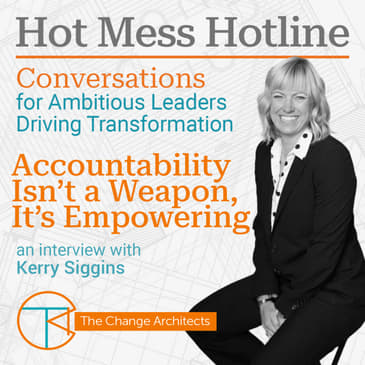

What if accountability isn’t a weapon? Empowering leaders, like Kerry Siggins, have embraced accountability so highly that they wish for that kind of freedom and ownership for everyone around them. Most trainings on accountability say to “Hold employees accountable.” What if, instead, we invited employees into accountability. It’s an invitation into empowerment.
Accountability is a topic we discuss a lot, especially when it comes to change and transformation. Nothing changes unless individuals decide to change first. Organizations don’t change; people do. Not only does Kerry share her story of transforming her company three times, she transformed her own life from addiction into recovery because of accountability!
About Kerry Siggins:
Kerry Siggins is the CEO of StoneAge, a fast-growing, employee-owned manufacturing and technology company based in Colorado. In 2023, Kerry was named EY Entrepreneur Of The Year and Colorado’s CEO of the Year. During her 17-year and counting tenure, Kerry has led StoneAge through three major transitions while continuously building a dynamic culture where employees think and act like owners. To that effect, StoneAge is recognized as a top company to work for by Outside Magazine and Inc. Magazine. She is a dynamic, sought after speaker who presents worldwide at corporations, universities, and conferences. Kerry hosts Reflect Forward, a popular leadership podcast and is an author, blogger, and contributor to Forbes, Entrepreneur, Authority Magazine, and BIC Magazine. Her blog is visited by thousands of readers each month and she recently released her first book, The Ownership Mindset: A Handbook for Transforming Your Life and Leadership.
Read the full blog post here: https://thechangearchitects.com/accountability-isnt-a-weapon-its-empowering-with-kerry-siggins/
[00:00:10] Hey there friend, you're listening to the Hot Mess Hotline and this is Stefanie Krievins.
[00:00:16] You are in the right place if you are an ambitious leader who's charged with delivering on the tech of the future right now.
[00:00:25] Or AI, AI, AI, AI. In order to do that, you and your team need to upskill in the process and tackle old problems in new ways.
[00:00:34] In the past, we would have called this change management and leadership development.
[00:00:38] But quite frankly, change is now the air that we breathe and your team needs a unified strategy for the 21st century.
[00:00:45] That's what we have for you here. These are executive level conversations that are nuanced and insightful and full of hard, earned lessons by other CEOs so that you can put into practice exactly what you learn today as soon as this episode is over.
[00:01:00] Remember, small tweaks have huge impact so take what's new and useful to you and leave the rest.
[00:01:08] Today's conversation is with Kerry Siggins. She is the CEO of Stone Age, a fast growing employee owned manufacturing and technology company based in Colorado.
[00:01:20] In 2023, Kerry was named UI entrepreneur of the year and Colorado CEO of the year.
[00:01:27] During her 17 year and counting tenure, Kerry has led Stone Age through three major transitions while also continuously building a dynamic culture where employees actually want to work.
[00:01:41] Or as you'll hear in this conversation, any culture that doesn't suck. She is also the author of a new book out called The Ownership Mindset, a handbook for transforming your life and leadership.
[00:01:53] That is exactly why Kerry and I connected not only in this conversation but over on her podcast which we've linked to here that I want you to get in on.
[00:02:03] But now let's dig into Kerry's story and the powerful journey that she has taken from overdose to amazing success in 2024 and beyond. Let's go.
[00:02:16] All right, Kerry, my new friend, tell me about your hot mess.
[00:02:19] Oh my gosh.
[00:02:22] I've had a few of them, but my biggest hot mess is from my 20s. So I developed substance abuse issues when I was about 22, 212122 right out of college.
[00:02:34] A lot of different reasons leading up to that which I've spent a lot of time in therapy and coaching to figure out why.
[00:02:41] So many stupid choices. But ultimately it led me to a really dark place. So in 2006 it was, it was the worst year of my life and I was definitely dealing with substance abuse.
[00:02:56] I decided that I've always been high functioning user and so I was very driven, very ambitious and just had this dark habit that I kept a secret.
[00:03:10] And I decided that I was going to do a figure competition which is basically like a body building competition.
[00:03:16] So you go and you lift weights and it's not like the big bulky but you know, you basically have men, you know, grading your body.
[00:03:24] And that's, and there's a lot of time back there exactly and you really have to manage everything that you eat and that combined with substance abuse issues.
[00:03:36] It just really caused me to spiral and I in fact, I remember at the summer of 2006 I called my mom and and I told her I was like, I ate cookie.
[00:03:45] I'm not going to be able to do this figure competition. I'm going to be so fat and she was like, why are you doing this? Why are you doing this to yourself that I just had was this mess of of the jumbled sense of of self.
[00:04:01] I didn't know who I was. I thought I had to be somebody different. I thought I had to be skinny to be lovable and and on on Labor Day of 2006 I actually accidentally overdozed and that was the most important day of my life it was a huge inflection point in my life.
[00:04:17] It was when I said, okay, that's it. I have to figure this out. I mean, they're going to choose to live or choose to die and so that was the star of the journey to where I am now completely thriving.
[00:04:29] You know, it's been almost, it'll be 18 years this September and and so yeah, that was my hot mess and it has led to so many good things.
[00:04:37] So I have no regrets and it worked through a lot of the shame that I felt and it was such an important moment in my life and and I have a ton of gratitude for it, but it's taking me a while to be able to say that.
[00:04:50] Oh, I totally get all of that. I feel that.
[00:04:55] What are some of the moments looking back at that time in your life? You know, there's a saying that things don't happen to you. They happen for you.
[00:05:04] What are some of those things from that time in your life that you would say, oh, thank you for happening for me so that you have the insight you now.
[00:05:12] Yeah, so the biggest one is that I understand how the world works and I think that that you know, I'm always been book smart and and but I'm straight smart.
[00:05:26] And I am really grateful for that and I think that it helps me be relatable. So I run a 200% company and lots of people struggle with all kinds of issues substance abuse being one of them.
[00:05:40] And I've had employees come to me and share their stories and ask for help because they know that I get it that I understand in fact several years ago, I had an employee call me from Las Vegas and he had gotten himself in trouble.
[00:05:54] And he was complaining suicide and he said I didn't know anybody else who took all, but I knew you would understand. And so I helped him, you know, get back to to Colorado and I helped him figure out what had happened and it was a much bigger thing that actually turned out really, really well, but having that kind of
[00:06:20] Relatedability and making it safe for people to come and say, hey, I know that you've been through something similar.
[00:06:26] Can you help me? I think has been really powerful. So that's one of the really good things that have come out of it is that I get how the world works.
[00:06:34] It takes a lot to pull something past me because I did all those things that I thought I was pulling past people.
[00:06:42] But I also think it makes me really relatable. So that's just one of them and, and I think it's been it's really powerful.
[00:06:50] It's it's helped me stay grounded, especially as I've been more and more successful in my career. I never want to forget where I came from. I never get hitting rock bottom.
[00:07:02] I will never forget that good people do bad things and I'll never forget that bad people have really redeeming qualities and I am so glad that I learned that about life.
[00:07:14] Wow. Wow.
[00:07:15] So since then, your life, your career has taken just a complete upward trajectory and I'm sure on the outside everyone thinks it just kind of goes like this.
[00:07:27] And we all know as humans it's more like this down and up down and up but we're trending up.
[00:07:34] Where has, where have you used the lessons of recovering as an addict to then become successful as a CEO?
[00:07:45] Yeah. So I think one of it is is understanding the intensity of which I do everything in life and so you know when I was in a toxic dark place that intensity showed up in really in really negative ways
[00:08:03] and so I had to learn a lot about where that intensity comes from and how to channel that into something that's much more positive but also how to be able to dial it back because not everybody wants to deal with my intensity all the time.
[00:08:18] So I think that's a really important, a really important lesson that I've had to learn is first having that self awareness and that self reflection to understand where that came from and then working on myself and developing tools to be able to use it in a positive way instead of a negative way.
[00:08:41] And also how to be able to be more content in the moment without constantly having to do and do and do and push and push and push so that it's healthier for me and for the people around me.
[00:08:54] And I think that my intensity has absolutely driven my success because as my husband says it and the most driven ambitious person that on the planet, which I was like hey now I mean there's a way worse to me.
[00:09:24] I think that's been a big one and it's been really important in my leadership journey because I want people to want to be part of my team and want to be part of the vision that I have for the company and I have to not just think about how people experience me but I want people to think about how they experience themselves and the presence of my leadership and and that intensity has to be you know has to be the sharp edges have to be smooth.
[00:09:48] I've learned along the way. Oh my gosh, I am right now I'm just going thank you universe for this conversation because I'm going to ask you all the questions that I need to hear the answers to right now.
[00:10:00] But we also you know we work with a lot of over achievers that you know I talk about the difference between over achieving and high achieving high achieving is great and that is that is where we should strive to be most of the time over achieving is that striving that to intense the sharp edges that cut yourself and other people.
[00:10:21] The perfectionism that I'm not good enough. I'm not doing enough voice. What how do you know when you have tipped into over achieving and the the too much the the.
[00:10:50] I'm going to do some of the things that I'm going to do is that I'm going to continue the cues of people around me and I also pay attention to what my body is telling me.
[00:10:58] So in terms of the people around me, I've developed I myself.
[00:11:02] Where enough person to be able to see when people are like, oh, that's moving too fast and so.
[00:11:08] So I really try to pick up on those cues, but I've also created a team that can hold me accountable to saying, hey, we're moving too fast and I've also learned the benefit of slowing down and making sure that we are very methodical and what we're doing.
[00:11:35] And I'm going to be able to say, like, I just overwhelmed that person. I can see by look at their face that like, let's go on here and then building those trusted relationships with people who experience me the brunt of me to be able to say too fast.
[00:11:49] You know, we got to figure this out. Let's slow down and so that's those are some of the things that that I've done to help that and then my body also I think our bodies tell us so much yes, but often over achievers, higher achievers people who aren't in tune.
[00:12:06] They don't realize what their bodies telling them and so whenever I start to feel like, oh, like my back is like super tight and story now and about ton of stuff that's going on and was like, that's my body telling me that I need to actually just slow down a little bit.
[00:12:19] So how do I get a little bit more sleep? You know, instead of working now and going to do yoga today.
[00:12:25] I'm going to take a couple days off to decompress because I'm feeling that tightness and in my body and that's telling me something that I'm pushing too hard.
[00:12:34] So really trying to have that body awareness is as a good signal.
[00:12:38] That is that is wonderful.
[00:12:40] We're going to talk about here in a second the several times you've transformed your company and grew it.
[00:12:46] But staying in this theme of you're hearing from your people that it's too much. It's too fast.
[00:12:53] You know, that's something we hear too in our work and I don't know the definition of too much too fast culture by culture.
[00:13:00] You know, only the culture gets to determine what that means. Sometimes that is quite literally just a defense mechanism to change itself.
[00:13:09] As a leader, not as a human, carry the human, carry the leader, carry the leader.
[00:13:15] How do you balance and like invite people along, pull people along when it's guys like you may think it's too fast.
[00:13:24] But I do need you to not to get up about 10%, and I'll not to down 10%.
[00:13:28] How do you lead your people through that?
[00:13:30] We have those exactly those conversations.
[00:13:32] I just had one this morning, so we were going through a pretty aggressive product roadmap and launch schedule.
[00:13:43] And our timelines have gotten extended as they typically do and so I was asking questions around, all right?
[00:13:50] So you know, one the why and then two, how do we make sure that we're building better schedules and then it's like, look, this is the drop dead date.
[00:13:57] And this is a completely reasonable drop dead date, but if we don't hit this date, we're going to blow a huge opportunity.
[00:14:04] And so we need to figure out right now, like we're going to be right up against it, how do we take some of these things out of the time line to be able to speed this up and present back to me is it you need an extra resource.
[00:14:18] You know, do you need some different tools like what is it you need to be able to shave a month off of this so that we're not so close because there's no doubt like we have to hit this and it's not going to be good first of a company as a company if we don't.
[00:14:31] So it's just like super pragmatic conversations, so you'll say, okay I understand why all this happened, I get it and I can appreciate it and I want to acknowledge it and we still have to figure out a way to speed it up.
[00:14:42] We can't add three months to the schedule you can add a month and a half to the schedule what do you need you need to tell me what do you need to be able to make this happen.
[00:14:51] Yes, because I've also learned like you just can't you know, I mean it's just otherwise people are just working longer hours and getting resentful and all of those things so having them be part of that solution rather than me figured out allows them to be able to come back and say okay, you know if we had a part time half another head count right here.
[00:15:06] We would be able to meet this deadline or if we took this project off of the priority list, we'd be able to do it great.
[00:15:13] Then I can help make that decision but they were the ones who were able to come up with what that solution or the potential solutions could be.
[00:15:20] So that's how I try to work through it. I still hold people accountable.
[00:15:23] I make sure that they understand the why like everybody understands the why why the deadline is really important.
[00:15:29] And then I think I'm very reasonable and saying okay bring bring to me some suggestions on how we can get it done and it's not just like this I don't care how you get it done just get it done.
[00:15:38] I think that scares people and and it doesn't create a you know collaborative environment where leaders understand show that they understand the real challenges.
[00:15:50] That teams face to do complex product design system design process design whatever it is you're creating yes yes yes.
[00:16:00] That is so good because it's when we say we don't have time we can't meet the deadline we're just pointing to one resource which is time and says like this is the end all be all.
[00:16:12] And maturing organizations mature leaders understand actually we've got seven levers to pull here yes time is one people resources are another money resources are another taking saying no to something is another which is usually the most powerful one quite frankly.
[00:16:29] Especially for me I should say but again the two ambitious the folks that want to do too fast we say oh yeah we can knock out five things and six months when it's well really we can knock out three things and six months yeah.
[00:16:42] And I thought you really learn that where we see the world through our own lens and it's very close ourselves another people shoes and I've had to learn that people just do not operate at my pace for the most part.
[00:16:53] And and me expecting them to.
[00:16:57] On me wishing that they would doesn't change that people operate at the pace of which they operate now doesn't mean that they can't be pushed and stretched and I try to do that in a really healthy way but I had to learn early on in my my days that people just don't move as fast as me and even though I don't feel like I'm moving fast I don't feel like I'm moving fast that is not how other people experience me so I think.
[00:17:19] That having that self awareness and that realization you know makes it easier on everybody just say okay you know we're going to figure it out we're going to.
[00:17:26] We're going to do a little bit less than what I was hoping we were going to do but we're going to do it better and the team is going to be healthier and people are going to have a lot more fun and they're going to feel really proud and and rewarded when they get the project done versus trying to cram a couple more things on in the reality probably don't really matter that much.
[00:17:47] Yes, yes, yes.
[00:17:50] I learned early on you know we have to ask ourselves prioritization questions to the lens of will this matter in 10 days 10 months or 10 years and I think I borrowed that from Martha Beck so I want to give the right credit but that really keeps things in perspective for me you know if it goes out mid Q1 versus end of Q1 and 10 years it doesn't matter.
[00:18:11] No, no.
[00:18:13] Definitely not.
[00:18:14] Yep, but losing entire years worth of revenue because it went out and Q2 that will matter because I don't really.
[00:18:20] Yes, the reason I'm asking this question is because obviously addiction issues are very rampant in our society and we keep them hidden in most cases but a lot of us are dealing with an addiction of some sort or an addictive system or a family member who's addictive.
[00:18:37] What did you learn in the recovery process about giving yourself and others grace that you get to now practice every day?
[00:18:46] Yeah, I mean the first thing that the first fundamental thing is that you have to own it.
[00:18:52] And you have to decide like I am here because of me and that is not to put yourself down to beat yourself up.
[00:19:00] You have to do it.
[00:19:00] I'm here because of me and by owning that and in many of it I'm empowering myself to start to do something that is different.
[00:19:10] And so, you know, that doesn't necessarily seem like a super compassionate way to approach it but I feel like it is because for me I was blaming other people.
[00:19:17] I was blaming situations and I was letting myself off the hook.
[00:19:22] And once I just said, okay, I am responsible for everything that happens in my life.
[00:19:26] I am responsible for every decision that I made to get me to this point.
[00:19:30] And yes, I might have had past trauma and past things that have led to some of these behaviors.
[00:19:36] It's an excuse if I say those are the reasons why and and I have to own it.
[00:19:43] And then when I started to own it, then I could start to actually look at my behaviors and say and understand those behaviors and say, okay, this is why I made that decision.
[00:19:51] And now how do I change that? How do I forgive that? How do I address it? Go back and apologize whatever it is.
[00:19:59] And so I think that compassion that grace has to come with accountability if you really want to change your life.
[00:20:04] And so I did a lot of things that I'm not proud of and I hurt people that I felt terrible about.
[00:20:10] But instead of very my head in the sand or beating myself up and just saying, you know, I can never change and then I'm never going to be able to fix those relationships I owned it and said, okay, I really screwed up and I'm going to go back and I'm going to apologize to all of those people who I hurt and I'm going to figure out how to love myself so that I can apologize to myself and forgive myself.
[00:20:32] So I think that accountability and responsibility just has to come into play but not as a weapon as a way to say, I love myself enough even if it's just a tiny little fraction because I hated myself back then.
[00:20:46] But I was like, you know what this is the piece I'm going to hang on to. I know I have potential to do something really important in life and that's what I'm going to figure out that's what I'm going to hold on to and be accountable to being that kind of person as I'm in recovery.
[00:20:59] Wow, so right and I mean that that's the quote that is the quote. I think this is going to be the child of the episode you know not using accountability as a weapon because it's not no.
[00:21:12] No and so many people use it that way and they also look at it that way, but it's not. It's a way to be able to say I did the things that I said that I was going to do.
[00:21:23] I am going to be the kind of person who looks at myself in the mirror and says, okay, you know here are the good things and here are the things that I need to work on and not put my head in the sand without you know this is my book right the ownership mindset like without the ownership mindset of like I am responsible for every single thing that happens in my life.
[00:21:42] Things don't happen to me they happen because of me or for me and I'm going to choose to look at every adversity as a gift is an opportunity for growth. Oh my god, you can just change your life and if you've been living in a victim mentality it's hard to start to say okay.
[00:22:03] I yes, this something really bad did happen to me or I am a victim of this but I can still choose to show up in a different way and and so you don't hold it as a weapon against yourself.
[00:22:16] We don't hold it as a weapon against anybody else you use it as a like kind loving tool for growth. Yes, and how does it feel when you choose to be accountable. Oh, I mean well, I mean it can feel mixed.
[00:22:31] It can feel very good.
[00:22:32] Can also be uncomfortable. Yes, I think when people went and that's why people avoid it is because it does feel uncomfortable but anybody who says like oh it's just this great thing like now sometimes it's really crappy.
[00:22:44] Like yeah, okay like I screwed up. I got to hold myself accountable to this. I have to go on it and it is going to feel it.
[00:22:52] And then I think that's an opportunity for a little bit but once you get through to the other side it is so empowering and you build relationships and you realize like oh that wasn't so bad actually really good things came from it.
[00:23:03] But let's be real. I mean anybody who's like I'm holding myself accountable to this right now there's some feelings of it. Yeah, we want to you.
[00:23:11] You know, we want to deflect or blame or put our head in the sand because that might feel like we are getting rid of that ikiness and the moment but what we don't realize is that that builds up over time and it damages relationships whether with other people or with ourselves.
[00:23:25] Because we know like I didn't do what I was going to do or I really screwed up on that and I blamed somebody else and and the consequences of not being accountable.
[00:23:36] That just builds up over time and then here you are 10 years later with a drug problem or whatever your issue is.
[00:23:44] And you realize like oh man that is what a lack of accountability just created for my my life. Yes, yes well and you said in your adding some new words to my vocabulary to write this happens because of me.
[00:23:58] You know that that sense of ownership is so freeing empowering and.
[00:24:06] Oh gosh joy giving life giving and that feels much better than the shame and the guilt than the blaming that that you that you can carry around if you don't choose accountability and I want joy.
[00:24:19] I want life I want optimism I want peace I want freedom over beating myself and others up because it sucks.
[00:24:27] I agree I agree and you just have to lean into it and you have to lean in with those uncomfortable moments so that you can feel that freedom.
[00:24:35] You know me owning all of those things happening in my life going back and apologizing to everybody who I could find you know there certainly wasn't everybody who I could go back to and and all of it.
[00:24:45] You know it was really hard and it was really emotional and I had to do a lot of work to forgive myself for for the decisions that I made but now here I am 18 years on the other side and it's like I'm so glad I did that difficult work.
[00:24:59] And here's a reality of life is that it's hard and the only way that we get good at doing her things is to do hard things and I know that because of what I went through and how I was accountable for those decisions and I went back and I.
[00:25:28] I think that's a lot of things that I have to do anything that life throws at me but you have to go do that work and yes.
[00:25:33] People, you know they don't realize that they're like I want this kind of life but they don't really want to go have to do the hard things that you have to do to create that kind of life and.
[00:25:43] That's the human journey is to do that work it's to lean into the uncomfortableness so that you can develop as a human being and find more joy and more happiness and more self esteem in life.
[00:25:55] Yep, for those who are just you know aspiring to have a high achieving career with meaning and purpose and you know hopefully that comes with the title and some wealth those are good things too but you know they want to be full on accountable yet.
[00:26:10] They're not going to go through the ad extirning the ad extracurc ovary what are your tips for embracing accountability as a maturing adult you know entering midlife and beyond.
[00:26:22] Yeah, well the first thing is that it's nobody responsibility for helping you find your purpose and meaning it's yours and I think a lot of people look at their companies that their bosses at their cultures to say oh I don't have meaning and purpose in my work and so it's somehow.
[00:26:37] There fault no one can find your purpose for you but you and so quit looking for your boss to do that or your company to do that.
[00:26:48] How I found purpose in in work and luckily, I think a lot of us stumble into it some of us are lucky enough to you know figure it out early on but I think most of us stumble into it and we stumble like the three people in our in the whole world that found it early on.
[00:27:03] That's the rest of us stumbled into it.
[00:27:06] Yeah, right.
[00:27:07] But I think because you have to try things and I think a lot of people are scared to try new things and so if you aren't happy in your role in your job if you don't find meaning and purpose in it then don't stay in it.
[00:27:19] And I know that sounds maybe a little bit harsh or maybe that's a hard thing to do there are certainly people who don't have opportunities like I've had.
[00:27:29] But the reality is is that we are still in charge of our lives and if we do not find purpose and meaning in our work then we have to go figure that out and how we do that is by experimenting by trying different things by getting good at our job.
[00:27:42] I did lots of jobs that we're not we're not part of my purpose but because I chose to do them really well.
[00:27:50] I gained skills I gained resiliency I learned how to practice how to master something and those skills helped me then when I started to find things that were more joyful for me to do the work.
[00:28:04] So you know yes, let's say that you're working in a fast food gobs like how do I find purpose in meaning it well get good at it just be like I'm going to be the very best that.
[00:28:12] I can be at this and I'm going to learn how to hold myself accountable and I'm going to learn how to master these skills and I'm going to learn how to have a smile on my face and great give great service even when I feel like crap all of those things are going to help you when you say okay, this isn't for me.
[00:28:28] I'm going to go try something different and learning those skills of resiliency and mastery and pushing through persevering to grow yourself will absolutely help you figure it out.
[00:28:39] So experiment if you're not happy in your job go look for a new one.
[00:28:45] If you're not happy in your job figure out was still how to get really good at it so that you can get gain those other skills that you can then eventually take on when you say okay I'm going to try something different in my life.
[00:28:55] Yes, yes and paying attention to what brings you joy and what brings you frustration those are equal lessons to learn and I just want to add in there and this is top of mine.
[00:29:05] So I have an eight month old right now and many folks at my age are kind of the opposite end of parenting which is fine so they've lived this but they see it in in everyone who's learning there's a frustration that comes with learning.
[00:29:18] That you only learn the lessons once you get to the other side and so I say I see it with my eight month old he's trying to crawl and stand up and so he lets out these gutterle screams because he's so frustrated because he wants to crawl.
[00:29:30] And the first couple times he did it I thought he was in pain so I was picking him up and moving in and I'm like oh he's learning he's frustrated and so I've got to let him sit in the frustration so he can learn what he needs to learn and.
[00:29:45] For human beings that is the way of learning like it doesn't change and so as adults we've somehow tricked yourself in believing if I'm frustrated it's too hard or it's too fast or too much or it's too something or I'm not enough or I'm not smart enough and it's.
[00:30:03] So frustration is just part of the learning curve choose to get past the frustration then you can choose it to find the lessons and it.
[00:30:13] You don't know what those are yet you're still learning and so again yeah as adults sit in the frustration because it's telling you something.
[00:30:22] Yep total they agree let's let's focus in on your career because you truly have transformed your company you have risen the ranks to to lead it in some new directions for the 21st century give us a high level overview of.
[00:30:35] The strategy you've deployed in recent years to bring your company up to speed in 21st century and take it beyond.
[00:30:43] Yeah so we manufacture industrial clean clean equipment high tech square pens on steroids so what.
[00:30:50] Yeah, they so the pressure washer that you use at home that's a you know maybe a couple thousand PSI's to be able to you know clean for people off of your concrete.
[00:30:58] Yeah, our tools started 2500 and go up to 40,000 PSI so for industrial application so our products are used in refineries chemical plants food processing plants.
[00:31:08] Shipyards anywhere you do is ultra high pressure water to clean something and so the tool at the company was started on nozzle self rotary nozzles so the power and the pressure on the flow of the water spin the nozzle which.
[00:31:20] Makes it easier to blast stuff off of pipes and surfaces and all kinds of things in 2013 we made the decision that we needed to build automated systems and so we started with mechanized systems a control box that you're feeding.
[00:31:36] You know a hose down the pipe with a tool at the end and that's really transformed known to building autonomous robotics that now can do cleaning with the push of the button.
[00:31:47] Now robots that set themselves up this is not like humanoid robots but robotics that that are making it easier for people to do this work fewer people to have to do it because nobody really wants to go into industrial cleaning so we have a massive labor shortage in our industry.
[00:32:03] And so yeah, so we've just really transitioned from like making these manual tools now to computerized cleaning systems that produce data and we have a software application that allows our customers to be able to.
[00:32:17] Go in and see exactly what's happening real time and we're planning on building that out so our our vision is to have computerized industrial cleaning solutions and every major major heavy industrial facility worldwide by 2040.
[00:32:31] And so that's a big lofty goal and we have our tools in every facility but not everybody has has adopted automation, especially outside of the US in Europe.
[00:32:42] Where labor is still less expensive than then buying these automated systems but our goal is to really drive the industry towards computerized technology because it's safer it's more efficient you use less water.
[00:32:55] And you don't have to use as many people which is a big issue for us we just don't have a ton of people coming into the industry so that's part of part of my current vision.
[00:33:05] I love it it's succinct it's it's clear I can see it and I'm not in your industry but I see it I understand it.
[00:33:14] What kind of leader do you need to be to get your company from here to 2040 I think two things one very strategic which I think is the blend of visionary leadership right as this big vision with how you actually execute and and that kind of that combination of management leadership so.
[00:33:33] You know really being able to balance the vision and then the actual like okay how do I build a team to get this done to execute so I think you got to be a really strategic leader.
[00:33:45] I think that I have to be ambidextrous meaning that I've got to be able to hold competing ideas in my brain at the same time.
[00:33:52] You know we are transitioning from a mere core business has always been tools and now it's getting more commoditized there's more.
[00:34:01] In competition in the industry and a lot it's part of let that stuff go.
[00:34:05] Yes, who we are.
[00:34:07] Yes, but the reality is is that's not who we're going to be and as that has become bread ocean we have to go create the new blue ocean and so how do you exploit the core not just give up on it but really reduce costs and be super efficient.
[00:34:22] In that in that old space that we were in so you don't just completely give up on it but all the innovation happens in this more computerized equipment which requires different thinking different business models different team structures.
[00:34:37] Yes, and so you've got to be able to do both of those right exploit the core and explore the new growth and those can be.
[00:34:43] Two very different types of activities that make each of those successful so I think ambidextrous is another one and then finally culture we're an employee owned company and I believe that we are.
[00:34:56] Where we are today because of our employees and I put my employees first because when you put your employees versus the organization they will put your customers first and so you know as we grow in scale.
[00:35:08] How do we make sure that we always keep our culture at the forefront of our strategy and not turn into some big company that sucks to work for.
[00:35:19] Just put a real bluntly like that.
[00:35:21] I love that.
[00:35:24] Oh my gosh, and so what are you going to ask your people to own in the next 15 years.
[00:35:30] Our growth on our scale I may are our big corporate role at the holding company level is to create a thousand millionaires through employee ownership and we can only do that if we do it together so it's living our values.
[00:35:43] Our values are very clear.
[00:35:46] Practice self leadership be a great teammate and deliver on the Stone Age assurance promise and so if everybody is really truly living those values and trying their very best to be the best self leader the best teammate and the best steward of the company.
[00:35:59] That is what owning it looks like for us and so we have to teach people how to do that not everybody comes in and is like oh I feel comfortable giving my boss feedback well we're a feedback oriented culture so you know we're going to teach you how to do it.
[00:36:13] Yep, not everybody feels comfortable speaking up and say I screwed up here a lot of people get punished for doing that.
[00:36:19] So we have to really train people and educate people on the own at mindset and our culture and those behaviors that might have been.
[00:36:35] So we have to do that.
[00:36:35] So I expect my employees to adopt and to live and breathe the own at mindset because it really does focus on self team and the overall company and I think we can do fantastic things when when people show up with that mindset.
[00:36:51] That's amazing oh my gosh all right.
[00:36:56] So for those listening in I'm going to put in the show notes the link to so the reason carrying I got connectors because I was on her podcast and we're like we have to have this conversation over here on the hot mess hotline.
[00:37:07] We got to get that book out there all of those things so we'll put that in the show notes because I want you all to listen to that and carry talks more about the term.
[00:37:16] Anbredactress as a leader and which I think is unbelievably intelligent being able to hold both and at the same time is an unbelievably powerful leadership quality.
[00:37:26] Carrias we wrap up here what is kind of this one powerful action stuff that you would recommend to leaders to help their culture truly own it.
[00:37:37] I think it starts with trust.
[00:37:40] If you want to create an ownership mindset within your organization, it starts with trust.
[00:37:45] And there's three aspects of trust.
[00:37:47] First, you have to trust yourself.
[00:37:49] Well, yes.
[00:37:51] And that means that you have the self-confidence to look at yourself and say,
[00:37:55] I can do hard things.
[00:37:57] I can make this decision.
[00:37:58] I can be a leader who's worth following.
[00:38:01] I trust myself.
[00:38:02] Then the second thing is is that you have to trust others.
[00:38:04] People are not going to show up and give their very best and truly own it.
[00:38:09] If they don't feel trusted by their leader, and so you have to build that trust.
[00:38:13] And that's building relationships, having one on one with your team, asking for their
[00:38:17] input, giving them, saying I trust you enough to make this decision.
[00:38:21] I trust you enough to figure out the how I'm going to give you the what?
[00:38:25] I trust you enough to give you to figure out the how to do it.
[00:38:29] That is how you build that trust with your employees, which then makes them say,
[00:38:35] OK, I'm going to give more.
[00:38:36] My manager trusts me.
[00:38:37] My manager believes in me that that makes me believe more in myself.
[00:38:41] And then the third part is to be trustworthy.
[00:38:44] You have to be a trustworthy person.
[00:38:46] You have to do what you say that you're going to do.
[00:38:48] You need to be consistent in the way you show up.
[00:38:51] If you're happy and positive one day and then grumpy and yelling at your employees the other
[00:38:55] day, people don't know what to expect from you.
[00:38:57] So they're always on egg shells.
[00:38:59] So consistency matters with being trustworthy, making ethical decisions, being transparent
[00:39:06] about the decisions that you make.
[00:39:08] Those are all aspects of being trustworthy.
[00:39:10] So if you want to have the ownership mindset within your company and you want people to
[00:39:15] show up for more than just a paycheck, whether that's on your just on your team or if you run
[00:39:20] a company, you really have to think about trust from those three lenses.
[00:39:24] Trust yourself, trust others and be trustworthy.
[00:39:28] So good.
[00:39:29] Thank you so much for this conversation around to I needed this today.
[00:39:36] And I know there's no good.
[00:39:39] So good.
[00:39:40] Nothing like having a newborn in your early 40s to recalculate your life.
[00:39:45] Yes, I mean, my son is 11 and I remember those days.
[00:39:49] And so they're so much fun, but they're they're also they can be really challenging.
[00:39:53] But you're going to learn so much totally totally.
[00:39:58] It's um, to to have your heart live outside your body is just a different way of being in the
[00:40:05] world and that's what's good and different lens.
[00:40:09] Yes, yes, yes, yes, yes, yes, yes, yes, yes, yes, yes, yes, yes, yes, yes, yes, yes, yes, yes, yes,
[00:40:09] totally agree with you.
[00:40:10] Yeah, motherhood is as one of the best things that I ever have done.
[00:40:15] So good to hear so good to hear.
[00:40:17] All right, well, Carrie, thank you so much.
[00:40:19] Thank you, Stephanie.
[00:40:19] This has been so much fun to be on the show.
[00:40:21] Awesome.
[00:40:22] My friend to say that Carrie is full of strength and resilience is an understatement.
[00:40:30] I want to share with you the phrase that I learned at the beginning of my coaching journey,
[00:40:34] but Carrie brought a new spin that I think is even more powerful.
[00:40:38] You know, I learned things happen for you.
[00:40:42] And she said things happen because of you.
[00:40:45] We are all change makers, different makers, leverage makers,
[00:40:49] own that presence in the world.
[00:40:52] There is such a thing as being too humble and a lot of leaders that we work with are too humble,
[00:40:58] own the fact that things happen because of you,
[00:41:02] because you show up because you choose to lead.
[00:41:05] The second one is,
[00:41:07] pull more levers in order to be successful.
[00:41:10] Carrie gave such a great example of the story of someone comes and says,
[00:41:15] we need more time.
[00:41:16] Well, you can have a little bit more time,
[00:41:18] but what are the other levers,
[00:41:20] the other resources that you can pull in to not just extend by three months,
[00:41:25] maybe only extend the timeline by 30 days,
[00:41:29] but that means adding resources in other areas.
[00:41:33] And hopefully also saying,
[00:41:35] note other seemingly pressing priorities which in the long run may not be as pressing as some of the most powerful initiatives on your team's plate.
[00:41:44] Third,
[00:41:45] remember that it is your job to know your purpose.
[00:41:47] And so when you're feeling the pressure of your workplace isn't giving you as much as you would like in your career,
[00:41:55] that means you need to go on the search,
[00:41:57] not your manager.
[00:41:58] And as a manager,
[00:42:00] because I know we've got a ton of leaders listening in here,
[00:42:03] remember that if you're feeling that pressure from your employee,
[00:42:07] remind them that they are the CEO of their life,
[00:42:09] you're not the CEO of their life.
[00:42:11] They are the CEO of their life.
[00:42:13] If they're not feeling fulfilled,
[00:42:15] they need to go on the hunt to fill fulfilled.
[00:42:19] There's only so much as their employer,
[00:42:21] as a company, as our manager,
[00:42:23] that you can do to support them.
[00:42:25] Can you support them in finding their purpose?
[00:42:28] but it's always their responsibility.
[00:42:31] All right, my friend,
[00:42:32] if you are
[00:42:34] trying to find more of the levers that you want to pull inside of your organization to drive change,
[00:42:40] if you're feeling like things are going too fast or too slow,
[00:42:44] we can help you with that.
[00:42:46] I want you to pop onto this website and complete one of the assessments that we make,
[00:42:52] available to you for free just to get the conversation started.
[00:42:56] So you can figure out what that tension is in your organization if things aren't working at the right speed.
[00:43:02] We have the answer.
[00:43:03] We call it the orange print.
[00:43:05] All right, now my friend,
[00:43:06] let's take these lessons that you learned today about owning it,
[00:43:11] being a leverage maker, a difference maker,
[00:43:13] take them back into your work and I'll see you soon, my friend.