

The role of the CIO has never been more demanding. In today’s rapidly changing technological landscape, CIOs are tasked with not only managing complex IT infrastructure, but also leading their teams through digital transformation, driving innovation, and ensuring cybersecurity. The pressure is immense, and the stakes are high.
Many CIOs find themselves at a crossroads. They are technically brilliant, but may struggle with the "people" side of leadership. They understand the importance of change management but may lack the tools and frameworks to effectively lead their teams through this process. This is where CIO coaching can make a world of difference.
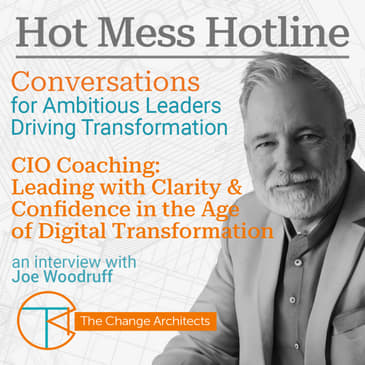
Listen to this episode with The Change Architects’ CIO coach, Joe Woodruff, and his approach to coaching the unique needs of our CIOs.
Read the full blog post here: https://thechangearchitects.com/cio-coaching-leading-with-clarity-and-confidence-in-the-age-of-digital-transformation/
About Joe Woodruff:
Joe Woodruff is a leadership coach, speaker and writer. In the years since co-founding CIO Mastermind, he has spoken and worked with hundreds of technology executives. Joe drives the content development for CIO Mastermind, and members call on him for coaching to sharpen their leadership skill-sets. His background brings a unique perspective to human motivation and organizational development. He is driven to equip technology leaders to elevate and extend their influence so that they are able to enjoy the profession of their dreams.
Joe leads CIO Mastermind's work with companies to improve employee development, increase engagement and inspire retention. He is an acting CIO and change-strategy consultant.
[00:00:10] Hey there, friend. You're listening to the Hot Mess Hotline and this is Stefanie Krievins. You are in the right place if you're an ambitious leader who is charged with delivering on the tech of the future right now. And as I said in a recent episode, or as we're saying, AI, AI, AI, in order to do that, you and your team need to upskill in the process of driving digital transformation, change, using new technology to solve all the problems.
[00:00:40] Old problems in new ways. In the past, we would have called this change management and leadership development. But change is now the air we breathe and your team needs a unified strategy for the 21st century. That's what we have for you here, my friend. These executive level conversations are nuanced, insightful, and hard-earned lessons that you can put into practice as soon as this episode is over. Remember, small tweaks can have huge impact.
[00:01:08] Take what's new and useful to you, leave the rest, and share the episode with someone that might need to hear the message. Today's guest is a new faculty member for us, a new executive coach bringing change-making in only the way that he can to our team. His name is Joe Woodruff. He's a leadership coach, a speaker, and a writer. Let's jump right into this conversation with Joe so he can share more about his street cred with you directly. Let's go.
[00:01:36] Joe, Joe. Joe, I'm so glad you're with me today. You're with our clients, serving them. I want to start with the best stuff, the good stuff. What are your two favorite success stories from your coaching that tie together people and change and coaching?
[00:01:53] Joe, Joe, I absolutely love these stories. I'll use Fred and Barney. I'll call the first one Fred.
[00:02:03] Fred was a technologist who found himself in a life transition. He was kind of down with the whole corporate thing for himself. He put himself in as a consultant doing some fractional things. He was realizing it's not so much the work that was driving his heart as it was.
[00:02:24] He wanted to do something for CIOs, for CTOs, for executive technologists. He wasn't quite sure where to begin. He and I had recently met and had developed a friendship that I'd offered myself to advocate for him and begin to coach him on some things.
[00:02:47] So he presented this time to me. And as we began to talk through it, he really dialed in on what was frustrating in the market for him, trying to serve or would wanting to serve us technologists.
[00:03:05] And what was most important to him is value. So we really had an opportunity to talk through how can we eliminate the frustration, put forward the value and bring technologists together in masterminds so that they're feeding off of each other.
[00:03:21] They're in a trusted environment. And six years later, he has a company well established for the technologist he wanted to serve, the family that he's trying to take care of.
[00:03:33] And it's just immensely satisfying within himself. So I love that story because it was a person who's at a crossroads. We meet them all the time.
[00:03:43] Yes. They have a background, but the background isn't the form of the background isn't necessarily what they want to continue in.
[00:03:51] So they need to support their heart, see where the frustration is, see where the passion is, and then actually have a real stable way to go.
[00:03:59] And fortunately for him, he understood you build over time. He wasn't measuring coaching as a success overnight.
[00:04:06] So I've been with him for six years through this process. Tremendous success story.
[00:04:13] But Joe, what I love about what you just said is, you know, folks oftentimes come into coaching and they intuitively know their values, but they don't know how to name them.
[00:04:24] They don't really know how to bring them to life consistently.
[00:04:28] They're not in relationship with them.
[00:04:31] They're just, they know when things piss them off or they know when something's not working for them, maybe, maybe.
[00:04:36] And oftentimes coaching is so valuable because it helps them name and articulate their values, what it looks like, what it feels like.
[00:04:43] How do you know when you have it? How, how do you know when you don't have it?
[00:04:46] But the other thing you said too, was around Fred's bringing his value to the world.
[00:04:52] And it just struck me. I've never made this connection is once you know your values, you know how you can bring value to the world.
[00:05:00] I like that.
[00:05:01] And yeah, I'm going to use that.
[00:05:03] I need these.
[00:05:04] I need these.
[00:05:05] I need it for myself.
[00:05:06] But that is, that is such a great truth that comes out of coaching.
[00:05:10] Once you know your values, you know the value you can bring to the world.
[00:05:13] I love that. I'm going to use that too.
[00:05:16] Well, you said it. Great job.
[00:05:19] All right. So tell us about Barney.
[00:05:21] Yeah, Barney. I love Barney.
[00:05:23] Barney is a young man.
[00:05:27] Let's call him 30.
[00:05:28] And placed in a position with responsibility above his experience.
[00:05:37] And so deep in the waters, very good at what he does technically.
[00:05:44] Certainly needs area of growth in leadership.
[00:05:49] And so when I was introduced to him, the challenge was turn him into a leader.
[00:05:55] And it was not a competence issue and certainly not a character issue.
[00:06:01] Great, great young man.
[00:06:03] It was really a calling issue.
[00:06:06] That idea of knowing your place and then standing strong in it.
[00:06:12] Because the rest of the management executive team, very strong personalities, drivers.
[00:06:22] You know the type.
[00:06:23] You can picture the room.
[00:06:24] And then here's this extremely competent, great character, young man in the midst of it.
[00:06:30] So a lot of what we did was work on seeing his values, seeing where he fits, tying what he does to the overall drive of the business.
[00:06:43] And we're now a year in.
[00:06:46] I coach the other managers and executives as well.
[00:06:50] And to a person, they have commented on Barney's growth that they've seen over the year.
[00:06:55] And it's been fun because Barney's taking the stand and the rest of the executive team loves it because they're not afraid of strength.
[00:07:06] Yes.
[00:07:07] So Barney was actually invited to step into his strength.
[00:07:10] And in doing that, he would become an even more valuable contributing member of the management team.
[00:07:16] It's been super.
[00:07:17] Oh, that's amazing.
[00:07:19] Oh, my gosh.
[00:07:22] And so much goodness around there about like finding a sense of self in a new role.
[00:07:27] Yeah.
[00:07:27] How do you answer the question, what is coaching?
[00:07:30] You know, I get that a lot.
[00:07:31] And when I started 10 years ago, I would say, oh, I'm a coach.
[00:07:35] And people say, oh, what's sport?
[00:07:37] And I'm like, that's funny.
[00:07:38] I was in my achievement.
[00:07:39] I don't do sports ball.
[00:07:41] So, you know, the industry has definitely come a long way.
[00:07:44] But every great coach has their own way of describing it.
[00:07:48] How do you describe and define what is coaching?
[00:07:51] Yeah, let me give you the definition and then the story that's behind it because I love the story.
[00:07:56] So coaching is coming alongside another to help, specifically help them discern their thinking
[00:08:04] and develop their best way forward.
[00:08:08] But here's the story.
[00:08:09] That word come alongside is derived from a Greek word called paraclete.
[00:08:14] And it's used to talk about divine intervention.
[00:08:19] So originally, paraclete was this idea of God help me and God stepping in.
[00:08:27] And then it carried through in Greek literature at one point to describe an individual whose name was Joseph.
[00:08:35] And I love the name Joseph.
[00:08:39] So many ironies there.
[00:08:41] He worked with changed his name to Barnabas, which means the son of encouragement.
[00:08:47] And it's the word paraclete.
[00:08:49] Because when you look at this man's life and work, he was always encouraging, always bringing out the best.
[00:08:57] So I've designed a whole system.
[00:08:58] I call it advocate based on this idea.
[00:09:01] So for me, a coach draws out and a mentor pours in.
[00:09:08] And an advocate incorporates all of that and stays with.
[00:09:12] They're alongside for the journey.
[00:09:14] So for me, coaching is a relationship that is seeking to draw out the best in another.
[00:09:19] And in that situation, then, of course, it is akin to sports in the athletic field, because that's exactly what a professional coach would do.
[00:09:30] Let's use football because I'm an avid Seahawk fan.
[00:09:34] Oh, boy.
[00:09:35] Don't turn any of your audience off with that.
[00:09:38] We've got a new coach.
[00:09:39] He's very demanding.
[00:09:41] We're so far undefeated.
[00:09:43] And the reason is because the players know the only thing he's doing is working for their best.
[00:09:50] And so they're giving the extra effort to it.
[00:09:53] Yes.
[00:09:54] Yeah.
[00:09:54] I love that.
[00:09:55] That's a great analogy.
[00:09:57] If you were going to go down the train of comparing yourself to God, we're going to have to have another conversation.
[00:10:01] No, no, no.
[00:10:03] I'll stick with you.
[00:10:04] You know better.
[00:10:05] You can call me Barney.
[00:10:07] I don't care.
[00:10:10] Oh, my gosh.
[00:10:12] What's your coaching style?
[00:10:14] You know, what do folks get when they work with you?
[00:10:16] Well, my coaching style is the best, of course.
[00:10:18] Of course.
[00:10:19] Of course.
[00:10:20] You get the three things that I mentioned.
[00:10:23] So I am driven by another person's best interest and success as they define it.
[00:10:29] And so you get, first of all, you just get this genuine drive.
[00:10:34] I mean, it's why I coach is I love people.
[00:10:37] My whole career in whatever form of coaching or leadership has been about another person's best and drawing that out.
[00:10:46] So I love to really help a person think.
[00:10:52] And then to mentor in.
[00:10:55] So where either I can help in the moment or bring some of my resources to bear, be they impersonal or preferably personal, to help right in that moment is beautiful.
[00:11:08] And then I cheer.
[00:11:09] Like, I'm relational.
[00:11:11] My coaching style is highly relational.
[00:11:14] It's not transactional.
[00:11:16] And so people, they can reach out to me anytime they want in between sessions.
[00:11:21] But they'll notice I'm often initiating, just checking in, seeing how they're doing and encouraging.
[00:11:27] We'll switch gears for just a hot second.
[00:11:29] When we think about those that we get to coach, those we get to walk alongside and be in relationship with, you know, we're there for a reason.
[00:11:36] And usually those reasons are to fix something or to make something better, not fix the person, but fix something in the organization and make the person better.
[00:11:45] What do you see organizations getting wrong when it comes to people and change?
[00:11:50] They do not spend enough investment with people up front.
[00:11:55] So I am a change specialist and I work around a threefold model.
[00:12:00] When it comes to change, you rally, you craft, and you drive.
[00:12:05] And that rally piece is essential.
[00:12:10] That gets to the motivation.
[00:12:12] And so often change, the call to change is top down.
[00:12:17] There's never been really digging deep into the front lines of why.
[00:12:25] And I put it this way.
[00:12:28] Change is not hard.
[00:12:29] Change is work.
[00:12:31] Change is actually easy.
[00:12:33] Yes.
[00:12:34] And we want change.
[00:12:36] I'm at a stoplight.
[00:12:38] I want to change to green.
[00:12:40] I was single.
[00:12:41] I wanted to change that to married.
[00:12:43] I was married.
[00:12:44] I wanted to change that to parent.
[00:12:47] All of which I wanted, which was hard.
[00:12:51] Certainly all of which is work.
[00:12:53] Yes.
[00:12:54] So I think that companies fail to understand the human dynamic of change.
[00:13:01] And they start working change as a process instead of change as people.
[00:13:06] Yes.
[00:13:07] Oh, my gosh.
[00:13:08] I couldn't believe.
[00:13:09] I couldn't agree even more.
[00:13:10] Which is why we're together, right?
[00:13:11] Right.
[00:13:12] Yeah.
[00:13:12] I mean, I say so often, we think that change management, especially for any organization that follows ITIL standards, right?
[00:13:20] We think change management is a flow chart.
[00:13:22] I was like, humans are squirrely when it comes to change.
[00:13:24] We don't follow a flow chart.
[00:13:27] Like, yes, you can do that with incident response.
[00:13:29] Yes, you can do that with some technical change if humans are involved.
[00:13:33] But if a human is involved, there's emotions.
[00:13:36] There's ownership.
[00:13:38] There's engagement.
[00:13:39] There's disengagement.
[00:13:40] I mean, there's so many factors.
[00:13:42] There's values, value confliction that go into why and how humans change that there are better frameworks to use than a flow chart in Visio to help make that happen.
[00:13:54] Which the first thing you said, explain the why.
[00:13:57] Explain the why.
[00:13:58] Explain the why.
[00:13:59] Change is always towards fulfillment.
[00:14:02] And if you've not shown how this fulfills every person involved, then you haven't done the job yet.
[00:14:07] Yep.
[00:14:08] Love that.
[00:14:10] So turning the lens back to you and your experience and how you've come to learn all these great lessons around change.
[00:14:16] Tell us a bit about your career experience before becoming a coach.
[00:14:20] Well, early in my career, I was a pastor.
[00:14:24] So I was in local church ministry.
[00:14:27] This predates.
[00:14:28] I mean, this thing is earned right here.
[00:14:34] So I existed before the International Coaching Federation.
[00:14:40] And when I was starting a church for the first time, I was given a coach.
[00:14:44] And it was such an incredible relationship that I realized everything I'd learned about leadership just got turned on its head.
[00:14:53] If you're not coaching, you're not leading.
[00:14:55] And I was raised in the school of delegation, which, of course, that's necessary.
[00:15:00] But if you're delegating but not developing, you're not leading.
[00:15:03] So I just soaked in coaching, assimilated coaching, started practicing it in each of the organizations and each of the churches I led.
[00:15:16] And all of a sudden, business people were seeing the difference and coming to me and saying, well, can you do that for me on a business side?
[00:15:23] So that was fun.
[00:15:26] I mean, people that were starting a new business.
[00:15:29] I remember one was a massage therapist or the Coast Guard invited me in because I had one of the officers in a church I was leading.
[00:15:39] And it was spectacular to begin to coach within that environment.
[00:15:44] And so I began to pursue that, you know, business coaching and leadership coaching with more of my full time effort because it was a whole new way for me to invest in people and draw out the best in people.
[00:16:01] And I love it.
[00:16:03] Awesome.
[00:16:04] Oh, my gosh.
[00:16:05] And tell us about some of your recent technology work, too.
[00:16:10] I mean, you're here to work with our CIOs and our executive leaders, you know.
[00:16:16] Tell folks why I chose you to do that.
[00:16:18] I mean, I will if you don't, but you can describe your recent, your, you know, your more recent experiences in the technology world that lend a lot of credibility and experience to your coaching with our IT leaders now.
[00:16:32] Yeah, I co-founded CIO Mastermind.
[00:16:35] And so I have been coaching technology leaders for the last six years, not just facilitating the peer groups they're in where I'm learning and learning and learning what they want to learn from each other, but then getting that individual time with them and working with them.
[00:16:53] As a result of that, I have also become a sitting CIO for companies that we consult with.
[00:17:00] So I do the work and I know the work, but I'm still driven by the success of the others who are doing the work.
[00:17:09] So my assignments are temporary.
[00:17:12] The CIOs, CTOs, and others who are listening to this, I mean, this is your career.
[00:17:18] And I want you to have the career of your dreams.
[00:17:23] That's why you brought me on is because, you know, I'm genuine and sincere about, again, just wanting the best of someone else.
[00:17:31] Yeah, for sure.
[00:17:32] For those listening in, you know, part of the reason we're doing this podcast is because I want folks to experience our coaches before they work with us and hopefully get value from this conversation, but get to know you.
[00:17:44] What do you think is important for folks listening in?
[00:17:48] Let's say they want to work with us at the Change Architects.
[00:17:51] What's important for them to consider when choosing a coach?
[00:17:54] Maybe not just, you know, we want them to choose you because you're the best, of course.
[00:17:57] Right, right.
[00:17:58] But what do you think is important for anybody considering hiring a coach to consider along the way?
[00:18:06] Why is the coach coaching?
[00:18:14] Some do it because they're want to be counselors.
[00:18:17] Some do it because of how you reflect upon them, how they invest in you.
[00:18:24] That's what I would ask first and foremost.
[00:18:28] Why are you doing what you're doing?
[00:18:30] How they do it?
[00:18:32] I mean, Stephanie and I can tell you there's different approaches, different models.
[00:18:36] If the result is that you are clearer in your thinking and confident in the plan that you've derived to move forward, that's great.
[00:18:47] How we got you there is going to differ.
[00:18:49] But why we're doing it, that's the decisive factor you've got to look at.
[00:18:56] Interesting.
[00:18:56] That's a great approach.
[00:18:57] I never thought about it that way.
[00:18:59] Because as coaches, we're not attached to your goals, but as humans, we're certainly invested in your success.
[00:19:05] Like we, the best coaches, and invested not financially or, you know, monetary.
[00:19:12] I mean, yes, there's an exchange of value and money in the relationship, but as humans, we are invested in your definition of success.
[00:19:21] Absolutely.
[00:19:22] Yes.
[00:19:22] Yes.
[00:19:24] Love that.
[00:19:25] What types of leaders and teams do you think you're a best fit for?
[00:19:28] Well, certainly the lifelong learner.
[00:19:30] Certainly people that are open to thinking differently.
[00:19:36] One of the strengths that I bring to any situation is that of perspective.
[00:19:40] So if I can help teams or leaders to open their thinking, think differently, I work best there.
[00:19:49] Those are, it's really that factor of we want to change.
[00:19:55] We may not know how to change.
[00:19:57] We know a lot, but we know we don't know everything.
[00:20:02] We've had some proven ideas and ways of doing things, but we know we need to challenge that for a new way forward.
[00:20:12] Coaching is all about the powerful question.
[00:20:14] What's your go-to powerful question?
[00:20:18] What else?
[00:20:20] Oh.
[00:20:22] What makes that so powerful?
[00:20:24] Well, because oftentimes someone will ask a question and someone will give an answer and we think, oh, that's it.
[00:20:33] And so the best coach will ask what else?
[00:20:37] And really cause a person to think and exhaust their thinking.
[00:20:43] So what else?
[00:20:44] Two words.
[00:20:45] Most powerful question I can ask.
[00:20:48] Those are the most powerful questions that I think folks need to hear your answers to, to know all the great things about Joe Woodruff.
[00:20:56] Is there anything else you'd like to share?
[00:20:58] What else, Joe?
[00:20:59] What else?
[00:21:01] Good for you, Stephanie.
[00:21:04] Try to be a good learner.
[00:21:07] Yeah.
[00:21:07] Let me say this.
[00:21:08] The reason Stephanie and I are driven for the success of people is because this thing is all about people.
[00:21:17] I don't care what organization we work with, what processes they have in place, what new technology, how AI is transforming their workplace.
[00:21:29] I'm aware of most of that stuff.
[00:21:32] I use what I can, but I care about the people who are doing it.
[00:21:39] Gosh, I wasn't planning on using this quote, but Carnegie said, take away my factory and my people will build a new factory.
[00:21:51] Take away my people and I have no factory.
[00:21:54] So we're all about you.
[00:21:56] I'm all about you.
[00:21:57] I signed just about every email with the words for you.
[00:22:02] And that's what drives me.
[00:22:04] I love that.
[00:22:05] Well, thank you.
[00:22:06] Thanks for this time and this conversation today.
[00:22:08] My pleasure.
[00:22:10] All right, my friend.
[00:22:10] I hope you are as grateful as I am for that conversation and for his presence here at the Change Architects.
[00:22:18] Joe has many roles in this world where he brings coaching alive, not only with CIO masterminds, but with other organizations being their fractional CTO.
[00:22:28] And I do really believe that his perspective and his experience that he can lend to our team is invaluable.
[00:22:36] As I said in the episode, and I'll repeat it here because I think it needs to be just reinforced in our world so, so much.
[00:22:44] And this is part of why I do coaching.
[00:22:46] Why we bring more coaching.
[00:22:48] Why we bring more coaching to the world in the guise of change management is because as leaders, we have to know our values so that we can define and bring our value to the world in only the way that we can.
[00:23:03] So, my friend, would you please share this episode with someone that you think maybe needs help defining their values?
[00:23:10] Maybe you're struggling with being able to clarify the specific value that they bring to the world.
[00:23:15] Maybe this is the conversation that they need to hear to start being a difference maker, a change maker, a leverage maker for their organization, for their family, for their community, for themselves.
[00:23:27] All right.
[00:23:28] Thank you.
[00:23:28] Thank you.
[00:23:29] Thank you.
[00:23:29] As always for being here, for being a listener, and I look forward to seeing you soon.