
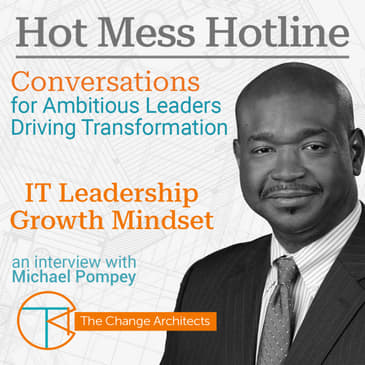

The demands on IT leaders have never been greater. You’re expected to be technically brilliant while also leading your teams through constant change and disruption. But what happens when your “superhero” drive to do more, learn more, and be more starts to work against you?
As Michael Pompey, Chief Information and Transformation Officer for the Girl Scouts of Eastern Pennsylvania, shares in a recent podcast interview, many IT leaders fall into the trap of believing that “more is more.” They push themselves to the limit, taking on every challenge and striving for perfection. While this drive can lead to early success, it can also become a recipe for burnout and stagnation.
Read the full blog post here: https://thechangearchitects.com/it-leadership-growth-mindset-with-michael-pompey/
About Michael Pompey:
Michael is a seasoned technology executive with over two decades of experience driving innovation and transformation in mission-driven organizations. Currently serving as the Chief Information and Transformation Officer for the Girl Scouts of Eastern Pennsylvania, he leads the organization’s technology strategy, overseeing the assessment and expansion of its digital capabilities to support growth in existing and new markets, with the ultimate aim of reaching all girls in the region. Michael’s career in technology began in the field of Juvenile Justice, where as a probation officer, he identified critical gaps in data management. By developing applications to track and forecast social and offender data, he demonstrated the transformative power of technology in improving case management and youth outcomes. This experience ignited his passion for leveraging data and technology to serve youth-focused nonprofits, propelling him into leadership roles across various mission-driven organizations. With a unique blend of expertise in both nonprofit and technology sectors, Michael has continually refined his skills to drive digital transformation in organizations dedicated to youth development. His academic foundation from the University of South Florida, combined with professional certifications from Microsoft, TBM, ITIL, and other leading technology providers, have equipped him to navigate the complexities of the digital age. Highly regarded for his thought leadership, Michael has served on advisory boards, including the Philadelphia Society for Information Management (SIM) Council, the CIO Forum Executive Council, and the Black Data Processing Associates (BDPA). His insights have been featured in prominent publications such as *CIO Magazine* and the *Business Intelligence Journal*. Outside of his professional endeavors, Michael is a dedicated family man and proud father of two teenage boys, who continually inspire his passion for technology and its impact on the next generation.
[00:00:10] Hey there, my friend. You're listening to the Hot Mess Hotline and this is Stefanie Krievins.
[00:00:15] You are totally in the right place if you're an ambitious leader who's charged with delivering on the tech of the future right now.
[00:00:22] In order to do that, you and your team need to upskill in the process and tackle old problems with new ways of thinking.
[00:00:30] In the past, we would have called this change management and leadership development,
[00:00:34] but change is now the air that we breathe and your team needs a unified strategy for the 21st century.
[00:00:40] These executive level conversations are nuanced, insightful, and hard-earned lessons that you can put into practice as soon as this episode is over.
[00:00:50] Remember, small tweaks can have huge impact, so take what's new and useful to you and leave the rest.
[00:00:57] And I'd be oh so grateful if you get value from this episode that you forward it on to a friend that you think needs to hear this message.
[00:01:04] My guest today is the one and only Michael Pompey.
[00:01:08] He is a technology executive with nearly two decades of experience driving innovation and transformation.
[00:01:15] His role in technology actually started when he was a probation officer,
[00:01:20] and now he is the chief information and transformation officer for the Girl Scouts of Eastern Pennsylvania,
[00:01:26] one of the United States' top 10 largest Girl Scouts councils.
[00:01:30] Not only that, he has numerous certifications from Microsoft, TBM, ITIL, so many more,
[00:01:37] and is a contributor and thought leader or an advisory board member for Philadelphia Society of Information Management,
[00:01:45] the CIO Forum Executive Council, and the Black Data Processing Associates.
[00:01:50] Not only that, he's contributed his insights to so many wonderful publications like CIO Magazine and the Business Intelligence Journal.
[00:01:58] Let's dig into this conversation where Michael talks about a painful time in his career
[00:02:03] that my hunch is that you've wrestled with as well at some point or are wrestling with now,
[00:02:09] and I want to help you get over it.
[00:02:11] Let's go.
[00:02:11] All right, Michael, tell me about your hot mess.
[00:02:14] Yes.
[00:02:14] So my hot mess is interesting.
[00:02:17] Just to give you some context regarding my hot mess and the organization that I was working with,
[00:02:22] I had the privilege, the honor, if you will, to join an organization at its very beginning,
[00:02:28] its most humblest origins, and the folks that were working there, we were tight.
[00:02:33] A lot of places like to say they're a family.
[00:02:35] We legit were like a family, right?
[00:02:38] We were all getting married at the same time, having kids at the same time, buying houses at the same time.
[00:02:42] I like to think of us as, if you remember the movie The Breakfast Club during the 80s, right?
[00:02:48] That tight-knit group at the end, imagine if they started a nonprofit,
[00:02:52] and this nonprofit's whole job was to get corporate folks to give money,
[00:02:59] to align interests, to help kids actually enter the workforce prepared.
[00:03:03] That was our mission and goal.
[00:03:06] So I had the opportunity to be with that group.
[00:03:09] And for me, we were successful beyond anybody's dreams.
[00:03:13] Folks knew us when we walked into the room.
[00:03:15] People could tell that you worked for this organization just by the way you engaged,
[00:03:19] how you're creative, how there was no challenge that was too big for us to overaccomplish.
[00:03:24] And we did it.
[00:03:25] We did the things, right?
[00:03:27] I have like goosebumps.
[00:03:28] I can feel your energy through the camera.
[00:03:31] I have the goosebumps.
[00:03:32] That was the organization that I helped to build and was able to work with
[00:03:37] and was able to give so many years of my life, right?
[00:03:40] So there's the context.
[00:03:41] Okay.
[00:03:42] The hot mess is when I realized that this organization that I loved so much
[00:03:49] and gave so much to was either going to kill me or I was going to kill it if I did not leave.
[00:04:02] Oh, that like hurts my stomach, my soul just to hear.
[00:04:06] It hurts to even say that out loud.
[00:04:09] That was the truth.
[00:04:10] And it was one of the truths that I didn't share with anybody at my time.
[00:04:14] My partners on the executive team, my team leads individually.
[00:04:18] You know, I knew that staying at this place because of the changes that were happening
[00:04:24] were either going to kill me or I was going to kill it.
[00:04:27] And it was one of those times where it's like, you know what?
[00:04:30] I have let myself become a big fish in a pond that was slowly drying up
[00:04:37] before realizing I didn't have the move to turn around anymore.
[00:04:42] And that if I didn't flip myself up into a larger body of water,
[00:04:46] something or someone was going to come by and say, wow, look at this and just
[00:04:52] pick me up and take me off with them.
[00:04:54] So that was the hot mess I found myself in.
[00:04:59] And so part of the reason I wanted to cover this topic is because I've been there myself
[00:05:06] and very ungracefully recognized it.
[00:05:10] And I think a lot of leaders find themselves in these shoes.
[00:05:13] And so I was like, we have to talk about this because this happens in our careers and it's
[00:05:18] painful.
[00:05:19] And there are things you don't realize until you've already gotten yourself out.
[00:05:25] And the metaphor that we're working with here, I just, I'm envisioning you literally running
[00:05:30] out of water to breathe in.
[00:05:32] Like it feels, it feels suffocating.
[00:05:34] And I want to start here with these questions from your perspective.
[00:05:38] What did it feel like to be Michael who was outgrowing his place?
[00:05:44] I mean, we're, we're talking the death of your soul here.
[00:05:47] Like what did it feel like in those moments?
[00:05:50] What were you saying to yourself?
[00:05:52] What were you hearing inside of your head that were indications that something was no
[00:05:57] longer right for you?
[00:05:59] Right.
[00:06:00] Well, what's interesting is that a lot of times, you know, and I see this sometimes with
[00:06:04] technology leaders, you're so used to fixing a problem.
[00:06:07] You're so used to coming in with the hail Mary solution, whether it's technology and
[00:06:12] innovation, a new process.
[00:06:13] And you're so good at it that you tend to think that when you run into something, you
[00:06:18] can sort of superhero your way out of it.
[00:06:21] Yes.
[00:06:22] In fact, one of my close friends, you know, my, my, my, my, so my nickname at the office
[00:06:27] was black Superman.
[00:06:28] And I actually have a cape at the back of my chair and a collection of the comic books
[00:06:34] and the black Kryptonians and even action figures.
[00:06:37] And she would often say that Mike, that superhero high that you have is a dangerous high.
[00:06:42] You can be addicted to being a superhero.
[00:06:44] So when I found myself asking these questions and seeing things change around me and just
[00:06:50] all those little sizes saying, you know what, Mike, something is wrong here.
[00:06:54] I felt that I could superhero my way out of it.
[00:06:56] Well, maybe I just need to do more or learn more or do something else.
[00:07:00] Yes.
[00:07:00] And that it wasn't me recognizing the environment around me.
[00:07:04] It was me internalizing it.
[00:07:05] And part of this is ego.
[00:07:07] I know that now that I could fix this and that if I just did better or did more, this
[00:07:12] would be all right.
[00:07:13] So, so when I think back to who I was back then, that's what he was thinking.
[00:07:19] He was thinking, okay, what's the problem?
[00:07:20] How are you going to solve this?
[00:07:21] How are you going to fix it?
[00:07:22] Not realizing that by trying to do that, I was prolonging not only my pain, but the
[00:07:30] organization's pain as well.
[00:07:32] Oh my gosh.
[00:07:34] Oh, I have so many questions.
[00:07:36] I, I want to drop a pin here.
[00:07:39] And then when we talk about reflections, when we get there, the curse of more.
[00:07:43] If I could do more, if I can learn more, if I could find more resources, this is the overachievers
[00:07:53] like curse is we believe more is more.
[00:07:57] And I bring that up because I have hit in 2024 personally and professionally, like I hate more
[00:08:05] is more.
[00:08:06] And I've spent 44 years saying more is more and I hate it.
[00:08:10] And I've, I hope, I hope that I finally learned my lesson.
[00:08:13] And I know we're talking about when you learned your lessons, but like more is not more.
[00:08:20] No, no, it is not.
[00:08:22] It is not.
[00:08:23] It is not.
[00:08:23] And what's interesting sometimes too, as technology leaders, we sometimes look at everything that
[00:08:29] we could possibly do for one side of that equation, right?
[00:08:32] Whether it's time and your relationships and family and compartmentalizing things.
[00:08:37] But sometimes we fail to see that the other side of that equation is infinite.
[00:08:42] You are never going to match it.
[00:08:46] Never.
[00:08:47] Never.
[00:08:47] And that's one of the things that, you know, this ordeal that we're just starting to peel
[00:08:52] the layers off describing started teaching me that lesson when I had to go through this.
[00:08:57] Hmm.
[00:08:58] What, what else were you feeling in those months and weeks leading up to knowing that you had
[00:09:06] to leave?
[00:09:07] So what's interesting is that, you know, we, we started the episode, right?
[00:09:11] Me mentioning that I journal a lot.
[00:09:14] And so in preparation for this, I was like, well, let me go back to the journals that I
[00:09:17] was writing during this time.
[00:09:19] And there's some pretty scary things in there.
[00:09:21] For instance, my wife told me one time, Michael, when you're asleep, you're sleeping like this
[00:09:28] with my head in my hands, face down in your pillow.
[00:09:34] That I was internalizing so much of the stress that my organization was going through at the
[00:09:40] time that, you know, it was affecting me physically, mentally, emotionally, started getting the usual
[00:09:47] suspects, right?
[00:09:48] The acid reflux, gaining weight, not enjoying any of your hobbies and different things of
[00:09:53] that nature.
[00:09:54] But all of those things just went by, right?
[00:09:58] I, I, I gave myself the usual delusion that it's just going to be temporary.
[00:10:03] And then I'll come back to these things once we get through this rough patch.
[00:10:06] So at the time, as I was going through these things, I didn't even recognize how bad things
[00:10:10] were getting.
[00:10:11] Um, it wouldn't be until after I left that friends walked up to me and said,
[00:10:17] Oh my goodness, you look so much better.
[00:10:20] And I'm like, what are you talking about?
[00:10:22] Don't I, you know, didn't I, didn't I put on this mask the right way?
[00:10:25] Didn't I hide all this stuff from you?
[00:10:27] They're like, no, I could tell.
[00:10:29] I could tell something was eating you up alive.
[00:10:30] I'm glad whatever it was that you did, you took care of because now you look different.
[00:10:36] Wow.
[00:10:37] Wow.
[00:10:39] So you were suffocating yourself in your sleep.
[00:10:42] You were gaining weight.
[00:10:44] Yeah.
[00:10:46] Yeah, exactly.
[00:10:47] Exactly.
[00:10:47] I was doing all these things.
[00:10:49] You know, when I think back of just how much we tend to internalize, um, because we think
[00:10:55] we can control it all.
[00:10:56] It was beyond, um, not healthy.
[00:10:58] And, and, and again, with, with maturity and with retrospect, I can see a lot of ego
[00:11:02] being in that as well.
[00:11:04] Of course.
[00:11:05] Of course.
[00:11:05] And, and I'm of the opinion, you know, ego is not all bad.
[00:11:09] I think if we know how to leverage our ego, we can actually do some really amazing things
[00:11:13] with it.
[00:11:13] It's when it lies to us for too long and too much and tells us to control versus allows
[00:11:24] you.
[00:11:25] I do believe we can use our egos to shine and to have courage when we need to.
[00:11:30] It's not all bad, but when it tells us that we have to control everything, when it tells
[00:11:34] us we always have to be perfect.
[00:11:36] We always have to put on the mask.
[00:11:39] That's when it's, it's overused.
[00:11:42] What did it feel like to have that mask on for you?
[00:11:45] Like, how did you know, how did you know you were using a mask versus using Michael?
[00:11:51] So one of the things that, you know, folks know about me, you know, whether it's a good
[00:11:56] thing or not, I usually kind of describe myself, uh, saying, you know, I'm about as
[00:11:59] subtle as a brick through your windshield.
[00:12:02] There's not a lot, there's not a lot of subtlety with me.
[00:12:05] You kind of, what you see is what you get.
[00:12:07] I love it.
[00:12:08] Um, and, and so, you know, as, as my, so as my organization was trained, it was changing
[00:12:13] around me, right.
[00:12:14] You're seeing the steady drip of people leaving, right.
[00:12:17] The institutional knowledge, you know, the different things that are going on.
[00:12:20] And I realized that I was wearing a mask when I had to hire, I had to sit on an interview
[00:12:28] for a replacement for a team lead that I was responsible for.
[00:12:33] And inside, as I was talking to them, I wanted to scream.
[00:12:37] Get out like that movie.
[00:12:39] Right.
[00:12:40] As they were sitting here.
[00:12:41] Yes.
[00:12:42] My job is to find talent for the organization and bring them in.
[00:12:45] But at the same time, I wanted to scream, run because, um, you know, I really just could
[00:12:52] not have them join the organization.
[00:12:54] It just, yeah, you knew better.
[00:12:55] It felt wrong.
[00:12:57] And so I just could not do that.
[00:12:58] So that's when I knew it was like, you know what, Mike, this is a mask.
[00:13:02] I can't, I can't, I can't, I can't, I can't do this.
[00:13:05] I feel those pains of those days.
[00:13:08] I, one time, um, I had an EA God lover.
[00:13:11] She was like the voice of the Holy spirit to me sometimes.
[00:13:14] And, um, there are two things that I quote her on often.
[00:13:17] And one is anytime I was emailing her at 10 o'clock at night, the next day, she would respond
[00:13:24] to me and go, shouldn't you have delegated this to me?
[00:13:26] So you didn't have to work at 10 o'clock at night.
[00:13:29] I'm like, Oh, you got me.
[00:13:30] And I've told that story a million times on this podcast.
[00:13:33] Cause it's just like the beams of truth.
[00:13:35] But the other thing that she said to me, because I said to her probably six weeks in a row,
[00:13:41] JC, if I can just get through the next two weeks, then everything will be okay.
[00:13:44] If I can just get through the next two weeks, everything will be okay.
[00:13:48] And she's like, Stephanie, you've said that for months straight now.
[00:13:51] Like, when is it going to stop?
[00:13:53] I was like, Oh, right.
[00:13:56] It never stops.
[00:13:57] It never stops.
[00:13:58] Yeah.
[00:13:59] Yeah.
[00:14:00] It's, and I think Marshall Goldsmith describes that too, uh, that a lot of leaders have this
[00:14:04] delusion that it's just a set period of time.
[00:14:07] And then once I get through it, everything will be better.
[00:14:09] But you know, that dream I had been doing for 10 years, right?
[00:14:15] You know, the same thing over and over again, it was just, just this one time or just this
[00:14:18] one crisis or just this one issue, but it just never would stop.
[00:14:23] Never.
[00:14:24] What were the actions that you took to get yourself out of that situation and get yourself into
[00:14:30] the place that you needed to be in that next season of life?
[00:14:33] There were a couple of things.
[00:14:35] One, you know, was having, you know, a conversation, right.
[00:14:38] You know, with my wife, with my friends, with my, with my coach, just about, Hey, you know,
[00:14:43] what am I facing?
[00:14:45] Because during all of this, these challenges, right.
[00:14:47] While, you know, the organization is constricting, right.
[00:14:51] You've got a change in public policy, which is affecting money.
[00:14:54] People are leaving.
[00:14:55] My friend and CEO at the time told me that she was leaving the organization.
[00:15:02] And in my mind, I'm thinking, wait a minute, you run this place.
[00:15:07] You're leaving.
[00:15:08] Is that an option?
[00:15:11] And then, and then at the same time, I'm thinking, oh my goodness, people are going
[00:15:15] to want me to stay, to take over.
[00:15:22] I was like, you know, that was sort of my, you know, uh, hero's journey refusal of the,
[00:15:29] of the call, if you will, to know that, Hey, this is, this is not where I need to be.
[00:15:34] I need to just be really, really clear on what it is I'm looking for and how to go.
[00:15:38] And one of the things that my coach said to me at the time, which really rung home,
[00:15:43] uh, he basically said something to the effect of, you know, Michael, you need to be in a
[00:15:46] place where you're celebrated, not tolerated.
[00:15:50] And when I thought about that, I was thinking, wait a minute, I am kind of tolerated.
[00:15:56] Haven't been celebrated in a, in a while.
[00:15:59] I haven't even allowed myself to celebrate some of my accomplishments in a while.
[00:16:03] And so that was one of the things that said, okay, you know what?
[00:16:05] Take an assessment and let's start taking a look at just what the next environment needs
[00:16:09] to look like for you.
[00:16:10] That's the mic drop of the moment.
[00:16:13] Are we in a place where we are celebrated, not tolerated?
[00:16:17] Correct.
[00:16:19] So what was that assessment?
[00:16:20] Like, I'm assuming you walked through it with your coach, like walk us through like
[00:16:24] some of those self-discovery moments.
[00:16:26] What are those, what were those hard hitting questions that you had to ask yourself
[00:16:31] so that you could find your next place?
[00:16:34] The hardest questions that I had to ask and answer was, you know, which part of this had
[00:16:40] I created either, you know, directly or inadvertently.
[00:16:46] Yes.
[00:16:46] Sometimes we can get, you know, used to what's familiar and what's comfortable, whether it's
[00:16:51] a bad job, a bad relationship, a car you put too much money into.
[00:16:55] And what's familiar is the thing that you want to stay around.
[00:16:59] And I had allowed myself to get really familiar with the ins and outs of my organization.
[00:17:03] I've pretty much probably done every single role except for CFO in it.
[00:17:07] And it's like, okay, so where have I let myself down and having to own that?
[00:17:13] And then once going through that piece, then asking some sort of, you know, again, you
[00:17:17] know, having a coach is great because they can sort of hold you accountable and give
[00:17:20] you this sort of external perspective.
[00:17:22] But part of it was just defining, well, hey, what is it that you want?
[00:17:26] What is it that you bring to the table?
[00:17:29] And where is the next place that you need to be?
[00:17:32] And that was a different set of questions because normally you're like, okay, you know,
[00:17:35] you do the usual suspects.
[00:17:36] Well, let me freshen up my resume.
[00:17:38] Let me hit the network event.
[00:17:39] Let me shotgun this place to see who's, and it really was like, no, no, no, no, no, no.
[00:17:42] Let's take a step back from that.
[00:17:44] What is it that you want?
[00:17:46] What's the value that you bring?
[00:17:48] And sometimes those are scary questions to ask yourself, right?
[00:17:51] But then once I did, and once I had that answer, I could see myself in a different light.
[00:17:57] I could see opportunities that, you know, I'd allowed my own internal thermostat, if you
[00:18:04] will hide from view because for whatever reason, they didn't match my own idea of what it was
[00:18:11] I could accomplish and go after.
[00:18:13] But once we had done some of that work, I could really start taking a look around me.
[00:18:18] I'm like, you know what?
[00:18:18] No, this is not for me.
[00:18:20] This is, no, this has been served its purpose.
[00:18:23] It's time for me to move to someplace else.
[00:18:25] And I could be selective about what things I would entertain versus not.
[00:18:29] And it didn't feel bad.
[00:18:31] It felt like a process of discovery and exploration.
[00:18:34] And so that's some of the steps that kind of led me to start moving to the new direction.
[00:18:40] I'm thinking of this concept of, you know, radical personal ownership and folks who are willing
[00:18:46] to ask and answer the question, what role did I play in creating this situation are often
[00:18:53] I find the people willing to take radical personal responsibility because, I mean, that is such
[00:18:59] a brave question to ask an answer for yourself.
[00:19:02] What do you know now about owning your career, owning what you want out of your life that you've
[00:19:10] come to learn since this experience?
[00:19:12] One of the things that I've come to learn since this experience really is what does it, at least
[00:19:18] for me, right?
[00:19:19] What does it mean to actually have that growth mindset?
[00:19:23] A lot of folks talk about growth mindset.
[00:19:25] But when you think about just what growth really feels like, you know, it's uncomfortable,
[00:19:31] right?
[00:19:31] You doubt yourself.
[00:19:32] I don't know enough.
[00:19:33] What am I doing?
[00:19:34] Is this a mistake?
[00:19:35] And things like that.
[00:19:36] And a lot of times those are so uncomfortable.
[00:19:39] People will tend to shy away from it.
[00:19:40] And for me, understanding that, hey, I want to get from here to there.
[00:19:44] There's a whole piece I need to learn and find out.
[00:19:48] And accepting that, you know what, it is going to feel uncomfortable.
[00:19:52] It's going to challenge my viewpoint.
[00:19:55] It's going to make me doubt myself.
[00:19:56] But knowing that those are the pieces that make me better on the other side of that and
[00:20:00] accepting that was something that I had shied away from before.
[00:20:03] So I wanted to stay in my areas of expertise.
[00:20:06] I wanted to stay in the places where I knew I could hit a home run every single time at
[00:20:10] bat.
[00:20:11] And that was one of the places that, you know, going through this process helped teach me
[00:20:16] that, you know what, this is the skill set and the muscle that you need to develop now
[00:20:21] in this next phase of your journey.
[00:20:24] And so that was one of the biggest takeaways of going through all of this.
[00:20:27] Oh, my gosh.
[00:20:28] And I just think about the connection to, because what I hear in your journey is a pattern of
[00:20:36] overachieving.
[00:20:38] And overachieving has this striving to it, this more is more kind of mentality that eventually
[00:20:45] brings us to our knees.
[00:20:47] And we have to admit, no, I just want to grow.
[00:20:49] I don't want to burn out all of the time.
[00:20:53] Michael, what I hear in your story is, and check me on this if you disagree, your striving
[00:21:01] before was related to more is more.
[00:21:04] I can do more.
[00:21:05] I can make this better.
[00:21:06] I can create better results.
[00:21:08] And through this journey, you came to admit to yourself, no, actually, I want to have a
[00:21:13] growth mindset.
[00:21:14] I want, I'm willing to be uncomfortable.
[00:21:16] I'm really willing to try new things.
[00:21:18] I'm willing to sit in the insecurity.
[00:21:20] How do you see high achieving and the growth mindset differently now than maybe you would
[00:21:27] have perceived it back then through that experience?
[00:21:31] You know, there's that old saying about, you know, what got you here won't get you there.
[00:21:36] That's right.
[00:21:37] Yes.
[00:21:37] Marshall Goldsmith, one of my boyfriends, the executive coach of executive coaches.
[00:21:42] He doesn't, he doesn't know me at all, but I know that.
[00:21:45] He doesn't know you yet.
[00:21:45] He doesn't know you yet.
[00:21:47] Yet.
[00:21:48] That's the growth mindset.
[00:21:49] Yet.
[00:21:50] I like it.
[00:21:50] Yeah.
[00:21:52] So, so, so for me, just, I guess, you know, one realizing that, you know, there are different
[00:21:58] seasons as it relates to a person and trying to, you know, stay in this one area all the
[00:22:04] time doesn't do me any good, doesn't do an organization good in order for me to really
[00:22:08] be the leader that I can be, right?
[00:22:12] I have to embrace the new, let go of the familiar.
[00:22:16] I've got to be a force multiplier.
[00:22:18] I've got to get my teams to move with me.
[00:22:20] That is a different set of skillsets.
[00:22:21] You can't code your way through that.
[00:22:23] I can't look at a line of code and look at all the, you know, the tuning that I've done
[00:22:27] on these databases and these clusters to prove that.
[00:22:30] No, it's something different now.
[00:22:31] And accepting that is one of the biggest pieces that came from this journal journey.
[00:22:35] And also the other piece that I got from this too, you know, there was, there was a fear,
[00:22:41] not so much a failure, but that people would attribute if the organization went under because
[00:22:49] of me.
[00:22:51] Right.
[00:22:52] And having to let go of that idea that, oh, well, people are going to say this organization
[00:22:56] tanked because I was the last one, you know, at the helm or things like that versus me realizing
[00:23:02] that, hey, me staying when I'm not operating the way that I need to be might exacerbate
[00:23:08] that in and of itself.
[00:23:09] So this was another piece that I took from this.
[00:23:12] Oh my gosh.
[00:23:13] That's, oh, that pressure that we put on ourselves is unbelievable and completely unrealistic.
[00:23:23] And my hunch is that it probably wasn't until you saw that in your journal where you were
[00:23:27] like, I'm putting the whole organization success on my shoulder.
[00:23:32] Like check yourself, Michael.
[00:23:34] Like, no offense, but you're not that important.
[00:23:37] Well, you know, and that's the thing about the superhero high, because you're so used
[00:23:42] to rushing in and saving the day all of the time that again, you know, that was my nickname.
[00:23:47] And so you kind of internalize that when you realize, you know what, maybe you need to
[00:23:51] kind of be more like Batman on this one and let folks kind of, you know, do for themselves
[00:23:56] with this versus trying to be, you know, Superman all the time.
[00:23:59] Yes.
[00:24:00] Oh my gosh.
[00:24:00] So we get to choose which superhero we get to be.
[00:24:04] Listen, you know, that's exactly right.
[00:24:07] That is exactly right.
[00:24:09] I love it.
[00:24:10] I have another friend, client, colleague who, uh, who's superhero of choices, Iron Man that
[00:24:16] comes out in certain situations because Iron Man has a strength and a drive and a determination
[00:24:25] that others don't, but he also knows when to put it away.
[00:24:28] Yeah, that's good.
[00:24:29] That's good.
[00:24:30] Yeah.
[00:24:30] No, that's, that's, that, that's the key right there.
[00:24:34] Knowing when to put it away.
[00:24:35] I love it.
[00:24:36] I never thought about superheroes.
[00:24:39] Hi.
[00:24:39] Yes.
[00:24:40] Oh, I'm also thinking of my husband.
[00:24:42] So he helped, um, run COVID response for our state during the heart of the pandemic.
[00:24:48] So from 2020 to 2022, basically.
[00:24:51] And, um, he worked a lot, but through that he earned the nickname, the, uh, Mr. Incredible.
[00:24:57] And, um, there are pieces of his story that I hear reflected in yours during the pandemic
[00:25:03] as well.
[00:25:04] And, um, yeah, the, I mean, the pandemic was such a time because it also showed me, so
[00:25:09] I don't know how they did it in Indiana, but here in Philly, they took the convention
[00:25:12] center, right.
[00:25:13] And, uh, it workers, we were like second in line healthcare workers were, were first.
[00:25:17] Um, and when I went down there, you know, you see the national guard and the Humvees and
[00:25:22] the QR codes and the scanners, and I'm seeing enterprise, you know, uh, you know, wireless
[00:25:27] access points, the databases, the screening and whatever.
[00:25:29] And I could see the large systems.
[00:25:31] And it reminded me, Mike, you got in a technology to help systems help people not to sit behind
[00:25:40] spreadsheets, not negotiate contracts, not to do procurements.
[00:25:43] You are supposed to be moving systems.
[00:25:46] What are you doing?
[00:25:47] And that's when I got the first knockings of that.
[00:25:49] Hey, you know what?
[00:25:50] Some, something may be misaligned here, but it wouldn't be until the organization started,
[00:25:55] you know, slowly, you know, drying up around me that I would see that.
[00:26:00] Hey, you know, you've let yourself get into a situation.
[00:26:03] Oh, I love that.
[00:26:05] It's, I love how the universe brings us the ways to show us our calling to light us back
[00:26:12] up, to remember what joy feels like and say, do that.
[00:26:16] Mike, do more of that.
[00:26:19] Yes.
[00:26:20] Yes.
[00:26:20] That's exactly what it was.
[00:26:22] So looking forward in your leadership journey, what do you want to take about the lessons that
[00:26:27] you've learned since then about who you are, who you are as a human, who you are as a spouse,
[00:26:33] who you are as a leader to continue to build those systems?
[00:26:37] And, and I almost said save the world, but that's a little too loaded for this conversation.
[00:26:43] Right.
[00:26:43] Exactly.
[00:26:44] Yeah.
[00:26:45] But do that big picture systems work that you know is impactful?
[00:26:49] What do you, what do you want to take with you into the future?
[00:26:52] Listen, there were some, you know, great things that, you know, I learned, you know, working
[00:26:57] with, you know, my previous organization and, you know, is where I was able to sort of honed
[00:27:02] my mission as related to helping nonprofits raise their expectation of excellence.
[00:27:09] And what, you know, and how I describe that for people is sometimes when a person is working
[00:27:14] for a mission-based organization or, or nonprofit, they might sometimes adopt the mentality that,
[00:27:19] okay, well, I'm delivering the service or this good.
[00:27:22] It's okay for it not to be like the for-profit people because it's for a good cause, right?
[00:27:29] Or for a mission.
[00:27:30] And my windmill that I've always tilted at is no, of anything, we should have the best
[00:27:38] things that we deploy because it is for people, because it is for children.
[00:27:42] And so my, you know, and working with organizations saying, hey, you know what, not only are we going
[00:27:46] to do this well, right, but we're going to change the expectation of what well is.
[00:27:52] There's no more reason why you should expect to do it second class.
[00:27:55] So for me, it is about using the same systems that Amazon does, the same processes that UPS
[00:28:01] does to deliver the same kinds of services and outcomes for people.
[00:28:05] So that I've taken with me and what that means and the learnings that that's going to push me
[00:28:10] and the uncomfortability that that will allow me to experience.
[00:28:13] But knowing that at the end of the day, that is the mission that I drive for through all
[00:28:17] of this is again, to help raise the expectation of excellence for those organizations to have
[00:28:23] a mission-based focus.
[00:28:24] That is who I am.
[00:28:25] They deserve to have someone like me.
[00:28:28] And that's what I bring.
[00:28:30] Oh, yes.
[00:28:32] I want more of that in the world, Mike.
[00:28:34] Yes.
[00:28:36] Oh, fabulous.
[00:28:38] All right.
[00:28:39] I just remembered our friend Rob Field had a special request for your podcast episode
[00:28:44] to ask you a certain question.
[00:28:46] Oh, Mr. Rob Field, of course.
[00:28:49] Of course.
[00:28:50] He wanted to make sure that we covered this together.
[00:28:53] Okay.
[00:28:55] And it's a riff on what I just asked you, but a little bit more present-based.
[00:28:59] What have you learned from that experience that has been instrumental in who you are now?
[00:29:04] You know what?
[00:29:06] The biggest piece from all of that experience that's been just crucial to understand who
[00:29:15] I am now is that we're bigger than our idea of us.
[00:29:22] And that a lot of times we will paint a comfortable picture.
[00:29:26] And I had done that.
[00:29:28] And my successes and my awards and my accolades, and while all of those are good, I can see now
[00:29:35] that I could have done so much more.
[00:29:37] But I allowed myself to paint a comfortable picture.
[00:29:40] So I am comfortable taking a brush to a new place where I am uncertain, where things feel
[00:29:49] unfamiliar, knowing that I've got the experience to paint another beautiful picture.
[00:29:55] It doesn't have to be the same thing.
[00:29:57] That's one of the biggest pieces I've learned from this.
[00:30:00] There is nothing to follow that up with, except I wished the whole world gets to learn these
[00:30:06] lessons through you too.
[00:30:08] So thank you so much, Mike.
[00:30:10] Thank you.
[00:30:10] You've made my day.
[00:30:11] Excellent.
[00:30:12] Thank you for the opportunity to share this story, Stephanie.
[00:30:14] I really appreciate it.
[00:30:15] Awesome.
[00:30:16] My friend, talking with Michael and feeling that pain that he was feeling as he was outgrowing
[00:30:24] his organization.
[00:30:25] I want to know, have you ever been there?
[00:30:27] I know I certainly have in my career.
[00:30:29] And there have been times that I have not handled it so gracefully.
[00:30:33] And I've sought to learn and grow from it.
[00:30:35] I hope that this conversation will help you do the same.
[00:30:40] The next time you feel like you're bumping up the limits of your role, of your organization,
[00:30:45] you have a better example from Michael about how to move through it, what questions to ask
[00:30:51] yourself.
[00:30:52] And I want to go back to that powerful question that he was willing to ask and answer for himself
[00:30:58] that I do believe was a pivotal moment in getting him to his next level.
[00:31:03] And that question was, how have I contributed to where I am now?
[00:31:07] What have I tolerated?
[00:31:09] Where have I created these problems for myself?
[00:31:11] Answer those questions for yourself.
[00:31:14] And you will truly be able to look yourself in the mirror with clarity to say, here's how
[00:31:20] I've created this.
[00:31:21] Now, what can I do next?
[00:31:23] What can I create for myself?
[00:31:25] What can I do to advance in the way that makes sense and honor my gifts and my strengths and
[00:31:31] my experience in a new place or in a new way for this existing organization?
[00:31:37] In order to get what you want out of your life and career, you first must be able to admit
[00:31:42] to yourself what you want out of your life and career and then go ask for it.
[00:31:47] That's the secret to all of this, my friend.
[00:31:50] All right.
[00:31:50] Again, if you got value from this episode, I'd be oh so grateful if you would share this
[00:31:54] with someone that you senses may be struggling with this as well, or.